After-work events for professionals in Regensburg
After-work events for professionals in Regensburg (Outlook)
Which formats will be particularly relevant in Regensburg in the future if you want to network after work, learn professionally, or simply make new contacts in a professional atmosphere? This article classifies the common event types, shows where you can reliably find upcoming dates, and gives practical tips on how to use after-work offers strategically for your career and quality of life.
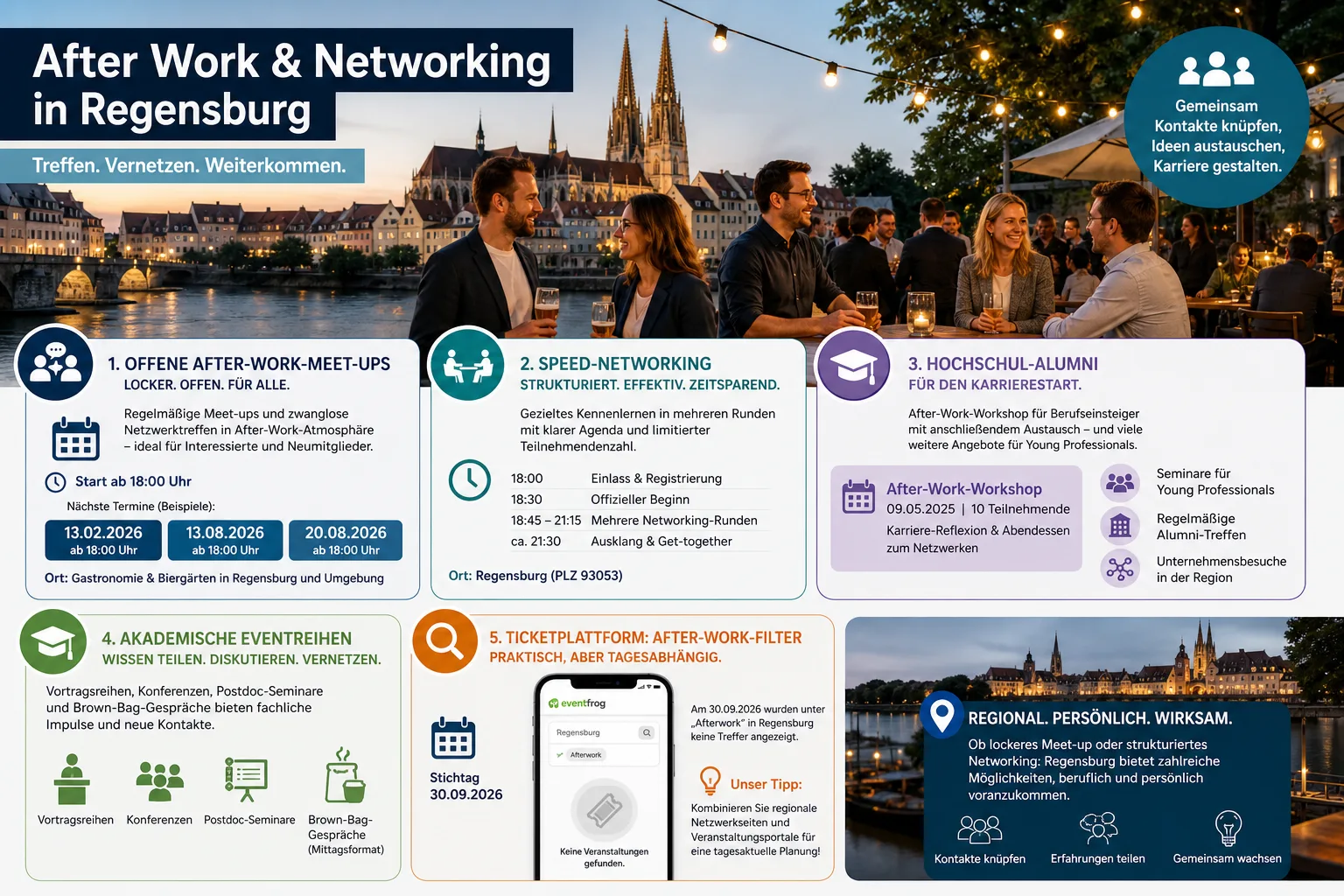
Open meet-ups & networking events: low-threshold entry
Open after-work meetings are usually the most accessible format: you can participate spontaneously, often need little preparation, and take place in an environment where small talk has just as much space as serious career questions.
How to recognize a good open meeting
- Clear target group, but no access barriers: e.g. "for professionals", "for founders", "for newcomers in the region".
- Transparent framework information: start time, location, possibly registration or admission.
- Welcoming setting: There are points of contact (greeting, name stickers, table topics) instead of just "standing and hoping".
How to get the most out of it in the future
- Go with a goal: e.g. "2 new contacts in my industry" or "1 person who knows about topic X".
- One sentence about you: Role + focus + what you are looking for/giving ("I work in..., currently I'm interested in..., I'm looking forward to exchanging about...").
- Follow up within 48 hours: Short message referring to the conversation – this turns a nice evening into a reliable network.
Structured speed networking: many conversations, clear process
Speed networking is a future top format for anyone who wants to make targeted new contacts in a short time. The added value lies in the structure: short conversation slots, clear moderation, usually a defined number of participants, and a wrap-up for in-depth conversations.
Typical process (which you can expect at new events)
- Arrival & check-in: short warm-up, possibly topic or industry clusters.
- Rounds with time windows: You introduce yourself several times in succession to different people.
- Notes & match phase: Many events offer lists/QR codes or contact cards.
- Open wrap-up: This is often where the most valuable deepening takes place.
Who benefits most
- Job change/reorientation: If you want to quickly get to know the "market" and the people behind it.
- Self-employed & founders: For cooperations, customer contacts, service provider networks.
- Managers/project managers: To identify talents, partners, or experts.
Practical tip: Plan a clear "pitch" (15–30 seconds) plus two specific questions that match your goals for speed networking. This significantly increases the quality of the conversations.
Alumni & young professional formats: transition, orientation, growth
Regensburg's university and educational environment is an important driver for after-work offers that will be particularly relevant for career starters and young professionals in the future. Alumni and young professional formats often combine input (workshop, short lecture, Q&A) with informal exchange.
What characterizes these formats in the future
- Career-oriented content: e.g. role changes, first leadership tasks, salary and development discussions, application/profile.
- Peer learning: Exchange with people in similar transition phases.
- Networking with regional employers: often through lectures, panel evenings, or company visits.
How to use alumni evenings strategically
- Check in advance: Is the event open to outsiders or only for alumni/members?
- Come with a concrete list of questions: e.g. "Which skills are most in demand in the region?"
- Think long-term: Alumni networks work best if you participate repeatedly.
Academic series & brown-bag formats: in-depth expertise
In addition to classic networking evenings, scientific lecture series, public discussion formats, and interdisciplinary talks will also play a role in the future. For professionals, they are particularly valuable if you want to stay "up to date" professionally and at the same time build contacts at the interfaces of business, administration, culture, and research.
Why these evenings are relevant for professionals
- Knowledge with context: You get new perspectives, not just buzzwords.
- Dialogue instead of sales: Questions and discussions are often explicitly intended.
- Meet young talent & experts: Good opportunity to get to know talents and specialists.
Brown-bag formats are not necessarily after-work in the strict sense (often at lunchtime). However, if you work flexibly, they can have a similarly strong networking and learning effect as evening events.
How to find upcoming dates (without search frustration)
A common stumbling block: Not all local after-work offers reliably appear on major ticket or event platforms. For future-proof planning, a "triad" of several sources that you check regularly is recommended:
- Regional business and industry networks: Own calendars, newsletters, and social media announcements.
- Universities, alumni, and continuing education offices: Event pages, public lecture calendars, career offers.
- City and regional event calendars: Especially helpful for formats with a cultural or location reference.
Trends you can expect at future events
- Hybrid elements: Registration/networking tools, digital waiting lists, or streaming components.
- Topic focus: New Work, digitalization, sustainability, AI, securing skilled workers – often as themed evenings.
- Target group specialization: Own series for founders, women in business, tech/creative, managers, or international professionals.
Checklist for your next after-work evening
- Define your goal: Contacts, learning, cooperation, job search – one is enough.
- Choose participation form: open (just show up) vs. structured (efficiency) vs. professional (depth).
- Prepare a short introduction: Role + topic + what you are looking for/giving.
- Have a way to share contact info ready: Business card or LinkedIn/website at hand.
- Plan follow-up: Schedule 2–3 follow-ups for the next day.
- Regularity instead of one-time visit: Networks grow through repetition.