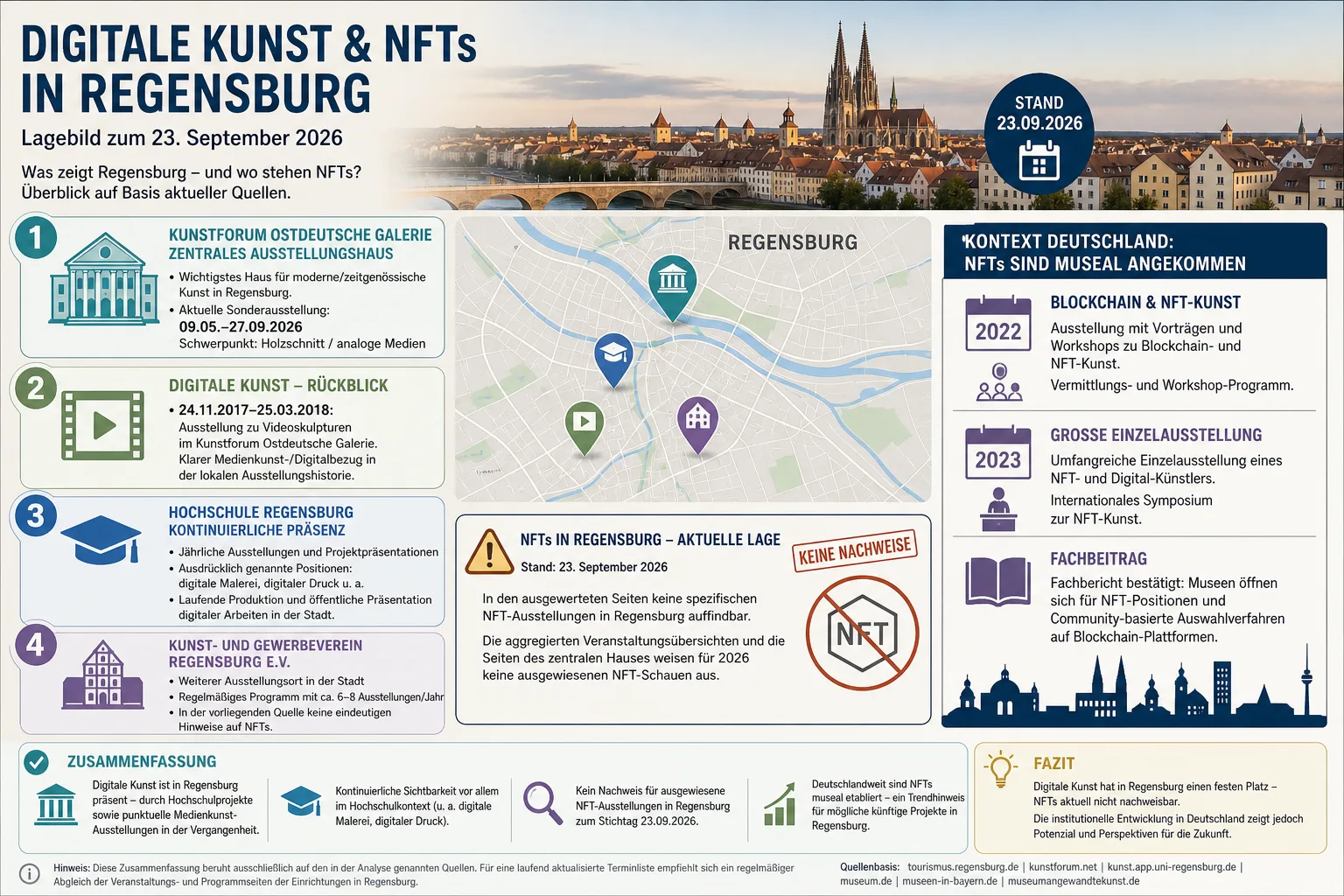
Digital Art & NFT Exhibitions in Regensburg
Digital Art & NFT Exhibitions in Regensburg (Preview 2026/2027)
Regensburg will be especially exciting in the coming season, as historical urban spaces merge with projections, screen-based works, generative imagery, and blockchain-based ownership models. This article compiles what you can expect from future digital art formats, how to find relevant program highlights early, and which questions regarding NFT art (curation, rights, sustainability) are likely to take center stage.
Note on focus: This text is intended as a forward-looking preview and planning guide for upcoming events in Regensburg. Specific dates and content are published by the respective organizers and may change.
What You Can Expect in Regensburg in 2026/2027
In the coming months and in 2027, digital art formats in Regensburg will likely become visible mainly in three contexts: in curated exhibitions of contemporary art, in university/campus presentations, and in temporary projects (screenings, performances, media art evenings). The focus will be less on “technology for technology’s sake” and more on questions such as:
- How does digital aesthetics affect historical urban space? (Light, projection, sound, mapping)
- What does “original” mean in digital works? (Editions, signatures, certificates, tokens)
- How does interactivity change the exhibition visit? (Sensors, AR elements, participatory interfaces)
If NFT art is explicitly announced in upcoming programs in Regensburg, it will likely appear as part of a broader media art perspective: as an interface between the art market, copyright, and digital infrastructure.
Where to Find Announcements and Tickets (Without Missing Anything)
For the upcoming season, a systematic search is worthwhile, as digital formats are often announced as special dates, series, or accompanying programs. In the next weeks and months, use especially:
- Official program calendars of exhibition venues, museums, and cultural offices (categories such as “media art,” “film/video,” “intermedia,” “digital”).
- University/college websites for showcases, annual exhibitions, and project presentations (often with PDF programs and tour times).
- Art associations, off-spaces, and project rooms (newsletters, social channels, short-term announcements).
- Search terms that may yield results in 2026/2027: “media art Regensburg,” “video work,” “digital painting,” “generative,” “AR installation,” “NFT exhibition,” “blockchain art.”
If you are planning tickets, it will be useful to pay attention to time slots, accessibility (e.g., seating, low-stimulus times), and photo/video rules for immersive installations or screenings, as these are often more strictly regulated for digital works.
Formats Likely to Appear: From GIF Loops to Generative
For the next exhibition and event cycles in Regensburg, these formats are especially plausible, as they can be implemented with manageable setups and still create a strong audience experience:
1) Screen-Based Works: Loop, GIF Aesthetics, Motion
Loop-based works (short, repeated sequences) will be well suited for exhibitions, foyers, shop window formats, and evening events. In curatorial texts, you will often find terms such as “channel,” “loop,” “single-channel video,” or “motion graphics.”
2) Projection, Mapping, and Site-Specific Media Art
Site-specific projections will be especially announced when the dramaturgy “old town meets present” is at the center. Pay attention to notes about outdoor areas, courtyards, or temporary festival settings when planning your season.
3) Generative Art (Code as Part of the Work)
In generative works, the code (or a set of rules) will help create the image. In 2026/2027, this field will often be announced together with questions about reproducibility (versions, seeds, parameters) and documentation.
4) AR/Hybrid Formats (Optional, but Popular with Audiences)
If AR components are integrated, organizers will typically provide information about compatible devices, data protection (app/tracking), and the on-site process. For your visit, it will be worthwhile to read these notes in advance.
NFT Exhibitions: What Matters in Art, Technology, and Law
If an NFT exhibition or NFT focus is announced in upcoming programs for Regensburg, the central questions will typically not only revolve around “buying,” but around understanding and contextualizing:
- What exactly is being shown? (the digital work itself, documentation, an installation, an edition)
- What is being acquired? (token/certificate, usage rights, possibly physical accompanying objects)
- How are copyright and usage rights explained? (e.g., transfer, exhibition, reproduction)
- How is the technical side made transparent? (blockchain network, wallet processes, custody, security and fraud risks)
- How is sustainability addressed? (energy consumption, network selection, compensation/reduction if addressed)
Important: NFT art also touches on financial aspects (pricing, volatility, risks). Event formats in 2026/2027 will therefore often offer educational elements (artist talks, panels, introductions) so that visitors can distinguish between artistic statement and market mechanics.
For an informed decision, it is crucial whether the exhibition explains in a comprehensible way how work, rights, and technology are connected—and what the limits of these models are.
How to Plan Your Visit: 1–2 Days of Digital Art in Regensburg
For 2026/2027, a good visiting strategy could be to combine classic exhibition visits with an event that explicitly focuses on media art. This structure remains flexible, regardless of which specific dates are announced:
Option A: 1 Day (Compact)
- Afternoon: Curated exhibition with contemporary positions (look for video/installation/intermedia in the description).
- Evening: Screening, talk, or performance with a digital focus (often announced as a series).
- Preparation: Read the short texts (work lists/room guides) in advance, as digital works are often explained conceptually.
Option B: 2 Days (With University and Emerging Artist Focus)
- Day 1: Exhibition + talk/panel (ideal for hearing terms like “generative,” “edition,” “token” in context).
- Day 2: Showcase/project presentation (suitable for discovering new visual languages early).
- Bonus: Plan time for exchange—many formats thrive on Q&A and mediation.
For Artists, Galleries & Collectors: Opportunities 2026/2027
In the coming season, opportunities in Regensburg will especially arise when actors combine digital production, curatorial framing, and legal clarity. In practice, this means:
For Artists
- Clearly structure your portfolio: Work file, exhibition format (screen/installation/print), technical requirements, and an understandable work description.
- Define rights clearly: What can the audience photograph? What can an institution document? What applies to online publication?
- NFT optional, but consistent: If tokenized, the token information should be curationally explainable (edition, metadata, storage strategy).
For Galleries & Project Spaces
- Consider mediation: Introductions, a glossary in the room, and clear context on technology/copyright increase trust.
- Plan installation professionally: Color calibration, audio guidance, playback systems, backups, and maintenance plans are part of quality.
- Transparency in token offerings: Information on wallet security, fraud prevention, and contact channels will be expected as standard in 2026/2027.
For Collectors
- Due diligence as routine: Provenance, scope of rights, edition logic, storage/access concept, and contract documents.
- Check for long-term viability: How will the work be re-installed in 5–10 years? Is there documentation, playback instructions, checksums/signatures?
- Assess financial risks realistically: Prices can fluctuate greatly; an exhibition does not replace investment advice.
Responsibility & Sustainability: What Organizers Will Often Make Transparent
For 2026/2027, it is expected that institutions and organizers will provide more information about the framework conditions for digital art, as audiences and funding logic increasingly demand this. In announcements, pay particular attention to:
- Data protection (for apps, AR, tracking, newsletter registration)
- Accessibility (subtitles, audio alternatives, seating, sensory information)
- Sustainability (energy requirements of installations, network choice for tokenization, production decisions)
- Documentation practices (how video/photo is recorded and published)
This transparency is a mark of quality: it helps visitors plan and strengthens trust in digital formats.