Modern Architecture in Regensburg: Buildings That Impress
Modern Architecture in Regensburg: Which Upcoming Formats and Dates You Should Keep an Eye on for 2026/2027
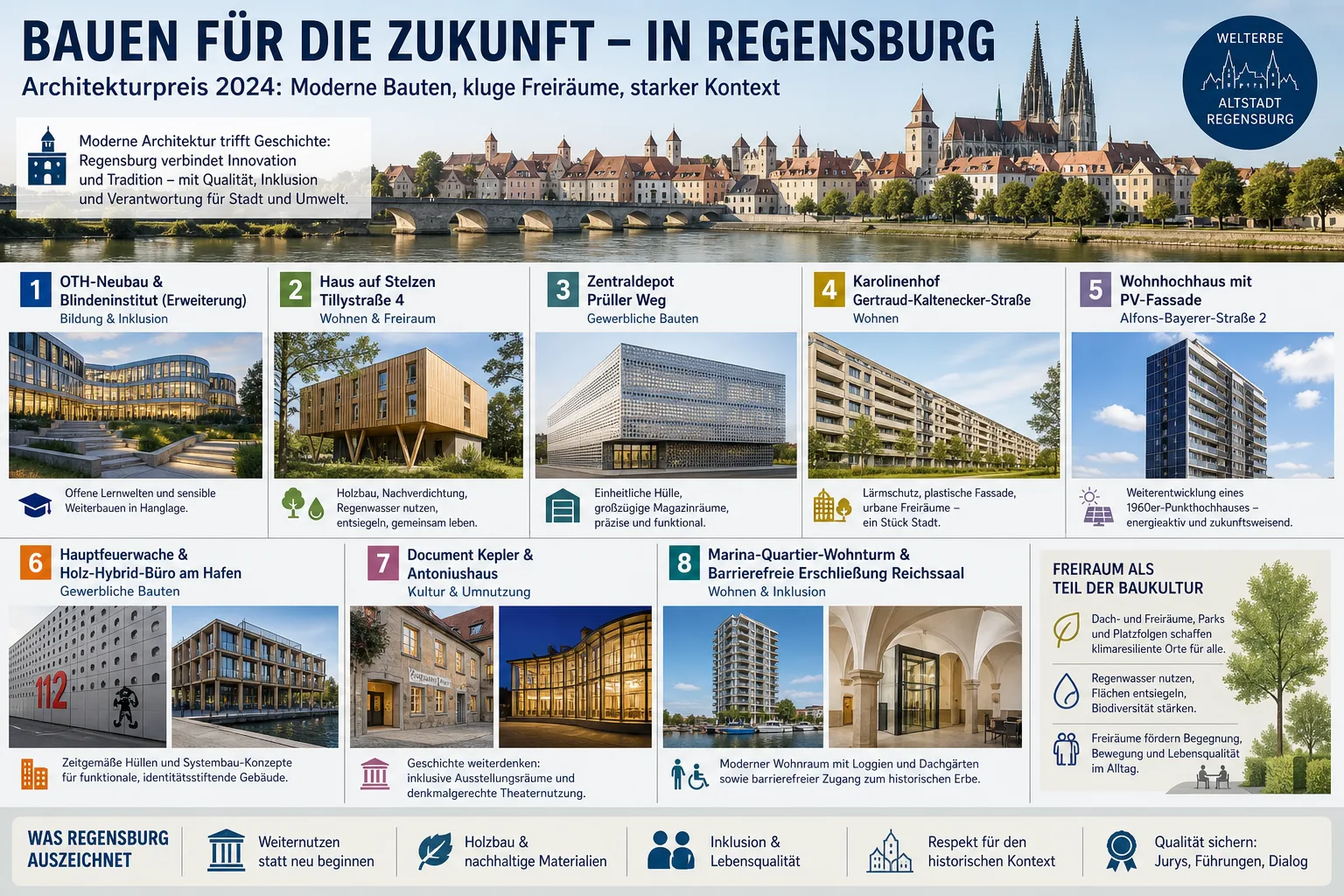
Regensburg is a UNESCO World Heritage Site – and precisely for this reason, it is exciting to see how the city will discuss new buildings, renovations, open spaces, and accessibility in the coming months and years. This article exclusively compiles upcoming (future) opportunities to experience modern architecture in Regensburg: recurring architecture events, lecture series, guided tours, and practical planning tips.
Note on up-to-dateness: Individual dates are often published at short notice by organizers. The formats listed below are chosen so that they take place regularly or are reliably announced through official channels.
Why It’s Worth Looking at Contemporary Building Culture in Regensburg in 2026/2027
In the coming months, topics such as climate adaptation (heat, heavy rain), conversion of existing buildings, timber construction, energy-active facades, and barrier-free access will continue to gain importance in many cities – including Regensburg. If you want to understand modern architecture, the best access is not through individual images, but through formats where planners, owners, administration, and the public come together: open house days, guided tours, exhibitions, lectures, and discussion evenings.
Especially in the context of a World Heritage city, the added value is great: Here, the question "How modern can it be?" is not negotiated abstractly, but very concretely in urban space – and often based on criteria such as scale, choice of materials, quality of use, open space, mobility, and social participation.
Upcoming, Regularly Recurring Architecture Formats (Regensburg & Bavaria)
1) Day of Architecture / Architektouren (next edition: 2027)
The Day of Architecture (often communicated as Architektouren in Bavaria) is an annually recurring format of the Chamber of Architects. For Regensburg, it is traditionally one of the most important weekends to get to know contemporary buildings, conversions, and open spaces through guided tours.
- When: The next edition after summer 2026 is the 2027 edition (announcement and program to follow via the Chamber of Architects or Architektouren channels).
- What you can expect there: Short guided tours, planners on site, insights into concepts (energy, materials, use), often also areas not otherwise accessible.
- How to stay up to date: Only use the newly published program from the official organizer websites (see sources).
2) Public Lectures, Exhibitions, and University Formats (from Fall Semester 2026)
Universities are a reliable pace-setter for architecture communication in many cities. For Regensburg, it is especially worthwhile to look at public lecture series, exhibitions, and project reports in the second half of 2026, which are typically announced by semester.
- When: Programs usually start in the winter semester (fall 2026) and summer semester (spring 2027).
- What to watch for: Is the event public? Is registration required? Are drawings/models shown or are construction site/building excursions offered?
- Added value: You get context on design methods, sustainability, building culture, and current standards/trends – without marketing filters.
3) City Tours and Themed Walks with a Contemporary Focus (ongoing, depending on the 2026/2027 season)
In addition to classic old town tours, there are increasingly themed walks that focus on urban development, reuse, new neighborhoods, mobility, and open space. For 2026/2027, it is advisable to look for formats that explicitly address contemporary architecture or "city in transition".
- When: Often seasonal (spring to fall 2026/2027), sometimes as special dates.
- Quality criterion: Good tours mention planning goals (e.g., unsealing, rainwater management, accessibility), not just stylistic epochs.
- Practical tip: Watch for information on route length, inclines, and barrier-free alternatives.
4) Exhibitions on Urban Development, Climate, and Building in Existing Structures (2026/2027: Check Announcements)
Exhibitions are particularly suitable for understanding projects that are (still) not freely accessible or whose quality only becomes apparent through plans, photo series, material samples, and key figures. For 2026/2027, it is worth looking for exhibitions focusing on:
- Climate adaptation & open space (shade, water, biodiversity)
- Conversion instead of demolition (renovation strategies, energy, circularity)
- Accessibility & inclusion (orientation, guidance systems, access)
You can reliably find announcements via the city's official culture and event websites as well as institutions with exhibition programs (see sources).
How to Plan Your Architecture Visit: Tickets, Times, Accessibility
-
Only use programs from official sources: Use the organizer websites (Architektouren/Chamber of Architects, university calendars, city event pages). This way you avoid outdated blog or social media lists.
-
Check accessibility in advance: Look for information on step-free access, elevators, seating, hearing support (if offered), and barrier-free routes. If information is missing, choose formats with a contact person and clear contact details.
-
Plan your arrival realistically: For tightly scheduled architecture weekends (e.g., Architektouren), time buffers are crucial. Allow extra time per station for walking and queues, especially with limited group sizes.
-
Prepare questions: Good questions for tours/lectures include: "Which changes of use were decisive?", "How is summer comfort achieved without air conditioning?", "Which materials are demountable?", "How was accessibility solved?"
Self-Guided Architecture Tours: How to Find Current Stops (Without Outdated Lists)
If you want to explore independently of guided tour dates in 2026/2027, the most important rule is: Select stops dynamically – based on current publications, instead of "eternal" top-10 lists.
- Architektouren/Chamber programs: Even if you do not participate on the event weekend, the current programs often provide good, verifiable project lists.
- University and institute websites: Lectures/exhibitions are often linked with project references there.
- City publications on urban development: Suitable for understanding neighborhoods, open space axes, and mobility projects in context.
This way you get a tour that matches your interests (timber construction, conversion, open space, education, infrastructure) and at the same time stays close to what is actually being discussed and shown in 2026/2027.
Respecting World Heritage: What to Look Out for in Modern Projects in the Old Town
In a World Heritage city, modern architecture is usually most convincing when it does not "loudly" compete for attention, but precisely responds to the location. For your visits in 2026/2027, it is worth looking at the following criteria, which regularly play a role in tours and discussions:
- Scale & grain: Does the structure fit the surroundings without becoming historicizing?
- Material & detail: Are materials durable, repairable, and appropriate for use (not just for appearance)?
- Accessibility: Is participation implemented as a matter of course (access, orientation, quality of stay)?
- Climate & water: Are shade, greening, unsealing, and rainwater strategies visible and effective?
- Openness of use: Are floor plans and access designed so that the building can withstand future changes of use?
With this "checklist," you not only listen to lectures and tours, but can also compare projects in a well-founded way – regardless of whether it is a new building, a renovation, or an open space component.
Sources & Further Links
- UNESCO Germany – World Heritage in Germany — Background on World Heritage framework conditions (accessed 2026-07-22)
- UNESCO – World Heritage (official overview page) — Basics and classification (accessed 2026-07-22)
- Bavarian Chamber of Architects (ByAK) — Announcements and information on chamber formats (accessed 2026-07-22)
- Architektouren Bavaria (ByAK) — Program and information on the next edition (accessed 2026-07-22)
- City of Regensburg (official website) — Official information, notes on culture/events and urban development (accessed 2026-07-22)
- OTH Regensburg (official website) — Semester-based announcements (lectures, exhibitions, dates) (accessed 2026-07-22)