Political Discussions & Talks in Regensburg
Political Discussions & Talks in Regensburg (Preview)
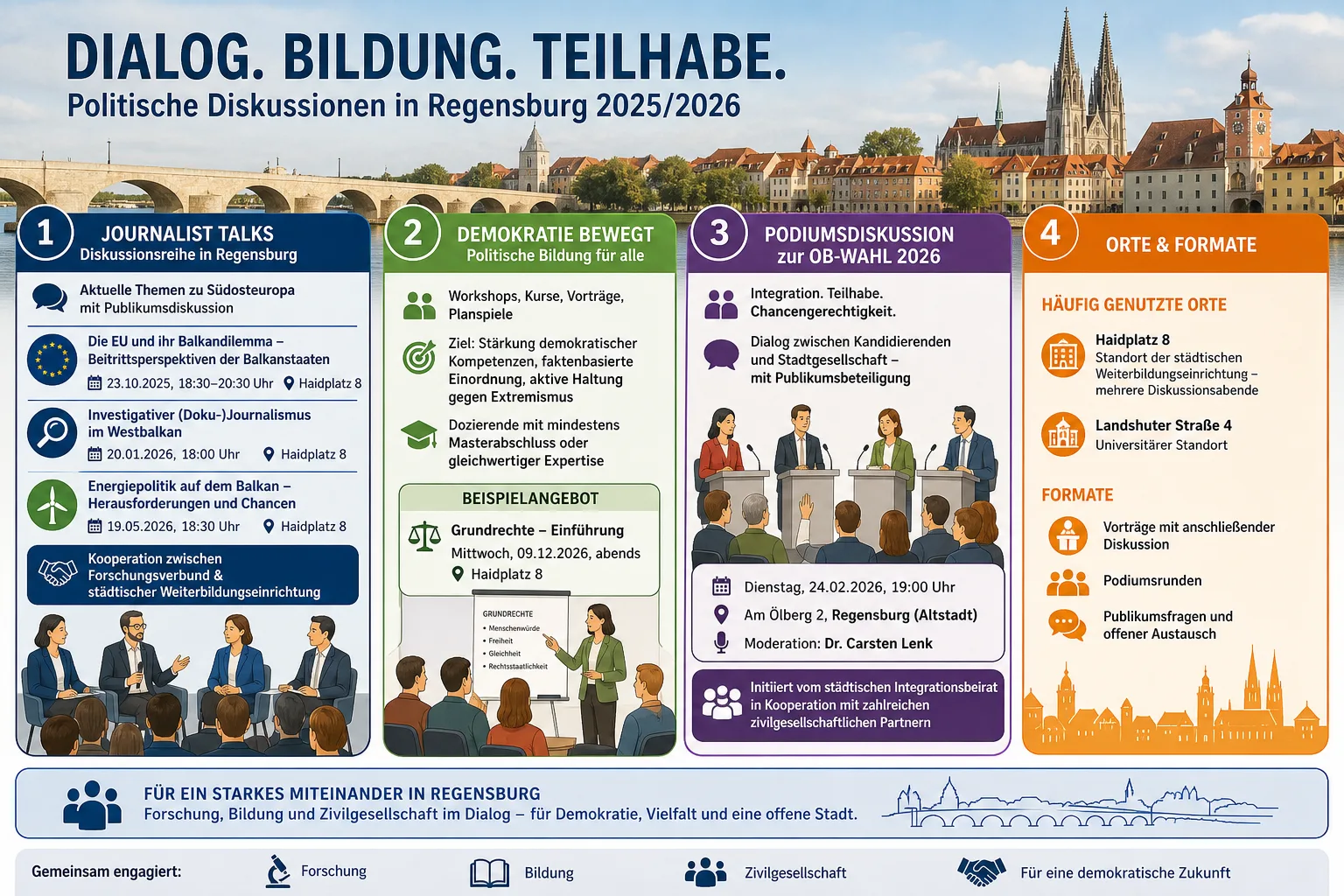
In the coming months, numerous political lectures, panel discussions, journalistic talks, and participation formats are expected to take place again in Regensburg. This overview helps you find suitable events, prepare well, and participate respectfully in discussions on site.
What to Expect in Regensburg in the Future
When political discussion formats are announced in Regensburg, they often follow a clear pattern: a short expert input, followed by a moderated discussion with the audience. For the next event cycles, these formats are likely to be particularly relevant:
- Public lectures with Q&A sessions: Contextualization of current developments, followed by audience questions.
- Journalistic discussion evenings: Reporters talk about research practice, information situation, and background.
- Workshops & simulation games: Political processes are practically played out in role formats (e.g., municipal decision-making paths).
- Panel discussions before elections and referendums: Candidates or representatives of different positions answer questions from the audience.
Since programs and venues vary depending on the organizer, it is worth checking the official event calendars and the pages of the respective educational institutions (see section "How to find the right dates").
Journalist Talks: Foreign Policy, EU Issues, and Research Practice (Outlook)
For upcoming discussion evenings with journalists, two levels are typically in focus: substantive foreign and European policy as well as journalistic working methods. When Southeast Europe or the Western Balkans appear in the program, EU enlargement issues, rule of law, media freedom, and geopolitical influence are often discussed as well.
Typical topics that may appear in future talks
- EU enlargement & accession processes: What criteria apply, what steps are pending, what does this mean politically and socially?
- Energy and security policy: Security of supply, dependencies, infrastructure, and European coordination.
- Investigative research: How are sources protected, how is verification done, how are risks weighed?
- Information spaces & disinformation: What patterns are recognized, which counter-strategies have proven effective?
If you would like to participate, simple preparation helps: While listening, note down concrete follow-up questions (e.g., "Which primary sources were used?" or "Which EU criteria are decisive here?"). Such questions increase the quality of the discussion and can usually be clarified well during the Q&A session.
"Democracy in Motion": Political Education to Participate In (Upcoming Course Formats)
Many municipal education programs will once again bundle courses, workshops, lectures and simulation games to strengthen political judgment and participation. When registering, pay attention to transparent information about leadership, learning objectives, methods, and sources.
Formats you will frequently find in the next course programs
- Basics of the political system in Germany: Responsibilities of municipality, state, federal government, and EU.
- Media literacy workshops: Checking claims, evaluating sources, image/video verification in everyday life.
- Simulation games: Decision-making situations in city council, committees, or European bodies are simulated.
- Fundamental rights in everyday life: Freedom of expression, right of assembly, and equal treatment – practical based on typical conflict situations.
A helpful quality check in advance: Serious offers not only state topics, but also methods (e.g., case work, moderated discussion, source work) and limitations (e.g., no individual legal advice).
Panel Discussions on Local Politics: How to Make the Most of Upcoming Evenings
Before municipal decision-making phases, panels and audience discussions are expected to be announced again in Regensburg. Such events are particularly valuable if you want to get an impression of argumentation style, priorities, and implementation plans.
How to recognize a good election or local panel
- Clear moderation: Speaking times, follow-up questions, and topic blocks are transparently regulated.
- Fact-based introduction: Terms and responsibilities are briefly explained so that the discussion remains comprehensible.
- Structured audience questions: Questions are collected, grouped by topic, and distributed fairly.
- Documentation: Key statements are often summarized or recorded after the event (if announced).
If you would like to ask a question yourself, formulate it as concretely and responsibility-related as possible, for example: "Which measure would you within municipal responsibility implement first, and how do you measure success?"
Join in, listen, contribute: How to Find the Right Dates
To reliably find future political events in Regensburg, it is best to use several sources and check the details shortly before the event (location, registration, accessibility, admission, costs).
- Official city and education calendars: Often the most reliable basis for dates, locations, and registration options.
- Websites of the organizers: Usually contain speaker bios, topic descriptions, and participation information.
- Newsletters & social media channels: Good for short-term changes, additional dates, or room changes.
- Accessibility information: Look for information on accessible entrances, sign language, induction loops, or streaming.
For a constructive discussion culture, a personal principle is worthwhile: tough on the issue, respectful in tone. This helps especially with controversial topics, without making discussions unproductive.