Street Music in Regensburg: Live Music & Open-Air Culture
Street Music & Spontaneous Concerts in Regensburg: How to Find Your Next Live Moments
In Regensburg, an evening can end quite differently than planned: a violin on the Danube riverbank, a jazz set in a courtyard, a choir on a square that was actually just a passageway. Especially in the coming weeks and months (when the city is particularly lively), many such spontaneous live moments arise—alongside and between curated open-air offerings.
This guide helps you to make it more likely to experience future street music and pop-up concerts: where you typically find them, when a walk is especially worthwhile, and how to be respectful and follow the rules.
Old Town & Danube: Where Street Music Is Most Likely to Appear Next
Regensburg's old town is compact, walkable, and acoustically diverse—ideal for musicians who can create a small stage in public space with just a few moves. In the coming months, spontaneous sets are especially likely where many people pass by, pause briefly, and there is enough space to listen.
- Routes between the Cathedral, Stone Bridge, and Danube riverbank: high foot traffic, good "short stop" dynamics.
- Squares with natural places to stay: benches, shade, outdoor dining (without blocking passageways).
- Riverside areas on warm evenings: calm atmosphere, often acoustic instruments and quieter sets.
Tip for the near future: If you want to specifically experience street music, don't plan "a concert," but rather a route. A 30–60 minute walk along busy axes significantly increases your chances of passing by at exactly the right moment by chance.
Open-Air Season: Why Official Stages Encourage Spontaneous Performances
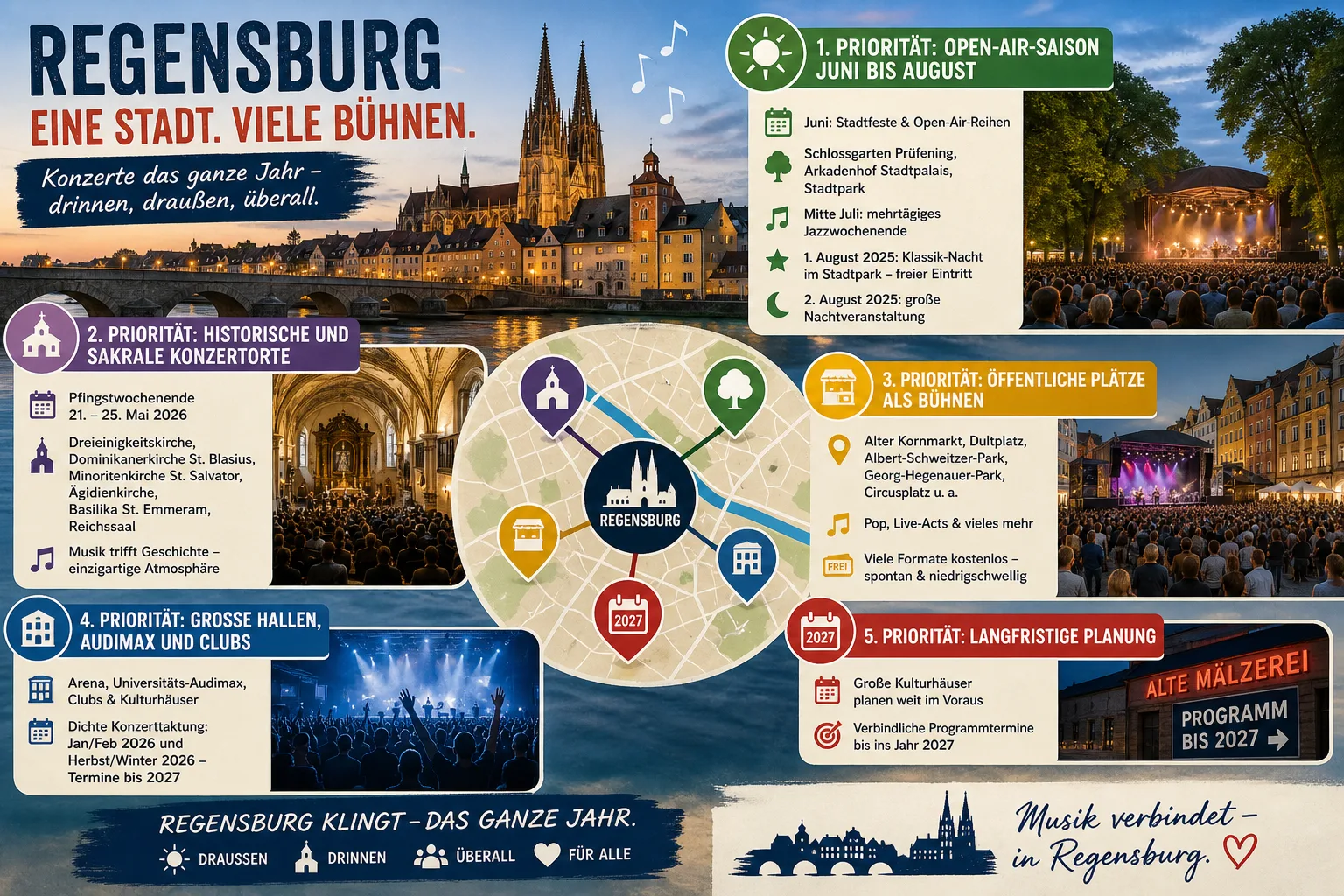
Regensburg regularly has phases with a dense open-air culture—with city festivals, series, and changing formats outdoors. When more events take place outside again in the coming weeks, experience shows that the likelihood of additional, informal live moments also increases: small aftershow sets, acoustic encores, musicians who stay in the city after an event and play in public spaces.
How to use this for your planning (without relying on individual, possibly changing dates):
- Check the city's cultural calendar and note evenings with several parallel events.
- Be out and about in the old town 30–90 minutes before the start—many spontaneous acts play "warm-up" or during transition times.
- Stay in the area briefly after the end: Especially the "winding down" of an evening is a good time for surprises.
Squares & Parks as Sound Spaces: Where Pop-up Concerts Work Well
In addition to the tourist hotspots, parks and larger squares also have the potential for spontaneous music—especially if they offer enough distance from residential windows and visitors are already sitting, picnicking, or strolling there. For the coming months: The more a place functions as a place to stay (not just as a passage), the more likely it is to host a short, informal concert.
- Parks: often suitable for acoustic sets, small ensembles, singer-songwriters.
- Spacious squares: helpful when listeners can spread out and paths remain clear.
- Courtyards and arcades (where publicly accessible): special acoustics, often an "intimate" atmosphere.
Important: Whether a place is actually suitable also depends on local rules (e.g., noise protection, passageways, special uses). Pay attention to signage and make sure that the operation of surrounding shops and paths is not impaired.
Historic Spaces & Acoustics: How Concert Venues Shape the Street Music of the Future
Regensburg's historic cityscape—known as a UNESCO World Heritage Site—not only provides beautiful backdrops but also special sound spaces. In the coming months, concerts in churches, halls, and courtyards will continue to shape the musical life. This also indirectly affects street music: musicians who perform in ensembles, choirs, or projects are often also active in public spaces—and bring repertoire, technique, and sound ideas "outside."
If you're looking for a varied musical evening, a mix can be worthwhile: first an official concert indoors, then a walk through the old town. This transition in particular is a time window in which spontaneous sets "dock" especially well.
Practical Tips for the Coming Weeks: How to Consciously Experience Street Music
- Choose times: Late afternoon to early evening is often ideal—many people are out and about, and the mood is open to short stops.
- Plan for the weather realistically: On mild, dry days, the chance of street music is much higher than during heat waves or rain.
- Use "program proximity": Around larger cultural evenings, additional, informal live moments often arise in the vicinity.
- Listen respectfully: Keep paths clear, don't be too loud with groups in the foreground, and think of residents.
- Support fairly: If you like something, a contribution in the hat is a direct, effective recognition—as long as it is allowed on site.
- Avoid conflicts: If security or law enforcement intervene, remember: stay friendly and accept that there may be rules and requirements.
The best thing about street music is its unpredictability—but with the right habits, you can increase the likelihood of catching exactly that one moment in the coming days or weeks that stays with you.
Conclusion: Regensburg as a City of Upcoming Sound Moments
Regensburg combines a historic backdrop with a vibrant present. In the near future, it is especially worthwhile to walk through the old town, riverbank paths, and parks with open ears: Between official programs and spontaneous performances, small concerts keep popping up—without tickets, without big announcements—but with real impact.