The History of Regensburg in 10 Stops
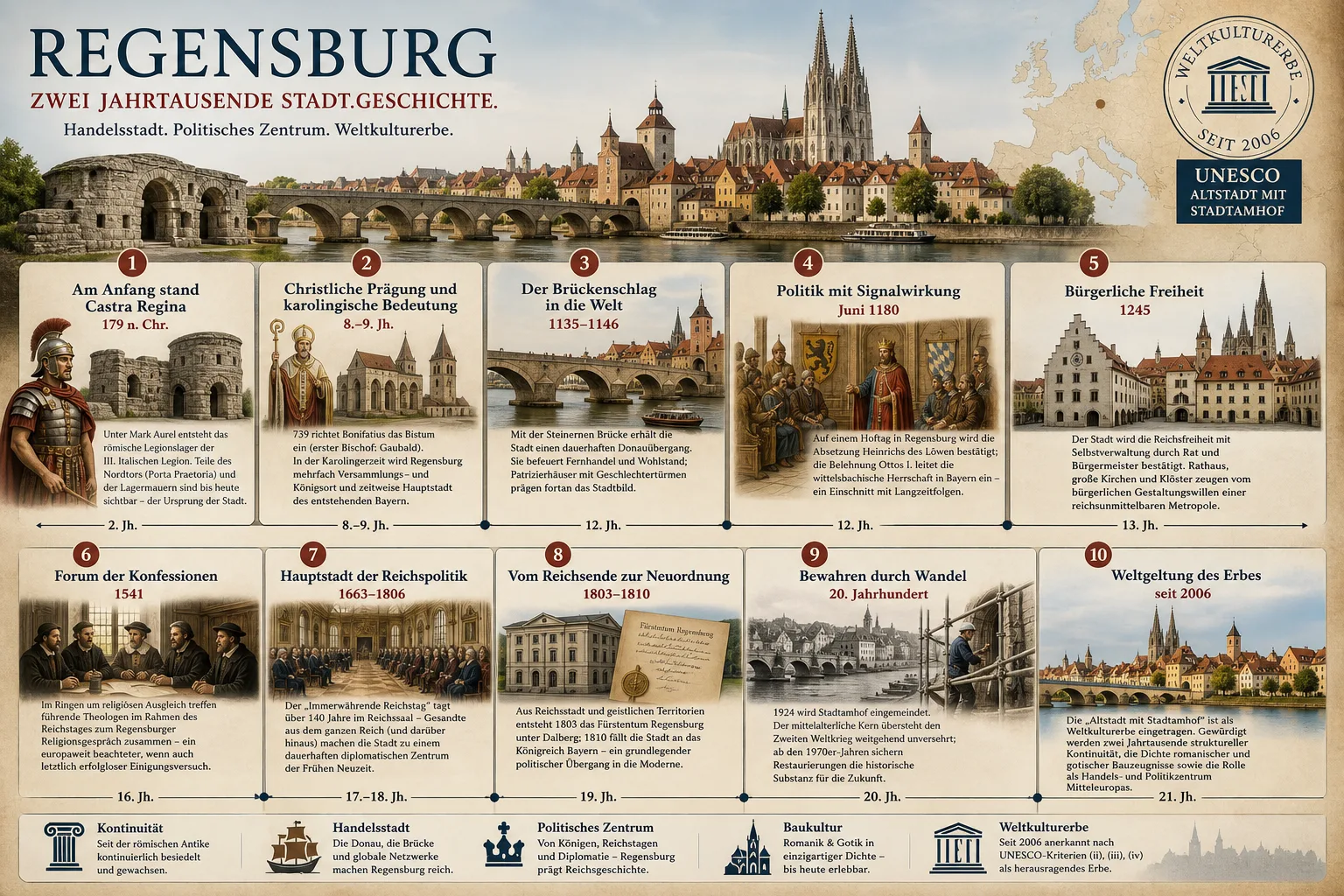
Experience Regensburg 2026/2027: A Tour in 10 Stops That Makes the City’s History Visible On Site
This future city walk takes you through 10 stops in Regensburg’s Old Town and to Stadtamhof. You use museums, signage, viewpoints, and bookable offers to discover history in an understandable way and without prior knowledge.
Target group: Visitors who want to explore Regensburg in their next travel plans (without specialist knowledge).
Stop 1: Starting Point at Roman Traces (Porta Praetoria)
You begin at a place where you can thematically anchor Roman city beginnings in Regensburg. On site, you will pay particular attention to how information boards, viewing windows, or guided tour offers explain the entry into the Roman era.
What you will pay attention to on site
- What information do you get directly at the object (signage, tour hints, audio guide)?
- How is “military, border, everyday life” made understandable without needing technical terms?
- Which viewing direction helps you mentally comprehend the location relative to the Danube?
Stop 2: Cathedral Square & Spiritual Center
Next, you will use Cathedral Square to connect church history, power, and urban space. In future tours or during an individual visit, architecture, rituals, and city expansions can be well considered together here.
Your focus
- You will pay attention to spatial effect: squares, axes, transitions between religious and secular buildings.
- You can plan to include a short interior visit if it fits your time window.
- If you are traveling with children or beginners, you will especially look for easily understandable explanatory offers (e.g., short texts, programs, family formats).
Stop 3: Stone Bridge as a Perspective on Trade & Routes
On the bridge, you will set a panorama point: From here, it will be easy in the future to explain how river, crossing, and routes shape the urban space. You use the place as a “mental hinge” between Old Town and Stadtamhof.
This is how you will “read” the place for yourself
- You will imagine which flows of goods and travelers are visible here today (tourism, everyday routes) and which narrative formats open up historical dimensions for you.
- You can plan a short photo break and later review the route using the pictures.
- If it is windy or very crowded, you will keep the crossing short and move the explanatory parts to quieter spots.
Stop 4: Old Town Hall – Experience Political Spaces
At this stop, you will focus on political history as a place-based experience: You plan to use the information on site (e.g., museum/guided tour format) so that you understand how decisions, protocol, and power communication are organized in spaces.
Practical planning for your future visit
- You will check in advance whether there are guided tours and whether booking is recommended.
- You will note which terms you want to look up after the visit (e.g., Imperial Diet, embassy, negotiation culture).
- If you have little time, you will prioritize this stop because it often provides “a lot of context per minute.”
Stop 5: Patrician Houses & Reading the Cityscape
Now you will slow down: In the alleys, you will use the cityscape as a historical source. Your goal is to recognize on facades, heights, passages, and courtyard situations how wealth, use, and representation are told in the urban space.
Observation tasks (which you will do along the way)
- You will photograph 3 details (portal, window, courtyard entrance) and later assign them: “residence,” “trade,” “craft,” “representation.”
- You will pay attention to where public explanatory texts or monument notes give you context.
- You will look for a quiet side street as a “contrast” to the main routes to better feel the city structure.
Stop 6: Understanding Places of Confessional Diversity
For the next stage, you will choose stops where you can consider faith, conflict, coexistence and urban everyday life together. You will especially look for well-explained formats (exhibitions, tours, text panels) that avoid polemics and promote historical multiperspectivity.
This is how you keep your orientation
- You will select only 1–2 interiors so that the route does not “tip over” and you keep an overview.
- You will pay attention to terms that need explanation and note them as questions.
- If you are traveling with a group, you will include a short conversation break: “What still has an effect here today, what is only historical?”
Stop 7: Traces of Diplomacy Around the Imperial Hall
You will set up this stop as a supplement to Stop 4: You focus on the environment in which everyday negotiations, embassies, and information flows are located. In your future visit, you will thus turn a single place into a “political neighborhood.”
What you will do here specifically
- You will take a short walk around the town hall area and check which clues (signs, thematic city tours) make diplomacy history tangible.
- You will take away a question: “How is European politics told in the urban space – through people, through institutions, or through places?”
- If available, you will choose a format that explains original rooms (instead of just listing data).
Stop 8: Breaks & Transitions in the City Model/Museum Context
For this stop, you will plan a museum or exhibition venue that shows city development as a line with breaks: administrative changes, modernization, new traffic axes, new uses. Your focus is to get an ordered overall picture in a short time.
This is how you use the stop effectively
- You will specifically look for city models, maps, or timelines because they quickly provide orientation.
- You will note 2–3 keywords that you want to “find again” in the old town afterwards.
- If your travel time is tight, you will keep this stop optional and instead extend the outdoor route.
Stop 9: Observing Monument Preservation in the Urban Space
At this stop, you will consciously look at preservation, use, and renovation: What clues show you that buildings are protected? Where do you recognize careful adaptations? This perspective helps you not only to “admire” World Heritage, but to understand it as an ongoing task.
Your “monument glasses” for the next visit
- You will note differences between modernized and traditionally appearing details (material, windows, ground floor zones).
- You will pay attention to how information is conveyed: factual, transparent, comprehensible.
- You will plan consideration as part of the visit: be quiet in residential areas, do not block paths, respect private courtyards.
Stop 10: UNESCO World Heritage – Rules, Responsibility, Sightlines
At the end, you will actively take up the World Heritage idea: You plan to clarify at a place with a good overview (or at a suitable information point) what World Heritage means in everyday life: protection, mediation, tourism management, and sustainable behavior.
What you will take away at the end
- You will want to understand which guiding ideas are behind the protection (ensemble, authenticity, mediation).
- You will set 1–2 rules for your own visit (e.g., photograph respectfully, avoid sensitive areas, avoid litter).
- You will consider for a next travel option whether you want to additionally book a thematic tour (Romans, Middle Ages, politics, World Heritage).
Mini-Checklist for Your Visit
- You will check the official pages for opening times and tickets before arrival (see Sources).
- You will plan comfortable shoes and shorten the route in heat/icy conditions.
- You will allow yourself a 10-minute “buffer” per interior stop (town hall/museum/church) so you don’t rush.
- At the end, you will secure 3 photos or notes as a memory: “Romans,” “Politics,” “World Heritage.”
Sources & Further Links
When planning your future visit, you will be able to use the following official and professionally established information sources:
- UNESCO World Heritage Centre — Official information on World Heritage and entries (accessed 2026-08-26)
- City of Regensburg (official) — Current notices, services, city information (accessed 2026-08-26)
- Tourism Regensburg — Planning info, route ideas, guided tour offers (accessed 2026-08-26)
- Bavarian State Office for Monument Preservation (BLfD) — Basics on monument preservation in Bavaria (accessed 2026-08-26)
- Historical Museum Regensburg — Exhibitions and educational offers (accessed 2026-08-26)