Volunteering & Volunteer Work in Regensburg
Volunteering & Volunteer Work in Regensburg: What Engagement Opportunities Await You in the Coming Months
In Regensburg, civic engagement will continue to be a crucial pillar for social participation, education, culture, and safety in the future. This overview looks ahead: at typical entry points, upcoming formats, and ways you can reliably be matched with suitable tasks in the coming weeks and months.
Article standpoint: It describes only future engagement steps and formats (e.g., info evenings, counseling, qualifications, ongoing intake of new volunteers) and shows you how you can sign up for them.
Why Volunteering in Regensburg Will Remain Especially Important in the Future
In the coming months, many organizations in Regensburg will continue to rely on volunteers: for visiting and companion services, learning support, integration work, cultural and environmental projects, as well as for operational services that regularly train and take on new members. At the same time, many people are increasingly seeking meaningful leisure activities, new contacts, or a contribution to local resilience.
If you get involved now, the advantage is: Many organizations are continuously planning introductions, training, and get-to-know-you appointments. This allows you to start your engagement in a way that fits your everyday life and ensures you are well prepared.
Contact Points: Where You Can Get Advice and Be Placed Next
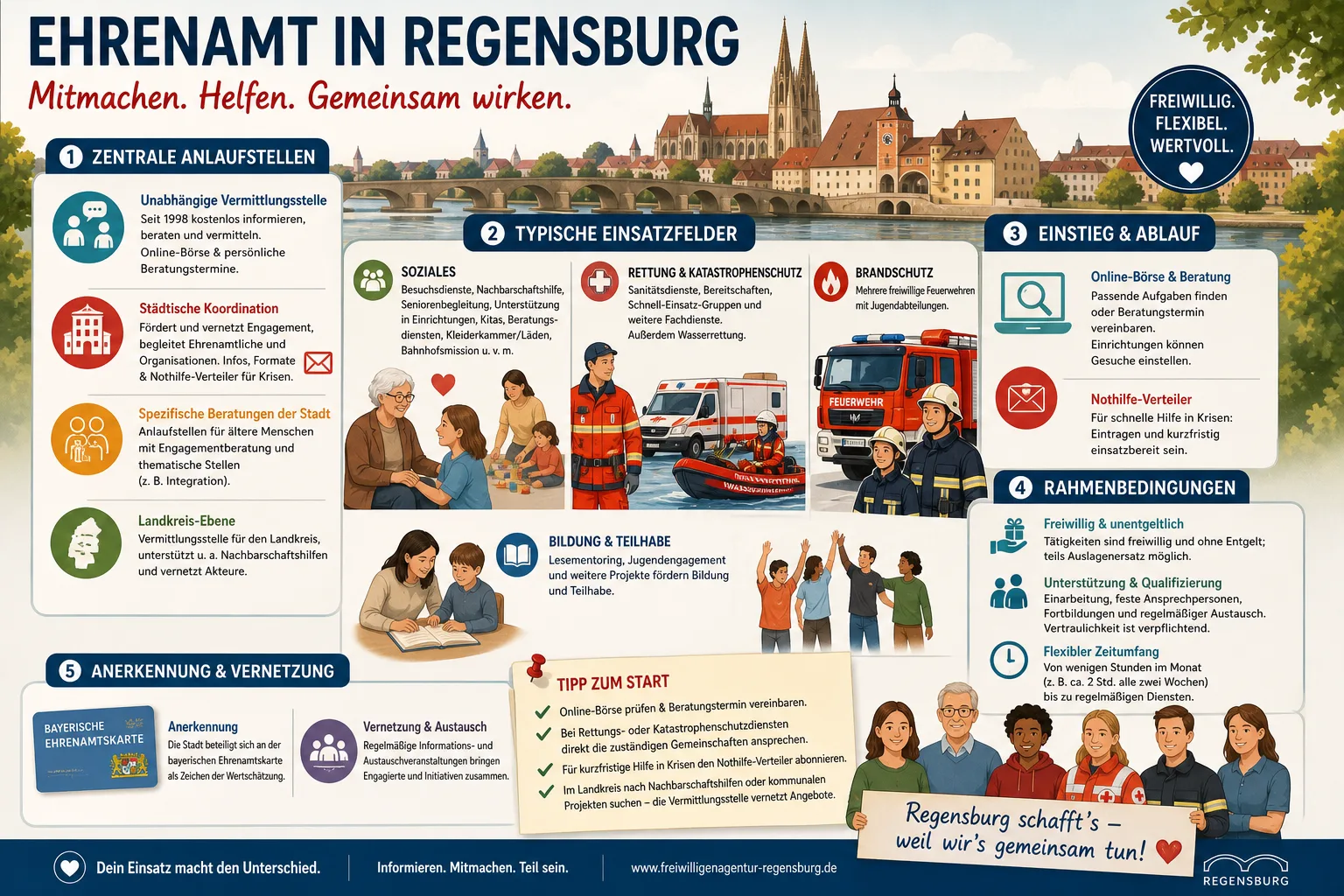
For getting started in Regensburg, two paths are especially practical for the future, as they quickly provide orientation and establish contacts:
1) Volunteer Agencies and Online Engagement Exchanges
If you want to start searching in the next few days, a regional volunteer agency or engagement exchange is often the fastest starting point. There you can filter offers by topics (e.g., social, education, environment), time commitment, or location. In many cases, a get-to-know-you meeting with the organization follows before you commit.
Important for future planning: Use the search filters so that they realistically fit your life (e.g., “2–3 hours/month” or “project-based”). This increases the likelihood that you will stay involved long-term.
2) Municipal Coordination & Information Formats
Many municipalities bundle civic engagement through coordination offices that organize networking, information events, and current calls. If you want to remain flexible in the future, such distribution lists and information formats are helpful because you get insights without having to commit immediately.
For you, this means concretely: In the coming weeks, you can first sign up for an info format (or join a distribution list) and then decide whether you want to join a permanent team or participate in project-based assignments.
3) Entry via Large Organizations (for Plannable Processes)
If you value structured training and regular practice evenings, it is worthwhile to contact established organizations directly soon (e.g., fire department, THW, aid organizations, water rescue). These organizations usually continuously take on new members and plan introductions and qualifications throughout the year.
Fields of Activity That Will Be Especially in Demand in the Near Future
Social & Neighborhood: Visiting Services, Companionship, Everyday Assistance
In the coming months, there will continue to be a need for reliable, low-threshold assistance. Typical tasks that are often newly filled include:
- Visiting and companion services (e.g., conversations, walks, accompanying to appointments)
- Support in facilities (e.g., leisure activities, help at events)
- Help in clothing stores, social department stores, or distribution points
- Support with low-threshold counseling or guide services (after training)
If you want to start soon, this field is often particularly beginner-friendly because many organizations offer short introductions and clear task profiles.
Education & Participation: Reading Mentoring, Learning Support, Youth Projects
For the coming school year and the next project phases, many programs regularly seek new volunteers. Typical are:
- Reading mentoring and learning support (regular meetings, usually at fixed times)
- Project support in youth work (e.g., creative activities, leisure events)
- Language and everyday support in integration contexts (after qualification)
If you enjoy working with children or young people, it is especially important for the next few months: Clarify in advance which qualifications, protection concepts, and, if applicable, certificates are required.
Environment, Culture & Urban Society: Action Days and Project Teams
In Regensburg, many engagements will continue to be organized on a project basis, for example around nature conservation, cultural events, or local initiatives. This form is well suited if you want to try things out in the coming months without a fixed weekly appointment.
Safety & Emergency Services: Fire Department, Rescue and Disaster Protection, Water Rescue
Organizations in civil protection regularly plan training modules, exercises, and team intakes. If you are interested in this in the coming months, you should expect the following points:
- binding introduction and training phases
- regular practice evenings or weekend appointments
- clear requirements for reliability, teamwork, and safety
For many, it is precisely this structured framework that is the reason they stay involved long-term.
How to Plan Your Entry: From Orientation to Start
Step 1 (this week): Define Goal & Time Budget
To avoid overcommitting in the coming months, a brief, honest self-assessment helps:
- Time: How many hours per month are realistic (including travel)?
- Rhythm: Prefer regular (e.g., 2×/month) or project-based?
- Contact: More contact with people (visiting service) or more organizational (e.g., support at events)?
- Workload: Do you want lighter everyday support or also challenging situations?
Step 2 (in the next 7–14 days): Start Placement
Next, choose one of the two pragmatic paths:
- Engagement exchange/volunteer agency: Save 3–5 suitable offers and make targeted inquiries for each.
- Direct contact with organizations: Ask the fire department/THW/aid organizations about the next intake or info appointment.
For a quick response, it helps if you write briefly and specifically in your inquiry: available times, interests, whether you are mobile, and when you would like to start.
Step 3 (afterwards): Get to Know Each Other, Clarify Framework, Start Well
Before you start, the following should always be clearly answered in a get-to-know-you meeting in the future:
- Which tasks are included – and what is explicitly not included?
- Who is the contact person, and how can you reach them in everyday life?
- What introduction/training is planned?
- What rules apply to data protection, confidentiality, and boundaries?
This way, your engagement begins in a planned and safe manner – for you and for the people you support.
Framework Conditions: Time, Qualification, Data Protection, and Insurance
Time Commitment: Flexible but Reliable in the Future
In most engagements, no “maximum workload” will be expected in the future, but reliability will. Many offers can be started with just a few hours per month. If your everyday life changes, early communication is crucial so organizations can plan anew.
Qualification: Further Training Will Remain Central in the Coming Months
Many organizations are increasingly relying on short introductory workshops and regular further training (e.g., communication, de-escalation, child protection, operational hygiene). This increases quality and protects everyone involved. Actively ask about the qualification plan when making contact.
Data Protection, Confidentiality, and Protection Concepts
If you will be dealing with personal information in the future (e.g., in visiting services, counseling contexts, or learning support), data protection and confidentiality will be bindingly regulated. In the EU, the General Data Protection Regulation (GDPR) is the central framework. Reputable organizations will explain to you in writing how data is processed and what rules apply to you during your assignment.
Insurance & Safety
For many forms of volunteering, there are protections depending on the organization and area of assignment (e.g., accident and liability regulations). Since details vary, you should have it explained to you before you start which protection specifically applies and which behavioral rules (e.g., occupational safety, operational rules, supervisory duties) must be observed.
Checklist for the Next 14 Days
- Today: Decide on 1–2 fields of activity (e.g., education + culture).
- In 48 hours: Set a realistic time budget (e.g., “2 hours every two weeks”).
- This week: Search for 3–5 offers via an engagement exchange or a volunteer agency and note down any questions.
- By the end of next week: Send 2–3 inquiries with clear availability and start date.
- In the following days: Arrange a get-to-know-you meeting, clarify task profile, onboarding, and data protection rules.
- Afterwards: Start with a “trial phase” (e.g., 4–6 weeks) to check if it is sustainable for you.