How Regensburg is Becoming a Smart City – Strategy & Transformation
How Regensburg is Becoming a Smart City – Strategy & Transformation
How is Regensburg becoming a Smart City? An outlook on strategy, digitalization, data, mobility, and participation in sustainable urban development – with a focus on upcoming projects and next steps.
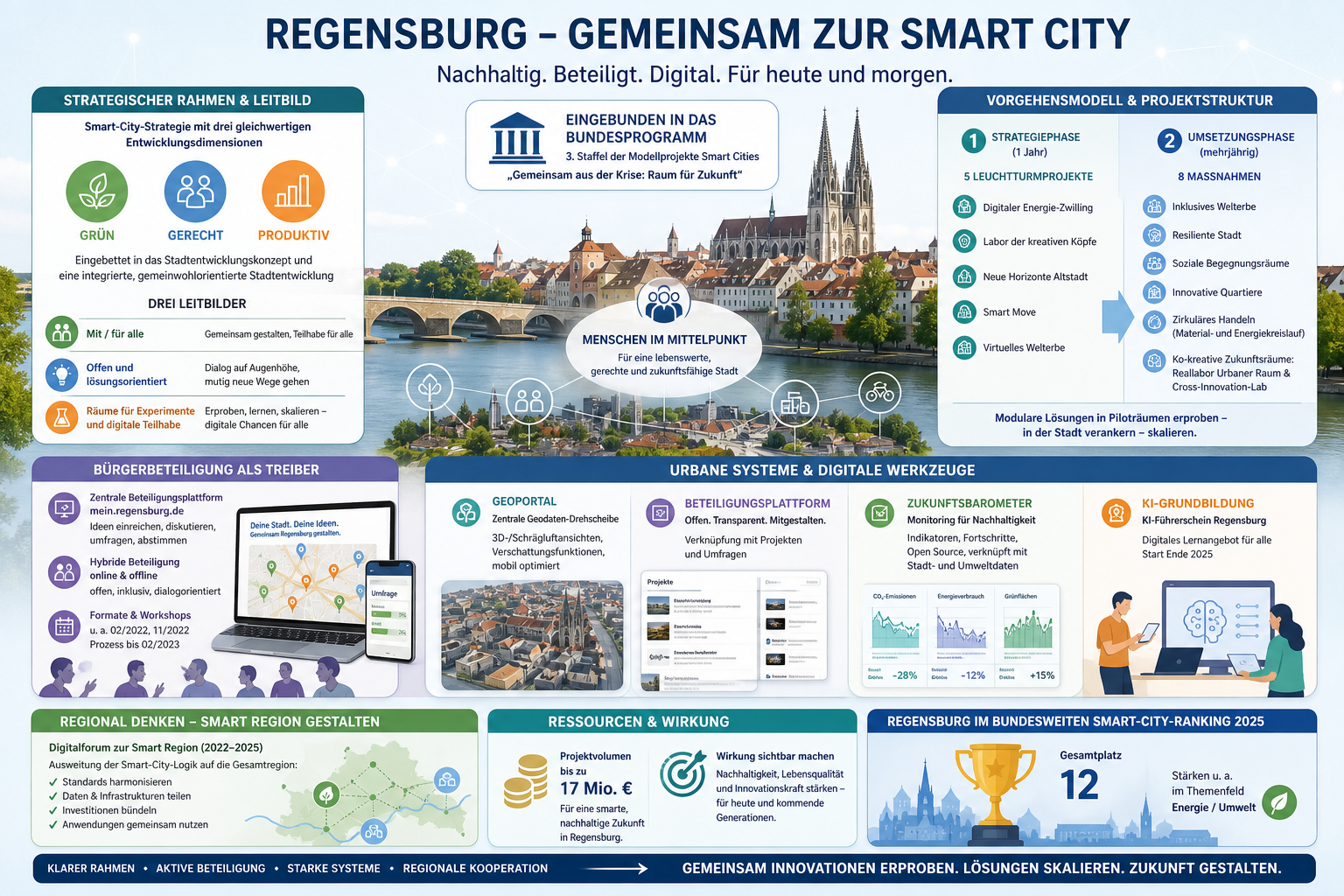
Guiding Principle: green, fair, productive
In the coming years, Regensburg will deliberately not align its Smart City path with as much technology as possible, but rather with a development of the city oriented toward the common good. At its core, it is about using digital tools in such a way that they measurably contribute to quality of life and at the same time support climate and resource protection.
The guiding principle can be translated into three equally important dimensions:
- Green: Climate protection, energy efficiency, and a resource-conserving infrastructure.
- Fair: Digital services that are accessible to everyone (e.g., low-barrier, understandable, multilingual).
- Productive: Capacity for innovation, new collaborations, and future-proof jobs.
In practical terms, this means: Smart City projects should not run "on the side" in isolation, but be integrated into urban planning, mobility, energy, education, and participation. This way, a system is gradually created in which decisions can be made more data-based, transparent, and comprehensible.
Federal Program & Funding: what this enables
A central framework for Regensburg's further Smart City work is integration into nationwide funding and learning networks around the Model Projects Smart Cities. Such programs combine financial support with knowledge transfer, standards (e.g., for Open Data, interoperability, and IT security), and the obligation to make results transferable.
This is relevant for urban development because, in the next project phases, not only individual pilot applications typically emerge, but also foundations such as data platforms, participation formats, evaluation logics, and operational concepts are considered. The goal is for digital projects to function in the long term, be compliant with data protection, and truly relieve the day-to-day work of administration.
From Strategy to Implementation: Package of Measures
In the coming years, Regensburg Smart City will primarily be measured by whether measures are noticeable in everyday life: in neighborhoods, in the old town, in mobility chains, and in municipal infrastructure. Modular projects are suitable for this, which initially start in clearly defined areas and are scaled up if successful.
Focus areas that may take center stage in the future
- Digital energy and city climate perspective: Digital models and analyses can help to better identify energy needs, peak loads, or potential for efficiency measures. In practice, this supports, for example, renovation strategies, network planning, or the prioritization of climate protection measures.
- World Heritage & digital mediation: For visitor guidance, orientation, and accessibility, digital information services, route aids, or multilingual content can be expanded – with the aim of making culture accessible and at the same time protecting sensitive areas.
- Smart Move – connected mobility: The expansion of digital mobility information (e.g., multimodal information, better transfer info) can help make routes more efficient and climate-friendly. It is important that data is open and interfaces are compatible.
- Resilience & situation pictures: Data-driven situation pictures (e.g., on heat, heavy rain, construction sites, traffic flows) can support municipal crisis and adaptation planning – especially when the information is prepared in an understandable way and updated regularly.
- Circular action: Circular economy can be digitally supported, for example through better material flows in construction projects, transparent reuse, or data-based procurement. This can save resources and make municipal processes more efficient.
- Co-creative future spaces: Real-world laboratories and innovation formats can test new solutions more quickly – provided that goals, responsibilities, data protection, and evaluation are clearly regulated from the outset.
Decisive for effectiveness is clean implementation: clear target images, measurable indicators, comprehensible data origin, regulated responsibilities, and a plan for how applications will be operated and financed after the pilot phase.
Data, Geoportal & Monitoring: Foundation for Decisions
For Smart City to be more than a collection of individual apps, a reliable data and system base is needed. For Regensburg, three building blocks in particular will play a role in the next development steps:
- Geoportal: Urban and environmental data can be made more understandable through map applications. Functions such as 3D views, thematic layers, or shading analyses support planning, climate adaptation, and citizen information.
- Monitoring (“Future Barometer”): A key figures portal can make progress visible – for example in climate, energy, mobility, or social participation. It is important that indicators are explained (definition, data source, update frequency) so that the numbers are not misunderstood.
- Data governance: Rules on data quality, responsibilities, open data strategy, IT security, and data protection determine whether digital projects are scalable and trustworthy.
A good benchmark here is: Can an interested person understand which data is used, where it comes from, how it is processed, and what limitations (e.g., uncertainties, gaps) exist? Exactly this transparency is a core of trust in Smart City projects.
Participation: how people can help shape things
Smart City will only work in the long term if people can understand, evaluate, and help shape the changes. That is why participation in Regensburg will likely continue to be organized on two tracks: digitally via platforms (for information, surveys, ideas) and analog via workshops and on-site formats (for exchange, conflict resolution, and joint design).
To ensure participation remains effective, future procedures should consistently fulfill three points:
- Early involvement: not just allowing comments when everything is already decided, but disclosing goals, options, and goal conflicts.
- Comprehensible feedback: document what happens to suggestions (adopted, rejected, postponed) and why.
- Low-barrier communication: understandable language, suitable times/places, digital accessibility, and, if possible, multilingual information.
Smart Region: Collaboration Beyond the City Limits
Many Smart City issues can only be sensibly solved regionally in practice: commuter traffic, energy and heating networks, environmental and climate data, or administrative services. That is why Regensburg will have to expand the Smart City approach more towards a Smart Region in the future.
In the next expansion stage, the following topics are typically in focus:
- Interoperable mobility data: coordinated interfaces and data formats so that information works across city and municipal boundaries.
- Joint environmental and climate data: comparable measurement and evaluation logics make it easier to coordinate climate adaptation.
- Coordinated digital standards: for example in open data, IT security, and data protection, so that solutions remain reusable and scalable.
The benefit for citizens then does not appear as a "Smart City" label, but as a smooth everyday life: better coordinated travel chains, clearer information, and services that work similarly regardless of place of residence.
What This Could Mean in Everyday Life in the Future
If Regensburg consistently develops the Smart City strategy further, the benefits can be felt especially in three areas:
- Orientation & access: understandable information (also low-barrier and multilingual) and digital assistance that makes staying in the city and old town easier.
- More efficient routes: better linking of means of transport, clearer real-time information, and data-based optimization of processes.
- Climate & quality of life: more targeted measures against heat, better prioritization in renovation and energy efficiency, and transparent monitoring of progress.
It remains important: "Smart" is not automatically "better." The quality depends on whether projects take data protection and IT security seriously, whether data is comprehensible, and whether the urban society has real opportunities to participate.
Sources
- Smart City Dialog – Model Projects Smart Cities — Program background, goals, knowledge and transfer approach (accessed 2026-05-13)
- Federal Institute for Research on Building, Urban Affairs and Spatial Development (BBSR) — Information on research/programs for urban and spatial development, including in the Smart City context (accessed 2026-05-13)
- Federal Ministry of the Interior (BMI) — Framework information on digitalization, administration, and funding programs (accessed 2026-05-13)