Zero Waste in Regensburg: Celebrate Green Events
Zero Waste & Green Events: How Future Festivals in Regensburg Can Succeed in an Environmentally Conscious Way
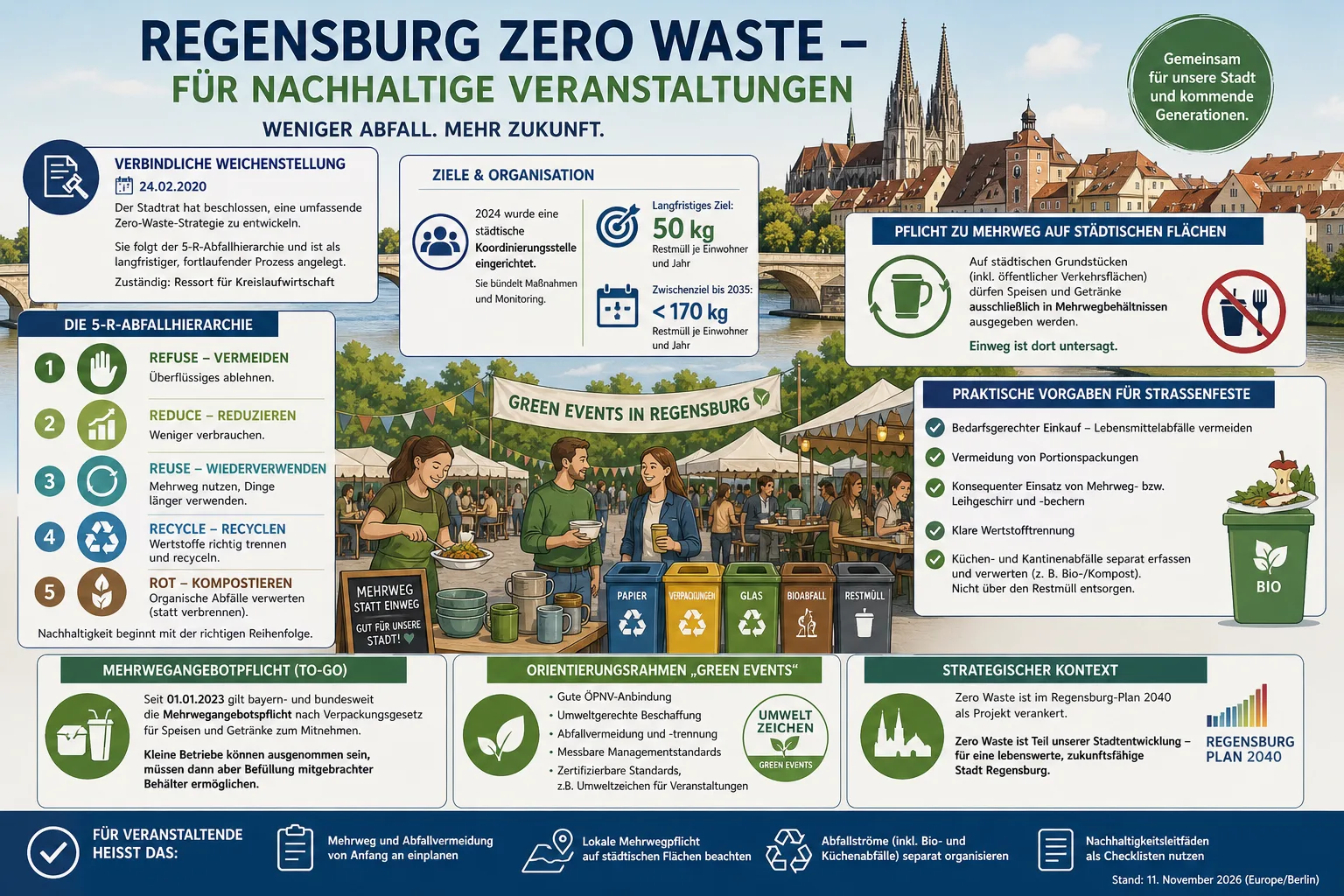
Regensburg thrives on markets, culture, sports, and street life. In the upcoming event season, the city (and everyone who organizes or attends a festival) can show that celebrating with significantly less waste is possible: with reusable systems, smart procurement, proper separation, and travel that relieves the climate and the city center.
Planning Principles for Upcoming Green Events in Regensburg
So that a Green Event does not fail due to details, organizers of future festivals in Regensburg should consider three levels early on:
- Rules & Framework: What requirements apply for space, permits, noise, hygiene, waste, reusable systems, deposit, street cleaning?
- Logistics: Where do cups, plates, cutlery come from? Where is washing done? How are returns collected? Who drives when?
- Behavior: What do visitors need to know (deposit, returns, separation, arrival) for everything to run smoothly?
Plan Measurably (Without Overhead)
For the next edition of a festival, a small set of key figures is worthwhile, which can be recorded without much effort:
- Reusable quota (e.g., share of sales via reusable systems)
- Waste per visitor (estimate via container or bag counts)
- Return rate (e.g., percentage of returned reusable cups)
- Share of arrivals by public transport/bicycle (short survey/QR code)
This way, future events can visibly improve instead of starting from scratch each time.
Reusable Systems for Drinks & Food: How to Make It Practical
The strongest lever for low-waste events is reusable systems. For upcoming events in Regensburg, three models are particularly practical:
1) Uniform Event Reusable Cup with Deposit
- Advantage: Fast, robust, compatible with many stands.
- Important: Plan enough return stations (well visible, short distances).
- Practical Tip: Set the deposit so that returns are attractive but do not slow down distribution.
2) Reusable Tableware via Rental/Washing Mobile
- Advantage: Also suitable for food; professional washing reduces hygiene risks.
- Important: Clarify electricity/water/access; plan washing times and peak times.
3) Cross-Vendor System (Bowls/Boxes)
- Advantage: Especially good for street food, to-go, and food trucks.
- Important: Uniform rules: distribution, deposit, returns, breakage/loss.
For reusable systems to really work, clear responsibilities are needed: Who supplies, who collects, who washes, who settles deposits – and who decides in case of shortages.
Waste Avoidance & Separation: How to Keep the Venue Clean
Even with optimal reusable systems, waste is generated. The goal for upcoming Regensburg events is: little waste, clean fractions, and simple processes.
This Is How Collection Points Become Intuitive
- 3–4 fractions are enough: Residual, paper, lightweight packaging/recyclables, organic (where sensible).
- Uniform look: Same colors/icons at all stations; large pictograms instead of text deserts.
- “Nudging”: Organic/residual closer to food area, paper closer to seating, recyclables at drink stands.
- Staff during peak times: Short hints (“Please return cups”) are more effective than extra bins.
Avoid Waste Before It Occurs
- No portion packs (sugar, ketchup, milk) – instead use dispensers/bulk containers.
- No giveaways without use (flyers, plastic trinkets). Better: QR codes, reusable vouchers, deposit bonuses.
- Refillable water (where possible): Refill points reduce single-use bottles.
Catering & Procurement: Regional, Seasonal, Plannable
For upcoming festivals in Regensburg, sustainability is especially credible when food and purchasing are right. Three levers are crucial:
- Calculate needs realistically: Better to restock more often than to keep too much in reserve.
- Offer seasonal & regional: Shorter supply chains and often better planning reliability.
- Strengthen vegetarian/vegan options: They are often less resource-intensive and make quantity planning easier.
For the upcoming season, a simple food concept is also worthwhile: smaller menus, standardized ingredients, flexible portion sizes. This reduces kitchen waste and speeds up the process.
Arrival & Mobility: Fewer Emissions, Less Pressure on the Old Town
At future large and neighborhood festivals, a large part of the environmental impact comes from travel. For Regensburg, these measures are particularly effective:
- Communicate public transport as standard: On ticket pages, posters, and social media, mention bus/train first, then parking.
- Plan bicycle-friendly: Additional parking spaces, clear signage, route information.
- Promote carsharing/pooling: Own note “Come together” plus drop-off zones relieve crowded areas.
Consistency is important: If mobility is easy and clearly explained, more people will voluntarily choose not to travel alone by car.
On-Site Communication: So Visitors Join In
Green events work best when they don’t feel like a sacrifice, but like comfort: clean spaces, clear returns, short distances. For upcoming events in Regensburg, these elements have proven effective:
- One sentence that explains everything: “We use reusable systems with deposit – returns at every drink station.”
- Signage at eye level: Mark returns and separation where decisions are made.
- Positive incentives: Deposit bonus for quick returns or a small thank you (e.g., discount on next purchase) – if organizationally possible.
- Short announcements: During peak times, a friendly announcement reminds about returns/separation.
Key point for next planning: What is not immediately understandable will not be done in the hustle and bustle. The simpler the system, the “greener” the result.
Checklists for Organizers, Gastronomy, and Visitors
Checklist: Organizers (Planning the Next Edition)
- Select reusable system (cups, tableware, boxes) and define return routes.
- Involve washing/logistics partners early; plan for peak load times.
- Define collection islands with clear fractions; prepare uniform pictograms.
- Oblige stand operators: no portion packs, clear separation rules, prioritize reusable systems.
- Mobility concept: communicate public transport/bicycle first, consider drop-off/accessibility.
- Brief team: 3 core messages on reusable systems, returns, separation.
- After the event: record 3 key figures and note improvements for the next round.
Checklist: Gastronomy/Stand Operators (for Upcoming Assignments)
- Train reusable distribution: deposit, returns, dealing with shortages.
- Plan menu so ingredients can be used multiple times; minimize leftovers.
- Use dispensers instead of portion packs.
- Clear waste at the stand: What is organic, what is recyclable, what is residual?
- Short announcement in the process: “Please return cups – returns over there.”
Checklist: Visitors (for the Next Festival in Regensburg)
- If possible: bring your own water bottle/cup (where accepted).
- Use reusable systems, consistently return deposit cups.
- Dispose of waste separately – ideally directly at collection islands, not in “just any” bin.
- Prefer public transport, bicycle, or shared travel.
- Better to quickly ask (“Where is the return?”) than take the cup with you.