Camille Claudel
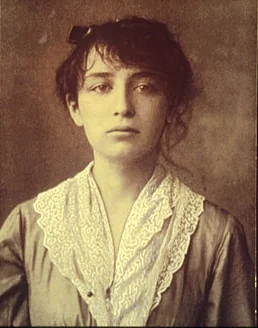
Image from Wikipedia
Image from Wikipedia
Camille Claudel – the Sculptress Between Passion, Break and Artistic Immortality
An Extraordinary Artist Personality of French Modernism
Camille Claudel is considered one of the most fascinating female sculptors of the 19th and early 20th centuries. Her life intertwines artistic brilliance, personal tragedy, and a late but lasting art historical recognition. Born on December 8, 1864, in Fère-en-Tardenois and died on October 19, 1943, in Montdevergues, she left behind a body of work that is still exhibited today in significant museums around the world. Her biography is closely linked to Auguste Rodin, yet her own signature possesses enough power to resonate well beyond this relationship. (de.wikipedia.org)
Biography: Background, Education, and Early Artistic Ambition
Claudel grew up in a family that recognized her talent early on. As a young woman, she displayed an extraordinary gift for form, movement, and expression, leading her to Paris, where she deepened her sculptural training. There, she entered an art milieu shaped by male hierarchies that offered limited space for women. It was precisely in this tension that she developed her artistic will with remarkable consistency. (de.wikipedia.org)
Her encounter with Auguste Rodin marked a pivotal turning point in her career. She was his student, later also his lover, and worked in an environment characterized by mutual inspiration but also dependency and conflict. Claudel spent her life in Rodin's shadow, even though her own works had long gained independent significance. The art historical appreciation of her work only began late, not least because her biography and oeuvre are hardly separable. (de.wikipedia.org)
The Breakthrough in the Shadow of Rodin
Camille Claudel worked with great intensity on a language of sculpture distinguished by movement, psychological tension, and expressive modeling. Her sculptures do not exhibit a smooth academic distance but rather a dramatic closeness to the human body and the emotional state of her figures. Works like La Valse exemplify an art that translates attraction, dynamism, and vulnerable tension into bronze. In doing so, Claudel created a vocabulary that stands clearly apart from mere decoration. (de.wikipedia.org)
For a long time, her name was primarily associated with Rodin in public perception, but contemporary research increasingly recognizes her career as an independent achievement. Sources such as Britannica and the National Museum of Women in the Arts highlight that Claudel was a significant sculptor of her time and should not be seen merely as a muse or student. Her works represent a modern sensibility in which form and inner state are inextricably linked. This is precisely where the core of her breakthrough lies, even if it was historically recognized far too late. (britannica.com)
Work, Style, and Artistic Signature
Claudel's preferred materials were bronze and marble, mediums that demand high precision and strong formal control. Her sculptures often appear physically dense, yet simultaneously nervous and dynamic, as if the moment of transformation itself is frozen. This tension between structure and emotion makes her art unmistakable. She does not seek the monumental for its own sake but rather the moment where body and feeling become one. (de.wikipedia.org)
Notably striking is her ability to not only represent a figure but also to imbue it with psychological depth. In Claudel's works, one encounters passion, vulnerability, pride, and loss within a visual language that resonates with French symbolism and the emerging modernity. Art historical classifications thus see her work as a premonition of later expressive tendencies. This explains why her sculptures are now read not only as historical documents but as living, emotional artworks. (theartstory.org)
Famous Works and Museum Presence
Among Camille Claudel's most well-known works is La Valse, a sculpture that powerfully unfolds its impact through the dancers' movement and the physical closeness of the figures. L’Âge mûr is also a key work in her oeuvre and is often interpreted as an expression of her personal and artistic conflicts. These works show how closely Claudel's sculptural technique intertwines with her life story. Her art thus remains not abstract, but existential. (de.wikipedia.org)
Today, her sculptures are represented in several major museums worldwide, underscoring her international significance. A significant milestone was the opening of the "Camille Claudel" museum in Nogent-sur-Seine in 2017, which honors her life's work and strengthens her position in the canon of art history. This has institutionalized her posthumous reputation. From a once-marginalized artist, she has become a central figure in French sculpture. (de.wikipedia.org)
Critical Reception and Late Recognition
The reception of Camille Claudel was long overshadowed by her relationship with Rodin. Only later art historical works and museum presentations consistently focused on her own creative achievements. Today, she is regarded as one of the most important female sculptors of the 19th century, her work convincing in its formal and emotional intensity. This reevaluation serves as an example of how much art historical authority depends on perspectives and power structures. (de.wikipedia.org)
Her tragic life story has long dominated public perception, but the serious reception of her art shifts the focus to form, composition, and sculptural innovation. Contributions from Christie’s, Britannica, and the NMWA emphasize her rank as an independent, pioneering artist. This combination of biographical drama and artistic substance is what makes Claudel relevant to this day. Her work challenges us to reread the history of modernity. (christies.com)
Personal Fate and Final Years
The later years of Camille Claudel's life were marked by isolation and institutional confinement. She spent large parts of her last decades in psychiatric institutions and died in 1943 in Montdevergues. This biographical tragedy has deeply influenced her perception and explains why her name is often associated with suffering. Yet, this ending should not obstruct the view of the creative greatness of her work. (de.wikipedia.org)
It is precisely the connection of artistic sensitivity and human vulnerability that makes Claudel an extraordinary figure in art history. Two biopics, documentaries, and numerous biographies explore her development and demonstrate how strongly her story continues to fascinate. She thus represents not only a body of work but also a cultural narrative about genius, female autonomy, and the cost of artistic independence. (de.wikipedia.org)
Cultural Influence and Contemporary Significance
Camille Claudel has profoundly changed the perception of female creativity in art. Today, her name appears as a reference point when discussing women in sculpture, the visibility of artistic achievement, and the power of historical attributions. The fact that her work is now present in museums, exhibitions, and scholarly publications marks a late but significant rehabilitation. Her art resonates not only historically but also culturally politically. (universalis.fr)
In today’s view of modernity, Claudel represents a sculpture that merges inner tension, sensual materiality, and psychological depth. She embodies the rare case of an artist whose work has only grown stronger after her death. Those who engage with her art discover not just Rodin's companion, but an independent master of form. This is where her enduring radiance lies. (theartstory.org)
Conclusion: Why Camille Claudel Continues to Inspire
Camille Claudel fascinates because her work combines elegance and shock, precision and emotionality, classical technique and modern intensity. Her sculptures tell the story of an artist who asserted herself against limitations while developing an unmistakable language of form. The late fame confirms what her works have long shown: here speaks a great sculptor with her own, unique voice. Anyone who experiences her works in a museum or exhibition encounters art of rare emotional power. (britannica.com)
Camille Claudel is worth rediscovering time and again. Her life story remains moving, yet her true greatness lies in the strength of her art. A visit to her works, especially at the Camille Claudel Museum in Nogent-sur-Seine, offers direct access to one of the most impressive artists of French modernity. Those who engage with her will experience not only art history but great, living sculpture. (de.wikipedia.org)
Official Channels of Camille Claudel:
- Instagram: No official profile found
- Facebook: No official profile found
- YouTube: No official profile found
- Spotify: No official profile found
- TikTok: No official profile found
Sources:
Upcoming Events
Freedom is a Different Place – The Life of Camille Claudel
"Art is a losing game"