
Giuseppe Verdi
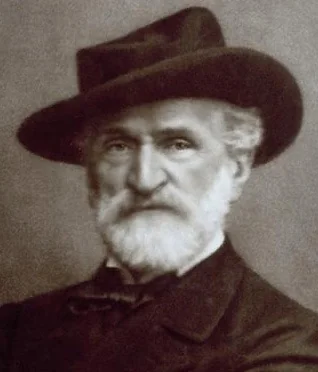
Image from Wikipedia
Image from Wikipedia
Giuseppe Verdi – Architect of Italian Opera and Eternal Voice of the Risorgimento
A Life for the Stage: How Verdi Merged Drama, Melody, and Humanity into Great Operatic Art
Giuseppe Fortunino Francesco Verdi, born on October 9 or 10, 1813 in Le Roncole near Busseto and died on January 27, 1901 in Milan, shaped 19th-century opera culture like few others as a composer of the Romantic era. His musical career spans from modest beginnings to the status of a national artist, whose presence as a conductor, artistic development as a music dramatist, and stylistic signature still define the international repertoire today. Works such as Rigoletto, Il trovatore, La traviata, Don Carlos/Don Carlo, Aida, Otello, and Falstaff, as well as the Messa da Requiem, comprise a discography that permanently influences opera and concert stages worldwide. Verdi's biography is simultaneously a cultural history of Italy: it narrates political renewal, bourgeois advancement, artistic self-assertion – and timeless melodies that still move audiences today.
Early Years and Apprenticeship: Talent, Discipline, and the Search for a Unique Voice
Verdi grew up in the Po Valley, receiving early organ lessons and already taking on musical services in the village church as a child – practical experience that shaped his later compositional techniques through solid contrapuntal work and clear sound architecture. Supported by the merchant and patron Antonio Barezzi, he studied privately in Milan with Vincenzo Lavigna after the conservatory had rejected his application. These formative years cultivated Verdi's musical expertise: he immersed himself in literature and drama theory, learned the mechanics of music theater, and practiced arranging for stage and orchestra. With Oberto (1839), he achieved a respectable success at La Scala; however, the ensuing defeat with the comic opera Un giorno di regno (1840) and personal tragedies plunged him into a crisis – a turning point after which his artistic development gained dramatic concentration and psychological depth.
The Breakthrough with Nabucco: Music as a Dramatic Idea
With Nabucco (premiered in 1842 at La Scala in Milan), Verdi conquered the operatic life of Europe. The work combines energetic choral scenes, well-defined character development, and stringent dramaturgy, where melody and rhythm propel the action forward. The famous chorus "Va, pensiero" has been interpreted – independent of the composer's concrete intentions – as a symbol of Italian longing for freedom. Verdi's stage presence as a musical theater man is exemplified here: he thought in scenes, transitions, and arcs of tension, actively shaped the libretto, and understood composition, orchestration, and vocal art as a unity of a dramatic idea. In the following years, he wrote operas at a high pace, refined his craft, and tested materials that ranged from political tableau to melodrama and psychological study.
The "trilogia popolare" and the Maturation of Dramatic Style
Rigoletto (1851), Il trovatore (1853), and La traviata (1853) mark Verdi's artistic maturity and belong to the most performed operatic literature. Rigoletto condenses a dark court world into nervously timed scenes and iconic numbers ("La donna è mobile"), while Il trovatore unfolds a nearly mythical family tragedy with motoric rhythm, cantabile line-writing, and archaic power. La traviata explores intimate emotions with chamber-music delicacy and sets new standards for psychological realism in the bel canto tradition with the character of Violetta. These works demonstrate Verdi's dramaturgical prowess: recitative, aria, ensemble, and chorus merge into organic acts, music serves as the pulse of the action, and the singing voices become vivid character voices with precise prosody.
Grand Opéra, Literature, and Political Resonance
From Paris to Naples, Verdi adapted literary sources (Schiller, Hugo, Shakespeare) and the aesthetics of French grand opéra. Don Carlos/Don Carlo (1867/revised versions) connects historical world theater with personal tragedy and expands the orchestral palette: muted colors for political intrigue, vibrant brass for religious-ceremonial tableaux, and wide-ranging cantilenas for emotional conflicts. With Simon Boccanegra (second version 1881), he perfected the art of symphonically conceived ensembles and subtle motif references, without ever transitioning into Wagnerian through-composition. Verdi's artistic development remained Italian at its core but opened up to European sound ideals – a balance that made him a key shaper of opera between bel canto tradition and realistic music drama.
Aida and the Late Monumental Style
Aida (1871) combines intimate soul drama with grand choral scenes and sophisticated orchestration. Verdi's production here displays a sovereign sound direction: exotic colors without cheap effects, clearly proportioned scene architecture, punchy brass choruses with rhythmic drive, and a string culture that remains cantabile even in the tutti. The famous triumph scene is not just a spectacle but a dramaturgical climax; the quiet finales give the work its tragic breath. Aida demonstrates how Verdi purposefully employs forms, key relationships, and thematic memories as narrative tools – a hallmark of his composer's signature in the 1870s.
Shakespeare Operas and Compositional Late Style: Otello and Falstaff
With Otello (1887) and Falstaff (1893), Verdi returned to the stage – both times with Arrigo Boito as librettist. Otello shows a dramatic condensation where motivic-thematic work, flexible scene transitions, and expressive harmony create a novel Verdi understanding of "through-composed" scenes. Falstaff, the culminating opera buffa of the 19th century, is a wonder of chamber-music transparency and rhythmic vitality: fast ensemble polyphony, speech-like declamation, sparkling woodwind colors, and a form dramaturgy that does away with the numbers form while preserving its energy. Both operas demonstrate Verdi's compositional mastery – a synthesis of melodic line, orchestral character, and dramaturgical timing.
Religious Music, Chamber Music, and Compositional Technique
Outside of opera, the Messa da Requiem (1874) stands out as a symphonic-dramatic sacred work – a score that unites choral polyphony, soloist profiles, and orchestral fury in the "Dies irae" with quiet intimacy in the "Lacrimosa." Late works such as the Quattro pezzi sacri (1898) show contrapuntal sovereignty and tonal austerity. The string quartet in E minor documents Verdi's sense of linear voice leading and harmonic economy. In production and arrangement, he remained pragmatic: he worked closely with librettists, singers, and theater management, fine-tuning prosody, establishing tonal sequences dramaturgically, and editing scores for performance reality – a professional music career at the highest organizational level.
Cultural Influence, Risorgimento, and Civic Engagement
Verdi became a symbolic figure of a culturally unified Italy. Although the interpretation of his choruses as political slogans is historically nuanced, his music served as a catalyst for national identity and civic emancipation. He engaged in public life, was politically appointed in the Kingdom of Italy, and enjoyed recognition as a modern farmer, owning land in Sant’Agata – an image of the artist taking responsibility. Particularly enduring is his foundation of the Casa di Riposo per Musicisti in Milan: a retirement home for needy musicians, which was to secure his royalties – a humanistic legacy that establishes Verdi's authority beyond the purely artistic.
Reception, Performance Tradition, and Presence
Verdi's operas form the backbone of the international repertoire – from municipal theaters to major opera houses. Critical reception highlights the dramaturgical coherence of the "trilogia popolare," the psychological subtleties in La traviata, the historical breadth of Don Carlo, and the orchestral refinement of Aida. Otello and Falstaff are regarded as pinnacles of a late classicism of form and a modern, text-close dramatic style. In recent performance practice, his works are continuously reinterpreted – between historically informed articulation, sonorous opulence, and lean transparency. Current productions, festivals, and new recordings attest to the enduring relevance of his music; documentaries and program notes also honor Verdi's cultural foundation and educational impact on new generations of performers.
Stylistic Signature: Melody, Prosody, and Dramatic Pulse
Verdi's melody is never mere embellishment but functional narrative: it encapsulates character, conflict, and situation in concise arcs. His prosody conforms to the Italian language, utilizing natural accentuation and giving figures distinctive contours. In the orchestra, he prefers clarity over density: pointed woodwinds, robust brass fanfares, and flexible string textures. Harmonically, he remains within an expanded tonal framework but employs surprising modulations and coloristic turns to mark dramatic turning points. It is precisely this balance of lyricism, structural logic, and theatrical impulse that makes his style robust for various interpretative approaches – from bel canto legato playing to dramatically sharp articulation.
Conclusion: Why Listen to – and Experience – Verdi?
Giuseppe Verdi combines melodic immediacy with dramaturgical rigor and human authenticity. His operas tell of love, power, freedom, and responsibility – themes that resonate as urgently today as they did during the Risorgimento. Those who experience his music live feel the pulse of the theater: choruses that open spaces; ensembles that heighten conflicts; arias that map soulscapes. Verdi remains intriguing because he unites grand form and vibrant presence – a composer who did not invent opera but forever shaped its face. Experience Verdi in the concert and opera house: each performance offers a new perspective on music that never ceases to tell us something today.
Official Channels of Giuseppe Verdi:
- Instagram: No official profile found
- Facebook: No official profile found
- YouTube: No official profile found
- Spotify: No official profile found
- TikTok: No official profile found
Sources:
- Wikipedia – Giuseppe Verdi
- Encyclopaedia Britannica – Giuseppe Verdi (updated February 19, 2026)
- Treccani – Verdi, Giuseppe (Biography)
- Casa di Riposo per Musicisti – Fondazione Giuseppe Verdi (Institution & Statutes)
- BR-KLASSIK – Giuseppe Verdi: Audio Biography/Chronicle
- Metropolitan Opera – Program booklet Il trovatore 2024/25
- Wikipedia – Viva Verdi! (Documentary about Casa Verdi)
- Wikipedia (EN) – Giuseppe Verdi (additional details on work and impact)
- Wikipedia: Image and text source
Upcoming Events
Nabucco
Otello - Verdi's Opera Tragedy in Bonn
Verdi: Aida – Grand Opera at the Staatstheater Kassel (INTERIM)
A Masked Ball
Matinee for: Nabucco
Verdi - La Traviata Chamber Version
Giuseppe Verdi – La Traviata in Chamber Version
Nabucco - State Theatre Cottbus Cottbus Performance 2026
Nabucco