
Gustav Mahler
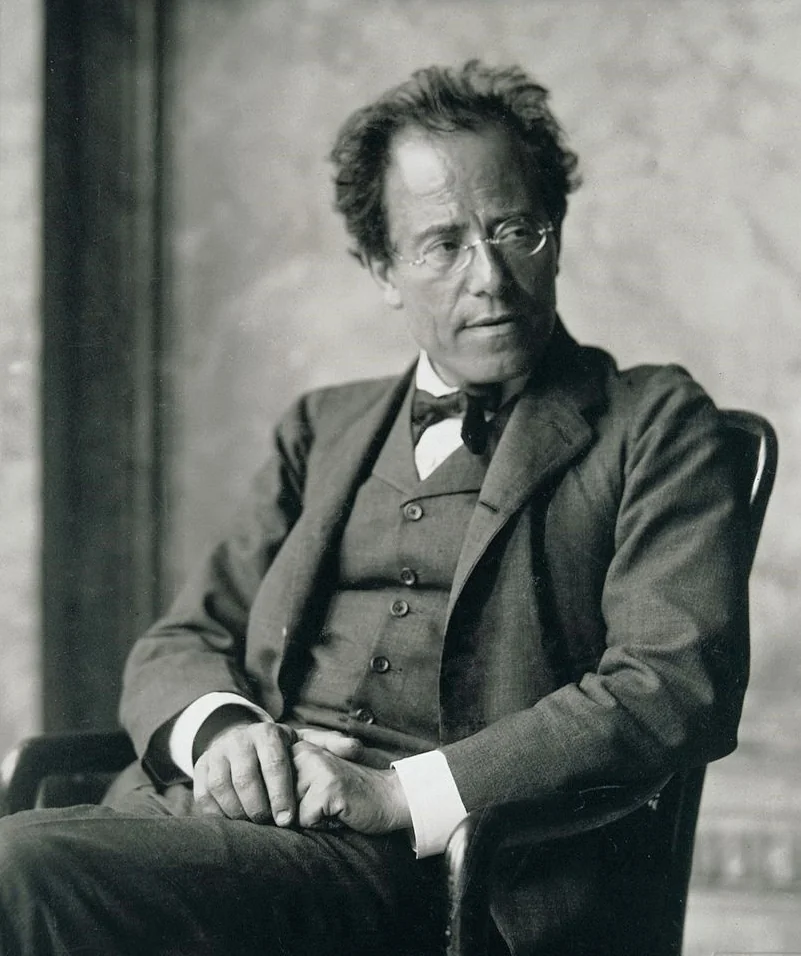
Image from Wikipedia
Image from Wikipedia
Gustav Mahler – Composer Between Late Romanticism and Modernism
The Visionary Who Transformed the Symphony Orchestra into a Whole World
Gustav Mahler was born on July 7, 1860, in the Bohemian town of Kalischt and died on May 18, 1911, in Vienna. As a composer, conductor, and opera reformer, he significantly shaped music history on the threshold of modernity. His musical career combined uncompromising artistic development with a stage presence that set standards in Hamburg, Vienna, and New York. As director of the Vienna Court Opera, he laid the foundation for a modern understanding of music theater; as chief conductor in New York, he shaped sound culture and repertoire with international resonance. His symphonies and song cycles are considered key works of late Romanticism – monuments of existential truthfulness, intellectual breadth, and orchestral innovation.
Early Years: Education, First Compositions, and the Search for a Personal Language
Growing up in a German-speaking Jewish family in Bohemia, Mahler showed exceptional musical talent from an early age. After studying at the Vienna Conservatory, he sharpened his profile as a pianist, conductor, and composer. The early works – from the cantata Das klagende Lied to the songs of a traveling journeyman – mark the seedbed of his personal style: a melodic emphasis that merges folk song tones with art song craftsmanship, and an instrumentation that contrasts intimate chamber music with eruptive orchestral color. Here, Mahler's dramatic thinking begins to emerge: music as a psychologically charged narrative, constructed from motifs, intermediates, and shimmering soundscapes.
Breakthrough as a Conductor: Hamburg as the Reformer’s Rehearsal Stage
In the 1890s, Mahler established his reputation in Hamburg as an energetic, detail-oriented orchestra leader. His rehearsal work focused on textual fidelity, clarity of voice leading, and dramatic truthfulness. This expertise not only shaped interpretive history and performance practice, but also honed his compositional thinking: his sense of form dramaturgy, thematic connections, and expansive tension arcs grew out of daily work with the repertoire. The years in Hamburg paved his way to the Court Opera in Vienna – a center where tradition, audience expectations, and artistic ambition collided.
Vienna Court Opera 1897–1907: Era of Reforms and Friction
At 36, Mahler took over the Vienna Court Opera and shaped it into a guiding star of European music theater. He emphasized ensemble discipline, stylistic unity, precise direction, and demanding casts. For him, repertoire maintenance meant not just preservation but updating: finely rehearsed tempos, meticulous phrasing, renewed staging – a holistic aesthetic that fused music, stage, and light into an organic unity. Cultural resistance, anti-Semitism, and internal institutional conflicts accompanied his success. Nevertheless, the Mahler era belongs to the most brilliant chapters in the history of Vienna opera; his work created a model for conducting authority and artistic responsibility in opera management.
New York 1908–1911: International Sound and the Late Style
Mahler shifted his focus in his final years to New York, where he conducted the Metropolitan Opera and led the New York Philharmonic as music director from 1909 to 1911. His programs combined classical repertoire with contemporary profiles; his energetic approach shaped sound balance and articulation on an international level. New York also became a resonance chamber for his last major works: Das Lied von der Erde, the Ninth Symphony, and the unfinished Tenth, in which farewell, transcendence, and formal experimentation condensed into a distinctive musical language. The late scores breathe orchestral asceticism and unheard transparency – a farewell to monumental gestures in favor of metaphysical luminosity.
Overview of Works: Symphony, Song, and the Art of Motivic Distillation
Mahler's discography in terms of his works ranges from Symphony No. 1 to No. 9, as well as the fragmentary Tenth; at the center are also Das Lied von der Erde, the song cycles Des Knaben Wunderhorn, Kindertotenlieder, and Rückert-Lieder. His symphonic output expands the genre through choral usage, quotation and collage techniques, remote orchestras, varying chamber groups in tutti, and topoi of marches and waltzes as well as radical dynamic trajectories. The Second, Resurrection Symphony, spans the arc from funeral march to visionary choral fugue; the Eighth, the "Symphony of a Thousand," reimagines vocal and symphonic forces; the Ninth dissolves the symphonic conclusion into glowing adagio. In the songs, Mahler transforms the closeness of folk songs into symphonic intimacy: orchestrated poetry, where text interpretation, vocal line, and instrumental color find a subtle balance.
Style, Composition, and Production: From Symphonic World Conceptions to Text-Related Sound Direction
From a professional perspective, Mahler marks an interface between late Romantic harmony, extended tonality, and echoes of modality. His compositional technique emphasizes variation rather than repetition, organically developing themes from germ motifs and linking movements cyclically. The orchestration oscillates between bright highlights and shadowy tones: harp and woodwind colors, layered brass choirs, percussion as semantic markers. Arranged quotes – from chorales to street music – act as semantic signals and ironic breakages. For production in the performance sense, this means: clear vocal relationships, articulatory precision, elastic tempo relations, and carefully graduated dynamics, so that narrative tensions become audible.
Cultural Influence and Reception: From the Conductor's Aesthetics to Modernity
Mahler influenced generations of composers, conductors, and orchestras. His symphonic dramaturgy foreshadowed modernity – from the psychology of soundscapes to the thinking in breaks and fractures. His conducting aesthetics established rehearsal culture as an interpretational laboratory. After initial skepticism, his music firmly established itself in the repertoire of the 20th century; the reception was deepened by benchmark cycles, critical complete editions, and the work of societies and foundations. Museums, scholarly, and digital archives preserve manuscripts, program notes, and conducting materials – a foundation on which research, performance practice, and editions remain interconnected.
Discography and Sound Legacy: From Early Sound Documents to Reference Cycles
The discographic history of Mahler's interpretation reflects changing sound ideals: from romantically saturated readings to structurally transparent interpretations to the chamber music-focused approaches of the present. Benchmarks are complete symphony cycles by renowned orchestras and conductors, supplemented by specific references – especially for the vocal-symphonic works. Label portraits, thematic focus on works, and curated editions today offer a wide range of editorial perspectives, from original score fidelity to historically informed readings of modern grand apparatuses.
Current Projects, Festivals, and Editions: Experiencing Mahler Today
Even more than a century after his death, Mahler remains present: large concert series, festivals, and thematic focuses are dedicated to his symphonies and songs. International orchestras present works – such as coupled performances of intermediate and late symphonies – and connect these with mediation formats. Forums and foundations promote new compositions in the context of Mahler, while critical editions and research projects deepen the source situation. Thus, engagement with Mahler remains not museum-like, but a vibrant cultural practice in dialogue between stage, scholarship, and audience.
Key Biographical Milestones in Brief: Experience Condensed
— 1860 Birth in Kalischt; education in Vienna. — 1891–1897 Hamburg: Profiling as opera and concert conductor. — 1897–1907 Vienna: Director of the Court Opera, reforms in repertoire, style, and staging. — 1908–1911 New York: Leading roles at the Metropolitan Opera and New York Philharmonic. — 1911 Death in Vienna. These milestones outline an artist who derived his artistic development from the practice of conducting and consolidated it in a unique language of composition.
Positioning and Impact: Expertise from a Music History Perspective
Historically, Mahler stands in a tradition that traces Beethoven, Berlioz, and Wagner into modernity: expansion of the symphonic form concept, integration of the songful, dramatization through choral interventions and dramatic figures in purely instrumental movements. His music anticipates aesthetic phenomena of the 20th century – fragment, collage, existential themes – and continues to present interpreters with productive challenges of balancing structure and expression. The high editorial standard of modern editions strengthens the reliability of today's readings, while archives secure the traces of interpretive traditions.
Reception and Criticism: Authority in the Mirror of Press and Institutions
The music press has emphasized for decades the emotional depth, orchestral inventiveness, and formal boldness of Mahler's scores. Institutions, foundations, and opera houses document his work as a conductor and reformer: the Vienna State Opera as a central place of activity, large orchestras as custodians of his symphonic cosmos. Competitions, awards, and curated program focuses show how strongly Mahler's work serves as a reference frame for contemporary composers. This connection of historical significance and current practice solidifies the authority of his oeuvre in the musical landscape.
Conclusion: Why Gustav Mahler Touches Us Today – and Overwhelms Live
Mahler's music poses the great questions of mortality, hope, nature, irony, and redemption – and it does so with a sound language that oscillates between intimacy and cathedral. His symphonies are world designs, his songs soul landscapes. Those who experience Mahler live feel the existential tension of his dramaturgy: the long breathing of the lines, the shock moments of the tutti, the silence after the sound fades. Thus, Mahler remains an event – not just a historical figure, but a contemporary experience that simultaneously demands heart, mind, and ear.
Official Channels of Gustav Mahler:
- Instagram: No official profile found
- Facebook: No official profile found
- YouTube: No official profile found
- Spotify: No official profile found
- TikTok: No official profile found
Sources:
- Wikipedia – Gustav Mahler
- Encyclopaedia Britannica – Gustav Mahler
- Deutsche Grammophon – Gustav Mahler: Biography
- International Gustav Mahler Society – Official Website
- Mahler Foundation – Official Foundation
- Vienna State Opera – Performance Archive: Gustav Mahler
- New York Philharmonic – Digital Archives
- LeMO – Living Museum Online: Biography Gustav Mahler
- House of Music Vienna – Biography Gustav Mahler
- Elbphilharmonie – International Music Festival Hamburg 2025 (Mahler Focus)
- Mahler Forum – Programme
- Wikipedia: Image and text source
Upcoming Events
Mahler II - Resurrection Symphony
Friday Concert № 1
Symphony Concert: Mahler - Symphony No. 5
Zodiac: Mahler 3
Zodiac Signs: Mahler 3
Zodiac Sign: Mahler 3
Song of the Night
2nd Academy Concert
Mainz Master Concerts - Mahler Monumental!