
Regensburg
Arnulfspl., 93047 Regensburg, Germany
Arnulfsplatz | Parking & Underground Garage
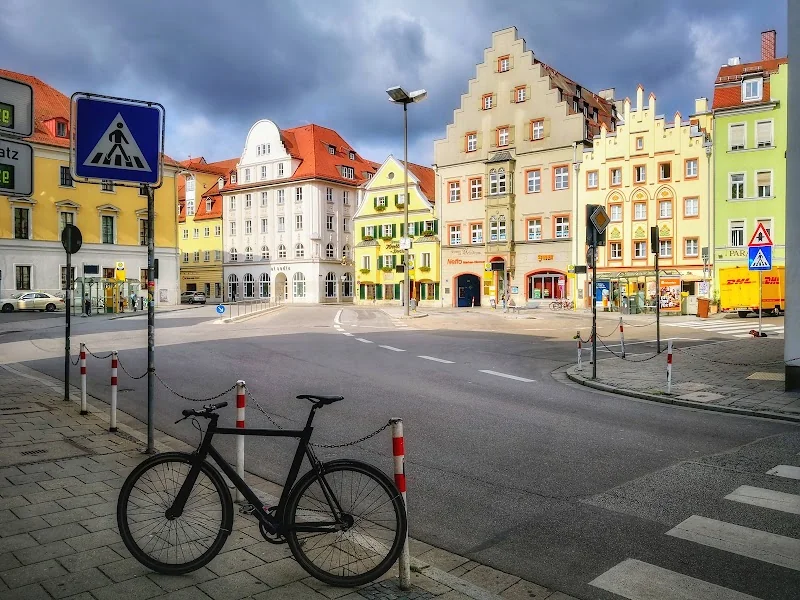
The Arnulfsplatz is one of those places in Regensburg where the old town, traffic, and everyday life overlap in a small space. Those looking for the square will find themselves in the middle of the western old town, near Bismarckplatz and the theater, at a point that the city itself describes as a hub of inner-city public transport. For visitors, this is convenient because pedestrian paths, bus lines, and the underground garage converge directly here. At the same time, there is much more behind the square than just arrival and departure: The surroundings are characterized by listed buildings, in which the history of the Regensburg old town can be read over centuries. This mix makes the Arnulfsplatz a place that one does not just pass through but consciously perceives - as a transition between mobility, urban history, and urban density. The address and coordinates provided by the city make orientation additionally easy: Arnulfsplatz 2 in 93047 Regensburg. ([regensburg.de](https://www.regensburg.de/leben/agenda-2030/nachhaltigkeitspfad-regensburg/station-9))
Parking at Arnulfsplatz: Underground Garage, Rates, and Environmental Zone
The official underground garage Arnulfsplatz is located at Arnulfsplatz 4A and is the most important answer to inquiries about parking at Arnulfsplatz, Arnulfsplatz parking garage, and Arnulfsplatz underground garage. The city mentions a 24-hour opening and an unlimited parking duration, which makes the location particularly flexible for day visits, evening appointments, and longer stays in the city center. Regarding the rates, the city distinguishes between day and night: During the day, from 7:00 AM to 7:00 PM, a price of 0.90 euros per 30 minutes applies, and from 10 hours to 24 hours, a flat rate of 18.00 euros is charged. At night, parking from 7:00 PM to 7:00 AM costs 8.00 euros. Additionally, there is a theater ticket from 6:30 PM to 11:00 PM for 5.00 euros, and a fee of 25.00 euros is charged for the loss of the parking ticket. It is also important for entry that the underground garage is located in the environmental zone of the city of Regensburg and may therefore only be accessed with a green particulate matter sticker. These details show why Arnulfsplatz is so often sought after as a practical city center address: It combines a central location with clear, well-planned parking conditions. ([regensburg.de](https://www.regensburg.de/leben/verkehr-u-mobilitaet/parken/tiefgarage-arnulfsplatz))
In practice, this means: Those arriving by car will find a central, city-center solution at Arnulfsplatz for theater, gastronomy, appointments in the old town, and short distances towards Bismarckplatz. The city explicitly refers to the parking guidance system and parking garages in the vicinity of the square; for example, the singing and music school recommends following the parking guidance system to the Arnulfsplatz and Bismarckplatz parking garages. The city's planning documents also keep the square explicitly relevant as a development site for individual traffic. Thus, Arnulfsplatz is not just an address but a building block of old town logistics: Those who want to arrive quickly and as directly as possible in the western center of the city benefit from the combination of underground garage, short pedestrian paths, and good signage. This is a real advantage, especially for visitors who do not want to limit their stay to a single building but wish to connect multiple destinations in the old town. ([regensburg.de](https://www.regensburg.de/leben/verkehr-u-mobilitaet/parken/tiefgarage-arnulfsplatz))
Access, Bus Lines, and Orientation in the Old Town
In public transport, Arnulfsplatz also plays a remarkably large role. The city describes it as a hub of inner-city public transport; electric buses from the old town line also stop at the station. The singing and music school mentions the stops Arnulfsplatz and Bismarckplatz and lists lines 1, 2, 4, 6, 11, 13, 17, as well as the old town bus for this area. So, anyone searching for Arnulfsplatz regensburg maps or for the simplest access will quickly realize: This place is not a peripheral location but a real hub between pedestrian paths, bus networks, and city center traffic. The location is also so dense that even short stays become easy to plan. Those coming from the western old town reach the square directly; those arriving by bus only need to walk a few steps towards the theater or Bismarckplatz. For an inner-city square, this is a remarkably comfortable interplay of public transport and a short remaining distance on foot. ([regensburg.de](https://www.regensburg.de/leben/agenda-2030/nachhaltigkeitspfad-regensburg/station-9))
Orientation is additionally easy because Arnulfsplatz is located near the theater and Bismarckplatz. The city of Regensburg regularly organizes tours there, with the meeting point at Arnulfsplatz in front of the theater, confirming the square as a well-known starting point in the urban structure. This is helpful for visitors because the square is thus not only a transport hub but also a reliable meeting point for city walks, cultural appointments, and explorations of the old town. Especially in the vicinity of the theater, the paths quickly become manageable: from the stop to the venue, from the underground garage to the evening appointment, or from the square further into the western old town. Therefore, those visiting Arnulfsplatz experience a very typical Regensburg city situation: historical surroundings, dense traffic network, and a high number of destinations that can be reached within a few minutes on foot. This mix explains why searches for Arnulfsplatz regensburg maps, Arnulfsplatz regensburg parking garage, or Arnulfsplatz parking lead so frequently to the same information space. ([regensburg.de](https://www.regensburg.de/veranstaltungen/detail/591406?utm_source=openai))
Arnulfsplatz 2 to 7: House Numbers, Monuments, and Usage
Around Arnulfsplatz, house numbers 2 to 4 show how closely history and present lie side by side here. Arnulfsplatz 2 is described in the monument database as a gabled house with Gothic substance, rebuilt in 1679, with a portal featuring a coat of arms around 1730 and a facade from the second half of the 19th century. This mix already makes it clear that the square is not a modern functional space but a grown urban space with several layers of time. Arnulfsplatz 3 is connected with the Kneitinger brewery; the city's monument information mentions a four-winged building group around a courtyard and a gabled front house from the 17th century with multiple renovations from the 18th to the 20th century. That gastronomy and urban culture still come together there fits a place that has historically always been an economic and meeting space. Therefore, Arnulfsplatz does not appear isolated but rather as a small-scale ensemble where living, working, and going out overlap in a small space. ([regensburg.de](https://www.regensburg.de/welterbe/welterbe-regensburg/1000-denkmaeler/51938/arnulfsplatz-2.html))
Arnulfsplatz 4 is also rich in building substance: The city describes it as a residential and commercial building with a large stepped gable and middle bay, with a cellar from around 1100, building substance from the 16th century, Renaissance vaults, a renovation around 1800, neo-Gothic facade design from 1896, and a purification in 1929. Arnulfsplatz 5 is classified as a residential and commercial building from the 18th century, which was expanded in 1872 and after 1950 and has a facade division in historicizing forms. These two house numbers show how strongly Arnulfsplatz is shaped by renovation history: not a single building ideal dominates, but a series of adaptations, extensions, and stylistic changes. For visitors, this results in a very authentic city image that is neither museum-like nor arbitrary. Especially the visible traces of medieval core, early modern expansion, and later facade design make the square a readable piece of Regensburg. Those passing by do not just see house numbers but stages of development of an old town that has constantly changed yet preserved its character. ([regensburg.de](https://www.regensburg.de/suche/16/21?utm_source=openai))
This density becomes even more evident at Arnulfsplatz 6 and 7. Arnulfsplatz 6 was once the Emslander brewery and is now a residential and commercial building; the city mentions a core building from around 1200, an expansion in the 19th century to a three-story house, and a fourth floor from 1899 or 1949. Arnulfsplatz 7, in turn, is a three-part building group with a residential and commercial building from the 14th century, Gothic vaults, a renovation from 1796, remnants of a Romanesque tower building, and a Romanesque residential building at the corner from the 11th to 13th century; later, the complex even served as a backdrop and props house for the city theater. These two buildings clearly illustrate how closely everyday use, theater history, and architectural history are intertwined at Arnulfsplatz. Those who perceive the square only as a parking lot or bus stop overlook one of the most interesting historical building lines of the western old town. House numbers 6 and 7 are not footnotes but central evidence that Arnulfsplatz is more than just a traffic area. ([regensburg.de](https://www.regensburg.de/welterbe/welterbe-regensburg/1000-denkmaeler/51943/arnulfsplatz-6.html?utm_source=openai))
History and Significance of Arnulfsplatz in Regensburg
Historically, Arnulfsplatz represents the great depth layer of Regensburg. The city refers to Roman traces that are still visible today in the context of the World Heritage and explicitly mentions the remains of a Roman underfloor heating system in the basement of the velodrome at Arnulfsplatz. This detail is more than just an archaeological footnote: It shows that the place did not only emerge in the Middle Ages or modern times but is embedded in an urban space whose history dates back to Roman times. Therefore, standing at Arnulfsplatz means moving to a place where the layers of the city overlap. The Roman remains in the velodrome connect with the medieval and modern buildings at the square to create a dense historical image that is particularly typical in Regensburg. Especially since the city was included in the UNESCO Danube Limes in 2021, this reference on-site feels even more tangible: Arnulfsplatz is not just an inner-city square but part of a much older historical continuum. ([regensburg.de](https://www.regensburg.de/regensburg-507/sehenswert/welterbe-donaulimes))
Additionally, the significance of the square for modern urban development comes into play. The city's planning documents designate Arnulfsplatz as the most important stop of public transport in the western old town and as a connection point for many bus lines; at the same time, the access function for individual traffic with the underground garage remains. In another urban usage concept, the area of Arnulfsplatz and Ludwigstraße is described as very well accessible, both by public transport and by car. This makes it understandable why the square, despite its historical surroundings, is repeatedly the subject of traffic and urban design questions: It is not only part of the backdrop but part of the infrastructure. Arnulfsplatz symbolically represents the way Regensburg organizes its old town - dense, mixed-use, and oriented towards short distances. This function also explains why so many search queries around the square involve parking, underground garage, parking garage, and maps. ([regensburg.de](https://www.regensburg.de/fm/121/werkbericht_planungs_baureferat_2007.pdf))
Urbanistically, Arnulfsplatz also marks an important edge. The city perceives the central old town as a space that extends westward to Arnulfsplatz. At the same time, events and tours show that the square serves as a meeting point and starting point for explorations of the southwestern old town. For the perception on-site, this means: Arnulfsplatz is neither a closed courtyard nor just a transit area but an open piece of city where living, traffic, culture, gastronomy, and monument preservation meet. Exactly this complexity makes it so interesting for visitors - and so search-strong for queries. Those passing by experience an old town at one of its most functional spots without losing the historical character. The square is thus a good example of how Regensburg not only preserves its heritage but also continues to use it in everyday life. ([regensburg.de](https://www.regensburg.de/integriertes-nutzungskonzept))
Arnulfsplatz for Visitors: Theater, Old Town, and Practical Tips
Those searching for Arnulfsplatz on a map should distinguish between two points: Arnulfsplatz 2 as the orientation point of the square and Arnulfsplatz 4A as the address of the underground garage. For those parking, the combination of 24-hour operation, unlimited parking duration, and theater ticket is particularly practical. For public transport users, the stops Arnulfsplatz and Bismarckplatz are the most important anchor points. This means in everyday practice: First define the destination, then choose the appropriate access, and then use the few minutes on foot in the old town. This short and clear logic makes the square so attractive for people switching between appointments, evening events, and city center visits. The immediate proximity to the theater and cultural institutions is also relevant, as the city repeatedly uses Arnulfsplatz as a meeting point for tours and cultural offerings. The result is a place that is functional in the best sense: easy to find, easy to reach, and still located in a historically rich environment. ([regensburg.de](https://www.regensburg.de/leben/verkehr-u-mobilitaet/parken/tiefgarage-arnulfsplatz))
When it comes to evening stays, the underground garage with the theater ticket is particularly interesting; during the day, the central location and proximity to many old town destinations speak for short distances on foot. For longer visits, it is also worth noting that the old town in this area is much more than a shopping zone: it is a place of residence, a workplace, a cultural space, and a historical ensemble at the same time. This makes Arnulfsplatz a very typical but by no means ordinary Regensburg place. Those arriving there land right in a piece of the city that tells a lot about Regensburg in a small space. Whether someone is searching for Arnulfsplatz regensburg, Arnulfsplatz parking, Arnulfsplatz underground garage regensburg, or Arnulfsplatz 4, 5, 6, and 7 - the search intentions converge here at a place where mobility and history truly belong together. This also explains why Arnulfsplatz is as useful as it is interesting for visitors: It is simultaneously access, orientation point, and part of the city experience. ([regensburg.de](https://www.regensburg.de/leben/verkehr-u-mobilitaet/parken/tiefgarage-arnulfsplatz))
Sources:
- City of Regensburg - Underground Garage Arnulfsplatz ([regensburg.de](https://www.regensburg.de/leben/verkehr-u-mobilitaet/parken/tiefgarage-arnulfsplatz))
- City of Regensburg - Sustainability Path Regensburg - Station 9: Arnulfsplatz ([regensburg.de](https://www.regensburg.de/leben/agenda-2030/nachhaltigkeitspfad-regensburg/station-9))
- City of Regensburg - Singing and Music School - Access ([regensburg.de](https://www.regensburg.de/singundmusikschule/anfahrt))
- City of Regensburg - UNESCO World Heritage Danube Limes ([regensburg.de](https://www.regensburg.de/regensburg-507/sehenswert/welterbe-donaulimes))
- City of Regensburg - 1000 Monuments: Arnulfsplatz 2 ([regensburg.de](https://www.regensburg.de/welterbe/welterbe-regensburg/1000-denkmaeler/51938/arnulfsplatz-2.html))
- City of Regensburg - Day of Open Monuments 2025 ([regensburg.de](https://www.regensburg.de/rathaus/aemteruebersicht/kulturreferat/amt-fuer-kulturelles-erbe/tag-des-offenen-denkmals-2025?utm_source=openai))
- City of Regensburg - Search on regensburg.de (Arnulfsplatz 4) ([regensburg.de](https://www.regensburg.de/suche/4/12?utm_source=openai))
- City of Regensburg - Search on regensburg.de (Arnulfsplatz 5) ([regensburg.de](https://www.regensburg.de/suche/5/11?utm_source=openai))
- City of Regensburg - 1000 Monuments: Arnulfsplatz 6 ([regensburg.de](https://www.regensburg.de/welterbe/welterbe-regensburg/1000-denkmaeler/51943/arnulfsplatz-6.html?utm_source=openai))
- City of Regensburg - 1000 Monuments: Arnulfsplatz 7 ([regensburg.de](https://www.regensburg.de/welterbe/welterbe-regensburg/1000-denkmaeler/51944/arnulfsplatz-7.html?utm_source=openai))
Mehr anzeigenWeniger anzeigen
Arnulfsplatz | Parking & Underground Garage
The Arnulfsplatz is one of those places in Regensburg where the old town, traffic, and everyday life overlap in a small space. Those looking for the square will find themselves in the middle of the western old town, near Bismarckplatz and the theater, at a point that the city itself describes as a hub of inner-city public transport. For visitors, this is convenient because pedestrian paths, bus lines, and the underground garage converge directly here. At the same time, there is much more behind the square than just arrival and departure: The surroundings are characterized by listed buildings, in which the history of the Regensburg old town can be read over centuries. This mix makes the Arnulfsplatz a place that one does not just pass through but consciously perceives - as a transition between mobility, urban history, and urban density. The address and coordinates provided by the city make orientation additionally easy: Arnulfsplatz 2 in 93047 Regensburg. ([regensburg.de](https://www.regensburg.de/leben/agenda-2030/nachhaltigkeitspfad-regensburg/station-9))
Parking at Arnulfsplatz: Underground Garage, Rates, and Environmental Zone
The official underground garage Arnulfsplatz is located at Arnulfsplatz 4A and is the most important answer to inquiries about parking at Arnulfsplatz, Arnulfsplatz parking garage, and Arnulfsplatz underground garage. The city mentions a 24-hour opening and an unlimited parking duration, which makes the location particularly flexible for day visits, evening appointments, and longer stays in the city center. Regarding the rates, the city distinguishes between day and night: During the day, from 7:00 AM to 7:00 PM, a price of 0.90 euros per 30 minutes applies, and from 10 hours to 24 hours, a flat rate of 18.00 euros is charged. At night, parking from 7:00 PM to 7:00 AM costs 8.00 euros. Additionally, there is a theater ticket from 6:30 PM to 11:00 PM for 5.00 euros, and a fee of 25.00 euros is charged for the loss of the parking ticket. It is also important for entry that the underground garage is located in the environmental zone of the city of Regensburg and may therefore only be accessed with a green particulate matter sticker. These details show why Arnulfsplatz is so often sought after as a practical city center address: It combines a central location with clear, well-planned parking conditions. ([regensburg.de](https://www.regensburg.de/leben/verkehr-u-mobilitaet/parken/tiefgarage-arnulfsplatz))
In practice, this means: Those arriving by car will find a central, city-center solution at Arnulfsplatz for theater, gastronomy, appointments in the old town, and short distances towards Bismarckplatz. The city explicitly refers to the parking guidance system and parking garages in the vicinity of the square; for example, the singing and music school recommends following the parking guidance system to the Arnulfsplatz and Bismarckplatz parking garages. The city's planning documents also keep the square explicitly relevant as a development site for individual traffic. Thus, Arnulfsplatz is not just an address but a building block of old town logistics: Those who want to arrive quickly and as directly as possible in the western center of the city benefit from the combination of underground garage, short pedestrian paths, and good signage. This is a real advantage, especially for visitors who do not want to limit their stay to a single building but wish to connect multiple destinations in the old town. ([regensburg.de](https://www.regensburg.de/leben/verkehr-u-mobilitaet/parken/tiefgarage-arnulfsplatz))
Access, Bus Lines, and Orientation in the Old Town
In public transport, Arnulfsplatz also plays a remarkably large role. The city describes it as a hub of inner-city public transport; electric buses from the old town line also stop at the station. The singing and music school mentions the stops Arnulfsplatz and Bismarckplatz and lists lines 1, 2, 4, 6, 11, 13, 17, as well as the old town bus for this area. So, anyone searching for Arnulfsplatz regensburg maps or for the simplest access will quickly realize: This place is not a peripheral location but a real hub between pedestrian paths, bus networks, and city center traffic. The location is also so dense that even short stays become easy to plan. Those coming from the western old town reach the square directly; those arriving by bus only need to walk a few steps towards the theater or Bismarckplatz. For an inner-city square, this is a remarkably comfortable interplay of public transport and a short remaining distance on foot. ([regensburg.de](https://www.regensburg.de/leben/agenda-2030/nachhaltigkeitspfad-regensburg/station-9))
Orientation is additionally easy because Arnulfsplatz is located near the theater and Bismarckplatz. The city of Regensburg regularly organizes tours there, with the meeting point at Arnulfsplatz in front of the theater, confirming the square as a well-known starting point in the urban structure. This is helpful for visitors because the square is thus not only a transport hub but also a reliable meeting point for city walks, cultural appointments, and explorations of the old town. Especially in the vicinity of the theater, the paths quickly become manageable: from the stop to the venue, from the underground garage to the evening appointment, or from the square further into the western old town. Therefore, those visiting Arnulfsplatz experience a very typical Regensburg city situation: historical surroundings, dense traffic network, and a high number of destinations that can be reached within a few minutes on foot. This mix explains why searches for Arnulfsplatz regensburg maps, Arnulfsplatz regensburg parking garage, or Arnulfsplatz parking lead so frequently to the same information space. ([regensburg.de](https://www.regensburg.de/veranstaltungen/detail/591406?utm_source=openai))
Arnulfsplatz 2 to 7: House Numbers, Monuments, and Usage
Around Arnulfsplatz, house numbers 2 to 4 show how closely history and present lie side by side here. Arnulfsplatz 2 is described in the monument database as a gabled house with Gothic substance, rebuilt in 1679, with a portal featuring a coat of arms around 1730 and a facade from the second half of the 19th century. This mix already makes it clear that the square is not a modern functional space but a grown urban space with several layers of time. Arnulfsplatz 3 is connected with the Kneitinger brewery; the city's monument information mentions a four-winged building group around a courtyard and a gabled front house from the 17th century with multiple renovations from the 18th to the 20th century. That gastronomy and urban culture still come together there fits a place that has historically always been an economic and meeting space. Therefore, Arnulfsplatz does not appear isolated but rather as a small-scale ensemble where living, working, and going out overlap in a small space. ([regensburg.de](https://www.regensburg.de/welterbe/welterbe-regensburg/1000-denkmaeler/51938/arnulfsplatz-2.html))
Arnulfsplatz 4 is also rich in building substance: The city describes it as a residential and commercial building with a large stepped gable and middle bay, with a cellar from around 1100, building substance from the 16th century, Renaissance vaults, a renovation around 1800, neo-Gothic facade design from 1896, and a purification in 1929. Arnulfsplatz 5 is classified as a residential and commercial building from the 18th century, which was expanded in 1872 and after 1950 and has a facade division in historicizing forms. These two house numbers show how strongly Arnulfsplatz is shaped by renovation history: not a single building ideal dominates, but a series of adaptations, extensions, and stylistic changes. For visitors, this results in a very authentic city image that is neither museum-like nor arbitrary. Especially the visible traces of medieval core, early modern expansion, and later facade design make the square a readable piece of Regensburg. Those passing by do not just see house numbers but stages of development of an old town that has constantly changed yet preserved its character. ([regensburg.de](https://www.regensburg.de/suche/16/21?utm_source=openai))
This density becomes even more evident at Arnulfsplatz 6 and 7. Arnulfsplatz 6 was once the Emslander brewery and is now a residential and commercial building; the city mentions a core building from around 1200, an expansion in the 19th century to a three-story house, and a fourth floor from 1899 or 1949. Arnulfsplatz 7, in turn, is a three-part building group with a residential and commercial building from the 14th century, Gothic vaults, a renovation from 1796, remnants of a Romanesque tower building, and a Romanesque residential building at the corner from the 11th to 13th century; later, the complex even served as a backdrop and props house for the city theater. These two buildings clearly illustrate how closely everyday use, theater history, and architectural history are intertwined at Arnulfsplatz. Those who perceive the square only as a parking lot or bus stop overlook one of the most interesting historical building lines of the western old town. House numbers 6 and 7 are not footnotes but central evidence that Arnulfsplatz is more than just a traffic area. ([regensburg.de](https://www.regensburg.de/welterbe/welterbe-regensburg/1000-denkmaeler/51943/arnulfsplatz-6.html?utm_source=openai))
History and Significance of Arnulfsplatz in Regensburg
Historically, Arnulfsplatz represents the great depth layer of Regensburg. The city refers to Roman traces that are still visible today in the context of the World Heritage and explicitly mentions the remains of a Roman underfloor heating system in the basement of the velodrome at Arnulfsplatz. This detail is more than just an archaeological footnote: It shows that the place did not only emerge in the Middle Ages or modern times but is embedded in an urban space whose history dates back to Roman times. Therefore, standing at Arnulfsplatz means moving to a place where the layers of the city overlap. The Roman remains in the velodrome connect with the medieval and modern buildings at the square to create a dense historical image that is particularly typical in Regensburg. Especially since the city was included in the UNESCO Danube Limes in 2021, this reference on-site feels even more tangible: Arnulfsplatz is not just an inner-city square but part of a much older historical continuum. ([regensburg.de](https://www.regensburg.de/regensburg-507/sehenswert/welterbe-donaulimes))
Additionally, the significance of the square for modern urban development comes into play. The city's planning documents designate Arnulfsplatz as the most important stop of public transport in the western old town and as a connection point for many bus lines; at the same time, the access function for individual traffic with the underground garage remains. In another urban usage concept, the area of Arnulfsplatz and Ludwigstraße is described as very well accessible, both by public transport and by car. This makes it understandable why the square, despite its historical surroundings, is repeatedly the subject of traffic and urban design questions: It is not only part of the backdrop but part of the infrastructure. Arnulfsplatz symbolically represents the way Regensburg organizes its old town - dense, mixed-use, and oriented towards short distances. This function also explains why so many search queries around the square involve parking, underground garage, parking garage, and maps. ([regensburg.de](https://www.regensburg.de/fm/121/werkbericht_planungs_baureferat_2007.pdf))
Urbanistically, Arnulfsplatz also marks an important edge. The city perceives the central old town as a space that extends westward to Arnulfsplatz. At the same time, events and tours show that the square serves as a meeting point and starting point for explorations of the southwestern old town. For the perception on-site, this means: Arnulfsplatz is neither a closed courtyard nor just a transit area but an open piece of city where living, traffic, culture, gastronomy, and monument preservation meet. Exactly this complexity makes it so interesting for visitors - and so search-strong for queries. Those passing by experience an old town at one of its most functional spots without losing the historical character. The square is thus a good example of how Regensburg not only preserves its heritage but also continues to use it in everyday life. ([regensburg.de](https://www.regensburg.de/integriertes-nutzungskonzept))
Arnulfsplatz for Visitors: Theater, Old Town, and Practical Tips
Those searching for Arnulfsplatz on a map should distinguish between two points: Arnulfsplatz 2 as the orientation point of the square and Arnulfsplatz 4A as the address of the underground garage. For those parking, the combination of 24-hour operation, unlimited parking duration, and theater ticket is particularly practical. For public transport users, the stops Arnulfsplatz and Bismarckplatz are the most important anchor points. This means in everyday practice: First define the destination, then choose the appropriate access, and then use the few minutes on foot in the old town. This short and clear logic makes the square so attractive for people switching between appointments, evening events, and city center visits. The immediate proximity to the theater and cultural institutions is also relevant, as the city repeatedly uses Arnulfsplatz as a meeting point for tours and cultural offerings. The result is a place that is functional in the best sense: easy to find, easy to reach, and still located in a historically rich environment. ([regensburg.de](https://www.regensburg.de/leben/verkehr-u-mobilitaet/parken/tiefgarage-arnulfsplatz))
When it comes to evening stays, the underground garage with the theater ticket is particularly interesting; during the day, the central location and proximity to many old town destinations speak for short distances on foot. For longer visits, it is also worth noting that the old town in this area is much more than a shopping zone: it is a place of residence, a workplace, a cultural space, and a historical ensemble at the same time. This makes Arnulfsplatz a very typical but by no means ordinary Regensburg place. Those arriving there land right in a piece of the city that tells a lot about Regensburg in a small space. Whether someone is searching for Arnulfsplatz regensburg, Arnulfsplatz parking, Arnulfsplatz underground garage regensburg, or Arnulfsplatz 4, 5, 6, and 7 - the search intentions converge here at a place where mobility and history truly belong together. This also explains why Arnulfsplatz is as useful as it is interesting for visitors: It is simultaneously access, orientation point, and part of the city experience. ([regensburg.de](https://www.regensburg.de/leben/verkehr-u-mobilitaet/parken/tiefgarage-arnulfsplatz))
Sources:
- City of Regensburg - Underground Garage Arnulfsplatz ([regensburg.de](https://www.regensburg.de/leben/verkehr-u-mobilitaet/parken/tiefgarage-arnulfsplatz))
- City of Regensburg - Sustainability Path Regensburg - Station 9: Arnulfsplatz ([regensburg.de](https://www.regensburg.de/leben/agenda-2030/nachhaltigkeitspfad-regensburg/station-9))
- City of Regensburg - Singing and Music School - Access ([regensburg.de](https://www.regensburg.de/singundmusikschule/anfahrt))
- City of Regensburg - UNESCO World Heritage Danube Limes ([regensburg.de](https://www.regensburg.de/regensburg-507/sehenswert/welterbe-donaulimes))
- City of Regensburg - 1000 Monuments: Arnulfsplatz 2 ([regensburg.de](https://www.regensburg.de/welterbe/welterbe-regensburg/1000-denkmaeler/51938/arnulfsplatz-2.html))
- City of Regensburg - Day of Open Monuments 2025 ([regensburg.de](https://www.regensburg.de/rathaus/aemteruebersicht/kulturreferat/amt-fuer-kulturelles-erbe/tag-des-offenen-denkmals-2025?utm_source=openai))
- City of Regensburg - Search on regensburg.de (Arnulfsplatz 4) ([regensburg.de](https://www.regensburg.de/suche/4/12?utm_source=openai))
- City of Regensburg - Search on regensburg.de (Arnulfsplatz 5) ([regensburg.de](https://www.regensburg.de/suche/5/11?utm_source=openai))
- City of Regensburg - 1000 Monuments: Arnulfsplatz 6 ([regensburg.de](https://www.regensburg.de/welterbe/welterbe-regensburg/1000-denkmaeler/51943/arnulfsplatz-6.html?utm_source=openai))
- City of Regensburg - 1000 Monuments: Arnulfsplatz 7 ([regensburg.de](https://www.regensburg.de/welterbe/welterbe-regensburg/1000-denkmaeler/51944/arnulfsplatz-7.html?utm_source=openai))
Arnulfsplatz | Parking & Underground Garage
The Arnulfsplatz is one of those places in Regensburg where the old town, traffic, and everyday life overlap in a small space. Those looking for the square will find themselves in the middle of the western old town, near Bismarckplatz and the theater, at a point that the city itself describes as a hub of inner-city public transport. For visitors, this is convenient because pedestrian paths, bus lines, and the underground garage converge directly here. At the same time, there is much more behind the square than just arrival and departure: The surroundings are characterized by listed buildings, in which the history of the Regensburg old town can be read over centuries. This mix makes the Arnulfsplatz a place that one does not just pass through but consciously perceives - as a transition between mobility, urban history, and urban density. The address and coordinates provided by the city make orientation additionally easy: Arnulfsplatz 2 in 93047 Regensburg. ([regensburg.de](https://www.regensburg.de/leben/agenda-2030/nachhaltigkeitspfad-regensburg/station-9))
Parking at Arnulfsplatz: Underground Garage, Rates, and Environmental Zone
The official underground garage Arnulfsplatz is located at Arnulfsplatz 4A and is the most important answer to inquiries about parking at Arnulfsplatz, Arnulfsplatz parking garage, and Arnulfsplatz underground garage. The city mentions a 24-hour opening and an unlimited parking duration, which makes the location particularly flexible for day visits, evening appointments, and longer stays in the city center. Regarding the rates, the city distinguishes between day and night: During the day, from 7:00 AM to 7:00 PM, a price of 0.90 euros per 30 minutes applies, and from 10 hours to 24 hours, a flat rate of 18.00 euros is charged. At night, parking from 7:00 PM to 7:00 AM costs 8.00 euros. Additionally, there is a theater ticket from 6:30 PM to 11:00 PM for 5.00 euros, and a fee of 25.00 euros is charged for the loss of the parking ticket. It is also important for entry that the underground garage is located in the environmental zone of the city of Regensburg and may therefore only be accessed with a green particulate matter sticker. These details show why Arnulfsplatz is so often sought after as a practical city center address: It combines a central location with clear, well-planned parking conditions. ([regensburg.de](https://www.regensburg.de/leben/verkehr-u-mobilitaet/parken/tiefgarage-arnulfsplatz))
In practice, this means: Those arriving by car will find a central, city-center solution at Arnulfsplatz for theater, gastronomy, appointments in the old town, and short distances towards Bismarckplatz. The city explicitly refers to the parking guidance system and parking garages in the vicinity of the square; for example, the singing and music school recommends following the parking guidance system to the Arnulfsplatz and Bismarckplatz parking garages. The city's planning documents also keep the square explicitly relevant as a development site for individual traffic. Thus, Arnulfsplatz is not just an address but a building block of old town logistics: Those who want to arrive quickly and as directly as possible in the western center of the city benefit from the combination of underground garage, short pedestrian paths, and good signage. This is a real advantage, especially for visitors who do not want to limit their stay to a single building but wish to connect multiple destinations in the old town. ([regensburg.de](https://www.regensburg.de/leben/verkehr-u-mobilitaet/parken/tiefgarage-arnulfsplatz))
Access, Bus Lines, and Orientation in the Old Town
In public transport, Arnulfsplatz also plays a remarkably large role. The city describes it as a hub of inner-city public transport; electric buses from the old town line also stop at the station. The singing and music school mentions the stops Arnulfsplatz and Bismarckplatz and lists lines 1, 2, 4, 6, 11, 13, 17, as well as the old town bus for this area. So, anyone searching for Arnulfsplatz regensburg maps or for the simplest access will quickly realize: This place is not a peripheral location but a real hub between pedestrian paths, bus networks, and city center traffic. The location is also so dense that even short stays become easy to plan. Those coming from the western old town reach the square directly; those arriving by bus only need to walk a few steps towards the theater or Bismarckplatz. For an inner-city square, this is a remarkably comfortable interplay of public transport and a short remaining distance on foot. ([regensburg.de](https://www.regensburg.de/leben/agenda-2030/nachhaltigkeitspfad-regensburg/station-9))
Orientation is additionally easy because Arnulfsplatz is located near the theater and Bismarckplatz. The city of Regensburg regularly organizes tours there, with the meeting point at Arnulfsplatz in front of the theater, confirming the square as a well-known starting point in the urban structure. This is helpful for visitors because the square is thus not only a transport hub but also a reliable meeting point for city walks, cultural appointments, and explorations of the old town. Especially in the vicinity of the theater, the paths quickly become manageable: from the stop to the venue, from the underground garage to the evening appointment, or from the square further into the western old town. Therefore, those visiting Arnulfsplatz experience a very typical Regensburg city situation: historical surroundings, dense traffic network, and a high number of destinations that can be reached within a few minutes on foot. This mix explains why searches for Arnulfsplatz regensburg maps, Arnulfsplatz regensburg parking garage, or Arnulfsplatz parking lead so frequently to the same information space. ([regensburg.de](https://www.regensburg.de/veranstaltungen/detail/591406?utm_source=openai))
Arnulfsplatz 2 to 7: House Numbers, Monuments, and Usage
Around Arnulfsplatz, house numbers 2 to 4 show how closely history and present lie side by side here. Arnulfsplatz 2 is described in the monument database as a gabled house with Gothic substance, rebuilt in 1679, with a portal featuring a coat of arms around 1730 and a facade from the second half of the 19th century. This mix already makes it clear that the square is not a modern functional space but a grown urban space with several layers of time. Arnulfsplatz 3 is connected with the Kneitinger brewery; the city's monument information mentions a four-winged building group around a courtyard and a gabled front house from the 17th century with multiple renovations from the 18th to the 20th century. That gastronomy and urban culture still come together there fits a place that has historically always been an economic and meeting space. Therefore, Arnulfsplatz does not appear isolated but rather as a small-scale ensemble where living, working, and going out overlap in a small space. ([regensburg.de](https://www.regensburg.de/welterbe/welterbe-regensburg/1000-denkmaeler/51938/arnulfsplatz-2.html))
Arnulfsplatz 4 is also rich in building substance: The city describes it as a residential and commercial building with a large stepped gable and middle bay, with a cellar from around 1100, building substance from the 16th century, Renaissance vaults, a renovation around 1800, neo-Gothic facade design from 1896, and a purification in 1929. Arnulfsplatz 5 is classified as a residential and commercial building from the 18th century, which was expanded in 1872 and after 1950 and has a facade division in historicizing forms. These two house numbers show how strongly Arnulfsplatz is shaped by renovation history: not a single building ideal dominates, but a series of adaptations, extensions, and stylistic changes. For visitors, this results in a very authentic city image that is neither museum-like nor arbitrary. Especially the visible traces of medieval core, early modern expansion, and later facade design make the square a readable piece of Regensburg. Those passing by do not just see house numbers but stages of development of an old town that has constantly changed yet preserved its character. ([regensburg.de](https://www.regensburg.de/suche/16/21?utm_source=openai))
This density becomes even more evident at Arnulfsplatz 6 and 7. Arnulfsplatz 6 was once the Emslander brewery and is now a residential and commercial building; the city mentions a core building from around 1200, an expansion in the 19th century to a three-story house, and a fourth floor from 1899 or 1949. Arnulfsplatz 7, in turn, is a three-part building group with a residential and commercial building from the 14th century, Gothic vaults, a renovation from 1796, remnants of a Romanesque tower building, and a Romanesque residential building at the corner from the 11th to 13th century; later, the complex even served as a backdrop and props house for the city theater. These two buildings clearly illustrate how closely everyday use, theater history, and architectural history are intertwined at Arnulfsplatz. Those who perceive the square only as a parking lot or bus stop overlook one of the most interesting historical building lines of the western old town. House numbers 6 and 7 are not footnotes but central evidence that Arnulfsplatz is more than just a traffic area. ([regensburg.de](https://www.regensburg.de/welterbe/welterbe-regensburg/1000-denkmaeler/51943/arnulfsplatz-6.html?utm_source=openai))
History and Significance of Arnulfsplatz in Regensburg
Historically, Arnulfsplatz represents the great depth layer of Regensburg. The city refers to Roman traces that are still visible today in the context of the World Heritage and explicitly mentions the remains of a Roman underfloor heating system in the basement of the velodrome at Arnulfsplatz. This detail is more than just an archaeological footnote: It shows that the place did not only emerge in the Middle Ages or modern times but is embedded in an urban space whose history dates back to Roman times. Therefore, standing at Arnulfsplatz means moving to a place where the layers of the city overlap. The Roman remains in the velodrome connect with the medieval and modern buildings at the square to create a dense historical image that is particularly typical in Regensburg. Especially since the city was included in the UNESCO Danube Limes in 2021, this reference on-site feels even more tangible: Arnulfsplatz is not just an inner-city square but part of a much older historical continuum. ([regensburg.de](https://www.regensburg.de/regensburg-507/sehenswert/welterbe-donaulimes))
Additionally, the significance of the square for modern urban development comes into play. The city's planning documents designate Arnulfsplatz as the most important stop of public transport in the western old town and as a connection point for many bus lines; at the same time, the access function for individual traffic with the underground garage remains. In another urban usage concept, the area of Arnulfsplatz and Ludwigstraße is described as very well accessible, both by public transport and by car. This makes it understandable why the square, despite its historical surroundings, is repeatedly the subject of traffic and urban design questions: It is not only part of the backdrop but part of the infrastructure. Arnulfsplatz symbolically represents the way Regensburg organizes its old town - dense, mixed-use, and oriented towards short distances. This function also explains why so many search queries around the square involve parking, underground garage, parking garage, and maps. ([regensburg.de](https://www.regensburg.de/fm/121/werkbericht_planungs_baureferat_2007.pdf))
Urbanistically, Arnulfsplatz also marks an important edge. The city perceives the central old town as a space that extends westward to Arnulfsplatz. At the same time, events and tours show that the square serves as a meeting point and starting point for explorations of the southwestern old town. For the perception on-site, this means: Arnulfsplatz is neither a closed courtyard nor just a transit area but an open piece of city where living, traffic, culture, gastronomy, and monument preservation meet. Exactly this complexity makes it so interesting for visitors - and so search-strong for queries. Those passing by experience an old town at one of its most functional spots without losing the historical character. The square is thus a good example of how Regensburg not only preserves its heritage but also continues to use it in everyday life. ([regensburg.de](https://www.regensburg.de/integriertes-nutzungskonzept))
Arnulfsplatz for Visitors: Theater, Old Town, and Practical Tips
Those searching for Arnulfsplatz on a map should distinguish between two points: Arnulfsplatz 2 as the orientation point of the square and Arnulfsplatz 4A as the address of the underground garage. For those parking, the combination of 24-hour operation, unlimited parking duration, and theater ticket is particularly practical. For public transport users, the stops Arnulfsplatz and Bismarckplatz are the most important anchor points. This means in everyday practice: First define the destination, then choose the appropriate access, and then use the few minutes on foot in the old town. This short and clear logic makes the square so attractive for people switching between appointments, evening events, and city center visits. The immediate proximity to the theater and cultural institutions is also relevant, as the city repeatedly uses Arnulfsplatz as a meeting point for tours and cultural offerings. The result is a place that is functional in the best sense: easy to find, easy to reach, and still located in a historically rich environment. ([regensburg.de](https://www.regensburg.de/leben/verkehr-u-mobilitaet/parken/tiefgarage-arnulfsplatz))
When it comes to evening stays, the underground garage with the theater ticket is particularly interesting; during the day, the central location and proximity to many old town destinations speak for short distances on foot. For longer visits, it is also worth noting that the old town in this area is much more than a shopping zone: it is a place of residence, a workplace, a cultural space, and a historical ensemble at the same time. This makes Arnulfsplatz a very typical but by no means ordinary Regensburg place. Those arriving there land right in a piece of the city that tells a lot about Regensburg in a small space. Whether someone is searching for Arnulfsplatz regensburg, Arnulfsplatz parking, Arnulfsplatz underground garage regensburg, or Arnulfsplatz 4, 5, 6, and 7 - the search intentions converge here at a place where mobility and history truly belong together. This also explains why Arnulfsplatz is as useful as it is interesting for visitors: It is simultaneously access, orientation point, and part of the city experience. ([regensburg.de](https://www.regensburg.de/leben/verkehr-u-mobilitaet/parken/tiefgarage-arnulfsplatz))
Sources:
- City of Regensburg - Underground Garage Arnulfsplatz ([regensburg.de](https://www.regensburg.de/leben/verkehr-u-mobilitaet/parken/tiefgarage-arnulfsplatz))
- City of Regensburg - Sustainability Path Regensburg - Station 9: Arnulfsplatz ([regensburg.de](https://www.regensburg.de/leben/agenda-2030/nachhaltigkeitspfad-regensburg/station-9))
- City of Regensburg - Singing and Music School - Access ([regensburg.de](https://www.regensburg.de/singundmusikschule/anfahrt))
- City of Regensburg - UNESCO World Heritage Danube Limes ([regensburg.de](https://www.regensburg.de/regensburg-507/sehenswert/welterbe-donaulimes))
- City of Regensburg - 1000 Monuments: Arnulfsplatz 2 ([regensburg.de](https://www.regensburg.de/welterbe/welterbe-regensburg/1000-denkmaeler/51938/arnulfsplatz-2.html))
- City of Regensburg - Day of Open Monuments 2025 ([regensburg.de](https://www.regensburg.de/rathaus/aemteruebersicht/kulturreferat/amt-fuer-kulturelles-erbe/tag-des-offenen-denkmals-2025?utm_source=openai))
- City of Regensburg - Search on regensburg.de (Arnulfsplatz 4) ([regensburg.de](https://www.regensburg.de/suche/4/12?utm_source=openai))
- City of Regensburg - Search on regensburg.de (Arnulfsplatz 5) ([regensburg.de](https://www.regensburg.de/suche/5/11?utm_source=openai))
- City of Regensburg - 1000 Monuments: Arnulfsplatz 6 ([regensburg.de](https://www.regensburg.de/welterbe/welterbe-regensburg/1000-denkmaeler/51943/arnulfsplatz-6.html?utm_source=openai))
- City of Regensburg - 1000 Monuments: Arnulfsplatz 7 ([regensburg.de](https://www.regensburg.de/welterbe/welterbe-regensburg/1000-denkmaeler/51944/arnulfsplatz-7.html?utm_source=openai))
Upcoming Events
No events found
Frequently Asked Questions
Reviews
No reviews found