
Regensburg
Landshuter Str. 4, 93047 Regensburg, Deutschland
Library WiOS Regensburg | Opening Hours & Collection
The library at the Science Center for Eastern and Southeastern Europe in Regensburg is much more than a classic lending location. It is a specialized research library for the history, economy, politics, society, culture, law, and languages of Eastern Europe. The Science Center for Eastern and Southeastern Europe, abbreviated as WiOS, was established in autumn 2007 as a cooperative level for non-university research on Eastern and Southeastern Europe. The center consolidates the expertise of the Leibniz Institute for Eastern and Southeastern European Studies, the Institute for Eastern Law, and the Hungarian Institute; the library is jointly supported by these partners and thus serves not only internal research needs but also the scientifically interested public. With its large collection, it is one of the largest public specialized libraries of its kind and is of interest to anyone who wants to engage deeply with Eastern and Southeastern Europe. ([wios-regensburg.de](https://www.wios-regensburg.de/ueber-wios.html))
Why the Library at the Science Center for Eastern and Southeastern Europe is So Important for Research
The special strength of this library lies in its clear scientific orientation. It does not collect broadly and superficially, but thematically precisely and with a long-term research focus. This makes it particularly valuable for students, doctoral candidates, researchers, and anyone seriously engaged with the region. Since its founding, WiOS has been a place where expertise is bundled: the two independent members, the Institute for Eastern Law and the Leibniz Institute for Eastern and Southeastern European Studies, work together at the same location; the University of Regensburg is an active promoter and partner. The library reflects this structure, as it is not merely a supplementary service but a central working tool for the entire scientific location. Those who conduct research here work in an environment where research, professional advice, and mediation are interconnected. The library supports not only the work of the institutes but also regional scientific use, for example, through interlibrary loan and digital access. Additionally, the Science Center also serves as a platform for conferences and lectures. This embeds the library in a vibrant research and event system that promotes exchange between specialists and interested audiences. This combination of collection strength, scientific density, and public accessibility is one of the most important reasons why the library at WiOS is known far beyond Regensburg. ([wios-regensburg.de](https://www.wios-regensburg.de/ueber-wios.html))
Collection, Special Areas, and Rare Sources for Eastern and Southeastern Europe
Visitors to the library at WiOS encounter an exceptionally differentiated collection. The collection areas include humanities and social science literature from and about Eastern and Southeastern Europe, with a focus on history, economy, politics, society, and culture of all countries and regions of Eastern Europe. In practice, this means: the library is not only a place for general secondary literature but also for specific types of sources and materials that are often only available in a fragmented manner in other libraries. Particularly noteworthy are current journals, historical newspapers, maps, statistics, legal collections, school programs, as well as literature on migration, integration, and minorities. According to the official collection description, the library comprises approximately 340,000 media units, including around 800 current journals and about 8,300 maps. Other special items include the estates of various scholars and historians, a Russian legal collection, and an extensive collection of Soviet posters. This mix of current specialized media, historical sources, and special collections defines the character of the library. It is therefore not simply large but also unusually dense in content. For research on nationality issues, political history, minorities, legal traditions, or economic developments in Eastern Europe, this is a real added value. Those working with regional, transnational, or comparative questions will find not only books here but a wealth of materials that make developments visible over longer periods. The digitization of these special collections is also being actively pursued to ensure that research results are even better available online in the future. ([leibniz-ios.de](https://leibniz-ios.de/bibliothek/ueber-die-bibliothek/bestand))
Opening Hours, On-site Library, and Reading Room: How to Use the Library Locally
Practically important for all visitors are the clearly regulated opening hours and the manner of use. The library is open from Monday to Thursday between 10:00 AM and 5:00 PM, and on Friday from 10:00 AM to 4:00 PM. From August 1 to September 15, reduced opening hours apply, with the library open from Tuesday to Thursday from 10:00 AM to 4:00 PM, while Monday and Friday remain closed. This information is particularly important if you are planning a longer journey or specifically want to work on research on-site. Also important: it is a reference library. Media cannot be taken freely as in a lending library but must be ordered to the reading room via loan slips. This is sensible for many special collections, as they are used in a targeted manner under controlled conditions. The library also operates with fixed provision times. Orders placed between 10 AM and 3 PM, or on Friday until 2 PM, can be picked up the same day from 4 PM or on Friday from 3 PM in the reading room. Later orders will be available from 11 AM the following day. Additionally, a free book scanner is available for on-site work. This is particularly practical for researchers who want to secure literature sections for their scientific documentation. This creates a service profile that is both strictly scientific and surprisingly user-friendly: clear times, reliable provision, and a good mix of analog reading and digital processing. Those who want to work efficiently can therefore prepare their visit well and meaningfully combine research, ordering, and use of the reading room. ([leibniz-ios.de](https://leibniz-ios.de/bibliothek/ueber-die-bibliothek/service))
Directions, Address, Parking, and Barrier-Free Access in Regensburg
The library is located at Landshuter Straße 4, 93047 Regensburg, in the area of the former tax office. The official Regensburg library overview lists the facility as a library at the Science Center for Eastern and Southeastern Europe and explicitly notes that it is accessible via the parking lot. This is particularly important for visitors with limited mobility, as access is not only correctly located spatially but also remains practically usable. The city of Regensburg also indicates a disabled parking space in front of Landshuter Str. 4. For those arriving by car, this provides a concrete point of orientation that significantly eases planning. At the same time, the library is located in an inner-city area, making travel by other means of transport sensible as well. The combination of a central address and clearly documented accessibility makes the location practical for on-site visits. It is also helpful for visitors that the library is not located in an anonymous external location but in a scientific ensemble that is well anchored in the cityscape of Regensburg. The location in WiOS means short distances to other facilities and an environment where scientific use, advice, and exchange come together closely. This is an advantage, especially for longer research, as one does not have to awkwardly visit various places. Therefore, those who want to work specifically with literature, catalogs, or special collections will find an address that fits well both organizationally and spatially into a research day. ([uni-regensburg.de](https://www.uni-regensburg.de/assets/bibliothek/bibliothek/pdf/bibliotheken_regensburg.pdf))
Research, OPAC, Interlibrary Loan, and Digital Offers for In-Depth Literature Work
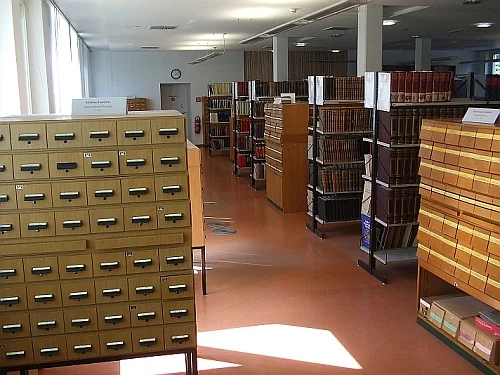
For actual literature research, the library offers very solid tools. The collection is documented online via the Regensburg Catalog plus; older collections additionally require the use of alphabetical as well as subject and keyword catalogs in card form. This may sound traditional at first but is particularly sensible for a specialized library with historically grown collections. Because not everything that is scientifically relevant has been digitally recorded from the outset. The combination of modern online research and supplementary analog catalogs thus allows for significantly deeper access to the collection. Additionally, there is a connection to interlibrary loan through the Bavarian library network with the sigil Re 13. Therefore, those who cannot work on-site still have access to part of the collections through this route and can integrate the offer into their own research. The digital and specialized additional offers of the house are also particularly valuable. The library is involved in the digital information offerings of osmikon, IREON, and OstDok, providing an infrastructure that extends far beyond the physical reading room. The Digital Library of IOS includes, among other things, the Amburger Library, maps, periodicals, travel reports, Ukrainica, and the IOS publication server. This shows that not only is there collection but also exploration, networking, and increasing digital availability. For topics with source references, for historical press work, or for work on regional special issues, this digital environment is particularly useful. Therefore, those who use the library at WiOS do not work in isolation with books but in a research network of catalog, portal, digitized materials, and specialized databases. This is where a significant part of its scientific strength lies. ([leibniz-ios.de](https://leibniz-ios.de/bibliothek/ueber-die-bibliothek/service))
Lectures, Collaborations, and Public Offers Surrounding the Library
The library is not only a quiet research location but also a place of exchange. The Science Center for Eastern and Southeastern Europe was founded as a cooperative level where the participating institutions bundle their professional strengths under one roof. This fits well with the fact that the library's rooms are regularly used during the semester for the Regensburg Lectures on Eastern Europe. This lecture series brings together external guests and specialists from the member institutions, making the library a place of discussion as well. This is complemented by the library's support association, which supports acquisitions, organizes lectures and exhibitions, and thus contributes to keeping the location vibrant. This is attractive for visitors because the library thus becomes not only an information repository but also a cultural and scientific meeting space. Those interested in regional research, Eastern European history, current developments, or professional mediation will experience an environment here where knowledge becomes visible and does not disappear into storage. Particularly in conjunction with the institutes and the digital offerings, a profile emerges that connects classic library work with scientific public engagement. This makes a visit to the library at WiOS interesting even for those who are not just looking for a single book but want an overview of topics, methods, and research contexts. Thus, a specialized library becomes a lively place where research, teaching, and the public come together. ([wios-regensburg.de](https://www.wios-regensburg.de/ueber-wios.html))
Sources:
Mehr anzeigenWeniger anzeigen
Library WiOS Regensburg | Opening Hours & Collection
The library at the Science Center for Eastern and Southeastern Europe in Regensburg is much more than a classic lending location. It is a specialized research library for the history, economy, politics, society, culture, law, and languages of Eastern Europe. The Science Center for Eastern and Southeastern Europe, abbreviated as WiOS, was established in autumn 2007 as a cooperative level for non-university research on Eastern and Southeastern Europe. The center consolidates the expertise of the Leibniz Institute for Eastern and Southeastern European Studies, the Institute for Eastern Law, and the Hungarian Institute; the library is jointly supported by these partners and thus serves not only internal research needs but also the scientifically interested public. With its large collection, it is one of the largest public specialized libraries of its kind and is of interest to anyone who wants to engage deeply with Eastern and Southeastern Europe. ([wios-regensburg.de](https://www.wios-regensburg.de/ueber-wios.html))
Why the Library at the Science Center for Eastern and Southeastern Europe is So Important for Research
The special strength of this library lies in its clear scientific orientation. It does not collect broadly and superficially, but thematically precisely and with a long-term research focus. This makes it particularly valuable for students, doctoral candidates, researchers, and anyone seriously engaged with the region. Since its founding, WiOS has been a place where expertise is bundled: the two independent members, the Institute for Eastern Law and the Leibniz Institute for Eastern and Southeastern European Studies, work together at the same location; the University of Regensburg is an active promoter and partner. The library reflects this structure, as it is not merely a supplementary service but a central working tool for the entire scientific location. Those who conduct research here work in an environment where research, professional advice, and mediation are interconnected. The library supports not only the work of the institutes but also regional scientific use, for example, through interlibrary loan and digital access. Additionally, the Science Center also serves as a platform for conferences and lectures. This embeds the library in a vibrant research and event system that promotes exchange between specialists and interested audiences. This combination of collection strength, scientific density, and public accessibility is one of the most important reasons why the library at WiOS is known far beyond Regensburg. ([wios-regensburg.de](https://www.wios-regensburg.de/ueber-wios.html))
Collection, Special Areas, and Rare Sources for Eastern and Southeastern Europe
Visitors to the library at WiOS encounter an exceptionally differentiated collection. The collection areas include humanities and social science literature from and about Eastern and Southeastern Europe, with a focus on history, economy, politics, society, and culture of all countries and regions of Eastern Europe. In practice, this means: the library is not only a place for general secondary literature but also for specific types of sources and materials that are often only available in a fragmented manner in other libraries. Particularly noteworthy are current journals, historical newspapers, maps, statistics, legal collections, school programs, as well as literature on migration, integration, and minorities. According to the official collection description, the library comprises approximately 340,000 media units, including around 800 current journals and about 8,300 maps. Other special items include the estates of various scholars and historians, a Russian legal collection, and an extensive collection of Soviet posters. This mix of current specialized media, historical sources, and special collections defines the character of the library. It is therefore not simply large but also unusually dense in content. For research on nationality issues, political history, minorities, legal traditions, or economic developments in Eastern Europe, this is a real added value. Those working with regional, transnational, or comparative questions will find not only books here but a wealth of materials that make developments visible over longer periods. The digitization of these special collections is also being actively pursued to ensure that research results are even better available online in the future. ([leibniz-ios.de](https://leibniz-ios.de/bibliothek/ueber-die-bibliothek/bestand))
Opening Hours, On-site Library, and Reading Room: How to Use the Library Locally
Practically important for all visitors are the clearly regulated opening hours and the manner of use. The library is open from Monday to Thursday between 10:00 AM and 5:00 PM, and on Friday from 10:00 AM to 4:00 PM. From August 1 to September 15, reduced opening hours apply, with the library open from Tuesday to Thursday from 10:00 AM to 4:00 PM, while Monday and Friday remain closed. This information is particularly important if you are planning a longer journey or specifically want to work on research on-site. Also important: it is a reference library. Media cannot be taken freely as in a lending library but must be ordered to the reading room via loan slips. This is sensible for many special collections, as they are used in a targeted manner under controlled conditions. The library also operates with fixed provision times. Orders placed between 10 AM and 3 PM, or on Friday until 2 PM, can be picked up the same day from 4 PM or on Friday from 3 PM in the reading room. Later orders will be available from 11 AM the following day. Additionally, a free book scanner is available for on-site work. This is particularly practical for researchers who want to secure literature sections for their scientific documentation. This creates a service profile that is both strictly scientific and surprisingly user-friendly: clear times, reliable provision, and a good mix of analog reading and digital processing. Those who want to work efficiently can therefore prepare their visit well and meaningfully combine research, ordering, and use of the reading room. ([leibniz-ios.de](https://leibniz-ios.de/bibliothek/ueber-die-bibliothek/service))
Directions, Address, Parking, and Barrier-Free Access in Regensburg
The library is located at Landshuter Straße 4, 93047 Regensburg, in the area of the former tax office. The official Regensburg library overview lists the facility as a library at the Science Center for Eastern and Southeastern Europe and explicitly notes that it is accessible via the parking lot. This is particularly important for visitors with limited mobility, as access is not only correctly located spatially but also remains practically usable. The city of Regensburg also indicates a disabled parking space in front of Landshuter Str. 4. For those arriving by car, this provides a concrete point of orientation that significantly eases planning. At the same time, the library is located in an inner-city area, making travel by other means of transport sensible as well. The combination of a central address and clearly documented accessibility makes the location practical for on-site visits. It is also helpful for visitors that the library is not located in an anonymous external location but in a scientific ensemble that is well anchored in the cityscape of Regensburg. The location in WiOS means short distances to other facilities and an environment where scientific use, advice, and exchange come together closely. This is an advantage, especially for longer research, as one does not have to awkwardly visit various places. Therefore, those who want to work specifically with literature, catalogs, or special collections will find an address that fits well both organizationally and spatially into a research day. ([uni-regensburg.de](https://www.uni-regensburg.de/assets/bibliothek/bibliothek/pdf/bibliotheken_regensburg.pdf))
Research, OPAC, Interlibrary Loan, and Digital Offers for In-Depth Literature Work
For actual literature research, the library offers very solid tools. The collection is documented online via the Regensburg Catalog plus; older collections additionally require the use of alphabetical as well as subject and keyword catalogs in card form. This may sound traditional at first but is particularly sensible for a specialized library with historically grown collections. Because not everything that is scientifically relevant has been digitally recorded from the outset. The combination of modern online research and supplementary analog catalogs thus allows for significantly deeper access to the collection. Additionally, there is a connection to interlibrary loan through the Bavarian library network with the sigil Re 13. Therefore, those who cannot work on-site still have access to part of the collections through this route and can integrate the offer into their own research. The digital and specialized additional offers of the house are also particularly valuable. The library is involved in the digital information offerings of osmikon, IREON, and OstDok, providing an infrastructure that extends far beyond the physical reading room. The Digital Library of IOS includes, among other things, the Amburger Library, maps, periodicals, travel reports, Ukrainica, and the IOS publication server. This shows that not only is there collection but also exploration, networking, and increasing digital availability. For topics with source references, for historical press work, or for work on regional special issues, this digital environment is particularly useful. Therefore, those who use the library at WiOS do not work in isolation with books but in a research network of catalog, portal, digitized materials, and specialized databases. This is where a significant part of its scientific strength lies. ([leibniz-ios.de](https://leibniz-ios.de/bibliothek/ueber-die-bibliothek/service))
Lectures, Collaborations, and Public Offers Surrounding the Library
The library is not only a quiet research location but also a place of exchange. The Science Center for Eastern and Southeastern Europe was founded as a cooperative level where the participating institutions bundle their professional strengths under one roof. This fits well with the fact that the library's rooms are regularly used during the semester for the Regensburg Lectures on Eastern Europe. This lecture series brings together external guests and specialists from the member institutions, making the library a place of discussion as well. This is complemented by the library's support association, which supports acquisitions, organizes lectures and exhibitions, and thus contributes to keeping the location vibrant. This is attractive for visitors because the library thus becomes not only an information repository but also a cultural and scientific meeting space. Those interested in regional research, Eastern European history, current developments, or professional mediation will experience an environment here where knowledge becomes visible and does not disappear into storage. Particularly in conjunction with the institutes and the digital offerings, a profile emerges that connects classic library work with scientific public engagement. This makes a visit to the library at WiOS interesting even for those who are not just looking for a single book but want an overview of topics, methods, and research contexts. Thus, a specialized library becomes a lively place where research, teaching, and the public come together. ([wios-regensburg.de](https://www.wios-regensburg.de/ueber-wios.html))
Sources:
Library WiOS Regensburg | Opening Hours & Collection
The library at the Science Center for Eastern and Southeastern Europe in Regensburg is much more than a classic lending location. It is a specialized research library for the history, economy, politics, society, culture, law, and languages of Eastern Europe. The Science Center for Eastern and Southeastern Europe, abbreviated as WiOS, was established in autumn 2007 as a cooperative level for non-university research on Eastern and Southeastern Europe. The center consolidates the expertise of the Leibniz Institute for Eastern and Southeastern European Studies, the Institute for Eastern Law, and the Hungarian Institute; the library is jointly supported by these partners and thus serves not only internal research needs but also the scientifically interested public. With its large collection, it is one of the largest public specialized libraries of its kind and is of interest to anyone who wants to engage deeply with Eastern and Southeastern Europe. ([wios-regensburg.de](https://www.wios-regensburg.de/ueber-wios.html))
Why the Library at the Science Center for Eastern and Southeastern Europe is So Important for Research
The special strength of this library lies in its clear scientific orientation. It does not collect broadly and superficially, but thematically precisely and with a long-term research focus. This makes it particularly valuable for students, doctoral candidates, researchers, and anyone seriously engaged with the region. Since its founding, WiOS has been a place where expertise is bundled: the two independent members, the Institute for Eastern Law and the Leibniz Institute for Eastern and Southeastern European Studies, work together at the same location; the University of Regensburg is an active promoter and partner. The library reflects this structure, as it is not merely a supplementary service but a central working tool for the entire scientific location. Those who conduct research here work in an environment where research, professional advice, and mediation are interconnected. The library supports not only the work of the institutes but also regional scientific use, for example, through interlibrary loan and digital access. Additionally, the Science Center also serves as a platform for conferences and lectures. This embeds the library in a vibrant research and event system that promotes exchange between specialists and interested audiences. This combination of collection strength, scientific density, and public accessibility is one of the most important reasons why the library at WiOS is known far beyond Regensburg. ([wios-regensburg.de](https://www.wios-regensburg.de/ueber-wios.html))
Collection, Special Areas, and Rare Sources for Eastern and Southeastern Europe
Visitors to the library at WiOS encounter an exceptionally differentiated collection. The collection areas include humanities and social science literature from and about Eastern and Southeastern Europe, with a focus on history, economy, politics, society, and culture of all countries and regions of Eastern Europe. In practice, this means: the library is not only a place for general secondary literature but also for specific types of sources and materials that are often only available in a fragmented manner in other libraries. Particularly noteworthy are current journals, historical newspapers, maps, statistics, legal collections, school programs, as well as literature on migration, integration, and minorities. According to the official collection description, the library comprises approximately 340,000 media units, including around 800 current journals and about 8,300 maps. Other special items include the estates of various scholars and historians, a Russian legal collection, and an extensive collection of Soviet posters. This mix of current specialized media, historical sources, and special collections defines the character of the library. It is therefore not simply large but also unusually dense in content. For research on nationality issues, political history, minorities, legal traditions, or economic developments in Eastern Europe, this is a real added value. Those working with regional, transnational, or comparative questions will find not only books here but a wealth of materials that make developments visible over longer periods. The digitization of these special collections is also being actively pursued to ensure that research results are even better available online in the future. ([leibniz-ios.de](https://leibniz-ios.de/bibliothek/ueber-die-bibliothek/bestand))
Opening Hours, On-site Library, and Reading Room: How to Use the Library Locally
Practically important for all visitors are the clearly regulated opening hours and the manner of use. The library is open from Monday to Thursday between 10:00 AM and 5:00 PM, and on Friday from 10:00 AM to 4:00 PM. From August 1 to September 15, reduced opening hours apply, with the library open from Tuesday to Thursday from 10:00 AM to 4:00 PM, while Monday and Friday remain closed. This information is particularly important if you are planning a longer journey or specifically want to work on research on-site. Also important: it is a reference library. Media cannot be taken freely as in a lending library but must be ordered to the reading room via loan slips. This is sensible for many special collections, as they are used in a targeted manner under controlled conditions. The library also operates with fixed provision times. Orders placed between 10 AM and 3 PM, or on Friday until 2 PM, can be picked up the same day from 4 PM or on Friday from 3 PM in the reading room. Later orders will be available from 11 AM the following day. Additionally, a free book scanner is available for on-site work. This is particularly practical for researchers who want to secure literature sections for their scientific documentation. This creates a service profile that is both strictly scientific and surprisingly user-friendly: clear times, reliable provision, and a good mix of analog reading and digital processing. Those who want to work efficiently can therefore prepare their visit well and meaningfully combine research, ordering, and use of the reading room. ([leibniz-ios.de](https://leibniz-ios.de/bibliothek/ueber-die-bibliothek/service))
Directions, Address, Parking, and Barrier-Free Access in Regensburg
The library is located at Landshuter Straße 4, 93047 Regensburg, in the area of the former tax office. The official Regensburg library overview lists the facility as a library at the Science Center for Eastern and Southeastern Europe and explicitly notes that it is accessible via the parking lot. This is particularly important for visitors with limited mobility, as access is not only correctly located spatially but also remains practically usable. The city of Regensburg also indicates a disabled parking space in front of Landshuter Str. 4. For those arriving by car, this provides a concrete point of orientation that significantly eases planning. At the same time, the library is located in an inner-city area, making travel by other means of transport sensible as well. The combination of a central address and clearly documented accessibility makes the location practical for on-site visits. It is also helpful for visitors that the library is not located in an anonymous external location but in a scientific ensemble that is well anchored in the cityscape of Regensburg. The location in WiOS means short distances to other facilities and an environment where scientific use, advice, and exchange come together closely. This is an advantage, especially for longer research, as one does not have to awkwardly visit various places. Therefore, those who want to work specifically with literature, catalogs, or special collections will find an address that fits well both organizationally and spatially into a research day. ([uni-regensburg.de](https://www.uni-regensburg.de/assets/bibliothek/bibliothek/pdf/bibliotheken_regensburg.pdf))
Research, OPAC, Interlibrary Loan, and Digital Offers for In-Depth Literature Work
For actual literature research, the library offers very solid tools. The collection is documented online via the Regensburg Catalog plus; older collections additionally require the use of alphabetical as well as subject and keyword catalogs in card form. This may sound traditional at first but is particularly sensible for a specialized library with historically grown collections. Because not everything that is scientifically relevant has been digitally recorded from the outset. The combination of modern online research and supplementary analog catalogs thus allows for significantly deeper access to the collection. Additionally, there is a connection to interlibrary loan through the Bavarian library network with the sigil Re 13. Therefore, those who cannot work on-site still have access to part of the collections through this route and can integrate the offer into their own research. The digital and specialized additional offers of the house are also particularly valuable. The library is involved in the digital information offerings of osmikon, IREON, and OstDok, providing an infrastructure that extends far beyond the physical reading room. The Digital Library of IOS includes, among other things, the Amburger Library, maps, periodicals, travel reports, Ukrainica, and the IOS publication server. This shows that not only is there collection but also exploration, networking, and increasing digital availability. For topics with source references, for historical press work, or for work on regional special issues, this digital environment is particularly useful. Therefore, those who use the library at WiOS do not work in isolation with books but in a research network of catalog, portal, digitized materials, and specialized databases. This is where a significant part of its scientific strength lies. ([leibniz-ios.de](https://leibniz-ios.de/bibliothek/ueber-die-bibliothek/service))
Lectures, Collaborations, and Public Offers Surrounding the Library
The library is not only a quiet research location but also a place of exchange. The Science Center for Eastern and Southeastern Europe was founded as a cooperative level where the participating institutions bundle their professional strengths under one roof. This fits well with the fact that the library's rooms are regularly used during the semester for the Regensburg Lectures on Eastern Europe. This lecture series brings together external guests and specialists from the member institutions, making the library a place of discussion as well. This is complemented by the library's support association, which supports acquisitions, organizes lectures and exhibitions, and thus contributes to keeping the location vibrant. This is attractive for visitors because the library thus becomes not only an information repository but also a cultural and scientific meeting space. Those interested in regional research, Eastern European history, current developments, or professional mediation will experience an environment here where knowledge becomes visible and does not disappear into storage. Particularly in conjunction with the institutes and the digital offerings, a profile emerges that connects classic library work with scientific public engagement. This makes a visit to the library at WiOS interesting even for those who are not just looking for a single book but want an overview of topics, methods, and research contexts. Thus, a specialized library becomes a lively place where research, teaching, and the public come together. ([wios-regensburg.de](https://www.wios-regensburg.de/ueber-wios.html))
Sources:
Upcoming Events
No events found
Frequently Asked Questions
Reviews
No reviews found