
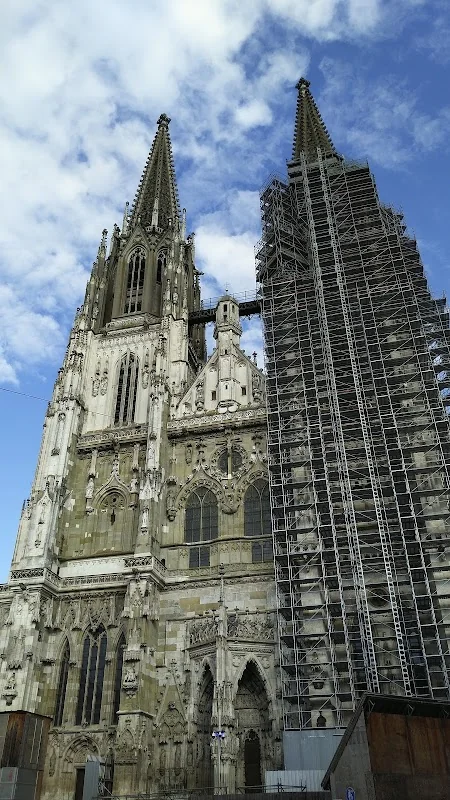
Regensburg
Niedermünstergasse 1, 93047 Regensburg, Deutschland
Diocese of Regensburg | Job Offers & Parishes
The Diocese of Regensburg is much more than a church administrative address in Niedermünstergasse. Here, history, pastoral care, personnel, information, and service come together. The diocese was elevated to a bishopric in 739 by Saint Boniface and has since shaped the religious, cultural, and social landscape in East Bavaria. Today, it is officially divided into 631 parishes, 15 deaneries, and 8 regions; the central administration is located in the Bishop's Ordinariate in Regensburg. Therefore, when people search for the Diocese of Regensburg, they often mean a place of calling, a contact person for parishes, a source for official documents, access to historical archives, and a network for practical help. This diversity makes the diocese particularly relevant as a location and information center for seekers, employees, volunteers, researchers, and believers alike. ([bistum-regensburg.de](https://bistum-regensburg.de/bistum/allgemeine-informationen))
Job Offers, Jobs, and Employees in the Diocese of Regensburg
The search for job offers, jobs, or employees in the Diocese of Regensburg leads directly to one of the most important topics on the website: the diocese as an employer. On the official career page, the church describes itself as one of the largest employers in Germany, with more than 24,000 full-time employees in the Diocese of Regensburg. This is not a niche operation but a broad working environment with very different fields of work. The page explicitly mentions pastoral professions, but also architecture, business administration, IT, human resources, PR, law, social work, and administration. For SEO, this is exciting because the search intent behind many terms targets not only traditional church professions but also modern specialist and administrative positions. The diocese also emphasizes that professional tasks should be reconciled with family and social commitments. Additionally, there is a flexible framework, mobile working depending on the activity, full-time and part-time models, 30 days of vacation, special regulations on certain days, further training, and additional benefits such as company pension plans, childcare subsidies, company doctors, discounted meals, and even support with housing placement. Therefore, those searching for human resources, employees, or jobs expect not only open positions but also a glimpse into the culture of a large church employer. This is precisely why the career page is so central: it connects purpose orientation with a professional working world and shows current job postings such as administrative management, youth department, lawyer, architect, human resources officer, or accounting. ([bistum-regensburg.de](https://bistum-regensburg.de/berufung-berufe/stellenangebote))
Parishes, Deaneries, Map, and Parish Communities
A second strong area of search queries revolves around parishes, deans, maps, and parish communities. The structure of the Diocese of Regensburg is clearly organized and simultaneously in transition. Officially, the diocese comprises 631 parishes organized into 15 deaneries and 8 regions. The regions are called Regensburg, Landshut, Straubing-Deggendorf, Kelheim, Cham, Amberg-Schwandorf, Weiden, and Tirschenreuth-Wunsiedel. The reorganization of the deaneries came into effect on March 1, 2022; since then, the previously 33 deaneries have been consolidated into 15 units. This is important for users who wonder why a sought-after location is now assigned to a different deanery or why names appear differently in older documents. The official parish and worship finder additionally provides practical orientation for the proximity of locations, postal codes, and worship times. Thus, the map of the diocese is not just a geographical graphic but a working tool for pastoral care, volunteering, and administration. The pastoral development until 2034 is also particularly relevant: the diocese accompanies the formation of parish communities and increasingly organizes pastoral tasks across parish boundaries. Those searching for parish communities in the Diocese of Regensburg usually want to understand how collaboration is organized locally, how deans support, and where communities are headed in the restructuring. This is where the official structure helps: each parish is assigned to a deanery, the deaneries strengthen communication between the diocese and parish level, and the parishes can be quickly searched by location or proximity through the finder. ([bistum-regensburg.de](https://bistum-regensburg.de/bistum/einrichtungen-a-z/dekanate-und-dekane))
Official Gazette, News, and Official Information from the Diocese
Those searching for the official gazette or news from the Diocese of Regensburg often seek reliability, currency, and official classification. The official gazette is the legally and administratively relevant level of the diocese. On the official gazette page, the volumes from 2000 to 2025 are accessible, providing a long and extremely important documentation for work in parishes, associations, and services. These issues publish statutes, regulations, and diocesan provisions, such as guidelines for parish council elections, parish communities, or liturgical and pastoral norms. For SEO analysis, it is important: the search term official gazette is not isolated but is almost always connected with specific administrative questions. Users want to know what applies, where the original document is located, and what deadlines or requirements must be observed. The news section of the diocese complements this formal level with current reports from the church, education, pastoral care, culture, finance, and regional development. For example, reports on new service centers, training days, financial reports, church campaigns, or pastoral development appear there. The website thus shows a dual character: on one hand, it is an official organ of documentation, and on the other, a lively news platform. This combination makes the site attractive for search engines and users because it covers both structured information and current events. Those who regularly follow the news section also recognize how the diocese is digitizing, administratively decentralizing, and strengthening pastoral work on-site. The official communication is therefore not just reporting but also steering, transparency, and public orientation at the same time. ([bistum-regensburg.de](https://bistum-regensburg.de/bistum/amtsblatt))
Contact Persons, Phone List, and Central Services
The search for contact persons or phone lists in the Diocese of Regensburg clearly shows how strongly the diocese relies on direct professional contacts. The Bishop's Ordinariate is located at Niedermünstergasse 1 in 93047 Regensburg and can be reached at +49 941 597-01; the central email is info@bistum-regensburg.de. On the professional pages of the diocese, there are also specific contact persons and their own numbers for the main department of pastoral care, the church music office, the church tax office, the telephone pastoral care, and other areas. For example, the main department of pastoral care can be found at Obermünsterplatz 7 and refers to direct contacts for liturgical, pastoral, and advisory questions. The church music office, in turn, lists regional cantors, a central management, and its own contact phone number. The church tax office also refers to a phone directory, which shows that the diocese works more with differentiated extensions than with a single large phone list. For seekers, this is practical: if someone is looking for a specific person or task, they do not end up in an unclear collective contact but on a professionally suitable page. This is also important for the keyword contact person because it is not just about names but about responsibilities. Additionally, the area of telephone pastoral care, which is represented in the Diocese of Regensburg with offices in Regensburg and Weiden, offers help around the clock. For people in crises, this is a particularly important service, and for SEO, it is a strong signal that the diocese covers not only administrative questions but also pastoral emergencies. Therefore, those searching for the Diocese of Regensburg phone list expect a mix of central phone numbers, professional extensions, and clearly defined responsibilities, and this structure is precisely what the website offers. ([bistum-regensburg.de](https://bistum-regensburg.de/bistum/einrichtungen-a-z/ordinariat))
Online Registers, Archives, and History of the Diocese
The keyword complex Diocese of Regensburg Matricula online, deceased priests, and history leads deep into the historical memory of the diocese. The Bishop's Central Archive started a project in 2021 to replace old microfiche backup media with a modern format. The goal was explicitly to make registers available to the public free of charge and barrier-free through the Matricula platform. This is a significant gain for family research and scientific inquiries, as baptisms, weddings, and other church entries become digitally accessible. At the same time, the archive page shows how closely the Diocese of Regensburg is connected to its past: after its founding in 739, it was long connected to the St. Emmeram Monastery in personal union, and only after 975 did it develop its own diocesan or high-stipend archive. The early records of organized holdings date back to the 17th century; a systematic order was established in the late 18th century. Today, interested parties can use the archive upon registration via email, with specific requirements for access and registration being necessary. The opening hours are also clearly stated. This historical depth is not just decoration for the diocese, but a genuine service element: those searching for family traces, parish history, or church tradition find here a professional research environment. In connection with Matricula, the archive becomes a digital gateway to the past. The topic of deceased priests also fits into this context, as the official page publishes and continuously maintains death announcements for clergy. This creates a dignified place of remembrance that connects church biography, local history, and current memory culture. Therefore, those making inquiries about archives, Matricula, priest deaths, or the history of the diocese are not only searching for data but also for belonging, origin, and continuity. ([bistum-regensburg.de](https://bistum-regensburg.de/news/matrikelbuecher-gehen-online))
Housing, Pastoral Care, and Deceased Clergy in the Diocese of Regensburg
In addition to administration, history, and personnel, concrete help in everyday life also plays a significant role in the Diocese of Regensburg. One example is the housing in the diocese: the diocese offers rental apartments in Regensburg, including in the city center, inner west, and Kumpfmühl, as well as in the city area of Straubing. There are fixed contact persons, an application or self-disclosure option, and even the option of a waiting list. For employees, applicants, or people with ties to the church environment, this is a strong plus, as finding housing in a city like Regensburg can quickly become a central issue. Another important topic is the support of parishes on-site. Since 2025, the diocese has been establishing service centers that are intended to relieve church foundations, parish offices, and volunteers in administrative matters; the first center in Regensburg began its work in spring 2025, and by 2027, thirteen such centers are to be established. This makes the term service very concrete in the church context. Additionally, telephone pastoral care, which is present in the Diocese of Regensburg with offices in Regensburg and Weiden, is available around the clock under the known free numbers. For seekers looking for pastoral care, help, or a listening ear, this is a central offer. The topic of deceased priests is also part of this caring culture: the diocese publishes death announcements and remembers clergy who served the diocese. Here, the connection of closeness and dignity that characterizes the Diocese of Regensburg is particularly evident. Housing, pastoral care, service centers, and remembrance of the deceased are not side aspects but expressions of a church that not only teaches and administers but also accompanies, supports, and remembers. This is precisely why the search intent behind these terms is particularly worthwhile. ([bistum-regensburg.de](https://bistum-regensburg.de/dienst-hilfe/wohnungen-im-bistum))
Sources:
- Diocese of Regensburg – General Information
- Diocese of Regensburg – Job Offers
- Diocese of Regensburg – Deaneries and Deans
- Diocese of Regensburg – Official Gazette
- Diocese of Regensburg – Bishop's Ordinariate
- Diocese of Regensburg – Bishop's Central Archive
- Diocese of Regensburg – Registers Go Online
- Diocese of Regensburg – Housing in the Diocese of Regensburg
- Diocese of Regensburg – Find Services and Parishes
- Diocese of Regensburg – Church Music Office
- Diocese of Regensburg – Telephone Pastoral Care
- Diocese of Regensburg – Deceased Clergy
Mehr anzeigenWeniger anzeigen
Diocese of Regensburg | Job Offers & Parishes
The Diocese of Regensburg is much more than a church administrative address in Niedermünstergasse. Here, history, pastoral care, personnel, information, and service come together. The diocese was elevated to a bishopric in 739 by Saint Boniface and has since shaped the religious, cultural, and social landscape in East Bavaria. Today, it is officially divided into 631 parishes, 15 deaneries, and 8 regions; the central administration is located in the Bishop's Ordinariate in Regensburg. Therefore, when people search for the Diocese of Regensburg, they often mean a place of calling, a contact person for parishes, a source for official documents, access to historical archives, and a network for practical help. This diversity makes the diocese particularly relevant as a location and information center for seekers, employees, volunteers, researchers, and believers alike. ([bistum-regensburg.de](https://bistum-regensburg.de/bistum/allgemeine-informationen))
Job Offers, Jobs, and Employees in the Diocese of Regensburg
The search for job offers, jobs, or employees in the Diocese of Regensburg leads directly to one of the most important topics on the website: the diocese as an employer. On the official career page, the church describes itself as one of the largest employers in Germany, with more than 24,000 full-time employees in the Diocese of Regensburg. This is not a niche operation but a broad working environment with very different fields of work. The page explicitly mentions pastoral professions, but also architecture, business administration, IT, human resources, PR, law, social work, and administration. For SEO, this is exciting because the search intent behind many terms targets not only traditional church professions but also modern specialist and administrative positions. The diocese also emphasizes that professional tasks should be reconciled with family and social commitments. Additionally, there is a flexible framework, mobile working depending on the activity, full-time and part-time models, 30 days of vacation, special regulations on certain days, further training, and additional benefits such as company pension plans, childcare subsidies, company doctors, discounted meals, and even support with housing placement. Therefore, those searching for human resources, employees, or jobs expect not only open positions but also a glimpse into the culture of a large church employer. This is precisely why the career page is so central: it connects purpose orientation with a professional working world and shows current job postings such as administrative management, youth department, lawyer, architect, human resources officer, or accounting. ([bistum-regensburg.de](https://bistum-regensburg.de/berufung-berufe/stellenangebote))
Parishes, Deaneries, Map, and Parish Communities
A second strong area of search queries revolves around parishes, deans, maps, and parish communities. The structure of the Diocese of Regensburg is clearly organized and simultaneously in transition. Officially, the diocese comprises 631 parishes organized into 15 deaneries and 8 regions. The regions are called Regensburg, Landshut, Straubing-Deggendorf, Kelheim, Cham, Amberg-Schwandorf, Weiden, and Tirschenreuth-Wunsiedel. The reorganization of the deaneries came into effect on March 1, 2022; since then, the previously 33 deaneries have been consolidated into 15 units. This is important for users who wonder why a sought-after location is now assigned to a different deanery or why names appear differently in older documents. The official parish and worship finder additionally provides practical orientation for the proximity of locations, postal codes, and worship times. Thus, the map of the diocese is not just a geographical graphic but a working tool for pastoral care, volunteering, and administration. The pastoral development until 2034 is also particularly relevant: the diocese accompanies the formation of parish communities and increasingly organizes pastoral tasks across parish boundaries. Those searching for parish communities in the Diocese of Regensburg usually want to understand how collaboration is organized locally, how deans support, and where communities are headed in the restructuring. This is where the official structure helps: each parish is assigned to a deanery, the deaneries strengthen communication between the diocese and parish level, and the parishes can be quickly searched by location or proximity through the finder. ([bistum-regensburg.de](https://bistum-regensburg.de/bistum/einrichtungen-a-z/dekanate-und-dekane))
Official Gazette, News, and Official Information from the Diocese
Those searching for the official gazette or news from the Diocese of Regensburg often seek reliability, currency, and official classification. The official gazette is the legally and administratively relevant level of the diocese. On the official gazette page, the volumes from 2000 to 2025 are accessible, providing a long and extremely important documentation for work in parishes, associations, and services. These issues publish statutes, regulations, and diocesan provisions, such as guidelines for parish council elections, parish communities, or liturgical and pastoral norms. For SEO analysis, it is important: the search term official gazette is not isolated but is almost always connected with specific administrative questions. Users want to know what applies, where the original document is located, and what deadlines or requirements must be observed. The news section of the diocese complements this formal level with current reports from the church, education, pastoral care, culture, finance, and regional development. For example, reports on new service centers, training days, financial reports, church campaigns, or pastoral development appear there. The website thus shows a dual character: on one hand, it is an official organ of documentation, and on the other, a lively news platform. This combination makes the site attractive for search engines and users because it covers both structured information and current events. Those who regularly follow the news section also recognize how the diocese is digitizing, administratively decentralizing, and strengthening pastoral work on-site. The official communication is therefore not just reporting but also steering, transparency, and public orientation at the same time. ([bistum-regensburg.de](https://bistum-regensburg.de/bistum/amtsblatt))
Contact Persons, Phone List, and Central Services
The search for contact persons or phone lists in the Diocese of Regensburg clearly shows how strongly the diocese relies on direct professional contacts. The Bishop's Ordinariate is located at Niedermünstergasse 1 in 93047 Regensburg and can be reached at +49 941 597-01; the central email is info@bistum-regensburg.de. On the professional pages of the diocese, there are also specific contact persons and their own numbers for the main department of pastoral care, the church music office, the church tax office, the telephone pastoral care, and other areas. For example, the main department of pastoral care can be found at Obermünsterplatz 7 and refers to direct contacts for liturgical, pastoral, and advisory questions. The church music office, in turn, lists regional cantors, a central management, and its own contact phone number. The church tax office also refers to a phone directory, which shows that the diocese works more with differentiated extensions than with a single large phone list. For seekers, this is practical: if someone is looking for a specific person or task, they do not end up in an unclear collective contact but on a professionally suitable page. This is also important for the keyword contact person because it is not just about names but about responsibilities. Additionally, the area of telephone pastoral care, which is represented in the Diocese of Regensburg with offices in Regensburg and Weiden, offers help around the clock. For people in crises, this is a particularly important service, and for SEO, it is a strong signal that the diocese covers not only administrative questions but also pastoral emergencies. Therefore, those searching for the Diocese of Regensburg phone list expect a mix of central phone numbers, professional extensions, and clearly defined responsibilities, and this structure is precisely what the website offers. ([bistum-regensburg.de](https://bistum-regensburg.de/bistum/einrichtungen-a-z/ordinariat))
Online Registers, Archives, and History of the Diocese
The keyword complex Diocese of Regensburg Matricula online, deceased priests, and history leads deep into the historical memory of the diocese. The Bishop's Central Archive started a project in 2021 to replace old microfiche backup media with a modern format. The goal was explicitly to make registers available to the public free of charge and barrier-free through the Matricula platform. This is a significant gain for family research and scientific inquiries, as baptisms, weddings, and other church entries become digitally accessible. At the same time, the archive page shows how closely the Diocese of Regensburg is connected to its past: after its founding in 739, it was long connected to the St. Emmeram Monastery in personal union, and only after 975 did it develop its own diocesan or high-stipend archive. The early records of organized holdings date back to the 17th century; a systematic order was established in the late 18th century. Today, interested parties can use the archive upon registration via email, with specific requirements for access and registration being necessary. The opening hours are also clearly stated. This historical depth is not just decoration for the diocese, but a genuine service element: those searching for family traces, parish history, or church tradition find here a professional research environment. In connection with Matricula, the archive becomes a digital gateway to the past. The topic of deceased priests also fits into this context, as the official page publishes and continuously maintains death announcements for clergy. This creates a dignified place of remembrance that connects church biography, local history, and current memory culture. Therefore, those making inquiries about archives, Matricula, priest deaths, or the history of the diocese are not only searching for data but also for belonging, origin, and continuity. ([bistum-regensburg.de](https://bistum-regensburg.de/news/matrikelbuecher-gehen-online))
Housing, Pastoral Care, and Deceased Clergy in the Diocese of Regensburg
In addition to administration, history, and personnel, concrete help in everyday life also plays a significant role in the Diocese of Regensburg. One example is the housing in the diocese: the diocese offers rental apartments in Regensburg, including in the city center, inner west, and Kumpfmühl, as well as in the city area of Straubing. There are fixed contact persons, an application or self-disclosure option, and even the option of a waiting list. For employees, applicants, or people with ties to the church environment, this is a strong plus, as finding housing in a city like Regensburg can quickly become a central issue. Another important topic is the support of parishes on-site. Since 2025, the diocese has been establishing service centers that are intended to relieve church foundations, parish offices, and volunteers in administrative matters; the first center in Regensburg began its work in spring 2025, and by 2027, thirteen such centers are to be established. This makes the term service very concrete in the church context. Additionally, telephone pastoral care, which is present in the Diocese of Regensburg with offices in Regensburg and Weiden, is available around the clock under the known free numbers. For seekers looking for pastoral care, help, or a listening ear, this is a central offer. The topic of deceased priests is also part of this caring culture: the diocese publishes death announcements and remembers clergy who served the diocese. Here, the connection of closeness and dignity that characterizes the Diocese of Regensburg is particularly evident. Housing, pastoral care, service centers, and remembrance of the deceased are not side aspects but expressions of a church that not only teaches and administers but also accompanies, supports, and remembers. This is precisely why the search intent behind these terms is particularly worthwhile. ([bistum-regensburg.de](https://bistum-regensburg.de/dienst-hilfe/wohnungen-im-bistum))
Sources:
- Diocese of Regensburg – General Information
- Diocese of Regensburg – Job Offers
- Diocese of Regensburg – Deaneries and Deans
- Diocese of Regensburg – Official Gazette
- Diocese of Regensburg – Bishop's Ordinariate
- Diocese of Regensburg – Bishop's Central Archive
- Diocese of Regensburg – Registers Go Online
- Diocese of Regensburg – Housing in the Diocese of Regensburg
- Diocese of Regensburg – Find Services and Parishes
- Diocese of Regensburg – Church Music Office
- Diocese of Regensburg – Telephone Pastoral Care
- Diocese of Regensburg – Deceased Clergy
Diocese of Regensburg | Job Offers & Parishes
The Diocese of Regensburg is much more than a church administrative address in Niedermünstergasse. Here, history, pastoral care, personnel, information, and service come together. The diocese was elevated to a bishopric in 739 by Saint Boniface and has since shaped the religious, cultural, and social landscape in East Bavaria. Today, it is officially divided into 631 parishes, 15 deaneries, and 8 regions; the central administration is located in the Bishop's Ordinariate in Regensburg. Therefore, when people search for the Diocese of Regensburg, they often mean a place of calling, a contact person for parishes, a source for official documents, access to historical archives, and a network for practical help. This diversity makes the diocese particularly relevant as a location and information center for seekers, employees, volunteers, researchers, and believers alike. ([bistum-regensburg.de](https://bistum-regensburg.de/bistum/allgemeine-informationen))
Job Offers, Jobs, and Employees in the Diocese of Regensburg
The search for job offers, jobs, or employees in the Diocese of Regensburg leads directly to one of the most important topics on the website: the diocese as an employer. On the official career page, the church describes itself as one of the largest employers in Germany, with more than 24,000 full-time employees in the Diocese of Regensburg. This is not a niche operation but a broad working environment with very different fields of work. The page explicitly mentions pastoral professions, but also architecture, business administration, IT, human resources, PR, law, social work, and administration. For SEO, this is exciting because the search intent behind many terms targets not only traditional church professions but also modern specialist and administrative positions. The diocese also emphasizes that professional tasks should be reconciled with family and social commitments. Additionally, there is a flexible framework, mobile working depending on the activity, full-time and part-time models, 30 days of vacation, special regulations on certain days, further training, and additional benefits such as company pension plans, childcare subsidies, company doctors, discounted meals, and even support with housing placement. Therefore, those searching for human resources, employees, or jobs expect not only open positions but also a glimpse into the culture of a large church employer. This is precisely why the career page is so central: it connects purpose orientation with a professional working world and shows current job postings such as administrative management, youth department, lawyer, architect, human resources officer, or accounting. ([bistum-regensburg.de](https://bistum-regensburg.de/berufung-berufe/stellenangebote))
Parishes, Deaneries, Map, and Parish Communities
A second strong area of search queries revolves around parishes, deans, maps, and parish communities. The structure of the Diocese of Regensburg is clearly organized and simultaneously in transition. Officially, the diocese comprises 631 parishes organized into 15 deaneries and 8 regions. The regions are called Regensburg, Landshut, Straubing-Deggendorf, Kelheim, Cham, Amberg-Schwandorf, Weiden, and Tirschenreuth-Wunsiedel. The reorganization of the deaneries came into effect on March 1, 2022; since then, the previously 33 deaneries have been consolidated into 15 units. This is important for users who wonder why a sought-after location is now assigned to a different deanery or why names appear differently in older documents. The official parish and worship finder additionally provides practical orientation for the proximity of locations, postal codes, and worship times. Thus, the map of the diocese is not just a geographical graphic but a working tool for pastoral care, volunteering, and administration. The pastoral development until 2034 is also particularly relevant: the diocese accompanies the formation of parish communities and increasingly organizes pastoral tasks across parish boundaries. Those searching for parish communities in the Diocese of Regensburg usually want to understand how collaboration is organized locally, how deans support, and where communities are headed in the restructuring. This is where the official structure helps: each parish is assigned to a deanery, the deaneries strengthen communication between the diocese and parish level, and the parishes can be quickly searched by location or proximity through the finder. ([bistum-regensburg.de](https://bistum-regensburg.de/bistum/einrichtungen-a-z/dekanate-und-dekane))
Official Gazette, News, and Official Information from the Diocese
Those searching for the official gazette or news from the Diocese of Regensburg often seek reliability, currency, and official classification. The official gazette is the legally and administratively relevant level of the diocese. On the official gazette page, the volumes from 2000 to 2025 are accessible, providing a long and extremely important documentation for work in parishes, associations, and services. These issues publish statutes, regulations, and diocesan provisions, such as guidelines for parish council elections, parish communities, or liturgical and pastoral norms. For SEO analysis, it is important: the search term official gazette is not isolated but is almost always connected with specific administrative questions. Users want to know what applies, where the original document is located, and what deadlines or requirements must be observed. The news section of the diocese complements this formal level with current reports from the church, education, pastoral care, culture, finance, and regional development. For example, reports on new service centers, training days, financial reports, church campaigns, or pastoral development appear there. The website thus shows a dual character: on one hand, it is an official organ of documentation, and on the other, a lively news platform. This combination makes the site attractive for search engines and users because it covers both structured information and current events. Those who regularly follow the news section also recognize how the diocese is digitizing, administratively decentralizing, and strengthening pastoral work on-site. The official communication is therefore not just reporting but also steering, transparency, and public orientation at the same time. ([bistum-regensburg.de](https://bistum-regensburg.de/bistum/amtsblatt))
Contact Persons, Phone List, and Central Services
The search for contact persons or phone lists in the Diocese of Regensburg clearly shows how strongly the diocese relies on direct professional contacts. The Bishop's Ordinariate is located at Niedermünstergasse 1 in 93047 Regensburg and can be reached at +49 941 597-01; the central email is info@bistum-regensburg.de. On the professional pages of the diocese, there are also specific contact persons and their own numbers for the main department of pastoral care, the church music office, the church tax office, the telephone pastoral care, and other areas. For example, the main department of pastoral care can be found at Obermünsterplatz 7 and refers to direct contacts for liturgical, pastoral, and advisory questions. The church music office, in turn, lists regional cantors, a central management, and its own contact phone number. The church tax office also refers to a phone directory, which shows that the diocese works more with differentiated extensions than with a single large phone list. For seekers, this is practical: if someone is looking for a specific person or task, they do not end up in an unclear collective contact but on a professionally suitable page. This is also important for the keyword contact person because it is not just about names but about responsibilities. Additionally, the area of telephone pastoral care, which is represented in the Diocese of Regensburg with offices in Regensburg and Weiden, offers help around the clock. For people in crises, this is a particularly important service, and for SEO, it is a strong signal that the diocese covers not only administrative questions but also pastoral emergencies. Therefore, those searching for the Diocese of Regensburg phone list expect a mix of central phone numbers, professional extensions, and clearly defined responsibilities, and this structure is precisely what the website offers. ([bistum-regensburg.de](https://bistum-regensburg.de/bistum/einrichtungen-a-z/ordinariat))
Online Registers, Archives, and History of the Diocese
The keyword complex Diocese of Regensburg Matricula online, deceased priests, and history leads deep into the historical memory of the diocese. The Bishop's Central Archive started a project in 2021 to replace old microfiche backup media with a modern format. The goal was explicitly to make registers available to the public free of charge and barrier-free through the Matricula platform. This is a significant gain for family research and scientific inquiries, as baptisms, weddings, and other church entries become digitally accessible. At the same time, the archive page shows how closely the Diocese of Regensburg is connected to its past: after its founding in 739, it was long connected to the St. Emmeram Monastery in personal union, and only after 975 did it develop its own diocesan or high-stipend archive. The early records of organized holdings date back to the 17th century; a systematic order was established in the late 18th century. Today, interested parties can use the archive upon registration via email, with specific requirements for access and registration being necessary. The opening hours are also clearly stated. This historical depth is not just decoration for the diocese, but a genuine service element: those searching for family traces, parish history, or church tradition find here a professional research environment. In connection with Matricula, the archive becomes a digital gateway to the past. The topic of deceased priests also fits into this context, as the official page publishes and continuously maintains death announcements for clergy. This creates a dignified place of remembrance that connects church biography, local history, and current memory culture. Therefore, those making inquiries about archives, Matricula, priest deaths, or the history of the diocese are not only searching for data but also for belonging, origin, and continuity. ([bistum-regensburg.de](https://bistum-regensburg.de/news/matrikelbuecher-gehen-online))
Housing, Pastoral Care, and Deceased Clergy in the Diocese of Regensburg
In addition to administration, history, and personnel, concrete help in everyday life also plays a significant role in the Diocese of Regensburg. One example is the housing in the diocese: the diocese offers rental apartments in Regensburg, including in the city center, inner west, and Kumpfmühl, as well as in the city area of Straubing. There are fixed contact persons, an application or self-disclosure option, and even the option of a waiting list. For employees, applicants, or people with ties to the church environment, this is a strong plus, as finding housing in a city like Regensburg can quickly become a central issue. Another important topic is the support of parishes on-site. Since 2025, the diocese has been establishing service centers that are intended to relieve church foundations, parish offices, and volunteers in administrative matters; the first center in Regensburg began its work in spring 2025, and by 2027, thirteen such centers are to be established. This makes the term service very concrete in the church context. Additionally, telephone pastoral care, which is present in the Diocese of Regensburg with offices in Regensburg and Weiden, is available around the clock under the known free numbers. For seekers looking for pastoral care, help, or a listening ear, this is a central offer. The topic of deceased priests is also part of this caring culture: the diocese publishes death announcements and remembers clergy who served the diocese. Here, the connection of closeness and dignity that characterizes the Diocese of Regensburg is particularly evident. Housing, pastoral care, service centers, and remembrance of the deceased are not side aspects but expressions of a church that not only teaches and administers but also accompanies, supports, and remembers. This is precisely why the search intent behind these terms is particularly worthwhile. ([bistum-regensburg.de](https://bistum-regensburg.de/dienst-hilfe/wohnungen-im-bistum))
Sources:
- Diocese of Regensburg – General Information
- Diocese of Regensburg – Job Offers
- Diocese of Regensburg – Deaneries and Deans
- Diocese of Regensburg – Official Gazette
- Diocese of Regensburg – Bishop's Ordinariate
- Diocese of Regensburg – Bishop's Central Archive
- Diocese of Regensburg – Registers Go Online
- Diocese of Regensburg – Housing in the Diocese of Regensburg
- Diocese of Regensburg – Find Services and Parishes
- Diocese of Regensburg – Church Music Office
- Diocese of Regensburg – Telephone Pastoral Care
- Diocese of Regensburg – Deceased Clergy
Upcoming Events
No events found
Frequently Asked Questions
Reviews
honey bee
26. June 2019
There is a beer festival opening parade in Regensburg. Pass through the Church and cross the river. The Cathedral itself is beautiful.
Jo Di
10. January 2026
A wonderful cathedral that you absolutely must see. In the Diocese of Regensburg, you can experience the beauty of the Catholic Church in the most diverse ways. Bishop Voderholzer is a man of integrity who serves the people as a shepherd and places Christ at the center. This is refreshing for a church whose shepherds mostly follow the spirit of the times rather than the Holy Spirit.
M.
12. August 2025
Very quick, unbureaucratic, and good communication is possible; the bishop is very open, approachable, interested, and helpful in his worldly Bavarian way.
Brigitte Darmstadt
18. January 2024
I was fully impressed by the sermon of Bishop Dr. Rudolf Voderholzer. He is detached from the world, which the church needs more than ever. I hope that in a few years he will move to the Archdiocese of Munich and one day become a cardinal.
Ettore Atalan
3. February 2019
The church tax office of the Diocese of Regensburg doesn't even respond to simple, understandable email inquiries. My recommendation: leave the church at the registry office. The sooner, the better, so this pretentious place doesn't get any more money.