
Regensburg
Rathauspl. 1, 93047 Regensburg, Deutschland
document Reichstag in the Old Town Hall | Photos & History
The document Reichstag in the Old Town Hall in Regensburg is more than a museum with a historic name. It is a place where city history, imperial history, and political memory overlap in a very direct way. Those searching for photos, old views, or background knowledge quickly land at a building that has stood at the center of the old town for centuries and today tells the story of the Everlasting Reichstag as a Reichstag museum. In the Old Town Hall, the city council and administration once worked, the judiciary with prison and interrogation room was located in the basement, and from 1663 to 1806, the Everlasting Reichstag convened on the first floor. This special connection of town hall, politics, law, and exhibition makes the place so impressive for visitors. The building itself was created when Regensburg was elevated to a Free Imperial City in 1245; the 55-meter high tower and the Reichs hall building, originally intended as a ballroom, still shape the image today. At the same time, access is not freely available, but only within the framework of guided tours, which makes the visit manageable, focused, and content-rich. This is precisely the appeal: Here, history is not only shown but can be experienced spatially. ([tourismus.regensburg.de](https://tourismus.regensburg.de/erleben-entdecken/unesco-welterbe-sehenswuerdigkeiten/sehenswuerdigkeiten/altes-rathaus))
History, Photos, and the Everlasting Reichstag
The historical significance of the Old Town Hall begins long before the Reichstag. The city of Regensburg points out that the building was created when Regensburg was elevated to a Free Imperial City in 1245. Particularly striking is the oldest part of the complex: the 55-meter high tower. Around 1320/1330, the Reichs hall building was constructed, whose Reichs hall was originally intended as a ballroom. Only later did the space develop into a political venue of European significance. From 1663, the Everlasting Reichstag met here for almost 150 years, thus making Regensburg permanently a center of imperial politics. This long usage phase explains why the name document Reichstag is not just a museum label but a precise reference to a historical functional history. Those searching for old images, historical photographs, or views of the house are essentially looking for traces of this political past: the Reichs hall, the portal with the protective and defensive figures, the tower, and the square, which has maintained its status as a representative center for centuries. The city of Regensburg also emphasizes that the Reichstag hall is considered a precursor to modern parliamentary forms and is even placed in line with later European institutions in tourist representations. This interpretation is not merely decorative but makes it understandable why the building holds significance far beyond the city limits. For visitors, history is therefore not abstract but closely connected to specific spaces. This creates the effect that many associate with search terms like old images, history, or the old Reichstag. ([tourismus.regensburg.de](https://tourismus.regensburg.de/erleben-entdecken/unesco-welterbe-sehenswuerdigkeiten/sehenswuerdigkeiten/altes-rathaus))
The role of the house as a place of political concentration is also extraordinary. Official sources describe the Old Town Hall as the heart of the Free Imperial City of Regensburg, where the city council and administration worked and where the judiciary was located in the basement with prison and interrogation room. This connected local rule with regional imperial politics in a single building. This simultaneity of administration, law, and Reichstag is one of the reasons why the document Reichstag functions so convincingly as a place of learning: It makes visible how power was organized in the pre-modern era, how spaces were used for consultations, and how political decisions needed a concrete location. The museum presentation complements this history with a permanent exhibition that explains the structure and function of the Reichstag. Particularly interesting is that the atmosphere in the Reichs hall and in the consultation rooms is said to still be well perceptible. This is more than a tourist formulation; it refers to the spatial continuity of a place that has not been modernly reshaped but has preserved its historical readability. Those searching for photos of the Old Town Hall or the document Reichstag usually want to see exactly this mix of architecture, historical ambiance, and political significance. The building is therefore not just a part of the Regensburg old town but a strong symbol of the city's long European history. ([regensburg.de](https://www.regensburg.de/museen/die-museen/documente/document-reichstag))
Guided Tours, Tickets, and Opening Hours at document Reichstag
A visit to the document Reichstag is intentionally organized as a guided experience. The city of Regensburg explicitly states: Access only with guided tours. This may be unusual for many visitors at first, but it is appropriate for the place because the historical rooms are sensitive, and their understanding benefits from expert mediation. Tickets can be obtained at the Tourist Info at Rathausplatz, which is immediately near the building. This keeps the visiting process simple: first arrive, then secure a ticket, and then start the tour. The regular standard tour costs 7.50 euros for adults, 4 euros reduced, and 15 euros for families; school classes pay 50 euros. Those who only want to see the interrogation room and the prison cells can choose the short tour, which does not include the rooms of the Everlasting Reichstag and is therefore cheaper. This pricing structure shows that the house addresses different target groups: individual visitors, families, school classes, groups, and those with professional interest. According to Regensburg Tourism, the permanent exhibition was redesigned in 2003 and complements the historical rooms with background knowledge about the structure and function of the Reichstag. This means that the visit is not reduced to mere spatial perception but is didactically deepened. This is particularly valuable for guests who are interested not only in architecture but also in the historical context. The tours thus combine tourist experience with historical mediation. The search queries for tours, tickets, or opening hours reflect this need for orientation, and the official information provides the appropriate structure for it. Those planning their visit should also note that there are seasonally different tour times, so a brief prior check is sensible. ([regensburg.de](https://www.regensburg.de/museen/die-museen/documente/document-reichstag))
The temporal organization follows a clear pattern. From April 1 to October 31, there are several tours in close succession in the morning as well as additional times in the early afternoon and late afternoon; additionally, an English-speaking tour is offered. From March 1 to March 31 and from November 1 to January 6, the number of appointments is reduced, and between January 7 and February 28 or 29, the offer is the most limited. The document Reichstag is closed on New Year's Day, Shrove Tuesday, and December 24 and 25. This staggered schedule is practically important because it shows that the offer does not function as a classic freely accessible museum but as a guided presentation within ongoing operations. For groups with special interests, special tours can be arranged outside regular times. This is also relevant for travel planning and SEO because the search intentions behind terms like opening hours, tickets, or program specifically target such details. Those thinking beyond Regensburg's old town also recognize: The Old Town Hall is not an isolated museum building but also a place where municipal events and receptions take place. This can lead to restricted access to the museum rooms. This speaks for early planning, especially for group trips, educational excursions, or spontaneous short visits. Overall, this creates a visiting model that is historically appropriate and organizationally transparent. ([regensburg.de](https://www.regensburg.de/museen/die-museen/documente/document-reichstag))
Directions and Parking at Rathausplatz 4
The location of the document Reichstag is central and yet easy to explain. The official address is Rathausplatz 4, 93047 Regensburg. The building is located in the Old Town Hall in the Reichs hall building with the Reichstag museum. Those arriving by bus can reach the house via the Altes Rathaus stop; additionally, the Fischmarkt stops are in close proximity, served by several lines. For train travelers, Regensburg Central Station is a good starting point, as from there one can take the bus in a few minutes to the Old Town Hall or walk through the old town. The official travel information states approximately 15 minutes of walking from the station square via Maximilianstraße, Grasgasse, Obermünsterstraße, Obere Bachgasse, Untere Bachgasse, Kohlenmarkt, and Rathausplatz. This route is not only practical but also a beautiful introduction to the old town: The path leads right through historic Regensburg and creates an atmospheric experience even before entering the museum. For drivers, the city's travel information recommends the underground garage at the theater at Bismarckplatz and the parking garage at Dachauplatz. This is particularly important because the Old Town Hall itself is located in a very densely built historic area, and direct parking options are not a priority. Therefore, those wishing to travel comfortably should consider the parking garages as part of their planning. This type of information is what people searching for directions or parking are looking for, and it is essential for a central location like the document Reichstag. The paths are short enough to combine the visit with a walk through the old town, but long enough to require early orientation. This is the advantage of a central, well-connected historic location. ([regensburg.de](https://www.regensburg.de/sixcms/media.php/464/Anfahrtsinformation.pdf))
The location is also advantageous for groups and organized visits. The city's travel information makes it clear that access to the Reichs hall building is via the portal building located to the right of the Tourist Information. A stone outdoor staircase leads to the inner staircase and the foyer of the Reichs hall on the first floor. This is important for orientation on site because visitors do not simply enter the building like a modern museum but enter the complex through a historical pathway. At the same time, the tourist infrastructure in the town hall area provides a good basis for further explorations in the old town. The Rathausplatz itself is considered a political and representative center, and the city's tourism pages emphasize the central position of the Old Town Hall within Regensburg's attractions. For SEO and practical planning, this is an advantage: Search queries for directions, address, parking, or bus meet here with concrete and reliable information. Those arriving by car should consider that the city center and old town of Regensburg are sensitively organized; therefore, parking garages like at the theater or at Dachauplatz are the better choice than hoping for spontaneous spots directly in front of the house. The same logic applies even more strongly for travel groups, as travel and walking times must be calculated cleanly. This documents the character of the house as a sight embedded in urban life, not as an isolated museum on the outskirts. ([regensburg.de](https://www.regensburg.de/sixcms/media.php/464/Anfahrtsinformation.pdf))
Reichs hall, Consultation Rooms, and Interrogation Room
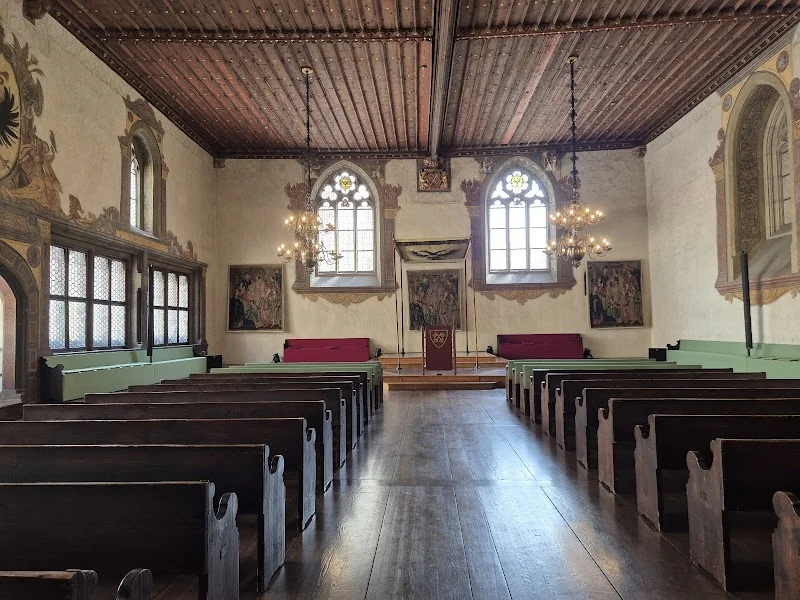
The heart of the document Reichstag is the Reichs hall. The official information from the museum and Regensburg Tourism GmbH emphasizes that the atmosphere of the Everlasting Reichstag in the Reichs hall and in the consultation rooms is still well perceptible. The Reichs hall was originally intended as a ballroom and was built in the early 14th century along with the Reichs hall building. Later, it became a place of political consultation of European significance. That is precisely why it makes sense to not only look for photos or beautiful views of the building during a visit but also to understand the function of the space. The consultation rooms of the imperial estates are part of this and show that politics did not only take place in the large plenary but in a spatially differentiated system of discussion, consultation, and decision-making. This part is complemented by the document collection and a permanent exhibition that explains the structure and function of the Reichstag. This means that the museum does not become a mere backdrop but a place of historical readability. Those taking the search intention behind terms like the old Reichstag, Reichstag museum, or Reichs hall seriously will find a place here where the terms have concrete spaces. This makes the visit particularly exciting for people who are interested not only in architecture but also in the political processes of the Old Empire. The city of Regensburg also points out that the Reichstag hall is seen as a precursor to modern parliamentary institutions. This is not a simplification but a classification that clarifies how unique the place is in European history. ([regensburg.de](https://www.regensburg.de/museen/die-museen/documente/document-reichstag))
In addition to the Reichs hall, the interrogation room is one of the most impressive components of the house. It is preserved in its original state and can be visited with guided tours. Regensburg Tourism GmbH describes it as an original preserved interrogation room, that is, a medieval torture chamber, and the city of Regensburg additionally refers to the prison and judiciary in the basement. These rooms make the history of the Old Town Hall not only representative but also very concrete and sometimes oppressive. This contrast between the representative Reichs hall and the strict, functional basement levels is characteristic of the place. It shows that power in the pre-modern town hall was not only celebrated or negotiated but also sanctioned and controlled. The doors, stairs, vaults, and cells thus tell of different levels of power. For many visitors, it is precisely the combination of Reichs hall, consultation rooms, documents, and interrogation room that makes the document Reichstag so impactful. It is a historical tour through political culture, jurisprudence, and city administration in a single building. Those wanting to take photos will find strong motifs at the portal, in the Reichs hall area, and in the historical sequences of rooms; those searching for history will find structure and context. Thus, the keywords photos, old images, Reichs hall, and interrogation room combine into a very clear visiting experience. ([tourismus.regensburg.de](https://tourismus.regensburg.de/erleben-entdecken/kunst-kultur/document-reichstag))
Accessibility and Practical Tips for the Visit
For planning the visit, some practical details are important. The city of Regensburg explicitly states that the rooms of the Everlasting Reichstag on the first floor are accessible. At the same time, it applies: the rooms for the judiciary in the basement are unfortunately not accessible. Those arriving with mobility restrictions should therefore register for the tour by phone in advance so that the organization can be appropriately prepared. This is an important note because the museum not only conveys historical content but also operates in a listed building that cannot be fully adapted to modern standards. Also relevant is that the Old Town Hall does not solely serve museum purposes. Events and receptions of the city of Regensburg also take place there, which is why access to the museum rooms may be temporarily restricted or even impossible. For visitors, this means: A quick look at the current tour situation is sensible, especially if one has a longer journey or only a fixed time frame available. The free admission to the museums of the city of Regensburg on the first Sunday of the month does not automatically apply here, as this regulation is explicitly excluded for the document Reichstag. Such details are particularly important for travel planning, family visits, and group trips. At the same time, the clear structure of the official information ensures that one can prepare the visit well. The document Reichstag is therefore not only historically impressive but also organizationally transparent. Those who heed the advice experience a calm, focused, and content-rich tour through one of the most significant places in Regensburg's city history. ([regensburg.de](https://www.regensburg.de/museen/die-museen/documente/document-reichstag))
An additional tip is to combine the visit with city exploration. Because the document Reichstag is located in the center of the old town, it can be easily combined with a walk over Rathausplatz, to the Tourist Information, to Haidplatz, or further through the UNESCO-protected old town. Regensburg Tourism GmbH emphasizes the central location of the Old Town Hall and describes the imposing tower as a widely visible sign. Those who plan their visit well can thus not only see the museum itself but also perceive the urban environment that makes the historical significance of the house understandable. For photo fans, a look at the portal building, the tower, and the surrounding squares is worthwhile; for history enthusiasts, the information boards, the permanent exhibition, and the tour provide the best access. The charm of the place lies precisely in the fact that it cannot be reduced to a single meaning. It is a museum, a place of political memory, an administrative building, an urban symbol, and part of the UNESCO heritage at the same time. That is why it also works so well as content for SEO landing pages: Search terms related to photos, history, tours, tickets, opening hours, directions, parking, and accessibility meet here with real, reliable facts. Those who know these facts plan better and experience the place more intensely. ([tourismus.regensburg.de](https://tourismus.regensburg.de/erleben-entdecken/unesco-welterbe-sehenswuerdigkeiten/sehenswuerdigkeiten/altes-rathaus))
Sources:
- City of Regensburg - document Reichstag ([regensburg.de](https://www.regensburg.de/museen/die-museen/documente/document-reichstag))
- Regensburg Tourism GmbH - document Reichstag ([tourismus.regensburg.de](https://tourismus.regensburg.de/erleben-entdecken/kunst-kultur/document-reichstag))
- Regensburg Tourism GmbH - Old Town Hall ([tourismus.regensburg.de](https://tourismus.regensburg.de/erleben-entdecken/unesco-welterbe-sehenswuerdigkeiten/sehenswuerdigkeiten/altes-rathaus))
- City of Regensburg - Travel Information document Reichstag ([regensburg.de](https://www.regensburg.de/sixcms/media.php/464/Anfahrtsinformation.pdf))
- City of Regensburg - Rathausplatz and Democracy History ([regensburg.de](https://www.regensburg.de/regensburg-507/sehenswert/der-rathausplatz?utm_source=openai))
Show moreShow less
document Reichstag in the Old Town Hall | Photos & History
The document Reichstag in the Old Town Hall in Regensburg is more than a museum with a historic name. It is a place where city history, imperial history, and political memory overlap in a very direct way. Those searching for photos, old views, or background knowledge quickly land at a building that has stood at the center of the old town for centuries and today tells the story of the Everlasting Reichstag as a Reichstag museum. In the Old Town Hall, the city council and administration once worked, the judiciary with prison and interrogation room was located in the basement, and from 1663 to 1806, the Everlasting Reichstag convened on the first floor. This special connection of town hall, politics, law, and exhibition makes the place so impressive for visitors. The building itself was created when Regensburg was elevated to a Free Imperial City in 1245; the 55-meter high tower and the Reichs hall building, originally intended as a ballroom, still shape the image today. At the same time, access is not freely available, but only within the framework of guided tours, which makes the visit manageable, focused, and content-rich. This is precisely the appeal: Here, history is not only shown but can be experienced spatially. ([tourismus.regensburg.de](https://tourismus.regensburg.de/erleben-entdecken/unesco-welterbe-sehenswuerdigkeiten/sehenswuerdigkeiten/altes-rathaus))
History, Photos, and the Everlasting Reichstag
The historical significance of the Old Town Hall begins long before the Reichstag. The city of Regensburg points out that the building was created when Regensburg was elevated to a Free Imperial City in 1245. Particularly striking is the oldest part of the complex: the 55-meter high tower. Around 1320/1330, the Reichs hall building was constructed, whose Reichs hall was originally intended as a ballroom. Only later did the space develop into a political venue of European significance. From 1663, the Everlasting Reichstag met here for almost 150 years, thus making Regensburg permanently a center of imperial politics. This long usage phase explains why the name document Reichstag is not just a museum label but a precise reference to a historical functional history. Those searching for old images, historical photographs, or views of the house are essentially looking for traces of this political past: the Reichs hall, the portal with the protective and defensive figures, the tower, and the square, which has maintained its status as a representative center for centuries. The city of Regensburg also emphasizes that the Reichstag hall is considered a precursor to modern parliamentary forms and is even placed in line with later European institutions in tourist representations. This interpretation is not merely decorative but makes it understandable why the building holds significance far beyond the city limits. For visitors, history is therefore not abstract but closely connected to specific spaces. This creates the effect that many associate with search terms like old images, history, or the old Reichstag. ([tourismus.regensburg.de](https://tourismus.regensburg.de/erleben-entdecken/unesco-welterbe-sehenswuerdigkeiten/sehenswuerdigkeiten/altes-rathaus))
The role of the house as a place of political concentration is also extraordinary. Official sources describe the Old Town Hall as the heart of the Free Imperial City of Regensburg, where the city council and administration worked and where the judiciary was located in the basement with prison and interrogation room. This connected local rule with regional imperial politics in a single building. This simultaneity of administration, law, and Reichstag is one of the reasons why the document Reichstag functions so convincingly as a place of learning: It makes visible how power was organized in the pre-modern era, how spaces were used for consultations, and how political decisions needed a concrete location. The museum presentation complements this history with a permanent exhibition that explains the structure and function of the Reichstag. Particularly interesting is that the atmosphere in the Reichs hall and in the consultation rooms is said to still be well perceptible. This is more than a tourist formulation; it refers to the spatial continuity of a place that has not been modernly reshaped but has preserved its historical readability. Those searching for photos of the Old Town Hall or the document Reichstag usually want to see exactly this mix of architecture, historical ambiance, and political significance. The building is therefore not just a part of the Regensburg old town but a strong symbol of the city's long European history. ([regensburg.de](https://www.regensburg.de/museen/die-museen/documente/document-reichstag))
Guided Tours, Tickets, and Opening Hours at document Reichstag
A visit to the document Reichstag is intentionally organized as a guided experience. The city of Regensburg explicitly states: Access only with guided tours. This may be unusual for many visitors at first, but it is appropriate for the place because the historical rooms are sensitive, and their understanding benefits from expert mediation. Tickets can be obtained at the Tourist Info at Rathausplatz, which is immediately near the building. This keeps the visiting process simple: first arrive, then secure a ticket, and then start the tour. The regular standard tour costs 7.50 euros for adults, 4 euros reduced, and 15 euros for families; school classes pay 50 euros. Those who only want to see the interrogation room and the prison cells can choose the short tour, which does not include the rooms of the Everlasting Reichstag and is therefore cheaper. This pricing structure shows that the house addresses different target groups: individual visitors, families, school classes, groups, and those with professional interest. According to Regensburg Tourism, the permanent exhibition was redesigned in 2003 and complements the historical rooms with background knowledge about the structure and function of the Reichstag. This means that the visit is not reduced to mere spatial perception but is didactically deepened. This is particularly valuable for guests who are interested not only in architecture but also in the historical context. The tours thus combine tourist experience with historical mediation. The search queries for tours, tickets, or opening hours reflect this need for orientation, and the official information provides the appropriate structure for it. Those planning their visit should also note that there are seasonally different tour times, so a brief prior check is sensible. ([regensburg.de](https://www.regensburg.de/museen/die-museen/documente/document-reichstag))
The temporal organization follows a clear pattern. From April 1 to October 31, there are several tours in close succession in the morning as well as additional times in the early afternoon and late afternoon; additionally, an English-speaking tour is offered. From March 1 to March 31 and from November 1 to January 6, the number of appointments is reduced, and between January 7 and February 28 or 29, the offer is the most limited. The document Reichstag is closed on New Year's Day, Shrove Tuesday, and December 24 and 25. This staggered schedule is practically important because it shows that the offer does not function as a classic freely accessible museum but as a guided presentation within ongoing operations. For groups with special interests, special tours can be arranged outside regular times. This is also relevant for travel planning and SEO because the search intentions behind terms like opening hours, tickets, or program specifically target such details. Those thinking beyond Regensburg's old town also recognize: The Old Town Hall is not an isolated museum building but also a place where municipal events and receptions take place. This can lead to restricted access to the museum rooms. This speaks for early planning, especially for group trips, educational excursions, or spontaneous short visits. Overall, this creates a visiting model that is historically appropriate and organizationally transparent. ([regensburg.de](https://www.regensburg.de/museen/die-museen/documente/document-reichstag))
Directions and Parking at Rathausplatz 4
The location of the document Reichstag is central and yet easy to explain. The official address is Rathausplatz 4, 93047 Regensburg. The building is located in the Old Town Hall in the Reichs hall building with the Reichstag museum. Those arriving by bus can reach the house via the Altes Rathaus stop; additionally, the Fischmarkt stops are in close proximity, served by several lines. For train travelers, Regensburg Central Station is a good starting point, as from there one can take the bus in a few minutes to the Old Town Hall or walk through the old town. The official travel information states approximately 15 minutes of walking from the station square via Maximilianstraße, Grasgasse, Obermünsterstraße, Obere Bachgasse, Untere Bachgasse, Kohlenmarkt, and Rathausplatz. This route is not only practical but also a beautiful introduction to the old town: The path leads right through historic Regensburg and creates an atmospheric experience even before entering the museum. For drivers, the city's travel information recommends the underground garage at the theater at Bismarckplatz and the parking garage at Dachauplatz. This is particularly important because the Old Town Hall itself is located in a very densely built historic area, and direct parking options are not a priority. Therefore, those wishing to travel comfortably should consider the parking garages as part of their planning. This type of information is what people searching for directions or parking are looking for, and it is essential for a central location like the document Reichstag. The paths are short enough to combine the visit with a walk through the old town, but long enough to require early orientation. This is the advantage of a central, well-connected historic location. ([regensburg.de](https://www.regensburg.de/sixcms/media.php/464/Anfahrtsinformation.pdf))
The location is also advantageous for groups and organized visits. The city's travel information makes it clear that access to the Reichs hall building is via the portal building located to the right of the Tourist Information. A stone outdoor staircase leads to the inner staircase and the foyer of the Reichs hall on the first floor. This is important for orientation on site because visitors do not simply enter the building like a modern museum but enter the complex through a historical pathway. At the same time, the tourist infrastructure in the town hall area provides a good basis for further explorations in the old town. The Rathausplatz itself is considered a political and representative center, and the city's tourism pages emphasize the central position of the Old Town Hall within Regensburg's attractions. For SEO and practical planning, this is an advantage: Search queries for directions, address, parking, or bus meet here with concrete and reliable information. Those arriving by car should consider that the city center and old town of Regensburg are sensitively organized; therefore, parking garages like at the theater or at Dachauplatz are the better choice than hoping for spontaneous spots directly in front of the house. The same logic applies even more strongly for travel groups, as travel and walking times must be calculated cleanly. This documents the character of the house as a sight embedded in urban life, not as an isolated museum on the outskirts. ([regensburg.de](https://www.regensburg.de/sixcms/media.php/464/Anfahrtsinformation.pdf))
Reichs hall, Consultation Rooms, and Interrogation Room
The heart of the document Reichstag is the Reichs hall. The official information from the museum and Regensburg Tourism GmbH emphasizes that the atmosphere of the Everlasting Reichstag in the Reichs hall and in the consultation rooms is still well perceptible. The Reichs hall was originally intended as a ballroom and was built in the early 14th century along with the Reichs hall building. Later, it became a place of political consultation of European significance. That is precisely why it makes sense to not only look for photos or beautiful views of the building during a visit but also to understand the function of the space. The consultation rooms of the imperial estates are part of this and show that politics did not only take place in the large plenary but in a spatially differentiated system of discussion, consultation, and decision-making. This part is complemented by the document collection and a permanent exhibition that explains the structure and function of the Reichstag. This means that the museum does not become a mere backdrop but a place of historical readability. Those taking the search intention behind terms like the old Reichstag, Reichstag museum, or Reichs hall seriously will find a place here where the terms have concrete spaces. This makes the visit particularly exciting for people who are interested not only in architecture but also in the political processes of the Old Empire. The city of Regensburg also points out that the Reichstag hall is seen as a precursor to modern parliamentary institutions. This is not a simplification but a classification that clarifies how unique the place is in European history. ([regensburg.de](https://www.regensburg.de/museen/die-museen/documente/document-reichstag))
In addition to the Reichs hall, the interrogation room is one of the most impressive components of the house. It is preserved in its original state and can be visited with guided tours. Regensburg Tourism GmbH describes it as an original preserved interrogation room, that is, a medieval torture chamber, and the city of Regensburg additionally refers to the prison and judiciary in the basement. These rooms make the history of the Old Town Hall not only representative but also very concrete and sometimes oppressive. This contrast between the representative Reichs hall and the strict, functional basement levels is characteristic of the place. It shows that power in the pre-modern town hall was not only celebrated or negotiated but also sanctioned and controlled. The doors, stairs, vaults, and cells thus tell of different levels of power. For many visitors, it is precisely the combination of Reichs hall, consultation rooms, documents, and interrogation room that makes the document Reichstag so impactful. It is a historical tour through political culture, jurisprudence, and city administration in a single building. Those wanting to take photos will find strong motifs at the portal, in the Reichs hall area, and in the historical sequences of rooms; those searching for history will find structure and context. Thus, the keywords photos, old images, Reichs hall, and interrogation room combine into a very clear visiting experience. ([tourismus.regensburg.de](https://tourismus.regensburg.de/erleben-entdecken/kunst-kultur/document-reichstag))
Accessibility and Practical Tips for the Visit
For planning the visit, some practical details are important. The city of Regensburg explicitly states that the rooms of the Everlasting Reichstag on the first floor are accessible. At the same time, it applies: the rooms for the judiciary in the basement are unfortunately not accessible. Those arriving with mobility restrictions should therefore register for the tour by phone in advance so that the organization can be appropriately prepared. This is an important note because the museum not only conveys historical content but also operates in a listed building that cannot be fully adapted to modern standards. Also relevant is that the Old Town Hall does not solely serve museum purposes. Events and receptions of the city of Regensburg also take place there, which is why access to the museum rooms may be temporarily restricted or even impossible. For visitors, this means: A quick look at the current tour situation is sensible, especially if one has a longer journey or only a fixed time frame available. The free admission to the museums of the city of Regensburg on the first Sunday of the month does not automatically apply here, as this regulation is explicitly excluded for the document Reichstag. Such details are particularly important for travel planning, family visits, and group trips. At the same time, the clear structure of the official information ensures that one can prepare the visit well. The document Reichstag is therefore not only historically impressive but also organizationally transparent. Those who heed the advice experience a calm, focused, and content-rich tour through one of the most significant places in Regensburg's city history. ([regensburg.de](https://www.regensburg.de/museen/die-museen/documente/document-reichstag))
An additional tip is to combine the visit with city exploration. Because the document Reichstag is located in the center of the old town, it can be easily combined with a walk over Rathausplatz, to the Tourist Information, to Haidplatz, or further through the UNESCO-protected old town. Regensburg Tourism GmbH emphasizes the central location of the Old Town Hall and describes the imposing tower as a widely visible sign. Those who plan their visit well can thus not only see the museum itself but also perceive the urban environment that makes the historical significance of the house understandable. For photo fans, a look at the portal building, the tower, and the surrounding squares is worthwhile; for history enthusiasts, the information boards, the permanent exhibition, and the tour provide the best access. The charm of the place lies precisely in the fact that it cannot be reduced to a single meaning. It is a museum, a place of political memory, an administrative building, an urban symbol, and part of the UNESCO heritage at the same time. That is why it also works so well as content for SEO landing pages: Search terms related to photos, history, tours, tickets, opening hours, directions, parking, and accessibility meet here with real, reliable facts. Those who know these facts plan better and experience the place more intensely. ([tourismus.regensburg.de](https://tourismus.regensburg.de/erleben-entdecken/unesco-welterbe-sehenswuerdigkeiten/sehenswuerdigkeiten/altes-rathaus))
Sources:
- City of Regensburg - document Reichstag ([regensburg.de](https://www.regensburg.de/museen/die-museen/documente/document-reichstag))
- Regensburg Tourism GmbH - document Reichstag ([tourismus.regensburg.de](https://tourismus.regensburg.de/erleben-entdecken/kunst-kultur/document-reichstag))
- Regensburg Tourism GmbH - Old Town Hall ([tourismus.regensburg.de](https://tourismus.regensburg.de/erleben-entdecken/unesco-welterbe-sehenswuerdigkeiten/sehenswuerdigkeiten/altes-rathaus))
- City of Regensburg - Travel Information document Reichstag ([regensburg.de](https://www.regensburg.de/sixcms/media.php/464/Anfahrtsinformation.pdf))
- City of Regensburg - Rathausplatz and Democracy History ([regensburg.de](https://www.regensburg.de/regensburg-507/sehenswert/der-rathausplatz?utm_source=openai))
document Reichstag in the Old Town Hall | Photos & History
The document Reichstag in the Old Town Hall in Regensburg is more than a museum with a historic name. It is a place where city history, imperial history, and political memory overlap in a very direct way. Those searching for photos, old views, or background knowledge quickly land at a building that has stood at the center of the old town for centuries and today tells the story of the Everlasting Reichstag as a Reichstag museum. In the Old Town Hall, the city council and administration once worked, the judiciary with prison and interrogation room was located in the basement, and from 1663 to 1806, the Everlasting Reichstag convened on the first floor. This special connection of town hall, politics, law, and exhibition makes the place so impressive for visitors. The building itself was created when Regensburg was elevated to a Free Imperial City in 1245; the 55-meter high tower and the Reichs hall building, originally intended as a ballroom, still shape the image today. At the same time, access is not freely available, but only within the framework of guided tours, which makes the visit manageable, focused, and content-rich. This is precisely the appeal: Here, history is not only shown but can be experienced spatially. ([tourismus.regensburg.de](https://tourismus.regensburg.de/erleben-entdecken/unesco-welterbe-sehenswuerdigkeiten/sehenswuerdigkeiten/altes-rathaus))
History, Photos, and the Everlasting Reichstag
The historical significance of the Old Town Hall begins long before the Reichstag. The city of Regensburg points out that the building was created when Regensburg was elevated to a Free Imperial City in 1245. Particularly striking is the oldest part of the complex: the 55-meter high tower. Around 1320/1330, the Reichs hall building was constructed, whose Reichs hall was originally intended as a ballroom. Only later did the space develop into a political venue of European significance. From 1663, the Everlasting Reichstag met here for almost 150 years, thus making Regensburg permanently a center of imperial politics. This long usage phase explains why the name document Reichstag is not just a museum label but a precise reference to a historical functional history. Those searching for old images, historical photographs, or views of the house are essentially looking for traces of this political past: the Reichs hall, the portal with the protective and defensive figures, the tower, and the square, which has maintained its status as a representative center for centuries. The city of Regensburg also emphasizes that the Reichstag hall is considered a precursor to modern parliamentary forms and is even placed in line with later European institutions in tourist representations. This interpretation is not merely decorative but makes it understandable why the building holds significance far beyond the city limits. For visitors, history is therefore not abstract but closely connected to specific spaces. This creates the effect that many associate with search terms like old images, history, or the old Reichstag. ([tourismus.regensburg.de](https://tourismus.regensburg.de/erleben-entdecken/unesco-welterbe-sehenswuerdigkeiten/sehenswuerdigkeiten/altes-rathaus))
The role of the house as a place of political concentration is also extraordinary. Official sources describe the Old Town Hall as the heart of the Free Imperial City of Regensburg, where the city council and administration worked and where the judiciary was located in the basement with prison and interrogation room. This connected local rule with regional imperial politics in a single building. This simultaneity of administration, law, and Reichstag is one of the reasons why the document Reichstag functions so convincingly as a place of learning: It makes visible how power was organized in the pre-modern era, how spaces were used for consultations, and how political decisions needed a concrete location. The museum presentation complements this history with a permanent exhibition that explains the structure and function of the Reichstag. Particularly interesting is that the atmosphere in the Reichs hall and in the consultation rooms is said to still be well perceptible. This is more than a tourist formulation; it refers to the spatial continuity of a place that has not been modernly reshaped but has preserved its historical readability. Those searching for photos of the Old Town Hall or the document Reichstag usually want to see exactly this mix of architecture, historical ambiance, and political significance. The building is therefore not just a part of the Regensburg old town but a strong symbol of the city's long European history. ([regensburg.de](https://www.regensburg.de/museen/die-museen/documente/document-reichstag))
Guided Tours, Tickets, and Opening Hours at document Reichstag
A visit to the document Reichstag is intentionally organized as a guided experience. The city of Regensburg explicitly states: Access only with guided tours. This may be unusual for many visitors at first, but it is appropriate for the place because the historical rooms are sensitive, and their understanding benefits from expert mediation. Tickets can be obtained at the Tourist Info at Rathausplatz, which is immediately near the building. This keeps the visiting process simple: first arrive, then secure a ticket, and then start the tour. The regular standard tour costs 7.50 euros for adults, 4 euros reduced, and 15 euros for families; school classes pay 50 euros. Those who only want to see the interrogation room and the prison cells can choose the short tour, which does not include the rooms of the Everlasting Reichstag and is therefore cheaper. This pricing structure shows that the house addresses different target groups: individual visitors, families, school classes, groups, and those with professional interest. According to Regensburg Tourism, the permanent exhibition was redesigned in 2003 and complements the historical rooms with background knowledge about the structure and function of the Reichstag. This means that the visit is not reduced to mere spatial perception but is didactically deepened. This is particularly valuable for guests who are interested not only in architecture but also in the historical context. The tours thus combine tourist experience with historical mediation. The search queries for tours, tickets, or opening hours reflect this need for orientation, and the official information provides the appropriate structure for it. Those planning their visit should also note that there are seasonally different tour times, so a brief prior check is sensible. ([regensburg.de](https://www.regensburg.de/museen/die-museen/documente/document-reichstag))
The temporal organization follows a clear pattern. From April 1 to October 31, there are several tours in close succession in the morning as well as additional times in the early afternoon and late afternoon; additionally, an English-speaking tour is offered. From March 1 to March 31 and from November 1 to January 6, the number of appointments is reduced, and between January 7 and February 28 or 29, the offer is the most limited. The document Reichstag is closed on New Year's Day, Shrove Tuesday, and December 24 and 25. This staggered schedule is practically important because it shows that the offer does not function as a classic freely accessible museum but as a guided presentation within ongoing operations. For groups with special interests, special tours can be arranged outside regular times. This is also relevant for travel planning and SEO because the search intentions behind terms like opening hours, tickets, or program specifically target such details. Those thinking beyond Regensburg's old town also recognize: The Old Town Hall is not an isolated museum building but also a place where municipal events and receptions take place. This can lead to restricted access to the museum rooms. This speaks for early planning, especially for group trips, educational excursions, or spontaneous short visits. Overall, this creates a visiting model that is historically appropriate and organizationally transparent. ([regensburg.de](https://www.regensburg.de/museen/die-museen/documente/document-reichstag))
Directions and Parking at Rathausplatz 4
The location of the document Reichstag is central and yet easy to explain. The official address is Rathausplatz 4, 93047 Regensburg. The building is located in the Old Town Hall in the Reichs hall building with the Reichstag museum. Those arriving by bus can reach the house via the Altes Rathaus stop; additionally, the Fischmarkt stops are in close proximity, served by several lines. For train travelers, Regensburg Central Station is a good starting point, as from there one can take the bus in a few minutes to the Old Town Hall or walk through the old town. The official travel information states approximately 15 minutes of walking from the station square via Maximilianstraße, Grasgasse, Obermünsterstraße, Obere Bachgasse, Untere Bachgasse, Kohlenmarkt, and Rathausplatz. This route is not only practical but also a beautiful introduction to the old town: The path leads right through historic Regensburg and creates an atmospheric experience even before entering the museum. For drivers, the city's travel information recommends the underground garage at the theater at Bismarckplatz and the parking garage at Dachauplatz. This is particularly important because the Old Town Hall itself is located in a very densely built historic area, and direct parking options are not a priority. Therefore, those wishing to travel comfortably should consider the parking garages as part of their planning. This type of information is what people searching for directions or parking are looking for, and it is essential for a central location like the document Reichstag. The paths are short enough to combine the visit with a walk through the old town, but long enough to require early orientation. This is the advantage of a central, well-connected historic location. ([regensburg.de](https://www.regensburg.de/sixcms/media.php/464/Anfahrtsinformation.pdf))
The location is also advantageous for groups and organized visits. The city's travel information makes it clear that access to the Reichs hall building is via the portal building located to the right of the Tourist Information. A stone outdoor staircase leads to the inner staircase and the foyer of the Reichs hall on the first floor. This is important for orientation on site because visitors do not simply enter the building like a modern museum but enter the complex through a historical pathway. At the same time, the tourist infrastructure in the town hall area provides a good basis for further explorations in the old town. The Rathausplatz itself is considered a political and representative center, and the city's tourism pages emphasize the central position of the Old Town Hall within Regensburg's attractions. For SEO and practical planning, this is an advantage: Search queries for directions, address, parking, or bus meet here with concrete and reliable information. Those arriving by car should consider that the city center and old town of Regensburg are sensitively organized; therefore, parking garages like at the theater or at Dachauplatz are the better choice than hoping for spontaneous spots directly in front of the house. The same logic applies even more strongly for travel groups, as travel and walking times must be calculated cleanly. This documents the character of the house as a sight embedded in urban life, not as an isolated museum on the outskirts. ([regensburg.de](https://www.regensburg.de/sixcms/media.php/464/Anfahrtsinformation.pdf))
Reichs hall, Consultation Rooms, and Interrogation Room
The heart of the document Reichstag is the Reichs hall. The official information from the museum and Regensburg Tourism GmbH emphasizes that the atmosphere of the Everlasting Reichstag in the Reichs hall and in the consultation rooms is still well perceptible. The Reichs hall was originally intended as a ballroom and was built in the early 14th century along with the Reichs hall building. Later, it became a place of political consultation of European significance. That is precisely why it makes sense to not only look for photos or beautiful views of the building during a visit but also to understand the function of the space. The consultation rooms of the imperial estates are part of this and show that politics did not only take place in the large plenary but in a spatially differentiated system of discussion, consultation, and decision-making. This part is complemented by the document collection and a permanent exhibition that explains the structure and function of the Reichstag. This means that the museum does not become a mere backdrop but a place of historical readability. Those taking the search intention behind terms like the old Reichstag, Reichstag museum, or Reichs hall seriously will find a place here where the terms have concrete spaces. This makes the visit particularly exciting for people who are interested not only in architecture but also in the political processes of the Old Empire. The city of Regensburg also points out that the Reichstag hall is seen as a precursor to modern parliamentary institutions. This is not a simplification but a classification that clarifies how unique the place is in European history. ([regensburg.de](https://www.regensburg.de/museen/die-museen/documente/document-reichstag))
In addition to the Reichs hall, the interrogation room is one of the most impressive components of the house. It is preserved in its original state and can be visited with guided tours. Regensburg Tourism GmbH describes it as an original preserved interrogation room, that is, a medieval torture chamber, and the city of Regensburg additionally refers to the prison and judiciary in the basement. These rooms make the history of the Old Town Hall not only representative but also very concrete and sometimes oppressive. This contrast between the representative Reichs hall and the strict, functional basement levels is characteristic of the place. It shows that power in the pre-modern town hall was not only celebrated or negotiated but also sanctioned and controlled. The doors, stairs, vaults, and cells thus tell of different levels of power. For many visitors, it is precisely the combination of Reichs hall, consultation rooms, documents, and interrogation room that makes the document Reichstag so impactful. It is a historical tour through political culture, jurisprudence, and city administration in a single building. Those wanting to take photos will find strong motifs at the portal, in the Reichs hall area, and in the historical sequences of rooms; those searching for history will find structure and context. Thus, the keywords photos, old images, Reichs hall, and interrogation room combine into a very clear visiting experience. ([tourismus.regensburg.de](https://tourismus.regensburg.de/erleben-entdecken/kunst-kultur/document-reichstag))
Accessibility and Practical Tips for the Visit
For planning the visit, some practical details are important. The city of Regensburg explicitly states that the rooms of the Everlasting Reichstag on the first floor are accessible. At the same time, it applies: the rooms for the judiciary in the basement are unfortunately not accessible. Those arriving with mobility restrictions should therefore register for the tour by phone in advance so that the organization can be appropriately prepared. This is an important note because the museum not only conveys historical content but also operates in a listed building that cannot be fully adapted to modern standards. Also relevant is that the Old Town Hall does not solely serve museum purposes. Events and receptions of the city of Regensburg also take place there, which is why access to the museum rooms may be temporarily restricted or even impossible. For visitors, this means: A quick look at the current tour situation is sensible, especially if one has a longer journey or only a fixed time frame available. The free admission to the museums of the city of Regensburg on the first Sunday of the month does not automatically apply here, as this regulation is explicitly excluded for the document Reichstag. Such details are particularly important for travel planning, family visits, and group trips. At the same time, the clear structure of the official information ensures that one can prepare the visit well. The document Reichstag is therefore not only historically impressive but also organizationally transparent. Those who heed the advice experience a calm, focused, and content-rich tour through one of the most significant places in Regensburg's city history. ([regensburg.de](https://www.regensburg.de/museen/die-museen/documente/document-reichstag))
An additional tip is to combine the visit with city exploration. Because the document Reichstag is located in the center of the old town, it can be easily combined with a walk over Rathausplatz, to the Tourist Information, to Haidplatz, or further through the UNESCO-protected old town. Regensburg Tourism GmbH emphasizes the central location of the Old Town Hall and describes the imposing tower as a widely visible sign. Those who plan their visit well can thus not only see the museum itself but also perceive the urban environment that makes the historical significance of the house understandable. For photo fans, a look at the portal building, the tower, and the surrounding squares is worthwhile; for history enthusiasts, the information boards, the permanent exhibition, and the tour provide the best access. The charm of the place lies precisely in the fact that it cannot be reduced to a single meaning. It is a museum, a place of political memory, an administrative building, an urban symbol, and part of the UNESCO heritage at the same time. That is why it also works so well as content for SEO landing pages: Search terms related to photos, history, tours, tickets, opening hours, directions, parking, and accessibility meet here with real, reliable facts. Those who know these facts plan better and experience the place more intensely. ([tourismus.regensburg.de](https://tourismus.regensburg.de/erleben-entdecken/unesco-welterbe-sehenswuerdigkeiten/sehenswuerdigkeiten/altes-rathaus))
Sources:
- City of Regensburg - document Reichstag ([regensburg.de](https://www.regensburg.de/museen/die-museen/documente/document-reichstag))
- Regensburg Tourism GmbH - document Reichstag ([tourismus.regensburg.de](https://tourismus.regensburg.de/erleben-entdecken/kunst-kultur/document-reichstag))
- Regensburg Tourism GmbH - Old Town Hall ([tourismus.regensburg.de](https://tourismus.regensburg.de/erleben-entdecken/unesco-welterbe-sehenswuerdigkeiten/sehenswuerdigkeiten/altes-rathaus))
- City of Regensburg - Travel Information document Reichstag ([regensburg.de](https://www.regensburg.de/sixcms/media.php/464/Anfahrtsinformation.pdf))
- City of Regensburg - Rathausplatz and Democracy History ([regensburg.de](https://www.regensburg.de/regensburg-507/sehenswert/der-rathausplatz?utm_source=openai))
Frequently Asked Questions
Reviews
Eric Garland
8. December 2025
Very interesting tour. Well worth a visit to learn about the history of this historic beautiful town.
Coral Ouellette
23. April 2025
Guide was very informative with our indoor tour of the rooms used and explanation of the methods of extracting a confession.
Laura Lieber
8. September 2024
Super fun, especially for kids, but the tour guide was great for adults, too.
Friedr Morandell
21. January 2018
It's worth a visit for its importance in the history of Germany. Audioguides are available in many languages and are very informative but the guide doesn't give you enough time to hear.
Petra Vallone
16. October 2024
Very informative and interesting tour through History. Your guide was very knowledgeable.