
Regensburg
Kumpfmühler Str. 2, 93047 Regensburg, Deutschland
Dörnbergpalais | Dörnbergpark & Parking
The Dörnbergpalais is one of the characteristic historical addresses in Regensburg and, together with the Dörnbergpark, forms an ensemble that uniquely combines architecture, garden art, and urban space. The palace is located at Kumpfmühler Straße 2 on the edge of the inner west, in an area where the proximity to the old town, the tranquil atmosphere of a historic park, and the functional closeness to court and office buildings converge. Therefore, when searching for Dörnbergpalais Regensburg, one is not only referring to a single building but often also to the Dörnbergpark, the paths around the palace, the access via Kumpfmühler Straße, and the question of how to get there and parking. The current image of the place is shaped by its history: from an early suburban villa, it developed into a palace in the 19th century, while the surrounding park was designed according to the principles of the English landscape garden. This connection makes the place equally interesting for walkers, architecture enthusiasts, and visitors to the district. The palace is not a classic event venue with a large ticket structure, but a monument and workplace in one of the most beautiful green locations in Regensburg. This is precisely what gives it its charm: understated, historical, urban, and surprisingly quiet. In the following sections, you will find the most important facts about the history, park, access, parking, and the special features of this place.
History of the Dörnbergpalais and its Classicist Roots
The history of the Dörnbergpalais begins in the early 19th century when the princely Thurn and Taxis court factor Philipp Reichenberger acquired the so-called Schereraacker at what would later become Kumpfmühler Straße in 1804. He intended to build a representative estate with a small English garden. The design for the mansion west of the old town was created by Emanuel d'Herigoyen, the princely city and country master builder, who shaped several significant classicist buildings in Regensburg. Between 1804 and 1806, the first version of today's ensemble was created, which at that time could still be understood as a suburban villa with a garden. The location was deliberately chosen: slightly outside the then-closed city, yet still closely connected to urban life. This position at the boundary between the old town, suburb, and open landscape makes the place so special to this day. The palace represents an era when Regensburg opened up to the outside and simultaneously developed new representative forms of living.
After Reichenberger's death and several changes of ownership, the estate came to Ludwig Paul von Axter in 1832 and finally to Ernst Friedrich Moritz Alexander Freiherr von Dörnberg in 1833. With this owner, the phase began that gave the ensemble its current name. Dörnberg had the palace expanded, the side wings lengthened and raised. By 1838, the form of the Dörnbergpalais known today had emerged. The architectural development shows how an early suburban villa became a representative city palace that opened more to the surroundings and the park. This expansion makes the building an important testimony to classicist Regensburg. It does not stand isolated but forms a historical connection with the later Dörnbergpark regarding living, representation, garden art, and social status. Therefore, the history of the house tells not only of individual construction phases but also of urban changes in the western part of the city. Today, when one looks at the palace, one does not simply see an old building but a piece of Regensburg's urban development on the scale of a private noble residence.
The later use of the estate is also historically interesting. After the death of Ernst Graf von Dörnberg, the property was transferred to the foundation he established, the Gräflich Dörnberg'sche Waisenfonds-Stiftung. This preserved the substance of the ensemble and prevented it from being dissolved into an ordinary urban new development area. This is a significant reason why the palace and the park are still perceived today as a coherent historical environment. The location at Kumpfmühler Straße 2 also makes the building easy to find and clearly locatable: those searching for the Dörnbergpalais are, in truth, looking for a piece of Regensburg's cultural history that can be read in architecture, ownership history, and urban development alike. In this sense, the palace is not just a beautiful building but a document of the transition from a private suburban villa to the representative city palace of the 19th century.
Dörnbergpark: English Landscape Garden with Sight Axes
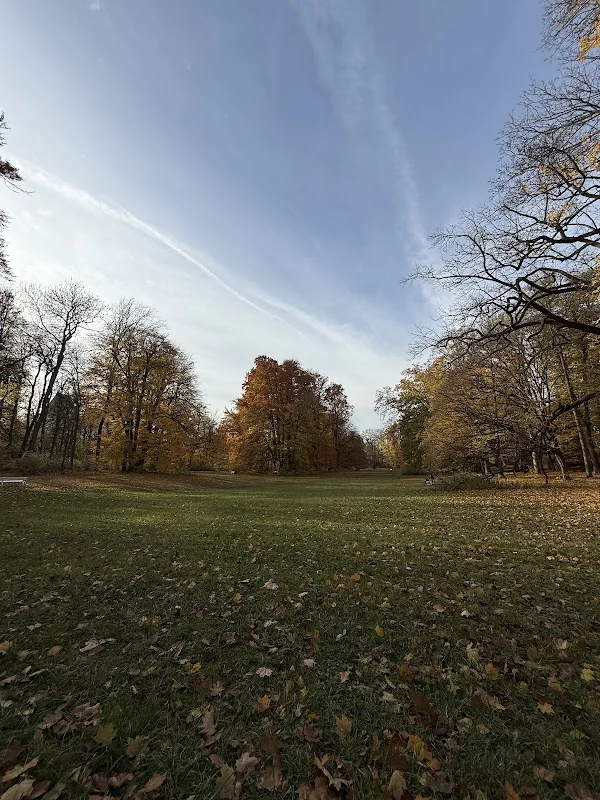
The Dörnbergpark is the second key to understanding the Dörnbergpalais, as both are historically and spatially inseparable. The city of Regensburg describes the park as an English landscape garden that offers everything characteristic of this style: gently winding paths, wide lawns, groups of trees with gnarled chestnuts and majestic beeches, as well as backdrop buildings embedded in nature. The planning of the current park goes back to the royal Bavarian court gardener director Carl von Effner, a student of Lenné. Effner was commissioned by Ernst Friedrich Freiherr von Dörnberg after he acquired the former villa with garden in 1832. As part of the park expansion, a generous landscape garden was created on the site starting in 1864, which reinterpreted the old garden and gave it significantly more spatial impact. The execution was taken over by court gardener Leonhard Kaiser along Kumpfmühler and Augustenstraße. Thus, the park developed into a facility that does not impress with monumental size but rather with clever sequences of space and strong visual relationships.
Particularly important are the sight axes. The Dörnbergpark is structured by three prominent buildings that together define the character of the facility: the Dörnbergpalais in the east, the Swiss house with rose garden in the west, and the society house in the north. These buildings not only mark endpoints of sight axes but also structure the park spaces. Between them lie large meadows, groups of trees, and winding paths that create new perspectives. This design makes the park a special place of Regensburg's garden art. The city notes that over 1,000 trees are registered in the park, and a large part of them is very old. Additionally, the historical significance of the so-called cluster plantings, a planting method that can still be traced in the facility and is considered a well-preserved example of Effner's design style, adds to this. Thus, the Dörnbergpark is not only beautiful but also valuable in terms of garden monument preservation.
The history of the park is closely linked to the history of its owners and the city. After the death of Ernst Graf von Dörnberg, the property was incorporated into a foundation. It was not until 1938 that the city administration managed to open the facility to the public. Since 1947, the park has been under monument protection, and in 1956, a care contract was concluded between the foundation and the city, which regulated the maintenance and management by the gardening office. The park is thus not simply a private green space but a public cultural asset with a long administrative history. In recent decades, the facility had to be closed temporarily due to tree diseases and drought damage; this shows how sensitive historical parks are and how much effort is needed to preserve their character. This blend of beauty, history, and care makes the Dörnbergpark a special place that goes far beyond the usual urban greenery. Those who walk here experience a grown ensemble with a long tradition, whose impact is still strong today.
The park also has much to offer in detail. The city describes that the wide lawns are framed by powerful groups of trees whose branches sometimes hang down to the ground. In spring, liverworts, wood anemones, larkspurs, and winterlings bloom, while in summer the canopy cools, and in autumn light, shadow, and the scent of leaves shape the character of the facility. The blood beech at the northern edge of the park is deliberately set as a dramatic endpoint of a sight axis. Such details show how strongly the Dörnbergpark relies on staged naturalness. It appears calm and self-evident, yet is, in truth, carefully composed. This makes it an ideal place for visitors who do not just want to see paths and buildings but seek a thoughtful connection between nature and architecture.
Access to the Dörnbergpalais, Parking, and Public Transport
Those wishing to visit the Dörnbergpalais or use the Dörnbergpark as a starting point for a walk should know the address Kumpfmühler Straße 2 in Regensburg. The place is located in an area that is easily accessible by both car and public transport. An important orientation is provided by the law firm in the building itself: it states that coming from Kumpfmühler Straße towards the city center, one turns left into Wittelsbacherstraße and then immediately left again into the avenue to Dörnbergpark. The law firm is located in the right wing of the building. This description is helpful for visitors because the palace appears as an ensemble from the outside and is not immediately recognizable as a single office building. First-time visitors benefit from clear guidance through the side streets. This also fits the location of the house: it is historical and simultaneously integrated into urban everyday life.
Regarding parking, there are two important notes from the sources found. First, the law firm mentions parking spaces in the courtyard. This indicates that there may be at least limited parking available directly at the building. Second, the Regensburg District Court refers to two parking spaces for the disabled on Augustenstraße right before the intersection with Kumpfmühler Straße, near the Justice Fountain. This is a valuable note for visitors with limited mobility. At the same time, it should be noted that this is an inner-city area where free parking spaces are not guaranteed. No large parking garage directly at the Dörnbergpalais is mentioned in the official information found. Therefore, those specifically searching for Dörnbergpark parking or Dörnbergpark parking garage should prepare for limited spaces and a combination of courtyard, street space, and surrounding parking spaces. This is why arriving by bus is often the more relaxing solution.
The most important public transport information also comes from the law firm in the palace: the nearby stop is named Justizgebäude, reachable by bus lines 8, 17, and 26. This means the Dörnbergpalais is well connected to Regensburg's public transport. Those arriving by bus reach the place without the hassle of finding a parking space and are quickly near the park and the justice buildings. The proximity to the justice quarter is also helpful for orientation: those heading for the Justizgebäude stop find themselves in an area where Kumpfmühler Straße, Augustenstraße, Wittelsbacherstraße, and the avenue to Dörnbergpark converge. This not only facilitates access but also the return after a walk through the park.
It is also practical that the Dörnbergpalais is located in a part of the city that can be easily combined with a city tour. The combination of palace, park, and nearby justice area makes the place interesting for various target groups: for people with appointments, for walkers, and for visitors who want to see historical architecture. Those planning to come by car should consider the inner-city location; those preferring bus and walking will find a significantly simpler solution. From an SEO perspective, this blend of access, parking, and public transport is relevant as it covers the most common user questions regarding the location. In practice, this means: for a relaxed visit, arriving by bus to the Justizgebäude stop is often the best choice, while parking is primarily sensible for short appointments or visits with a clear destination.
Walk, Surroundings, and Special Highlights around the Palace
The Dörnbergpalais unfolds its effect not only through its facade but especially in interaction with its surroundings. Therefore, those visiting the building should not only keep an eye on the house number but also on the surrounding spaces of the Dörnbergpark. The city of Regensburg describes the park as a facility with winding paths, large lawns, and powerful groups of trees that always reveal new sight axes. This makes a walk so appealing: instead of a strictly geometric path layout, one experiences changing spatial images that make the area seem larger than it actually is. This illusion of spaciousness is typical for English landscape parks and is particularly well achieved in the Dörnbergpark. The palace serves as one of the architectural reference points that anchors the area at its eastern edge.
Among the special highlights are the rose garden in the former Swiss house area, the society house in the north, and the dense, old groups of trees that act like backdrops. In spring, the park shows its delicate side with blossoms and fresh green; in summer, it provides shade and tranquility; in autumn, the foliage creates particularly beautiful color moods. The city also mentions that rabbits and field hares can frolic in the park during the early morning hours and that bats and owls also find habitat here. Such observations make it clear that the Dörnbergpark is not just a monument but also a vibrant urban space. Those who walk through it with an open eye experience nature, history, and urban ecology simultaneously.
For visitors, the interplay of architecture and landscape is particularly interesting. The Dörnbergpalais does not appear as an isolated urban object near the park but rather as the architectural counterpoint to the open meadows and trees. This connection makes the location so attractive. The palace embodies order, representation, and classicist form; the park responds with openness, curves, and a seemingly natural appearance. Together, they form an ensemble suitable for both short visits and longer walks. Those searching for historical places in Regensburg receive not just a single monument but a complete scene with plenty of atmosphere. The surroundings are quiet enough for a walk but close enough to the city center to easily connect with other destinations.
Another practical aspect: the place is excellent for people interested in urban history, garden art, or historical residential culture. The palace itself is an impressive example of classicist architecture, while the park is a lesson in the English landscape garden of the 19th century. Together, a visit emerges that does not need to be loud or spectacular to have a lasting impact. It is precisely the quiet, well-kept, and historical ambiance that is the true strength of the place. Therefore, those looking for a destination that does not rely on grand staging but still offers substantial value will find a very convincing address at the Dörnbergpalais and in the Dörnbergpark.
What Visitors Can Expect Today at the Dörnbergpalais
Those visiting the Dörnbergpalais today should understand it as a historical place with current use. The building is not a large event hall and not a classic tourist ticket location, but a palace with office use in a listed environment. This shapes the visitor's expectations: one does not come for a fixed program but for the architecture, the location, and the immediate access to Dörnbergpark. This mix is typical for many Regensburg monuments that continue to be used in urban everyday life and thus remain lively. The Dörnbergpalais is a good example of this, as it combines historical substance with a very practical present. Therefore, those searching for Dörnbergpalais Regensburg, Dörnbergpark Regensburg, or Dörnbergpark access often want to know exactly how history, place, and current use fit together. The answer is simple: very closely.
For a visit, it is worthwhile to approach the place with some time. Arriving via Kumpfmühler Straße already conveys a different city feeling than an ordinary city center visit. The view of the palace, the proximity to the avenue, the transitions to the park, and the tranquility of the area create a framework that feels more like a walk than an appointment. At the same time, the location is central enough to connect the visit with further paths in the city. This makes the place particularly interesting for people seeking short, high-quality urban experiences. Those who pay attention to details will also see traces of history: the classicist origins, the expansions of the 19th century, the park architectural staging, and the current integration into a well-maintained, publicly accessible green area.
It is also important to honestly assess the capacity. For the Dörnbergpalais, there are no regular hall or event specifications in the available sources as with a concert hall. Therefore, it is sensible not to confuse the place with an event location. Its strength lies not in a large number of seats but in the quality of the place itself. This is even an advantage from an SEO perspective, as users searching for capacity, seating plans, or parking quickly find the relevant information and simultaneously understand that this is a historical palace with a different function. This transparent handling of the location builds trust and ensures that the search for information remains practically helpful.
Ultimately, the Dörnbergpalais is an address for all those who want to discover Regensburg not only as an old town but also as a city of garden facilities and historical villas. The palace itself tells of classicist architecture, the Dörnbergpark of landscape art and urban nature, and the connection to Kumpfmühler Straße shows how well historical places can be integrated into today's everyday life. Those visiting the ensemble experience not an overloaded hotspot but a place with tranquility, history, and clear urban identity. This is precisely what makes it appealing.
Sources:
- City of Regensburg - The Dörnbergpark – an English Landscape Garden in Transition
- City of Regensburg - The Dörnbergpark – History and Future (PDF)
- Bavarian State Ministry of Justice - District Court Regensburg Contact
- Law Firm Dr. Münch - Contact and Directions in the Dörnberg-Palais
- vhs Regensburg - Park Tour for Spring Bloom: Dörnbergpark
Show moreShow less
Dörnbergpalais | Dörnbergpark & Parking
The Dörnbergpalais is one of the characteristic historical addresses in Regensburg and, together with the Dörnbergpark, forms an ensemble that uniquely combines architecture, garden art, and urban space. The palace is located at Kumpfmühler Straße 2 on the edge of the inner west, in an area where the proximity to the old town, the tranquil atmosphere of a historic park, and the functional closeness to court and office buildings converge. Therefore, when searching for Dörnbergpalais Regensburg, one is not only referring to a single building but often also to the Dörnbergpark, the paths around the palace, the access via Kumpfmühler Straße, and the question of how to get there and parking. The current image of the place is shaped by its history: from an early suburban villa, it developed into a palace in the 19th century, while the surrounding park was designed according to the principles of the English landscape garden. This connection makes the place equally interesting for walkers, architecture enthusiasts, and visitors to the district. The palace is not a classic event venue with a large ticket structure, but a monument and workplace in one of the most beautiful green locations in Regensburg. This is precisely what gives it its charm: understated, historical, urban, and surprisingly quiet. In the following sections, you will find the most important facts about the history, park, access, parking, and the special features of this place.
History of the Dörnbergpalais and its Classicist Roots
The history of the Dörnbergpalais begins in the early 19th century when the princely Thurn and Taxis court factor Philipp Reichenberger acquired the so-called Schereraacker at what would later become Kumpfmühler Straße in 1804. He intended to build a representative estate with a small English garden. The design for the mansion west of the old town was created by Emanuel d'Herigoyen, the princely city and country master builder, who shaped several significant classicist buildings in Regensburg. Between 1804 and 1806, the first version of today's ensemble was created, which at that time could still be understood as a suburban villa with a garden. The location was deliberately chosen: slightly outside the then-closed city, yet still closely connected to urban life. This position at the boundary between the old town, suburb, and open landscape makes the place so special to this day. The palace represents an era when Regensburg opened up to the outside and simultaneously developed new representative forms of living.
After Reichenberger's death and several changes of ownership, the estate came to Ludwig Paul von Axter in 1832 and finally to Ernst Friedrich Moritz Alexander Freiherr von Dörnberg in 1833. With this owner, the phase began that gave the ensemble its current name. Dörnberg had the palace expanded, the side wings lengthened and raised. By 1838, the form of the Dörnbergpalais known today had emerged. The architectural development shows how an early suburban villa became a representative city palace that opened more to the surroundings and the park. This expansion makes the building an important testimony to classicist Regensburg. It does not stand isolated but forms a historical connection with the later Dörnbergpark regarding living, representation, garden art, and social status. Therefore, the history of the house tells not only of individual construction phases but also of urban changes in the western part of the city. Today, when one looks at the palace, one does not simply see an old building but a piece of Regensburg's urban development on the scale of a private noble residence.
The later use of the estate is also historically interesting. After the death of Ernst Graf von Dörnberg, the property was transferred to the foundation he established, the Gräflich Dörnberg'sche Waisenfonds-Stiftung. This preserved the substance of the ensemble and prevented it from being dissolved into an ordinary urban new development area. This is a significant reason why the palace and the park are still perceived today as a coherent historical environment. The location at Kumpfmühler Straße 2 also makes the building easy to find and clearly locatable: those searching for the Dörnbergpalais are, in truth, looking for a piece of Regensburg's cultural history that can be read in architecture, ownership history, and urban development alike. In this sense, the palace is not just a beautiful building but a document of the transition from a private suburban villa to the representative city palace of the 19th century.
Dörnbergpark: English Landscape Garden with Sight Axes
The Dörnbergpark is the second key to understanding the Dörnbergpalais, as both are historically and spatially inseparable. The city of Regensburg describes the park as an English landscape garden that offers everything characteristic of this style: gently winding paths, wide lawns, groups of trees with gnarled chestnuts and majestic beeches, as well as backdrop buildings embedded in nature. The planning of the current park goes back to the royal Bavarian court gardener director Carl von Effner, a student of Lenné. Effner was commissioned by Ernst Friedrich Freiherr von Dörnberg after he acquired the former villa with garden in 1832. As part of the park expansion, a generous landscape garden was created on the site starting in 1864, which reinterpreted the old garden and gave it significantly more spatial impact. The execution was taken over by court gardener Leonhard Kaiser along Kumpfmühler and Augustenstraße. Thus, the park developed into a facility that does not impress with monumental size but rather with clever sequences of space and strong visual relationships.
Particularly important are the sight axes. The Dörnbergpark is structured by three prominent buildings that together define the character of the facility: the Dörnbergpalais in the east, the Swiss house with rose garden in the west, and the society house in the north. These buildings not only mark endpoints of sight axes but also structure the park spaces. Between them lie large meadows, groups of trees, and winding paths that create new perspectives. This design makes the park a special place of Regensburg's garden art. The city notes that over 1,000 trees are registered in the park, and a large part of them is very old. Additionally, the historical significance of the so-called cluster plantings, a planting method that can still be traced in the facility and is considered a well-preserved example of Effner's design style, adds to this. Thus, the Dörnbergpark is not only beautiful but also valuable in terms of garden monument preservation.
The history of the park is closely linked to the history of its owners and the city. After the death of Ernst Graf von Dörnberg, the property was incorporated into a foundation. It was not until 1938 that the city administration managed to open the facility to the public. Since 1947, the park has been under monument protection, and in 1956, a care contract was concluded between the foundation and the city, which regulated the maintenance and management by the gardening office. The park is thus not simply a private green space but a public cultural asset with a long administrative history. In recent decades, the facility had to be closed temporarily due to tree diseases and drought damage; this shows how sensitive historical parks are and how much effort is needed to preserve their character. This blend of beauty, history, and care makes the Dörnbergpark a special place that goes far beyond the usual urban greenery. Those who walk here experience a grown ensemble with a long tradition, whose impact is still strong today.
The park also has much to offer in detail. The city describes that the wide lawns are framed by powerful groups of trees whose branches sometimes hang down to the ground. In spring, liverworts, wood anemones, larkspurs, and winterlings bloom, while in summer the canopy cools, and in autumn light, shadow, and the scent of leaves shape the character of the facility. The blood beech at the northern edge of the park is deliberately set as a dramatic endpoint of a sight axis. Such details show how strongly the Dörnbergpark relies on staged naturalness. It appears calm and self-evident, yet is, in truth, carefully composed. This makes it an ideal place for visitors who do not just want to see paths and buildings but seek a thoughtful connection between nature and architecture.
Access to the Dörnbergpalais, Parking, and Public Transport
Those wishing to visit the Dörnbergpalais or use the Dörnbergpark as a starting point for a walk should know the address Kumpfmühler Straße 2 in Regensburg. The place is located in an area that is easily accessible by both car and public transport. An important orientation is provided by the law firm in the building itself: it states that coming from Kumpfmühler Straße towards the city center, one turns left into Wittelsbacherstraße and then immediately left again into the avenue to Dörnbergpark. The law firm is located in the right wing of the building. This description is helpful for visitors because the palace appears as an ensemble from the outside and is not immediately recognizable as a single office building. First-time visitors benefit from clear guidance through the side streets. This also fits the location of the house: it is historical and simultaneously integrated into urban everyday life.
Regarding parking, there are two important notes from the sources found. First, the law firm mentions parking spaces in the courtyard. This indicates that there may be at least limited parking available directly at the building. Second, the Regensburg District Court refers to two parking spaces for the disabled on Augustenstraße right before the intersection with Kumpfmühler Straße, near the Justice Fountain. This is a valuable note for visitors with limited mobility. At the same time, it should be noted that this is an inner-city area where free parking spaces are not guaranteed. No large parking garage directly at the Dörnbergpalais is mentioned in the official information found. Therefore, those specifically searching for Dörnbergpark parking or Dörnbergpark parking garage should prepare for limited spaces and a combination of courtyard, street space, and surrounding parking spaces. This is why arriving by bus is often the more relaxing solution.
The most important public transport information also comes from the law firm in the palace: the nearby stop is named Justizgebäude, reachable by bus lines 8, 17, and 26. This means the Dörnbergpalais is well connected to Regensburg's public transport. Those arriving by bus reach the place without the hassle of finding a parking space and are quickly near the park and the justice buildings. The proximity to the justice quarter is also helpful for orientation: those heading for the Justizgebäude stop find themselves in an area where Kumpfmühler Straße, Augustenstraße, Wittelsbacherstraße, and the avenue to Dörnbergpark converge. This not only facilitates access but also the return after a walk through the park.
It is also practical that the Dörnbergpalais is located in a part of the city that can be easily combined with a city tour. The combination of palace, park, and nearby justice area makes the place interesting for various target groups: for people with appointments, for walkers, and for visitors who want to see historical architecture. Those planning to come by car should consider the inner-city location; those preferring bus and walking will find a significantly simpler solution. From an SEO perspective, this blend of access, parking, and public transport is relevant as it covers the most common user questions regarding the location. In practice, this means: for a relaxed visit, arriving by bus to the Justizgebäude stop is often the best choice, while parking is primarily sensible for short appointments or visits with a clear destination.
Walk, Surroundings, and Special Highlights around the Palace
The Dörnbergpalais unfolds its effect not only through its facade but especially in interaction with its surroundings. Therefore, those visiting the building should not only keep an eye on the house number but also on the surrounding spaces of the Dörnbergpark. The city of Regensburg describes the park as a facility with winding paths, large lawns, and powerful groups of trees that always reveal new sight axes. This makes a walk so appealing: instead of a strictly geometric path layout, one experiences changing spatial images that make the area seem larger than it actually is. This illusion of spaciousness is typical for English landscape parks and is particularly well achieved in the Dörnbergpark. The palace serves as one of the architectural reference points that anchors the area at its eastern edge.
Among the special highlights are the rose garden in the former Swiss house area, the society house in the north, and the dense, old groups of trees that act like backdrops. In spring, the park shows its delicate side with blossoms and fresh green; in summer, it provides shade and tranquility; in autumn, the foliage creates particularly beautiful color moods. The city also mentions that rabbits and field hares can frolic in the park during the early morning hours and that bats and owls also find habitat here. Such observations make it clear that the Dörnbergpark is not just a monument but also a vibrant urban space. Those who walk through it with an open eye experience nature, history, and urban ecology simultaneously.
For visitors, the interplay of architecture and landscape is particularly interesting. The Dörnbergpalais does not appear as an isolated urban object near the park but rather as the architectural counterpoint to the open meadows and trees. This connection makes the location so attractive. The palace embodies order, representation, and classicist form; the park responds with openness, curves, and a seemingly natural appearance. Together, they form an ensemble suitable for both short visits and longer walks. Those searching for historical places in Regensburg receive not just a single monument but a complete scene with plenty of atmosphere. The surroundings are quiet enough for a walk but close enough to the city center to easily connect with other destinations.
Another practical aspect: the place is excellent for people interested in urban history, garden art, or historical residential culture. The palace itself is an impressive example of classicist architecture, while the park is a lesson in the English landscape garden of the 19th century. Together, a visit emerges that does not need to be loud or spectacular to have a lasting impact. It is precisely the quiet, well-kept, and historical ambiance that is the true strength of the place. Therefore, those looking for a destination that does not rely on grand staging but still offers substantial value will find a very convincing address at the Dörnbergpalais and in the Dörnbergpark.
What Visitors Can Expect Today at the Dörnbergpalais
Those visiting the Dörnbergpalais today should understand it as a historical place with current use. The building is not a large event hall and not a classic tourist ticket location, but a palace with office use in a listed environment. This shapes the visitor's expectations: one does not come for a fixed program but for the architecture, the location, and the immediate access to Dörnbergpark. This mix is typical for many Regensburg monuments that continue to be used in urban everyday life and thus remain lively. The Dörnbergpalais is a good example of this, as it combines historical substance with a very practical present. Therefore, those searching for Dörnbergpalais Regensburg, Dörnbergpark Regensburg, or Dörnbergpark access often want to know exactly how history, place, and current use fit together. The answer is simple: very closely.
For a visit, it is worthwhile to approach the place with some time. Arriving via Kumpfmühler Straße already conveys a different city feeling than an ordinary city center visit. The view of the palace, the proximity to the avenue, the transitions to the park, and the tranquility of the area create a framework that feels more like a walk than an appointment. At the same time, the location is central enough to connect the visit with further paths in the city. This makes the place particularly interesting for people seeking short, high-quality urban experiences. Those who pay attention to details will also see traces of history: the classicist origins, the expansions of the 19th century, the park architectural staging, and the current integration into a well-maintained, publicly accessible green area.
It is also important to honestly assess the capacity. For the Dörnbergpalais, there are no regular hall or event specifications in the available sources as with a concert hall. Therefore, it is sensible not to confuse the place with an event location. Its strength lies not in a large number of seats but in the quality of the place itself. This is even an advantage from an SEO perspective, as users searching for capacity, seating plans, or parking quickly find the relevant information and simultaneously understand that this is a historical palace with a different function. This transparent handling of the location builds trust and ensures that the search for information remains practically helpful.
Ultimately, the Dörnbergpalais is an address for all those who want to discover Regensburg not only as an old town but also as a city of garden facilities and historical villas. The palace itself tells of classicist architecture, the Dörnbergpark of landscape art and urban nature, and the connection to Kumpfmühler Straße shows how well historical places can be integrated into today's everyday life. Those visiting the ensemble experience not an overloaded hotspot but a place with tranquility, history, and clear urban identity. This is precisely what makes it appealing.
Sources:
- City of Regensburg - The Dörnbergpark – an English Landscape Garden in Transition
- City of Regensburg - The Dörnbergpark – History and Future (PDF)
- Bavarian State Ministry of Justice - District Court Regensburg Contact
- Law Firm Dr. Münch - Contact and Directions in the Dörnberg-Palais
- vhs Regensburg - Park Tour for Spring Bloom: Dörnbergpark
Dörnbergpalais | Dörnbergpark & Parking
The Dörnbergpalais is one of the characteristic historical addresses in Regensburg and, together with the Dörnbergpark, forms an ensemble that uniquely combines architecture, garden art, and urban space. The palace is located at Kumpfmühler Straße 2 on the edge of the inner west, in an area where the proximity to the old town, the tranquil atmosphere of a historic park, and the functional closeness to court and office buildings converge. Therefore, when searching for Dörnbergpalais Regensburg, one is not only referring to a single building but often also to the Dörnbergpark, the paths around the palace, the access via Kumpfmühler Straße, and the question of how to get there and parking. The current image of the place is shaped by its history: from an early suburban villa, it developed into a palace in the 19th century, while the surrounding park was designed according to the principles of the English landscape garden. This connection makes the place equally interesting for walkers, architecture enthusiasts, and visitors to the district. The palace is not a classic event venue with a large ticket structure, but a monument and workplace in one of the most beautiful green locations in Regensburg. This is precisely what gives it its charm: understated, historical, urban, and surprisingly quiet. In the following sections, you will find the most important facts about the history, park, access, parking, and the special features of this place.
History of the Dörnbergpalais and its Classicist Roots
The history of the Dörnbergpalais begins in the early 19th century when the princely Thurn and Taxis court factor Philipp Reichenberger acquired the so-called Schereraacker at what would later become Kumpfmühler Straße in 1804. He intended to build a representative estate with a small English garden. The design for the mansion west of the old town was created by Emanuel d'Herigoyen, the princely city and country master builder, who shaped several significant classicist buildings in Regensburg. Between 1804 and 1806, the first version of today's ensemble was created, which at that time could still be understood as a suburban villa with a garden. The location was deliberately chosen: slightly outside the then-closed city, yet still closely connected to urban life. This position at the boundary between the old town, suburb, and open landscape makes the place so special to this day. The palace represents an era when Regensburg opened up to the outside and simultaneously developed new representative forms of living.
After Reichenberger's death and several changes of ownership, the estate came to Ludwig Paul von Axter in 1832 and finally to Ernst Friedrich Moritz Alexander Freiherr von Dörnberg in 1833. With this owner, the phase began that gave the ensemble its current name. Dörnberg had the palace expanded, the side wings lengthened and raised. By 1838, the form of the Dörnbergpalais known today had emerged. The architectural development shows how an early suburban villa became a representative city palace that opened more to the surroundings and the park. This expansion makes the building an important testimony to classicist Regensburg. It does not stand isolated but forms a historical connection with the later Dörnbergpark regarding living, representation, garden art, and social status. Therefore, the history of the house tells not only of individual construction phases but also of urban changes in the western part of the city. Today, when one looks at the palace, one does not simply see an old building but a piece of Regensburg's urban development on the scale of a private noble residence.
The later use of the estate is also historically interesting. After the death of Ernst Graf von Dörnberg, the property was transferred to the foundation he established, the Gräflich Dörnberg'sche Waisenfonds-Stiftung. This preserved the substance of the ensemble and prevented it from being dissolved into an ordinary urban new development area. This is a significant reason why the palace and the park are still perceived today as a coherent historical environment. The location at Kumpfmühler Straße 2 also makes the building easy to find and clearly locatable: those searching for the Dörnbergpalais are, in truth, looking for a piece of Regensburg's cultural history that can be read in architecture, ownership history, and urban development alike. In this sense, the palace is not just a beautiful building but a document of the transition from a private suburban villa to the representative city palace of the 19th century.
Dörnbergpark: English Landscape Garden with Sight Axes
The Dörnbergpark is the second key to understanding the Dörnbergpalais, as both are historically and spatially inseparable. The city of Regensburg describes the park as an English landscape garden that offers everything characteristic of this style: gently winding paths, wide lawns, groups of trees with gnarled chestnuts and majestic beeches, as well as backdrop buildings embedded in nature. The planning of the current park goes back to the royal Bavarian court gardener director Carl von Effner, a student of Lenné. Effner was commissioned by Ernst Friedrich Freiherr von Dörnberg after he acquired the former villa with garden in 1832. As part of the park expansion, a generous landscape garden was created on the site starting in 1864, which reinterpreted the old garden and gave it significantly more spatial impact. The execution was taken over by court gardener Leonhard Kaiser along Kumpfmühler and Augustenstraße. Thus, the park developed into a facility that does not impress with monumental size but rather with clever sequences of space and strong visual relationships.
Particularly important are the sight axes. The Dörnbergpark is structured by three prominent buildings that together define the character of the facility: the Dörnbergpalais in the east, the Swiss house with rose garden in the west, and the society house in the north. These buildings not only mark endpoints of sight axes but also structure the park spaces. Between them lie large meadows, groups of trees, and winding paths that create new perspectives. This design makes the park a special place of Regensburg's garden art. The city notes that over 1,000 trees are registered in the park, and a large part of them is very old. Additionally, the historical significance of the so-called cluster plantings, a planting method that can still be traced in the facility and is considered a well-preserved example of Effner's design style, adds to this. Thus, the Dörnbergpark is not only beautiful but also valuable in terms of garden monument preservation.
The history of the park is closely linked to the history of its owners and the city. After the death of Ernst Graf von Dörnberg, the property was incorporated into a foundation. It was not until 1938 that the city administration managed to open the facility to the public. Since 1947, the park has been under monument protection, and in 1956, a care contract was concluded between the foundation and the city, which regulated the maintenance and management by the gardening office. The park is thus not simply a private green space but a public cultural asset with a long administrative history. In recent decades, the facility had to be closed temporarily due to tree diseases and drought damage; this shows how sensitive historical parks are and how much effort is needed to preserve their character. This blend of beauty, history, and care makes the Dörnbergpark a special place that goes far beyond the usual urban greenery. Those who walk here experience a grown ensemble with a long tradition, whose impact is still strong today.
The park also has much to offer in detail. The city describes that the wide lawns are framed by powerful groups of trees whose branches sometimes hang down to the ground. In spring, liverworts, wood anemones, larkspurs, and winterlings bloom, while in summer the canopy cools, and in autumn light, shadow, and the scent of leaves shape the character of the facility. The blood beech at the northern edge of the park is deliberately set as a dramatic endpoint of a sight axis. Such details show how strongly the Dörnbergpark relies on staged naturalness. It appears calm and self-evident, yet is, in truth, carefully composed. This makes it an ideal place for visitors who do not just want to see paths and buildings but seek a thoughtful connection between nature and architecture.
Access to the Dörnbergpalais, Parking, and Public Transport
Those wishing to visit the Dörnbergpalais or use the Dörnbergpark as a starting point for a walk should know the address Kumpfmühler Straße 2 in Regensburg. The place is located in an area that is easily accessible by both car and public transport. An important orientation is provided by the law firm in the building itself: it states that coming from Kumpfmühler Straße towards the city center, one turns left into Wittelsbacherstraße and then immediately left again into the avenue to Dörnbergpark. The law firm is located in the right wing of the building. This description is helpful for visitors because the palace appears as an ensemble from the outside and is not immediately recognizable as a single office building. First-time visitors benefit from clear guidance through the side streets. This also fits the location of the house: it is historical and simultaneously integrated into urban everyday life.
Regarding parking, there are two important notes from the sources found. First, the law firm mentions parking spaces in the courtyard. This indicates that there may be at least limited parking available directly at the building. Second, the Regensburg District Court refers to two parking spaces for the disabled on Augustenstraße right before the intersection with Kumpfmühler Straße, near the Justice Fountain. This is a valuable note for visitors with limited mobility. At the same time, it should be noted that this is an inner-city area where free parking spaces are not guaranteed. No large parking garage directly at the Dörnbergpalais is mentioned in the official information found. Therefore, those specifically searching for Dörnbergpark parking or Dörnbergpark parking garage should prepare for limited spaces and a combination of courtyard, street space, and surrounding parking spaces. This is why arriving by bus is often the more relaxing solution.
The most important public transport information also comes from the law firm in the palace: the nearby stop is named Justizgebäude, reachable by bus lines 8, 17, and 26. This means the Dörnbergpalais is well connected to Regensburg's public transport. Those arriving by bus reach the place without the hassle of finding a parking space and are quickly near the park and the justice buildings. The proximity to the justice quarter is also helpful for orientation: those heading for the Justizgebäude stop find themselves in an area where Kumpfmühler Straße, Augustenstraße, Wittelsbacherstraße, and the avenue to Dörnbergpark converge. This not only facilitates access but also the return after a walk through the park.
It is also practical that the Dörnbergpalais is located in a part of the city that can be easily combined with a city tour. The combination of palace, park, and nearby justice area makes the place interesting for various target groups: for people with appointments, for walkers, and for visitors who want to see historical architecture. Those planning to come by car should consider the inner-city location; those preferring bus and walking will find a significantly simpler solution. From an SEO perspective, this blend of access, parking, and public transport is relevant as it covers the most common user questions regarding the location. In practice, this means: for a relaxed visit, arriving by bus to the Justizgebäude stop is often the best choice, while parking is primarily sensible for short appointments or visits with a clear destination.
Walk, Surroundings, and Special Highlights around the Palace
The Dörnbergpalais unfolds its effect not only through its facade but especially in interaction with its surroundings. Therefore, those visiting the building should not only keep an eye on the house number but also on the surrounding spaces of the Dörnbergpark. The city of Regensburg describes the park as a facility with winding paths, large lawns, and powerful groups of trees that always reveal new sight axes. This makes a walk so appealing: instead of a strictly geometric path layout, one experiences changing spatial images that make the area seem larger than it actually is. This illusion of spaciousness is typical for English landscape parks and is particularly well achieved in the Dörnbergpark. The palace serves as one of the architectural reference points that anchors the area at its eastern edge.
Among the special highlights are the rose garden in the former Swiss house area, the society house in the north, and the dense, old groups of trees that act like backdrops. In spring, the park shows its delicate side with blossoms and fresh green; in summer, it provides shade and tranquility; in autumn, the foliage creates particularly beautiful color moods. The city also mentions that rabbits and field hares can frolic in the park during the early morning hours and that bats and owls also find habitat here. Such observations make it clear that the Dörnbergpark is not just a monument but also a vibrant urban space. Those who walk through it with an open eye experience nature, history, and urban ecology simultaneously.
For visitors, the interplay of architecture and landscape is particularly interesting. The Dörnbergpalais does not appear as an isolated urban object near the park but rather as the architectural counterpoint to the open meadows and trees. This connection makes the location so attractive. The palace embodies order, representation, and classicist form; the park responds with openness, curves, and a seemingly natural appearance. Together, they form an ensemble suitable for both short visits and longer walks. Those searching for historical places in Regensburg receive not just a single monument but a complete scene with plenty of atmosphere. The surroundings are quiet enough for a walk but close enough to the city center to easily connect with other destinations.
Another practical aspect: the place is excellent for people interested in urban history, garden art, or historical residential culture. The palace itself is an impressive example of classicist architecture, while the park is a lesson in the English landscape garden of the 19th century. Together, a visit emerges that does not need to be loud or spectacular to have a lasting impact. It is precisely the quiet, well-kept, and historical ambiance that is the true strength of the place. Therefore, those looking for a destination that does not rely on grand staging but still offers substantial value will find a very convincing address at the Dörnbergpalais and in the Dörnbergpark.
What Visitors Can Expect Today at the Dörnbergpalais
Those visiting the Dörnbergpalais today should understand it as a historical place with current use. The building is not a large event hall and not a classic tourist ticket location, but a palace with office use in a listed environment. This shapes the visitor's expectations: one does not come for a fixed program but for the architecture, the location, and the immediate access to Dörnbergpark. This mix is typical for many Regensburg monuments that continue to be used in urban everyday life and thus remain lively. The Dörnbergpalais is a good example of this, as it combines historical substance with a very practical present. Therefore, those searching for Dörnbergpalais Regensburg, Dörnbergpark Regensburg, or Dörnbergpark access often want to know exactly how history, place, and current use fit together. The answer is simple: very closely.
For a visit, it is worthwhile to approach the place with some time. Arriving via Kumpfmühler Straße already conveys a different city feeling than an ordinary city center visit. The view of the palace, the proximity to the avenue, the transitions to the park, and the tranquility of the area create a framework that feels more like a walk than an appointment. At the same time, the location is central enough to connect the visit with further paths in the city. This makes the place particularly interesting for people seeking short, high-quality urban experiences. Those who pay attention to details will also see traces of history: the classicist origins, the expansions of the 19th century, the park architectural staging, and the current integration into a well-maintained, publicly accessible green area.
It is also important to honestly assess the capacity. For the Dörnbergpalais, there are no regular hall or event specifications in the available sources as with a concert hall. Therefore, it is sensible not to confuse the place with an event location. Its strength lies not in a large number of seats but in the quality of the place itself. This is even an advantage from an SEO perspective, as users searching for capacity, seating plans, or parking quickly find the relevant information and simultaneously understand that this is a historical palace with a different function. This transparent handling of the location builds trust and ensures that the search for information remains practically helpful.
Ultimately, the Dörnbergpalais is an address for all those who want to discover Regensburg not only as an old town but also as a city of garden facilities and historical villas. The palace itself tells of classicist architecture, the Dörnbergpark of landscape art and urban nature, and the connection to Kumpfmühler Straße shows how well historical places can be integrated into today's everyday life. Those visiting the ensemble experience not an overloaded hotspot but a place with tranquility, history, and clear urban identity. This is precisely what makes it appealing.
Sources:
- City of Regensburg - The Dörnbergpark – an English Landscape Garden in Transition
- City of Regensburg - The Dörnbergpark – History and Future (PDF)
- Bavarian State Ministry of Justice - District Court Regensburg Contact
- Law Firm Dr. Münch - Contact and Directions in the Dörnberg-Palais
- vhs Regensburg - Park Tour for Spring Bloom: Dörnbergpark
Upcoming Events
No events found
Frequently Asked Questions
Reviews
No reviews found