
Regensburg
Niedermünstergasse 6, 93047 Regensburg, Deutschland
Cathedral Parish Church Niedermünster | Photos & History
The Cathedral Parish Church Niedermünster is one of the places in Regensburg where history is not only told but can be experienced spatially. Located directly next to the cathedral, it combines the role of a vibrant parish and worship church with an extraordinarily deep archaeological subsoil. Here, Roman, early medieval, Ottonian, and Romanesque layers lie so close together that a visit becomes a journey through many centuries. Those who view the church from the outside initially see a compact Romanesque basilica with a characteristic west building; those who get to know it better discover the connection to the veneration of Saint Erhard, to the convent of Niedermünster, and to the development of the World Heritage City of Regensburg. Therefore, the place is not only religiously significant but also culturally and historically highly relevant. Particularly noteworthy is that the currently visible house of worship and the underlying document Niedermünster complement each other: above, the church as a place of prayer and music; below, archaeology as a vivid memory of the city. This combination makes Niedermünster one of the densest historical addresses in the Regensburg old town area. ([de.dehio.org](https://de.dehio.org/bauwerk/regensburg-kath-dompfarrkirche-niedermuenster))
History of the Cathedral Parish Church Niedermünster
The history of the Cathedral Parish Church Niedermünster does not begin with the visible building from the 12th century, but with a much older religious and political tradition. According to the documented and scientifically processed findings, the convent developed from the veneration of the burial site of the court bishop Erhard, who died around 700. An earlier church likely stood at the same location during the Agilolfing period; its surroundings were later remodeled, expanded, and newly interpreted as sacred multiple times. The Ottonian phase is particularly important: Duke Heinrich I of Bavaria began a new church building, which his wife Judith completed after Heinrich was buried there in 955. Judith joined the convent in 973 and became abbess, and in 1002 the convent gained imperial immediacy through Emperor Heinrich II. Thus, Niedermünster became one of the most significant spiritual institutions in Bavaria, and the church became the burial place of a ruling family that significantly shaped the history of Regensburg. The Dehio also emphasizes that Ober- and Niedermünster were the only noble women's convents in Old Bavaria and that Niedermünster was among the wealthiest imperial convents after St. Emmeram. ([de.dehio.org](https://de.dehio.org/bauwerk/regensburg-kath-dompfarrkirche-niedermuenster))
The current building was constructed in the middle of the 12th century. Around 1146, a new construction of the church and the convent began, and the city fire of 1152 left traces that are still recognizable today on parts of the south tower and the southern nave wall. Although there are no specific documentary data on the existing fourth church building, stylistic and architectural clues clearly place its origin in the Romanesque High Middle Ages. The church was modified several times in the following centuries: Under Abbess A. Maria von Salis, the forecourt was redesigned and expanded in 1621 with a new west facade, the church interior was vaulted in Baroque style in 1625, and around 1730, further Baroque interventions were added, including stucco work and the elevation of the apse. These layers explain why the church today appears both strictly Romanesque and surprisingly Baroque. After the abolition of imperial freedom in 1803, the transition to Bavaria in 1810, and the death of the last canoness in 1819, the church became a cathedral parish church in 1821. Thus, the convent became an active parish center, whose structural substance does not obscure but rather makes visible the long history of the place. ([de.dehio.org](https://de.dehio.org/bauwerk/regensburg-kath-dompfarrkirche-niedermuenster))
Document Niedermünster: Archaeology beneath the church
Under the Cathedral Parish Church Niedermünster lies one of the most impressive archaeological windows into the history of Regensburg. The document Niedermünster shows a time span from 179 AD, when the III Italic Legion established the legionary camp Castra Regina, to the 12th century, when the Romanesque church building was constructed. The official descriptions refer to one of the largest archaeological excavations in Germany, and this finding is particularly comprehensible in a confined space: several construction and usage phases lie layer upon layer, in some places up to five meters high in the historical structure of the site. The development ranges from the Roman military camp with its walls, towers, and alleys to early medieval repurposing, to the palace chapel of the dukes and the church of the noble women's convent. For visitors, it is precisely this simultaneous readability of the layers that makes it appealing, as they can see directly how a Roman camp developed into a medieval city and ultimately into a spiritual center. The document Niedermünster is thus not only a museum under a church but a place where the emergence of Regensburg can be traced concretely. ([bistum-regensburg.de](https://bistum-regensburg.de/kunst-kultur/dioezeanmuseen/document-niedermuenster))
Particularly exciting is the presentation underground. The document works with 3D animations and a modern lighting concept, so that the archaeological findings do not appear as mere wall remnants but as understandable city history. The official texts mention, among other things, Roman foundations, the palace chapel of the Duke of Bavaria, the early medieval house of worship, the church of the noble women's convent, and the burial site of St. Erhard. The dimensions of the Roman starting situation are also specifically named: Castra Regina was surrounded by a roughly 2000-meter-long ashlar wall with 22 towers and four monumental gates and accommodated about 6000 soldiers and the military administration. It is also important for visitors that the document Niedermünster is only accessible with a guided tour. Public tours take place on Mondays, Sundays, and public holidays at 2:30 PM. Tickets are available at the information center DOMPLATZ 5, which is also the meeting point. The number of places is limited to 15 people, so advance registration is advisable. This keeps the visit personal and manageable, which greatly suits the special character of this historical place. ([bistum-regensburg.de](https://bistum-regensburg.de/kunst-kultur/dioezeanmuseen/document-niedermuenster))
Architecture, furnishings, and photos of the church
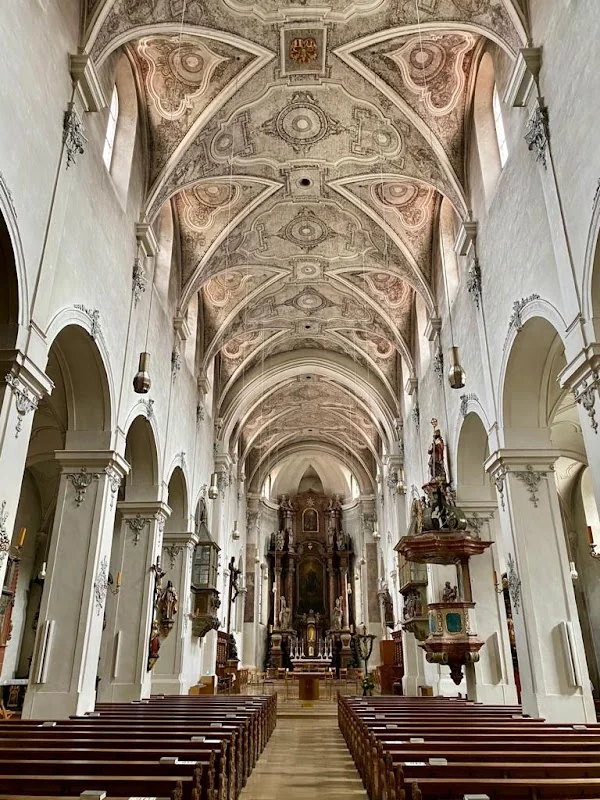
Those looking for photos of the Cathedral Parish Church Niedermünster will primarily encounter strong architectural contrasts. According to the monument list, the church is a three-nave pillar basilica without a transept, with three choirs, two west towers, and a forecourt. It thus possesses a very clear Romanesque basic structure, which can be particularly well read in exterior shots: massive walls, a calm rhythm of openings, and the distinctive west building give the church a closed, almost defensive appearance. At the same time, the Romanesque core has not remained unchanged. The interior was vaulted in Baroque style in 1625, and around 1730, further modifications were added, creating the impression of a church that is both medieval and early modern. The monument list also mentions furnishings, which means that not only the building form but also the liturgical inventory shapes the historical character. For photographic perspective, this is particularly interesting because exterior and interior views tell two very different but interconnected stories. Outside, Romanesque practicality dominates, while inside, Baroque warmth and solemnity prevail. This tension makes the church visually so attractive and explains why it repeatedly appears in image collections, event announcements, and travel impressions with its west towers, the choir closure, and the bright interior. ([de.dehio.org](https://de.dehio.org/bauwerk/regensburg-kath-dompfarrkirche-niedermuenster))
The details are also remarkable. The Romanesque choir closure from the 12th century consists of finely crafted ashlar masonry; the south portal and the double arcade on the first floor of the south tower are dated to around 1160/70. The forecourt was expanded in 1621 and received a new west facade, while the Baroque vaulting from 1625 gave the interior a different spatial effect. Around 1730, stucco work and apse elevation were added. This results in an image that is typical for historical architecture in Regensburg: the medieval core remains preserved, but the Baroque interventions have not been concealed but today form a second aesthetic layer. Those planning photos should therefore not only choose the overall view from the west side but also detail shots of the ashlar work, the towers, and the transition between Romanesque severity and Baroque transformation. In this sense, Niedermünster is a church that tells a lot in pictures because the chronology of building can be read like a single visual textbook. ([de.dehio.org](https://de.dehio.org/bauwerk/regensburg-kath-dompfarrkirche-niedermuenster))
Noon music, services, and church life
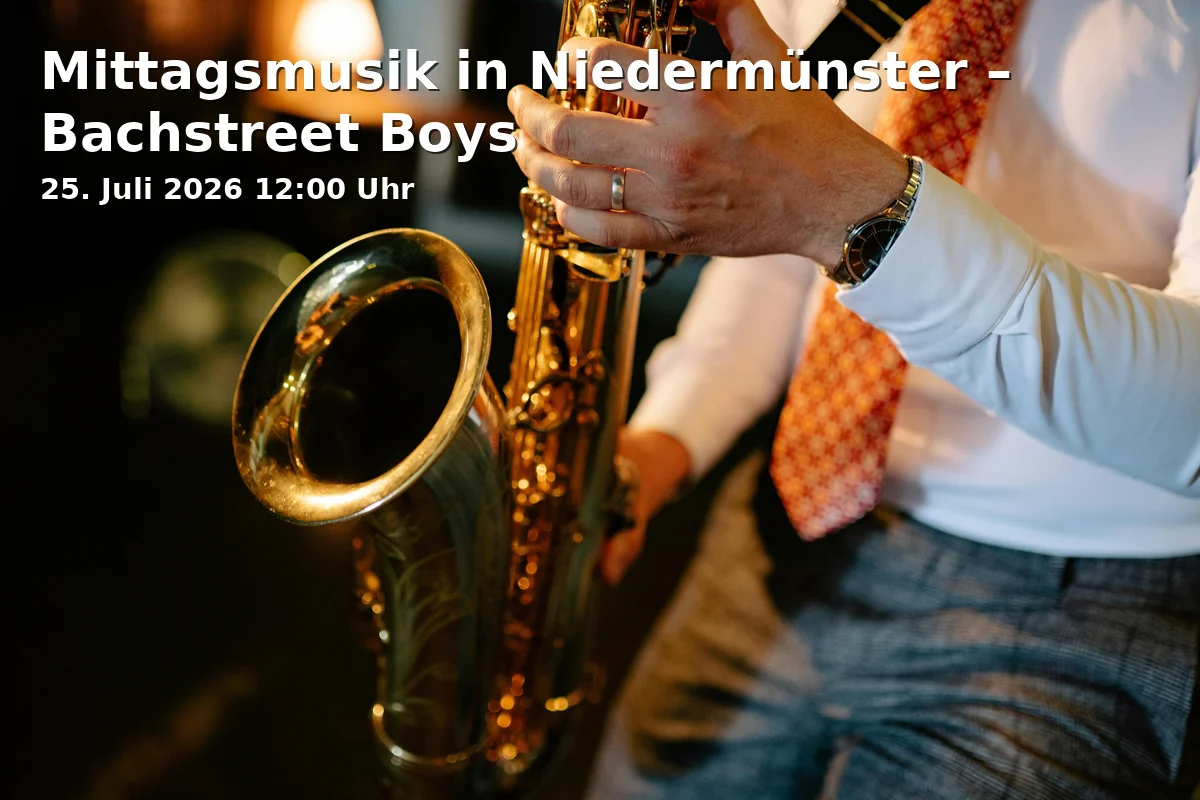
The Cathedral Parish Church Niedermünster is not only a historical monument but an active spiritual and cultural place. This becomes particularly visible at the noon music in Niedermünster, which is supported by the city center pastoral care and the cathedral parish community. Every Saturday at 12:05 PM, it invites free of charge to a contemplative concert lasting about half an hour. The format is intentionally designed to be low-threshold: people can pause briefly in the midst of everyday life, listen, and experience the special acoustics of the space. The official notices emphasize that the program is updated weekly and can be accessed via the project page and accompanying social media channels. For the church, this series means that it remains lively not only liturgically but also musically every weekend. Furthermore, concert events, chamber music evenings, and spiritual programs regularly appear in the event calendars of the city of Regensburg. The church is thus a space where prayer, music, and old town culture complement each other. Those who want to not only see Regensburg but also hear it will find a very distinctive place here. ([bistum-regensburg.de](https://bistum-regensburg.de/news/gute-musik-nette-leute-tolle-atmosphaere-klingt-gut?utm_source=openai))
Even beyond the noon music, Niedermünster remains a place with a clear liturgical identity. The church serves as a cathedral parish church and is thus closely linked to pastoral care in the center of Regensburg. The diocesan website repeatedly reports on pontifical masses, festive services, and special liturgical celebrations in the church, such as for the feast of Saint Erhard or the beginning of the Easter penitential season. This recurrence shows that the church does not serve merely as a backdrop for historical remembrance but continues to fulfill its true essence: it gathers people for worship, music, and communal prayer. This is also reflected in the special connection to Saint Erhard, whose grave is venerated in Niedermünster and who is regarded as one of the most significant diocesan saints. It is precisely in the interplay of relic veneration, music, and urban public life that it becomes clear why Niedermünster remains so vibrant for Regensburg. It is a place where tradition does not become museum-like but is made newly experienceable in regular formats such as noon music, festive services, and spiritual events. ([bistum-regensburg.de](https://bistum-regensburg.de/news/durch-das-beispiel-des-hl-erhard-hilfe-erfahren-festgottesdienst-zu-ehren-des-hl-erhard-in-der-niedermuensterkirche-68?utm_source=openai))
Directions, location, and practical visit planning
Practically speaking, the Cathedral Parish Church Niedermünster is located in one of the densest and most beautiful locations in the Regensburg old town. Several official descriptions emphasize that it is located directly next to the cathedral and is anchored in the historic center of the city, in the northeast corner of the former Roman legionary camp Castra Regina. For visitors, this means primarily one thing: the church can be excellently integrated into a tour of the old town, for example, together with the cathedral, cathedral square, Old Corn Market, and the surrounding churches. Because the location is so central, the last section of the path is most pleasantly covered on foot; this is a practical recommendation derived from the location itself. Those wishing to attend tours in the document Niedermünster will find tickets and meeting point at the information center DOMPLATZ 5 at Domplatz 5. There, information on visiting hours is also provided. It is also helpful for planning that DOMPLATZ 5 has seasonal opening hours: from May to October, Monday to Saturday from 10:00 AM to 5:00 PM, and from November to April, Monday to Saturday from 11:00 AM to 4:00 PM, and on Sundays and public holidays from 1:30 PM to 2:30 PM. This makes it clear that a visit should be well prepared, especially if one wants to experience not only the church but also the archaeological exhibition beneath it. ([bistum-regensburg.de](https://bistum-regensburg.de/kunst-kultur/dioezeanmuseen/document-niedermuenster))
For visitors, the address and building regulations in the vicinity are also interesting. The church itself is listed as Niedermünstergasse 3, while adjacent buildings such as the former convent and ordinaries ensemble, the cathedral parish courtyard, and the former cathedral prebend house complement the historical structure of the area. This makes it clear that Niedermünster does not stand isolated but is part of a coherent spiritual quarter. Those interested in history should therefore not only perceive the church itself but also the surrounding courtyards, facades, and passages. This spatial interconnection with the former women's convent particularly enhances the impression of a grown place. When planning the visit, it is worthwhile to combine an archaeological tour, church visit, and a musical format such as the noon music. This way, a short stop becomes a very complete impression of Regensburg's religious and cultural center. The location, the good guiding structures, and the dense historical environment make Niedermünster one of the best addresses for visitors who want not only to check off sights but truly experience city history. ([de.dehio.org](https://de.dehio.org/bauwerk/regensburg-kath-dompfarrkirche-niedermuenster))
Why the Cathedral Parish Church Niedermünster is so important for Regensburg
The cultural and historical significance of the Cathedral Parish Church Niedermünster goes far beyond the function of a normal parish church. It is part of a place where nearly two thousand years of city history become visible in almost immediate proximity. This is already shown by the official classification as one of the largest archaeological excavation sites in Germany and as a place where the development from the Roman camp to the medieval bishop's and trading city can be traced. In terms of monument and tourism perspective, Niedermünster is therefore a key location for understanding Regensburg. Here, Roman infrastructure, early medieval rule, Ottonian memorial culture, the history of the women's convent, and the Baroque transformation of a church space intersect. The veneration of Saint Erhard also plays a significant role, as his grave connects the church with the early Christianization of the place and with the spiritual identity of the diocese. Therefore, when visiting the Cathedral Parish Church Niedermünster, one does not only look at a single church but at the history of an entire urban body. This density of historical layers is rare and explains why the place is important for experts, cultural travelers, and believers alike. ([bistum-regensburg.de](https://bistum-regensburg.de/kunst-kultur/dioezeanmuseen/document-niedermuenster))
At the same time, Niedermünster is an example of how a monument can be meaningfully used today. The church is not only preserved but actively integrated into the religious and cultural life of the city. Guided tours make the past understandable, music formats open the space for today's visitors, and liturgical use keeps the original purpose of the church alive. This connection of preservation and presence makes the place so convincing. The Cathedral Parish Church Niedermünster is thus not a closed space of remembrance but a vibrant part of Regensburg that connects history, faith, and city identity. From an SEO perspective, this is a strong foundation because search queries for photos, history, parish, tours, or noon music always lead back to the same core: Niedermünster is one of the richest and densest historical places in the city. Those who take their time there experience not only architecture but a piece of lived Regensburg continuity. ([de.dehio.org](https://de.dehio.org/bauwerk/regensburg-kath-dompfarrkirche-niedermuenster))
Sources:
Mehr anzeigenWeniger anzeigen
Cathedral Parish Church Niedermünster | Photos & History
The Cathedral Parish Church Niedermünster is one of the places in Regensburg where history is not only told but can be experienced spatially. Located directly next to the cathedral, it combines the role of a vibrant parish and worship church with an extraordinarily deep archaeological subsoil. Here, Roman, early medieval, Ottonian, and Romanesque layers lie so close together that a visit becomes a journey through many centuries. Those who view the church from the outside initially see a compact Romanesque basilica with a characteristic west building; those who get to know it better discover the connection to the veneration of Saint Erhard, to the convent of Niedermünster, and to the development of the World Heritage City of Regensburg. Therefore, the place is not only religiously significant but also culturally and historically highly relevant. Particularly noteworthy is that the currently visible house of worship and the underlying document Niedermünster complement each other: above, the church as a place of prayer and music; below, archaeology as a vivid memory of the city. This combination makes Niedermünster one of the densest historical addresses in the Regensburg old town area. ([de.dehio.org](https://de.dehio.org/bauwerk/regensburg-kath-dompfarrkirche-niedermuenster))
History of the Cathedral Parish Church Niedermünster
The history of the Cathedral Parish Church Niedermünster does not begin with the visible building from the 12th century, but with a much older religious and political tradition. According to the documented and scientifically processed findings, the convent developed from the veneration of the burial site of the court bishop Erhard, who died around 700. An earlier church likely stood at the same location during the Agilolfing period; its surroundings were later remodeled, expanded, and newly interpreted as sacred multiple times. The Ottonian phase is particularly important: Duke Heinrich I of Bavaria began a new church building, which his wife Judith completed after Heinrich was buried there in 955. Judith joined the convent in 973 and became abbess, and in 1002 the convent gained imperial immediacy through Emperor Heinrich II. Thus, Niedermünster became one of the most significant spiritual institutions in Bavaria, and the church became the burial place of a ruling family that significantly shaped the history of Regensburg. The Dehio also emphasizes that Ober- and Niedermünster were the only noble women's convents in Old Bavaria and that Niedermünster was among the wealthiest imperial convents after St. Emmeram. ([de.dehio.org](https://de.dehio.org/bauwerk/regensburg-kath-dompfarrkirche-niedermuenster))
The current building was constructed in the middle of the 12th century. Around 1146, a new construction of the church and the convent began, and the city fire of 1152 left traces that are still recognizable today on parts of the south tower and the southern nave wall. Although there are no specific documentary data on the existing fourth church building, stylistic and architectural clues clearly place its origin in the Romanesque High Middle Ages. The church was modified several times in the following centuries: Under Abbess A. Maria von Salis, the forecourt was redesigned and expanded in 1621 with a new west facade, the church interior was vaulted in Baroque style in 1625, and around 1730, further Baroque interventions were added, including stucco work and the elevation of the apse. These layers explain why the church today appears both strictly Romanesque and surprisingly Baroque. After the abolition of imperial freedom in 1803, the transition to Bavaria in 1810, and the death of the last canoness in 1819, the church became a cathedral parish church in 1821. Thus, the convent became an active parish center, whose structural substance does not obscure but rather makes visible the long history of the place. ([de.dehio.org](https://de.dehio.org/bauwerk/regensburg-kath-dompfarrkirche-niedermuenster))
Document Niedermünster: Archaeology beneath the church
Under the Cathedral Parish Church Niedermünster lies one of the most impressive archaeological windows into the history of Regensburg. The document Niedermünster shows a time span from 179 AD, when the III Italic Legion established the legionary camp Castra Regina, to the 12th century, when the Romanesque church building was constructed. The official descriptions refer to one of the largest archaeological excavations in Germany, and this finding is particularly comprehensible in a confined space: several construction and usage phases lie layer upon layer, in some places up to five meters high in the historical structure of the site. The development ranges from the Roman military camp with its walls, towers, and alleys to early medieval repurposing, to the palace chapel of the dukes and the church of the noble women's convent. For visitors, it is precisely this simultaneous readability of the layers that makes it appealing, as they can see directly how a Roman camp developed into a medieval city and ultimately into a spiritual center. The document Niedermünster is thus not only a museum under a church but a place where the emergence of Regensburg can be traced concretely. ([bistum-regensburg.de](https://bistum-regensburg.de/kunst-kultur/dioezeanmuseen/document-niedermuenster))
Particularly exciting is the presentation underground. The document works with 3D animations and a modern lighting concept, so that the archaeological findings do not appear as mere wall remnants but as understandable city history. The official texts mention, among other things, Roman foundations, the palace chapel of the Duke of Bavaria, the early medieval house of worship, the church of the noble women's convent, and the burial site of St. Erhard. The dimensions of the Roman starting situation are also specifically named: Castra Regina was surrounded by a roughly 2000-meter-long ashlar wall with 22 towers and four monumental gates and accommodated about 6000 soldiers and the military administration. It is also important for visitors that the document Niedermünster is only accessible with a guided tour. Public tours take place on Mondays, Sundays, and public holidays at 2:30 PM. Tickets are available at the information center DOMPLATZ 5, which is also the meeting point. The number of places is limited to 15 people, so advance registration is advisable. This keeps the visit personal and manageable, which greatly suits the special character of this historical place. ([bistum-regensburg.de](https://bistum-regensburg.de/kunst-kultur/dioezeanmuseen/document-niedermuenster))
Architecture, furnishings, and photos of the church
Those looking for photos of the Cathedral Parish Church Niedermünster will primarily encounter strong architectural contrasts. According to the monument list, the church is a three-nave pillar basilica without a transept, with three choirs, two west towers, and a forecourt. It thus possesses a very clear Romanesque basic structure, which can be particularly well read in exterior shots: massive walls, a calm rhythm of openings, and the distinctive west building give the church a closed, almost defensive appearance. At the same time, the Romanesque core has not remained unchanged. The interior was vaulted in Baroque style in 1625, and around 1730, further modifications were added, creating the impression of a church that is both medieval and early modern. The monument list also mentions furnishings, which means that not only the building form but also the liturgical inventory shapes the historical character. For photographic perspective, this is particularly interesting because exterior and interior views tell two very different but interconnected stories. Outside, Romanesque practicality dominates, while inside, Baroque warmth and solemnity prevail. This tension makes the church visually so attractive and explains why it repeatedly appears in image collections, event announcements, and travel impressions with its west towers, the choir closure, and the bright interior. ([de.dehio.org](https://de.dehio.org/bauwerk/regensburg-kath-dompfarrkirche-niedermuenster))
The details are also remarkable. The Romanesque choir closure from the 12th century consists of finely crafted ashlar masonry; the south portal and the double arcade on the first floor of the south tower are dated to around 1160/70. The forecourt was expanded in 1621 and received a new west facade, while the Baroque vaulting from 1625 gave the interior a different spatial effect. Around 1730, stucco work and apse elevation were added. This results in an image that is typical for historical architecture in Regensburg: the medieval core remains preserved, but the Baroque interventions have not been concealed but today form a second aesthetic layer. Those planning photos should therefore not only choose the overall view from the west side but also detail shots of the ashlar work, the towers, and the transition between Romanesque severity and Baroque transformation. In this sense, Niedermünster is a church that tells a lot in pictures because the chronology of building can be read like a single visual textbook. ([de.dehio.org](https://de.dehio.org/bauwerk/regensburg-kath-dompfarrkirche-niedermuenster))
Noon music, services, and church life
The Cathedral Parish Church Niedermünster is not only a historical monument but an active spiritual and cultural place. This becomes particularly visible at the noon music in Niedermünster, which is supported by the city center pastoral care and the cathedral parish community. Every Saturday at 12:05 PM, it invites free of charge to a contemplative concert lasting about half an hour. The format is intentionally designed to be low-threshold: people can pause briefly in the midst of everyday life, listen, and experience the special acoustics of the space. The official notices emphasize that the program is updated weekly and can be accessed via the project page and accompanying social media channels. For the church, this series means that it remains lively not only liturgically but also musically every weekend. Furthermore, concert events, chamber music evenings, and spiritual programs regularly appear in the event calendars of the city of Regensburg. The church is thus a space where prayer, music, and old town culture complement each other. Those who want to not only see Regensburg but also hear it will find a very distinctive place here. ([bistum-regensburg.de](https://bistum-regensburg.de/news/gute-musik-nette-leute-tolle-atmosphaere-klingt-gut?utm_source=openai))
Even beyond the noon music, Niedermünster remains a place with a clear liturgical identity. The church serves as a cathedral parish church and is thus closely linked to pastoral care in the center of Regensburg. The diocesan website repeatedly reports on pontifical masses, festive services, and special liturgical celebrations in the church, such as for the feast of Saint Erhard or the beginning of the Easter penitential season. This recurrence shows that the church does not serve merely as a backdrop for historical remembrance but continues to fulfill its true essence: it gathers people for worship, music, and communal prayer. This is also reflected in the special connection to Saint Erhard, whose grave is venerated in Niedermünster and who is regarded as one of the most significant diocesan saints. It is precisely in the interplay of relic veneration, music, and urban public life that it becomes clear why Niedermünster remains so vibrant for Regensburg. It is a place where tradition does not become museum-like but is made newly experienceable in regular formats such as noon music, festive services, and spiritual events. ([bistum-regensburg.de](https://bistum-regensburg.de/news/durch-das-beispiel-des-hl-erhard-hilfe-erfahren-festgottesdienst-zu-ehren-des-hl-erhard-in-der-niedermuensterkirche-68?utm_source=openai))
Directions, location, and practical visit planning
Practically speaking, the Cathedral Parish Church Niedermünster is located in one of the densest and most beautiful locations in the Regensburg old town. Several official descriptions emphasize that it is located directly next to the cathedral and is anchored in the historic center of the city, in the northeast corner of the former Roman legionary camp Castra Regina. For visitors, this means primarily one thing: the church can be excellently integrated into a tour of the old town, for example, together with the cathedral, cathedral square, Old Corn Market, and the surrounding churches. Because the location is so central, the last section of the path is most pleasantly covered on foot; this is a practical recommendation derived from the location itself. Those wishing to attend tours in the document Niedermünster will find tickets and meeting point at the information center DOMPLATZ 5 at Domplatz 5. There, information on visiting hours is also provided. It is also helpful for planning that DOMPLATZ 5 has seasonal opening hours: from May to October, Monday to Saturday from 10:00 AM to 5:00 PM, and from November to April, Monday to Saturday from 11:00 AM to 4:00 PM, and on Sundays and public holidays from 1:30 PM to 2:30 PM. This makes it clear that a visit should be well prepared, especially if one wants to experience not only the church but also the archaeological exhibition beneath it. ([bistum-regensburg.de](https://bistum-regensburg.de/kunst-kultur/dioezeanmuseen/document-niedermuenster))
For visitors, the address and building regulations in the vicinity are also interesting. The church itself is listed as Niedermünstergasse 3, while adjacent buildings such as the former convent and ordinaries ensemble, the cathedral parish courtyard, and the former cathedral prebend house complement the historical structure of the area. This makes it clear that Niedermünster does not stand isolated but is part of a coherent spiritual quarter. Those interested in history should therefore not only perceive the church itself but also the surrounding courtyards, facades, and passages. This spatial interconnection with the former women's convent particularly enhances the impression of a grown place. When planning the visit, it is worthwhile to combine an archaeological tour, church visit, and a musical format such as the noon music. This way, a short stop becomes a very complete impression of Regensburg's religious and cultural center. The location, the good guiding structures, and the dense historical environment make Niedermünster one of the best addresses for visitors who want not only to check off sights but truly experience city history. ([de.dehio.org](https://de.dehio.org/bauwerk/regensburg-kath-dompfarrkirche-niedermuenster))
Why the Cathedral Parish Church Niedermünster is so important for Regensburg
The cultural and historical significance of the Cathedral Parish Church Niedermünster goes far beyond the function of a normal parish church. It is part of a place where nearly two thousand years of city history become visible in almost immediate proximity. This is already shown by the official classification as one of the largest archaeological excavation sites in Germany and as a place where the development from the Roman camp to the medieval bishop's and trading city can be traced. In terms of monument and tourism perspective, Niedermünster is therefore a key location for understanding Regensburg. Here, Roman infrastructure, early medieval rule, Ottonian memorial culture, the history of the women's convent, and the Baroque transformation of a church space intersect. The veneration of Saint Erhard also plays a significant role, as his grave connects the church with the early Christianization of the place and with the spiritual identity of the diocese. Therefore, when visiting the Cathedral Parish Church Niedermünster, one does not only look at a single church but at the history of an entire urban body. This density of historical layers is rare and explains why the place is important for experts, cultural travelers, and believers alike. ([bistum-regensburg.de](https://bistum-regensburg.de/kunst-kultur/dioezeanmuseen/document-niedermuenster))
At the same time, Niedermünster is an example of how a monument can be meaningfully used today. The church is not only preserved but actively integrated into the religious and cultural life of the city. Guided tours make the past understandable, music formats open the space for today's visitors, and liturgical use keeps the original purpose of the church alive. This connection of preservation and presence makes the place so convincing. The Cathedral Parish Church Niedermünster is thus not a closed space of remembrance but a vibrant part of Regensburg that connects history, faith, and city identity. From an SEO perspective, this is a strong foundation because search queries for photos, history, parish, tours, or noon music always lead back to the same core: Niedermünster is one of the richest and densest historical places in the city. Those who take their time there experience not only architecture but a piece of lived Regensburg continuity. ([de.dehio.org](https://de.dehio.org/bauwerk/regensburg-kath-dompfarrkirche-niedermuenster))
Sources:
Cathedral Parish Church Niedermünster | Photos & History
The Cathedral Parish Church Niedermünster is one of the places in Regensburg where history is not only told but can be experienced spatially. Located directly next to the cathedral, it combines the role of a vibrant parish and worship church with an extraordinarily deep archaeological subsoil. Here, Roman, early medieval, Ottonian, and Romanesque layers lie so close together that a visit becomes a journey through many centuries. Those who view the church from the outside initially see a compact Romanesque basilica with a characteristic west building; those who get to know it better discover the connection to the veneration of Saint Erhard, to the convent of Niedermünster, and to the development of the World Heritage City of Regensburg. Therefore, the place is not only religiously significant but also culturally and historically highly relevant. Particularly noteworthy is that the currently visible house of worship and the underlying document Niedermünster complement each other: above, the church as a place of prayer and music; below, archaeology as a vivid memory of the city. This combination makes Niedermünster one of the densest historical addresses in the Regensburg old town area. ([de.dehio.org](https://de.dehio.org/bauwerk/regensburg-kath-dompfarrkirche-niedermuenster))
History of the Cathedral Parish Church Niedermünster
The history of the Cathedral Parish Church Niedermünster does not begin with the visible building from the 12th century, but with a much older religious and political tradition. According to the documented and scientifically processed findings, the convent developed from the veneration of the burial site of the court bishop Erhard, who died around 700. An earlier church likely stood at the same location during the Agilolfing period; its surroundings were later remodeled, expanded, and newly interpreted as sacred multiple times. The Ottonian phase is particularly important: Duke Heinrich I of Bavaria began a new church building, which his wife Judith completed after Heinrich was buried there in 955. Judith joined the convent in 973 and became abbess, and in 1002 the convent gained imperial immediacy through Emperor Heinrich II. Thus, Niedermünster became one of the most significant spiritual institutions in Bavaria, and the church became the burial place of a ruling family that significantly shaped the history of Regensburg. The Dehio also emphasizes that Ober- and Niedermünster were the only noble women's convents in Old Bavaria and that Niedermünster was among the wealthiest imperial convents after St. Emmeram. ([de.dehio.org](https://de.dehio.org/bauwerk/regensburg-kath-dompfarrkirche-niedermuenster))
The current building was constructed in the middle of the 12th century. Around 1146, a new construction of the church and the convent began, and the city fire of 1152 left traces that are still recognizable today on parts of the south tower and the southern nave wall. Although there are no specific documentary data on the existing fourth church building, stylistic and architectural clues clearly place its origin in the Romanesque High Middle Ages. The church was modified several times in the following centuries: Under Abbess A. Maria von Salis, the forecourt was redesigned and expanded in 1621 with a new west facade, the church interior was vaulted in Baroque style in 1625, and around 1730, further Baroque interventions were added, including stucco work and the elevation of the apse. These layers explain why the church today appears both strictly Romanesque and surprisingly Baroque. After the abolition of imperial freedom in 1803, the transition to Bavaria in 1810, and the death of the last canoness in 1819, the church became a cathedral parish church in 1821. Thus, the convent became an active parish center, whose structural substance does not obscure but rather makes visible the long history of the place. ([de.dehio.org](https://de.dehio.org/bauwerk/regensburg-kath-dompfarrkirche-niedermuenster))
Document Niedermünster: Archaeology beneath the church
Under the Cathedral Parish Church Niedermünster lies one of the most impressive archaeological windows into the history of Regensburg. The document Niedermünster shows a time span from 179 AD, when the III Italic Legion established the legionary camp Castra Regina, to the 12th century, when the Romanesque church building was constructed. The official descriptions refer to one of the largest archaeological excavations in Germany, and this finding is particularly comprehensible in a confined space: several construction and usage phases lie layer upon layer, in some places up to five meters high in the historical structure of the site. The development ranges from the Roman military camp with its walls, towers, and alleys to early medieval repurposing, to the palace chapel of the dukes and the church of the noble women's convent. For visitors, it is precisely this simultaneous readability of the layers that makes it appealing, as they can see directly how a Roman camp developed into a medieval city and ultimately into a spiritual center. The document Niedermünster is thus not only a museum under a church but a place where the emergence of Regensburg can be traced concretely. ([bistum-regensburg.de](https://bistum-regensburg.de/kunst-kultur/dioezeanmuseen/document-niedermuenster))
Particularly exciting is the presentation underground. The document works with 3D animations and a modern lighting concept, so that the archaeological findings do not appear as mere wall remnants but as understandable city history. The official texts mention, among other things, Roman foundations, the palace chapel of the Duke of Bavaria, the early medieval house of worship, the church of the noble women's convent, and the burial site of St. Erhard. The dimensions of the Roman starting situation are also specifically named: Castra Regina was surrounded by a roughly 2000-meter-long ashlar wall with 22 towers and four monumental gates and accommodated about 6000 soldiers and the military administration. It is also important for visitors that the document Niedermünster is only accessible with a guided tour. Public tours take place on Mondays, Sundays, and public holidays at 2:30 PM. Tickets are available at the information center DOMPLATZ 5, which is also the meeting point. The number of places is limited to 15 people, so advance registration is advisable. This keeps the visit personal and manageable, which greatly suits the special character of this historical place. ([bistum-regensburg.de](https://bistum-regensburg.de/kunst-kultur/dioezeanmuseen/document-niedermuenster))
Architecture, furnishings, and photos of the church
Those looking for photos of the Cathedral Parish Church Niedermünster will primarily encounter strong architectural contrasts. According to the monument list, the church is a three-nave pillar basilica without a transept, with three choirs, two west towers, and a forecourt. It thus possesses a very clear Romanesque basic structure, which can be particularly well read in exterior shots: massive walls, a calm rhythm of openings, and the distinctive west building give the church a closed, almost defensive appearance. At the same time, the Romanesque core has not remained unchanged. The interior was vaulted in Baroque style in 1625, and around 1730, further modifications were added, creating the impression of a church that is both medieval and early modern. The monument list also mentions furnishings, which means that not only the building form but also the liturgical inventory shapes the historical character. For photographic perspective, this is particularly interesting because exterior and interior views tell two very different but interconnected stories. Outside, Romanesque practicality dominates, while inside, Baroque warmth and solemnity prevail. This tension makes the church visually so attractive and explains why it repeatedly appears in image collections, event announcements, and travel impressions with its west towers, the choir closure, and the bright interior. ([de.dehio.org](https://de.dehio.org/bauwerk/regensburg-kath-dompfarrkirche-niedermuenster))
The details are also remarkable. The Romanesque choir closure from the 12th century consists of finely crafted ashlar masonry; the south portal and the double arcade on the first floor of the south tower are dated to around 1160/70. The forecourt was expanded in 1621 and received a new west facade, while the Baroque vaulting from 1625 gave the interior a different spatial effect. Around 1730, stucco work and apse elevation were added. This results in an image that is typical for historical architecture in Regensburg: the medieval core remains preserved, but the Baroque interventions have not been concealed but today form a second aesthetic layer. Those planning photos should therefore not only choose the overall view from the west side but also detail shots of the ashlar work, the towers, and the transition between Romanesque severity and Baroque transformation. In this sense, Niedermünster is a church that tells a lot in pictures because the chronology of building can be read like a single visual textbook. ([de.dehio.org](https://de.dehio.org/bauwerk/regensburg-kath-dompfarrkirche-niedermuenster))
Noon music, services, and church life
The Cathedral Parish Church Niedermünster is not only a historical monument but an active spiritual and cultural place. This becomes particularly visible at the noon music in Niedermünster, which is supported by the city center pastoral care and the cathedral parish community. Every Saturday at 12:05 PM, it invites free of charge to a contemplative concert lasting about half an hour. The format is intentionally designed to be low-threshold: people can pause briefly in the midst of everyday life, listen, and experience the special acoustics of the space. The official notices emphasize that the program is updated weekly and can be accessed via the project page and accompanying social media channels. For the church, this series means that it remains lively not only liturgically but also musically every weekend. Furthermore, concert events, chamber music evenings, and spiritual programs regularly appear in the event calendars of the city of Regensburg. The church is thus a space where prayer, music, and old town culture complement each other. Those who want to not only see Regensburg but also hear it will find a very distinctive place here. ([bistum-regensburg.de](https://bistum-regensburg.de/news/gute-musik-nette-leute-tolle-atmosphaere-klingt-gut?utm_source=openai))
Even beyond the noon music, Niedermünster remains a place with a clear liturgical identity. The church serves as a cathedral parish church and is thus closely linked to pastoral care in the center of Regensburg. The diocesan website repeatedly reports on pontifical masses, festive services, and special liturgical celebrations in the church, such as for the feast of Saint Erhard or the beginning of the Easter penitential season. This recurrence shows that the church does not serve merely as a backdrop for historical remembrance but continues to fulfill its true essence: it gathers people for worship, music, and communal prayer. This is also reflected in the special connection to Saint Erhard, whose grave is venerated in Niedermünster and who is regarded as one of the most significant diocesan saints. It is precisely in the interplay of relic veneration, music, and urban public life that it becomes clear why Niedermünster remains so vibrant for Regensburg. It is a place where tradition does not become museum-like but is made newly experienceable in regular formats such as noon music, festive services, and spiritual events. ([bistum-regensburg.de](https://bistum-regensburg.de/news/durch-das-beispiel-des-hl-erhard-hilfe-erfahren-festgottesdienst-zu-ehren-des-hl-erhard-in-der-niedermuensterkirche-68?utm_source=openai))
Directions, location, and practical visit planning
Practically speaking, the Cathedral Parish Church Niedermünster is located in one of the densest and most beautiful locations in the Regensburg old town. Several official descriptions emphasize that it is located directly next to the cathedral and is anchored in the historic center of the city, in the northeast corner of the former Roman legionary camp Castra Regina. For visitors, this means primarily one thing: the church can be excellently integrated into a tour of the old town, for example, together with the cathedral, cathedral square, Old Corn Market, and the surrounding churches. Because the location is so central, the last section of the path is most pleasantly covered on foot; this is a practical recommendation derived from the location itself. Those wishing to attend tours in the document Niedermünster will find tickets and meeting point at the information center DOMPLATZ 5 at Domplatz 5. There, information on visiting hours is also provided. It is also helpful for planning that DOMPLATZ 5 has seasonal opening hours: from May to October, Monday to Saturday from 10:00 AM to 5:00 PM, and from November to April, Monday to Saturday from 11:00 AM to 4:00 PM, and on Sundays and public holidays from 1:30 PM to 2:30 PM. This makes it clear that a visit should be well prepared, especially if one wants to experience not only the church but also the archaeological exhibition beneath it. ([bistum-regensburg.de](https://bistum-regensburg.de/kunst-kultur/dioezeanmuseen/document-niedermuenster))
For visitors, the address and building regulations in the vicinity are also interesting. The church itself is listed as Niedermünstergasse 3, while adjacent buildings such as the former convent and ordinaries ensemble, the cathedral parish courtyard, and the former cathedral prebend house complement the historical structure of the area. This makes it clear that Niedermünster does not stand isolated but is part of a coherent spiritual quarter. Those interested in history should therefore not only perceive the church itself but also the surrounding courtyards, facades, and passages. This spatial interconnection with the former women's convent particularly enhances the impression of a grown place. When planning the visit, it is worthwhile to combine an archaeological tour, church visit, and a musical format such as the noon music. This way, a short stop becomes a very complete impression of Regensburg's religious and cultural center. The location, the good guiding structures, and the dense historical environment make Niedermünster one of the best addresses for visitors who want not only to check off sights but truly experience city history. ([de.dehio.org](https://de.dehio.org/bauwerk/regensburg-kath-dompfarrkirche-niedermuenster))
Why the Cathedral Parish Church Niedermünster is so important for Regensburg
The cultural and historical significance of the Cathedral Parish Church Niedermünster goes far beyond the function of a normal parish church. It is part of a place where nearly two thousand years of city history become visible in almost immediate proximity. This is already shown by the official classification as one of the largest archaeological excavation sites in Germany and as a place where the development from the Roman camp to the medieval bishop's and trading city can be traced. In terms of monument and tourism perspective, Niedermünster is therefore a key location for understanding Regensburg. Here, Roman infrastructure, early medieval rule, Ottonian memorial culture, the history of the women's convent, and the Baroque transformation of a church space intersect. The veneration of Saint Erhard also plays a significant role, as his grave connects the church with the early Christianization of the place and with the spiritual identity of the diocese. Therefore, when visiting the Cathedral Parish Church Niedermünster, one does not only look at a single church but at the history of an entire urban body. This density of historical layers is rare and explains why the place is important for experts, cultural travelers, and believers alike. ([bistum-regensburg.de](https://bistum-regensburg.de/kunst-kultur/dioezeanmuseen/document-niedermuenster))
At the same time, Niedermünster is an example of how a monument can be meaningfully used today. The church is not only preserved but actively integrated into the religious and cultural life of the city. Guided tours make the past understandable, music formats open the space for today's visitors, and liturgical use keeps the original purpose of the church alive. This connection of preservation and presence makes the place so convincing. The Cathedral Parish Church Niedermünster is thus not a closed space of remembrance but a vibrant part of Regensburg that connects history, faith, and city identity. From an SEO perspective, this is a strong foundation because search queries for photos, history, parish, tours, or noon music always lead back to the same core: Niedermünster is one of the richest and densest historical places in the city. Those who take their time there experience not only architecture but a piece of lived Regensburg continuity. ([de.dehio.org](https://de.dehio.org/bauwerk/regensburg-kath-dompfarrkirche-niedermuenster))
Sources:
Frequently Asked Questions
Reviews
Lena Stecher
28. January 2026
Candle light Concert Coldplay meets Ed Sheeran
L.R. Henry
22. June 2024
Beautiful medieval church with a tranquil vibe and charming chapels. There is a reliquary and historical paintings in the chapels.
david antoun
4. January 2024
A medieval church from the 12th century, built on top of roman buildings which can be visited only by guided tour. Here also the final rest of St. Erhard and some royal dukes.
Arkel Angel
26. August 2022
Gorgeous. This cathedral is hidden but I encourage you to visit it. The beautiful artwork and the ceilings will captivate you.
T S
4. November 2018
Pretty church with nice decorations. It is in the middle of the city in the „Altstadt“ (oldtown). When you visit Regensburg you should check this church out.