
Regensburg
Haidpl. 8, 93047 Regensburg, Deutschland
Justitia Fountain | Haidplatz & History in Regensburg
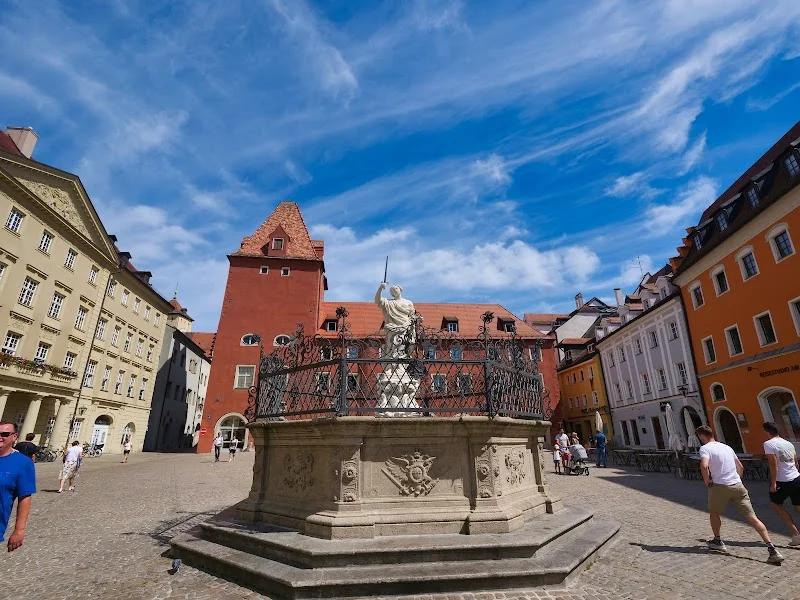
The Justitia Fountain is one of those symbols of the city of Regensburg that one perceives as decoration at first glance and understands as a historical document at second glance. It stands on Haidplatz in the city center, a square that has been a marketplace, meeting place, festive backdrop, and traffic hub since the Middle Ages. The city of Regensburg dates the fountain to 1656 and describes it as an octagonal fountain shaft with Justitia, sword, scales, coat of arms, and angel cartouches. This very mix makes the place so appealing to visitors: the fountain is not an isolated monument but part of a vibrant ensemble of historical facades, cafés, cultural sites, and public urban space. Those who stand here experience Regensburg not only as a UNESCO World Heritage Site but as a city where political memory, craftsmanship, and everyday life have intertwined for centuries. Therefore, the Justitia Fountain is not simply a photo motif but a brief, very dense entry into the history of Haidplatz and the old town of Regensburg. ([regensburg.de](https://www.regensburg.de/kultur/kulturdatenbank/eintrag/118983))
History of the Justitia Fountain at Haidplatz
The creation of the fountain is closely linked to the city’s history in the mid-17th century. The cultural database of the city of Regensburg states that the year of creation is 1656 and refers to the stonemason Leoprand Hilmer. The official explanations also state that the commission was directly related to the agreement of 1655, which settled disputes between the ecclesiastical estates and the Protestant magistrate of the imperial city. Thus, the fountain is not merely a decorative structure but a politically charged object of urban culture. The renewal of the water supply also played a role in its construction; the fountain was therefore part of a practical infrastructure project and at the same time an expression of self-understanding and order. The fact that Regensburg created several symbolically designed fountains at central locations during this time fits this image of a self-confident imperial city that made its identity visible in stone and metal. ([regensburg.de](https://www.regensburg.de/kultur/kulturdatenbank/eintrag/118983))
The location itself has long been predestined for this purpose. According to the city of Regensburg, Haidplatz is one of the oldest and most beautiful squares in the city; its origin lies in a long, triangular meadow west of the former Roman fort. Early on, the area served as a public space for trade, encounters, and representation. In the Middle Ages, buildings developed here that still shape the square today, and the Justitia Fountain was set as a new central element in the 17th century. The city also describes that the square was a marketplace for vegetable wholesalers in the 14th century and later also served as a grain market. This explains why a fountain with such clear moral and political symbolism was erected here: in a square that concentrated economic and public life, a figure of justice fit particularly well. The current location in the middle of the historical city center still makes these connections clearly recognizable. ([regensburg.de](https://www.regensburg.de/regensburg-507/sehenswert/der-regensburger-haidplatz))
Justitia, Coat of Arms, and Baroque Fountain Architecture
The Justitia Fountain at Haidplatz is architecturally compact but surprisingly rich in its symbolism. The city of Regensburg describes an octagonal basin from which a fountain shaft rises. Sandstone and wrought iron were used, materials that fit well with the historical character of the square. Coat of arms and angel cartouches are attached to the side walls, while the fountain figure itself embodies Justitia. The sword and scales are made of wrought iron; additionally, a crane stands to Justitia's right as a symbol of vigilance and wisdom. This combination is typical of a fountain that is meant to do more than just beautify; it is also meant to tell a story. Those who stand before the structure immediately recognize that it is about more than just water: it is about justice, moral order, urban self-assertion, and the visual language of a time when public art was meant to make the values of the city visible. Therefore, the fountain is as interesting for architecture enthusiasts as it is for visitors who want to read historical symbols. ([regensburg.de](https://www.regensburg.de/kultur/kulturdatenbank/eintrag/118983))
In a larger context, the Justitia Fountain belongs to a whole group of Regensburg fountains that were adorned with symbols of the Holy Roman Empire and the imperial city between 1566 and 1721. The specialized portal on the Holy Roman Empire in Regensburg names five such fountains: Eagle Fountain, Electors' Fountain, Peace Fountain, Justitia Fountain, and Imperial City Fountain. This classification is important because it makes the Haidplatz Fountain appear as part of a conscious political imagery program. The structure is also closely related in content to the Peace Fountain in the Old Town Hall; both refer to negotiation, peace, and order in a time of religious and urban tensions. The fact that the fountain no longer carries water today changes little about its significance. On the contrary: precisely because it remains readable as a historical sign, it acts as a silent point of remembrance amidst the hustle and bustle of the old town. For a modern visitor, this is an advantage, as one can focus on form, material, inscriptions, and symbolism without being distracted by a loud presentation. ([regensburg.de](https://www.regensburg.de/kultur/kulturdatenbank/eintrag/118983))
Haidplatz as a Stage of Regensburg's Old Town
Haidplatz itself is an essential part of the attractiveness of the Justitia Fountain. Regensburg Tourism GmbH describes the square as one of the oldest and most beautiful squares in the city, with an area of over 3,000 square meters and an origin as a long meadow west of the Roman fort. Here, large knight tournaments with up to 300 participants once took place; spectators, jugglers, and merchants came from afar. This historical expanse is still palpable today, even though the square now appears more like an urban living room. Around the fountain stand buildings that make the square a small textbook of city history: the Golden Cross, the Thon-Dittmer Palace, the New Weigh House, the Arch, and the Brother House. Particularly exciting is that these houses not only look beautiful but also carry concrete functions and stories, from the former city scales to representative spaces to cultural use. Therefore, anyone visiting the Justitia Fountain not only gets a fountain but also an entire historical environment. ([tourismus.regensburg.de](https://tourismus.regensburg.de/erleben-entdecken/unesco-welterbe-sehenswuerdigkeiten/haidplatz))
The more recent city history is also visible at Haidplatz. The city of Regensburg shows in its documentation that the square was used by cars, buses, and trams until the 20th century and even served as a parking lot in the early 1980s. Only during the traffic calming measures was it redesigned; since then, it has again become a place for festivals, concerts, and public events. This development explains why the Justitia Fountain works so well today: it does not stand as a museum piece behind barriers but in the middle of a public space that is once again designed for staying, meeting, and urban life. This is part of its fascination. Those who experience the square in everyday life see local guests, tourists, cultural events, and historical architecture in close proximity. For an SEO perspective, this is important because many people search for “Haidplatz Regensburg,” “Justitia Fountain History,” or the cultural environment of the square. For visitors, it is even easier: the fountain is the ideal center for a brief but dense stop in the old town. ([regensburg.de](https://www.regensburg.de/regensburg-507/sehenswert/der-regensburger-haidplatz))
Access, Public Transport, and Parking around the Justitia Fountain
The access to the Justitia Fountain today is primarily a matter of the right combination of public transport and a short walk. The city of Regensburg mentions in connection with the city library at Haidplatz the RVV lines 1, 2, 4, 11, and 17 with the stop Fischmarkt as well as the old town bus with the stop Haidplatz. Additionally, the old town bus line B of the free EMIL runs from Unterer Wöhrd via the Old Corn Market, the Cathedral, and the Old Town Hall to Haidplatz. This is very convenient for visitors because the fountain is located in an area designed for short distances. Those who want to explore the old town on foot can easily combine the visit with other stops. The central location ensures that the Justitia Fountain is well suited as a stop on a tour. There is no need to plan a special trip just for the fountain; it is located exactly where one would like to be in Regensburg anyway. ([regensburg.de](https://www.regensburg.de/stadtbuecherei/buechereien/haidplatz?utm_source=openai))
By car, it is usually advisable to use a public parking garage in the old town rather than searching for parking spaces directly at the square. The city of Regensburg indicates that the Dachauplatz parking garage is open 24 hours, has unlimited parking duration, and provides current occupancy information. For many guests, this is a practical solution because one can reach the historical city center in just a few minutes from there. This also fits with the general traffic logic of Regensburg's old town: the area around Haidplatz is strongly oriented towards pedestrians, culture, and staying, not towards long-term parking directly in front of the monument. Those who arrive early or travel outside of peak times often experience the old town more relaxed, but fundamentally, the combination of parking garage and walking remains the most sensible choice. Another advantage: on the way from the parking lot to Haidplatz, one already sees many facades, alleys, and squares that make up the historical character of the city. The path itself thus becomes part of the visit. ([regensburg.de](https://www.regensburg.de/leben/verkehr-u-mobilitaet/parken/parkhaus-dachauplatz?utm_source=openai))
Visiting, Photo Time, and Tour
For the actual visit, the Justitia Fountain is most impressive when one does not just look at it from a distance but perceives it in the context of the square. Since the fountain has not carried water for a long time, its form language takes center stage: the octagon, the stone surfaces, the coats of arms, the figure of Justitia, and the small elevated position in the square structure. This results in a good photo motif, especially when the light falls flat over Haidplatz and the contours of stone and metal stand out clearly. Those who want to experience the old town in peace should take a moment to walk around the square, observe the facades, and see the effect of the fountain from different angles. It is interesting how the fountain changes depending on the viewpoint: at times it appears as the focal point, then again as a quiet axis within a much larger ensemble. This is a gift for visitors who appreciate historical places because one can recognize a lot in a short time without needing an elaborate program. ([regensburg.de](https://www.regensburg.de/kultur/kulturdatenbank/eintrag/118983))
The visit can be particularly well combined with the sights around Haidplatz. The Golden Cross recalls the representative past of the square and the significance of Regensburg as a residence for emperors, kings, and envoys. The Thon-Dittmer Palace today houses cultural institutions, while the New Weigh House recalls the city administration and the famous religious debate of 1541. The Arch and the Brother House also expand the image of the square with medieval residential and social history. Therefore, anyone searching for “Justitia Fountain Regensburg,” “Haidplatz Sights,” or “Old Town Regensburg Tour” will find a particularly compact route here. A sensible walk could start at the Old Town Hall, lead through Haidplatz, and then continue towards the Cathedral or the Danube. This turns the fountain visit into a small tour through several centuries of urban development. It is not a long hike but rather a short, very dense section of Regensburg, which first-time visitors particularly appreciate. ([tourismus.regensburg.de](https://tourismus.regensburg.de/erleben-entdecken/unesco-welterbe-sehenswuerdigkeiten/haidplatz))
Why the Justitia Fountain is Still Important Today
Why does the Justitia Fountain remain important today? Because it is a rare clear example of how public art, urban identity, and historical memory can interact. The figure of Justitia is not random decoration but a statement. It reminds us of law, balance, and the hope for orderly relations in a city that was shaped by confessional and political tensions in the 17th century. At the same time, the fountain stands in a place that has lived from the interplay between everyday life and representation for centuries. This is precisely why it fits so well into the image of Regensburg: the city is not only medievally preserved but also full of vibrant urban spaces where history is not concluded but continues to be visible. The Justitia Fountain shows that a monument does not have to be loud to have significance. Its quiet presence is enough to imbue Haidplatz with an additional level. ([regensburg.de](https://www.regensburg.de/kultur/kulturdatenbank/eintrag/118983))
For visitors and locals, this is a real advantage. The fountain provides a clear anchor point in the cityscape, helps with orientation, and simultaneously creates atmosphere. Those who know Haidplatz experience the Justitia Fountain as a familiar center; those who see it for the first time gain quick access to Regensburg's history. This is probably one of the reasons why search queries often lead to variants like “Justitia Fountain Regensburg,” “Justitia Fountain Haidplatz,” or “Haidplatz Regensburg”: people are looking not only for an object but for a place with significance. The fountain fulfills exactly this expectation because it makes clear in just a few seconds how Regensburg integrates its past into today's cityscape. A brief stop is enough to see how law, art, and place culture come together here. After that, one is ready for the next section through the old town – and therein lies its lasting value. ([regensburg.de](https://www.regensburg.de/regensburg-507/sehenswert/der-regensburger-haidplatz))
Sources:
Mehr anzeigenWeniger anzeigen
Justitia Fountain | Haidplatz & History in Regensburg
The Justitia Fountain is one of those symbols of the city of Regensburg that one perceives as decoration at first glance and understands as a historical document at second glance. It stands on Haidplatz in the city center, a square that has been a marketplace, meeting place, festive backdrop, and traffic hub since the Middle Ages. The city of Regensburg dates the fountain to 1656 and describes it as an octagonal fountain shaft with Justitia, sword, scales, coat of arms, and angel cartouches. This very mix makes the place so appealing to visitors: the fountain is not an isolated monument but part of a vibrant ensemble of historical facades, cafés, cultural sites, and public urban space. Those who stand here experience Regensburg not only as a UNESCO World Heritage Site but as a city where political memory, craftsmanship, and everyday life have intertwined for centuries. Therefore, the Justitia Fountain is not simply a photo motif but a brief, very dense entry into the history of Haidplatz and the old town of Regensburg. ([regensburg.de](https://www.regensburg.de/kultur/kulturdatenbank/eintrag/118983))
History of the Justitia Fountain at Haidplatz
The creation of the fountain is closely linked to the city’s history in the mid-17th century. The cultural database of the city of Regensburg states that the year of creation is 1656 and refers to the stonemason Leoprand Hilmer. The official explanations also state that the commission was directly related to the agreement of 1655, which settled disputes between the ecclesiastical estates and the Protestant magistrate of the imperial city. Thus, the fountain is not merely a decorative structure but a politically charged object of urban culture. The renewal of the water supply also played a role in its construction; the fountain was therefore part of a practical infrastructure project and at the same time an expression of self-understanding and order. The fact that Regensburg created several symbolically designed fountains at central locations during this time fits this image of a self-confident imperial city that made its identity visible in stone and metal. ([regensburg.de](https://www.regensburg.de/kultur/kulturdatenbank/eintrag/118983))
The location itself has long been predestined for this purpose. According to the city of Regensburg, Haidplatz is one of the oldest and most beautiful squares in the city; its origin lies in a long, triangular meadow west of the former Roman fort. Early on, the area served as a public space for trade, encounters, and representation. In the Middle Ages, buildings developed here that still shape the square today, and the Justitia Fountain was set as a new central element in the 17th century. The city also describes that the square was a marketplace for vegetable wholesalers in the 14th century and later also served as a grain market. This explains why a fountain with such clear moral and political symbolism was erected here: in a square that concentrated economic and public life, a figure of justice fit particularly well. The current location in the middle of the historical city center still makes these connections clearly recognizable. ([regensburg.de](https://www.regensburg.de/regensburg-507/sehenswert/der-regensburger-haidplatz))
Justitia, Coat of Arms, and Baroque Fountain Architecture
The Justitia Fountain at Haidplatz is architecturally compact but surprisingly rich in its symbolism. The city of Regensburg describes an octagonal basin from which a fountain shaft rises. Sandstone and wrought iron were used, materials that fit well with the historical character of the square. Coat of arms and angel cartouches are attached to the side walls, while the fountain figure itself embodies Justitia. The sword and scales are made of wrought iron; additionally, a crane stands to Justitia's right as a symbol of vigilance and wisdom. This combination is typical of a fountain that is meant to do more than just beautify; it is also meant to tell a story. Those who stand before the structure immediately recognize that it is about more than just water: it is about justice, moral order, urban self-assertion, and the visual language of a time when public art was meant to make the values of the city visible. Therefore, the fountain is as interesting for architecture enthusiasts as it is for visitors who want to read historical symbols. ([regensburg.de](https://www.regensburg.de/kultur/kulturdatenbank/eintrag/118983))
In a larger context, the Justitia Fountain belongs to a whole group of Regensburg fountains that were adorned with symbols of the Holy Roman Empire and the imperial city between 1566 and 1721. The specialized portal on the Holy Roman Empire in Regensburg names five such fountains: Eagle Fountain, Electors' Fountain, Peace Fountain, Justitia Fountain, and Imperial City Fountain. This classification is important because it makes the Haidplatz Fountain appear as part of a conscious political imagery program. The structure is also closely related in content to the Peace Fountain in the Old Town Hall; both refer to negotiation, peace, and order in a time of religious and urban tensions. The fact that the fountain no longer carries water today changes little about its significance. On the contrary: precisely because it remains readable as a historical sign, it acts as a silent point of remembrance amidst the hustle and bustle of the old town. For a modern visitor, this is an advantage, as one can focus on form, material, inscriptions, and symbolism without being distracted by a loud presentation. ([regensburg.de](https://www.regensburg.de/kultur/kulturdatenbank/eintrag/118983))
Haidplatz as a Stage of Regensburg's Old Town
Haidplatz itself is an essential part of the attractiveness of the Justitia Fountain. Regensburg Tourism GmbH describes the square as one of the oldest and most beautiful squares in the city, with an area of over 3,000 square meters and an origin as a long meadow west of the Roman fort. Here, large knight tournaments with up to 300 participants once took place; spectators, jugglers, and merchants came from afar. This historical expanse is still palpable today, even though the square now appears more like an urban living room. Around the fountain stand buildings that make the square a small textbook of city history: the Golden Cross, the Thon-Dittmer Palace, the New Weigh House, the Arch, and the Brother House. Particularly exciting is that these houses not only look beautiful but also carry concrete functions and stories, from the former city scales to representative spaces to cultural use. Therefore, anyone visiting the Justitia Fountain not only gets a fountain but also an entire historical environment. ([tourismus.regensburg.de](https://tourismus.regensburg.de/erleben-entdecken/unesco-welterbe-sehenswuerdigkeiten/haidplatz))
The more recent city history is also visible at Haidplatz. The city of Regensburg shows in its documentation that the square was used by cars, buses, and trams until the 20th century and even served as a parking lot in the early 1980s. Only during the traffic calming measures was it redesigned; since then, it has again become a place for festivals, concerts, and public events. This development explains why the Justitia Fountain works so well today: it does not stand as a museum piece behind barriers but in the middle of a public space that is once again designed for staying, meeting, and urban life. This is part of its fascination. Those who experience the square in everyday life see local guests, tourists, cultural events, and historical architecture in close proximity. For an SEO perspective, this is important because many people search for “Haidplatz Regensburg,” “Justitia Fountain History,” or the cultural environment of the square. For visitors, it is even easier: the fountain is the ideal center for a brief but dense stop in the old town. ([regensburg.de](https://www.regensburg.de/regensburg-507/sehenswert/der-regensburger-haidplatz))
Access, Public Transport, and Parking around the Justitia Fountain
The access to the Justitia Fountain today is primarily a matter of the right combination of public transport and a short walk. The city of Regensburg mentions in connection with the city library at Haidplatz the RVV lines 1, 2, 4, 11, and 17 with the stop Fischmarkt as well as the old town bus with the stop Haidplatz. Additionally, the old town bus line B of the free EMIL runs from Unterer Wöhrd via the Old Corn Market, the Cathedral, and the Old Town Hall to Haidplatz. This is very convenient for visitors because the fountain is located in an area designed for short distances. Those who want to explore the old town on foot can easily combine the visit with other stops. The central location ensures that the Justitia Fountain is well suited as a stop on a tour. There is no need to plan a special trip just for the fountain; it is located exactly where one would like to be in Regensburg anyway. ([regensburg.de](https://www.regensburg.de/stadtbuecherei/buechereien/haidplatz?utm_source=openai))
By car, it is usually advisable to use a public parking garage in the old town rather than searching for parking spaces directly at the square. The city of Regensburg indicates that the Dachauplatz parking garage is open 24 hours, has unlimited parking duration, and provides current occupancy information. For many guests, this is a practical solution because one can reach the historical city center in just a few minutes from there. This also fits with the general traffic logic of Regensburg's old town: the area around Haidplatz is strongly oriented towards pedestrians, culture, and staying, not towards long-term parking directly in front of the monument. Those who arrive early or travel outside of peak times often experience the old town more relaxed, but fundamentally, the combination of parking garage and walking remains the most sensible choice. Another advantage: on the way from the parking lot to Haidplatz, one already sees many facades, alleys, and squares that make up the historical character of the city. The path itself thus becomes part of the visit. ([regensburg.de](https://www.regensburg.de/leben/verkehr-u-mobilitaet/parken/parkhaus-dachauplatz?utm_source=openai))
Visiting, Photo Time, and Tour
For the actual visit, the Justitia Fountain is most impressive when one does not just look at it from a distance but perceives it in the context of the square. Since the fountain has not carried water for a long time, its form language takes center stage: the octagon, the stone surfaces, the coats of arms, the figure of Justitia, and the small elevated position in the square structure. This results in a good photo motif, especially when the light falls flat over Haidplatz and the contours of stone and metal stand out clearly. Those who want to experience the old town in peace should take a moment to walk around the square, observe the facades, and see the effect of the fountain from different angles. It is interesting how the fountain changes depending on the viewpoint: at times it appears as the focal point, then again as a quiet axis within a much larger ensemble. This is a gift for visitors who appreciate historical places because one can recognize a lot in a short time without needing an elaborate program. ([regensburg.de](https://www.regensburg.de/kultur/kulturdatenbank/eintrag/118983))
The visit can be particularly well combined with the sights around Haidplatz. The Golden Cross recalls the representative past of the square and the significance of Regensburg as a residence for emperors, kings, and envoys. The Thon-Dittmer Palace today houses cultural institutions, while the New Weigh House recalls the city administration and the famous religious debate of 1541. The Arch and the Brother House also expand the image of the square with medieval residential and social history. Therefore, anyone searching for “Justitia Fountain Regensburg,” “Haidplatz Sights,” or “Old Town Regensburg Tour” will find a particularly compact route here. A sensible walk could start at the Old Town Hall, lead through Haidplatz, and then continue towards the Cathedral or the Danube. This turns the fountain visit into a small tour through several centuries of urban development. It is not a long hike but rather a short, very dense section of Regensburg, which first-time visitors particularly appreciate. ([tourismus.regensburg.de](https://tourismus.regensburg.de/erleben-entdecken/unesco-welterbe-sehenswuerdigkeiten/haidplatz))
Why the Justitia Fountain is Still Important Today
Why does the Justitia Fountain remain important today? Because it is a rare clear example of how public art, urban identity, and historical memory can interact. The figure of Justitia is not random decoration but a statement. It reminds us of law, balance, and the hope for orderly relations in a city that was shaped by confessional and political tensions in the 17th century. At the same time, the fountain stands in a place that has lived from the interplay between everyday life and representation for centuries. This is precisely why it fits so well into the image of Regensburg: the city is not only medievally preserved but also full of vibrant urban spaces where history is not concluded but continues to be visible. The Justitia Fountain shows that a monument does not have to be loud to have significance. Its quiet presence is enough to imbue Haidplatz with an additional level. ([regensburg.de](https://www.regensburg.de/kultur/kulturdatenbank/eintrag/118983))
For visitors and locals, this is a real advantage. The fountain provides a clear anchor point in the cityscape, helps with orientation, and simultaneously creates atmosphere. Those who know Haidplatz experience the Justitia Fountain as a familiar center; those who see it for the first time gain quick access to Regensburg's history. This is probably one of the reasons why search queries often lead to variants like “Justitia Fountain Regensburg,” “Justitia Fountain Haidplatz,” or “Haidplatz Regensburg”: people are looking not only for an object but for a place with significance. The fountain fulfills exactly this expectation because it makes clear in just a few seconds how Regensburg integrates its past into today's cityscape. A brief stop is enough to see how law, art, and place culture come together here. After that, one is ready for the next section through the old town – and therein lies its lasting value. ([regensburg.de](https://www.regensburg.de/regensburg-507/sehenswert/der-regensburger-haidplatz))
Sources:
Justitia Fountain | Haidplatz & History in Regensburg
The Justitia Fountain is one of those symbols of the city of Regensburg that one perceives as decoration at first glance and understands as a historical document at second glance. It stands on Haidplatz in the city center, a square that has been a marketplace, meeting place, festive backdrop, and traffic hub since the Middle Ages. The city of Regensburg dates the fountain to 1656 and describes it as an octagonal fountain shaft with Justitia, sword, scales, coat of arms, and angel cartouches. This very mix makes the place so appealing to visitors: the fountain is not an isolated monument but part of a vibrant ensemble of historical facades, cafés, cultural sites, and public urban space. Those who stand here experience Regensburg not only as a UNESCO World Heritage Site but as a city where political memory, craftsmanship, and everyday life have intertwined for centuries. Therefore, the Justitia Fountain is not simply a photo motif but a brief, very dense entry into the history of Haidplatz and the old town of Regensburg. ([regensburg.de](https://www.regensburg.de/kultur/kulturdatenbank/eintrag/118983))
History of the Justitia Fountain at Haidplatz
The creation of the fountain is closely linked to the city’s history in the mid-17th century. The cultural database of the city of Regensburg states that the year of creation is 1656 and refers to the stonemason Leoprand Hilmer. The official explanations also state that the commission was directly related to the agreement of 1655, which settled disputes between the ecclesiastical estates and the Protestant magistrate of the imperial city. Thus, the fountain is not merely a decorative structure but a politically charged object of urban culture. The renewal of the water supply also played a role in its construction; the fountain was therefore part of a practical infrastructure project and at the same time an expression of self-understanding and order. The fact that Regensburg created several symbolically designed fountains at central locations during this time fits this image of a self-confident imperial city that made its identity visible in stone and metal. ([regensburg.de](https://www.regensburg.de/kultur/kulturdatenbank/eintrag/118983))
The location itself has long been predestined for this purpose. According to the city of Regensburg, Haidplatz is one of the oldest and most beautiful squares in the city; its origin lies in a long, triangular meadow west of the former Roman fort. Early on, the area served as a public space for trade, encounters, and representation. In the Middle Ages, buildings developed here that still shape the square today, and the Justitia Fountain was set as a new central element in the 17th century. The city also describes that the square was a marketplace for vegetable wholesalers in the 14th century and later also served as a grain market. This explains why a fountain with such clear moral and political symbolism was erected here: in a square that concentrated economic and public life, a figure of justice fit particularly well. The current location in the middle of the historical city center still makes these connections clearly recognizable. ([regensburg.de](https://www.regensburg.de/regensburg-507/sehenswert/der-regensburger-haidplatz))
Justitia, Coat of Arms, and Baroque Fountain Architecture
The Justitia Fountain at Haidplatz is architecturally compact but surprisingly rich in its symbolism. The city of Regensburg describes an octagonal basin from which a fountain shaft rises. Sandstone and wrought iron were used, materials that fit well with the historical character of the square. Coat of arms and angel cartouches are attached to the side walls, while the fountain figure itself embodies Justitia. The sword and scales are made of wrought iron; additionally, a crane stands to Justitia's right as a symbol of vigilance and wisdom. This combination is typical of a fountain that is meant to do more than just beautify; it is also meant to tell a story. Those who stand before the structure immediately recognize that it is about more than just water: it is about justice, moral order, urban self-assertion, and the visual language of a time when public art was meant to make the values of the city visible. Therefore, the fountain is as interesting for architecture enthusiasts as it is for visitors who want to read historical symbols. ([regensburg.de](https://www.regensburg.de/kultur/kulturdatenbank/eintrag/118983))
In a larger context, the Justitia Fountain belongs to a whole group of Regensburg fountains that were adorned with symbols of the Holy Roman Empire and the imperial city between 1566 and 1721. The specialized portal on the Holy Roman Empire in Regensburg names five such fountains: Eagle Fountain, Electors' Fountain, Peace Fountain, Justitia Fountain, and Imperial City Fountain. This classification is important because it makes the Haidplatz Fountain appear as part of a conscious political imagery program. The structure is also closely related in content to the Peace Fountain in the Old Town Hall; both refer to negotiation, peace, and order in a time of religious and urban tensions. The fact that the fountain no longer carries water today changes little about its significance. On the contrary: precisely because it remains readable as a historical sign, it acts as a silent point of remembrance amidst the hustle and bustle of the old town. For a modern visitor, this is an advantage, as one can focus on form, material, inscriptions, and symbolism without being distracted by a loud presentation. ([regensburg.de](https://www.regensburg.de/kultur/kulturdatenbank/eintrag/118983))
Haidplatz as a Stage of Regensburg's Old Town
Haidplatz itself is an essential part of the attractiveness of the Justitia Fountain. Regensburg Tourism GmbH describes the square as one of the oldest and most beautiful squares in the city, with an area of over 3,000 square meters and an origin as a long meadow west of the Roman fort. Here, large knight tournaments with up to 300 participants once took place; spectators, jugglers, and merchants came from afar. This historical expanse is still palpable today, even though the square now appears more like an urban living room. Around the fountain stand buildings that make the square a small textbook of city history: the Golden Cross, the Thon-Dittmer Palace, the New Weigh House, the Arch, and the Brother House. Particularly exciting is that these houses not only look beautiful but also carry concrete functions and stories, from the former city scales to representative spaces to cultural use. Therefore, anyone visiting the Justitia Fountain not only gets a fountain but also an entire historical environment. ([tourismus.regensburg.de](https://tourismus.regensburg.de/erleben-entdecken/unesco-welterbe-sehenswuerdigkeiten/haidplatz))
The more recent city history is also visible at Haidplatz. The city of Regensburg shows in its documentation that the square was used by cars, buses, and trams until the 20th century and even served as a parking lot in the early 1980s. Only during the traffic calming measures was it redesigned; since then, it has again become a place for festivals, concerts, and public events. This development explains why the Justitia Fountain works so well today: it does not stand as a museum piece behind barriers but in the middle of a public space that is once again designed for staying, meeting, and urban life. This is part of its fascination. Those who experience the square in everyday life see local guests, tourists, cultural events, and historical architecture in close proximity. For an SEO perspective, this is important because many people search for “Haidplatz Regensburg,” “Justitia Fountain History,” or the cultural environment of the square. For visitors, it is even easier: the fountain is the ideal center for a brief but dense stop in the old town. ([regensburg.de](https://www.regensburg.de/regensburg-507/sehenswert/der-regensburger-haidplatz))
Access, Public Transport, and Parking around the Justitia Fountain
The access to the Justitia Fountain today is primarily a matter of the right combination of public transport and a short walk. The city of Regensburg mentions in connection with the city library at Haidplatz the RVV lines 1, 2, 4, 11, and 17 with the stop Fischmarkt as well as the old town bus with the stop Haidplatz. Additionally, the old town bus line B of the free EMIL runs from Unterer Wöhrd via the Old Corn Market, the Cathedral, and the Old Town Hall to Haidplatz. This is very convenient for visitors because the fountain is located in an area designed for short distances. Those who want to explore the old town on foot can easily combine the visit with other stops. The central location ensures that the Justitia Fountain is well suited as a stop on a tour. There is no need to plan a special trip just for the fountain; it is located exactly where one would like to be in Regensburg anyway. ([regensburg.de](https://www.regensburg.de/stadtbuecherei/buechereien/haidplatz?utm_source=openai))
By car, it is usually advisable to use a public parking garage in the old town rather than searching for parking spaces directly at the square. The city of Regensburg indicates that the Dachauplatz parking garage is open 24 hours, has unlimited parking duration, and provides current occupancy information. For many guests, this is a practical solution because one can reach the historical city center in just a few minutes from there. This also fits with the general traffic logic of Regensburg's old town: the area around Haidplatz is strongly oriented towards pedestrians, culture, and staying, not towards long-term parking directly in front of the monument. Those who arrive early or travel outside of peak times often experience the old town more relaxed, but fundamentally, the combination of parking garage and walking remains the most sensible choice. Another advantage: on the way from the parking lot to Haidplatz, one already sees many facades, alleys, and squares that make up the historical character of the city. The path itself thus becomes part of the visit. ([regensburg.de](https://www.regensburg.de/leben/verkehr-u-mobilitaet/parken/parkhaus-dachauplatz?utm_source=openai))
Visiting, Photo Time, and Tour
For the actual visit, the Justitia Fountain is most impressive when one does not just look at it from a distance but perceives it in the context of the square. Since the fountain has not carried water for a long time, its form language takes center stage: the octagon, the stone surfaces, the coats of arms, the figure of Justitia, and the small elevated position in the square structure. This results in a good photo motif, especially when the light falls flat over Haidplatz and the contours of stone and metal stand out clearly. Those who want to experience the old town in peace should take a moment to walk around the square, observe the facades, and see the effect of the fountain from different angles. It is interesting how the fountain changes depending on the viewpoint: at times it appears as the focal point, then again as a quiet axis within a much larger ensemble. This is a gift for visitors who appreciate historical places because one can recognize a lot in a short time without needing an elaborate program. ([regensburg.de](https://www.regensburg.de/kultur/kulturdatenbank/eintrag/118983))
The visit can be particularly well combined with the sights around Haidplatz. The Golden Cross recalls the representative past of the square and the significance of Regensburg as a residence for emperors, kings, and envoys. The Thon-Dittmer Palace today houses cultural institutions, while the New Weigh House recalls the city administration and the famous religious debate of 1541. The Arch and the Brother House also expand the image of the square with medieval residential and social history. Therefore, anyone searching for “Justitia Fountain Regensburg,” “Haidplatz Sights,” or “Old Town Regensburg Tour” will find a particularly compact route here. A sensible walk could start at the Old Town Hall, lead through Haidplatz, and then continue towards the Cathedral or the Danube. This turns the fountain visit into a small tour through several centuries of urban development. It is not a long hike but rather a short, very dense section of Regensburg, which first-time visitors particularly appreciate. ([tourismus.regensburg.de](https://tourismus.regensburg.de/erleben-entdecken/unesco-welterbe-sehenswuerdigkeiten/haidplatz))
Why the Justitia Fountain is Still Important Today
Why does the Justitia Fountain remain important today? Because it is a rare clear example of how public art, urban identity, and historical memory can interact. The figure of Justitia is not random decoration but a statement. It reminds us of law, balance, and the hope for orderly relations in a city that was shaped by confessional and political tensions in the 17th century. At the same time, the fountain stands in a place that has lived from the interplay between everyday life and representation for centuries. This is precisely why it fits so well into the image of Regensburg: the city is not only medievally preserved but also full of vibrant urban spaces where history is not concluded but continues to be visible. The Justitia Fountain shows that a monument does not have to be loud to have significance. Its quiet presence is enough to imbue Haidplatz with an additional level. ([regensburg.de](https://www.regensburg.de/kultur/kulturdatenbank/eintrag/118983))
For visitors and locals, this is a real advantage. The fountain provides a clear anchor point in the cityscape, helps with orientation, and simultaneously creates atmosphere. Those who know Haidplatz experience the Justitia Fountain as a familiar center; those who see it for the first time gain quick access to Regensburg's history. This is probably one of the reasons why search queries often lead to variants like “Justitia Fountain Regensburg,” “Justitia Fountain Haidplatz,” or “Haidplatz Regensburg”: people are looking not only for an object but for a place with significance. The fountain fulfills exactly this expectation because it makes clear in just a few seconds how Regensburg integrates its past into today's cityscape. A brief stop is enough to see how law, art, and place culture come together here. After that, one is ready for the next section through the old town – and therein lies its lasting value. ([regensburg.de](https://www.regensburg.de/regensburg-507/sehenswert/der-regensburger-haidplatz))
Sources:
Upcoming Events
No events found
Frequently Asked Questions
Reviews
BradinHK
23. December 2019
One of the interesting things to see at Haidplatz in the heart of Regensburg is Justiabrunnen (Justice Fountain). This is a Baroque style fountain created by sculptor Leoprand Hilmer in 1656. Unfortunately, like quite a few of the city statues, we found it to be nonoperational and covered up during our December visit. Seems this is a small attraction that can only be enjoyed during the warmer months of the year.
Neal Hauser
14. August 2025
Nice landmark
Heran Bago
23. September 2021
This landmark is perfectly acceptable.
* aya
24. July 2024
2024/7/5 Friday around 15:40 Fountain of the goddess with a sword You often see water jugs, but… A sword, what a surprise (laughs) It's called the Justitiabrunnen (Justice Fountain) The statue of the warrior woman of justice, Justitia, wields a sword and scales Constructed in 1543, it became a monument to the city's self-image In 1611, the current octagonal fountain was built At that time, a new Justitia statue was created from red sandstone The work was renovated in 1652, 1705, and 1770 In 1887, the current Justitia was made of bronze Funded by a wine merchant from Frankfurt, based on the original stone statue During World War II air raids, much of the Römerberg was reduced to rubble The fountain and Justitia statue were reportedly almost unharmed Most of the medieval vaulted cellars of the buildings in this area withstood the bombs dropped during World War II The cellars are connected by an underground network, and over the emergency exit next to the Justice Fountain's fire reservoir, over 800 people were able to escape.
Zape Ute
15. October 2023
Stylish, Baroque fountain at Haidplatz. It was created in 1656 by sculptor Leoprand Hilmer as part of the city's water supply reconstruction. The figure is surrounded by a wrought-iron fence with ornamental motifs. The striking fountain is now a meeting point and a popular photo spot. About the history: A wooden public fountain was first erected at Haidplatz in 1551. It was supplied via a pipeline that led from the nearby village of Dechbetten into the city. When these sources could no longer adequately supply the growing population of Regensburg, the council members decided to build a new fountain house at Eisbuckel. With the reconstruction of the water pipes, the existing fountain at the central Haidplatz was replaced in 1656 by a much larger and more magnificent one.