
Regensburg
Killermannstraße 26, 93049 Regensburg, Deutschland
Catholic Church St. Bonifaz | Regensburg & Photos
The Catholic Church St. Bonifaz is one of the prominent ecclesiastical places in the west of Regensburg and is closely connected to the district of Prüfening. Those searching for the church are often looking not only for a sacred building but also for a vibrant community meeting point with services, groups, music, and established points of contact in everyday life. Officially, the church belongs to the parish of St. Bonifaz – St. Georg, which sees itself as a young community with monastic roots. This blend of modern parish church, established tradition, and active community work makes St. Bonifaz interesting for many visitors, believers, and seekers. The parish explicitly invites people to get to know the community, its services, initiatives, and groups; the website features sections such as News, Services, Parish Bulletin, Events, and Impressions from the parish. ([st-bonifaz-regensburg.de](https://www.st-bonifaz-regensburg.de/?utm_source=openai))
Where is the Catholic Church St. Bonifaz located in Regensburg?
The primary search intent behind the keywords is clearly the location. The church is located at Killermannstraße 26, 93049 Regensburg, in the western district or the district of Prüfening. Several official and event-related pages of the parish also mention the intersection of Killermannstraße/Roter-Brach-Weg as a reference point. This is particularly helpful for visitors, as it allows the church to be easily situated within the local street network. So, anyone searching for the address, the church in Prüfening, or the church name plus Regensburg will find the same place here. The official contact pages also mention the parish office St. Bonifaz – St. Georg at exactly the same address, which shows that the church building and parish office are closely connected spatially. In practice, this means: St. Bonifaz is not just a place for services, but a common focal point of the parish with a clear address, clear responsibility, and a well-defined location in the western part of Regensburg. Current event notices, such as for the Bible study group or concerts, also repeatedly locate the church at this address and at the same intersection. This confirms the image of a church that is firmly anchored in the neighborhood and is regularly used by the community as a meeting point, liturgical place, and event venue. ([st-bonifaz-regensburg.de](https://www.st-bonifaz-regensburg.de/kontakt.html))
For SEO analysis, these local terms are particularly important: Regensburg, Prüfening, Killermannstraße, and the combination of church and address. Search queries like catholic church st bonifaz regensburg, church st bonifaz address, or catholic church st bonifaz killermannstraße regensburg show that many users first seek the exact location before they are interested in history or programs. This is logical because churches usually involve practical questions: Where is the entrance? Which street leads there? What is the name of the district? The parish itself supports this orientation by not describing the location abstractly on its website but repeatedly connecting it to the specific site. Especially for a modern church located somewhat away from the historic old town, this clear addressing is valuable. It not only facilitates visits but also the planning of baptisms, first communions, confirmations, concerts, markets, or meetings of various groups. Therefore, those looking for St. Bonifaz are almost always also searching for the district of Prüfening. And this is precisely the strongest geographical anchor of this location. ([st-bonifaz-regensburg.de](https://www.st-bonifaz-regensburg.de/kontakt.html))
Content-wise, it is also interesting that the parish cannot be reduced to St. Bonifaz alone. The parish also includes the old parish church St. Georg in Prüfening, the St. Anna Church in Großprüfening, and the pilgrimage church of the Assumption of Mary in Dechbetten. This creates a church network that extends far beyond a single building. For visitors, this means that St. Bonifaz is usually the modern, easily accessible center of the parish, while the other churches complement the historical and regional context. This also explains why many search queries begin with the location Regensburg: users want to understand the modern parish church in a larger context and quickly know where it is specifically located. The official website addresses this mix by consolidating community life, services, groups, and contacts in one place. Thus, the address becomes not only a navigable position on the map but also an organizational center of the entire parish. ([st-bonifaz-regensburg.de](https://www.st-bonifaz-regensburg.de/unsere-pfarrei/kirchen-in-der-pfarrei.html))
Services, Bible Study Group, and Vibrant Parish
A second major keyword theme is liturgical and communal life. The service page of the parish shows that St. Bonifaz is important not only for Sunday masses but also as a place with regular and diverse spiritual offerings. The parish website lists mass celebrations, evening masses, baptisms, weddings, and special celebrations; at the same time, the website refers to the respective parish bulletin for exact details. This is typical for an active community where dates are not static but are oriented around the church year, school times, festivals, and specific occasions. This is particularly evident in events like the Bible study group St. Bonifaz, which takes place in June 2026 in the parish church, or the Corpus Christi procession, which begins with a festive service at St. Bonifaz and moves through the district from there. Such formats show that the church is used as a starting point for faith discussions, liturgy, and public testimony. ([st-bonifaz-regensburg.de](https://www.st-bonifaz-regensburg.de/liturgie-und-seelsorge/gottesdienste.html))
Those searching for church st bonifaz services usually want to know how vibrant the parish actually is. The official pages provide a clear answer: very vibrant. The parish lists on its website, in addition to services, family and children's liturgy, children's choir, youth choir, project choir, church choir, altar servers, and various groups, circles, and associations. This is a clear sign that St. Bonifaz does not only function on Sunday mornings but is present as a religious and social place throughout the week. The connection of liturgy and music is particularly noticeable. The church choir rehearses in the Bonifaz church, sings at services and parish celebrations, and thus supports the liturgical quality of the community. Additionally, there are offerings such as Bible study, sermons, spiritual thoughts, women's discussion groups, senior work, and neighborhood assistance. For visitors, this creates an image of the church as a space for encounters, not just as a mere building. Therefore, those who come here often experience not only a service but also a network of volunteer work, music, conversation, and willingness to help. This diversity is one of the main reasons why the church is so present in search behavior. ([st-bonifaz-regensburg.de](https://www.st-bonifaz-regensburg.de/kontakt.html))
The parish's motto for 2026 is Love. Simple. Real. Strong. This also fits the community's orientation, as it does not set a great distance but rather emphasizes closeness and credibility. In the website's schedule, alongside the classic services, tables, conventions, workshops, children's offerings, family formats, and musical evenings also appear. This creates a contemporary image of parish life that is both rooted and open. Especially for people looking for review or program information, this diversity is relevant: here, the church is not experienced as a rigid monument but as a place that changes throughout the year and continually offers new access points. Therefore, those wanting to know what is happening at St. Bonifaz should not only look for a service schedule but also for Bible study, church music, first communion, confirmation, or Corpus Christi. These search terms reflect the practical use of the church. They show that St. Bonifaz is a hub of the parish both spiritually and organizationally and culturally. ([st-bonifaz-regensburg.de](https://www.st-bonifaz-regensburg.de/?utm_source=openai))
Architecture, Construction History, and Special Details
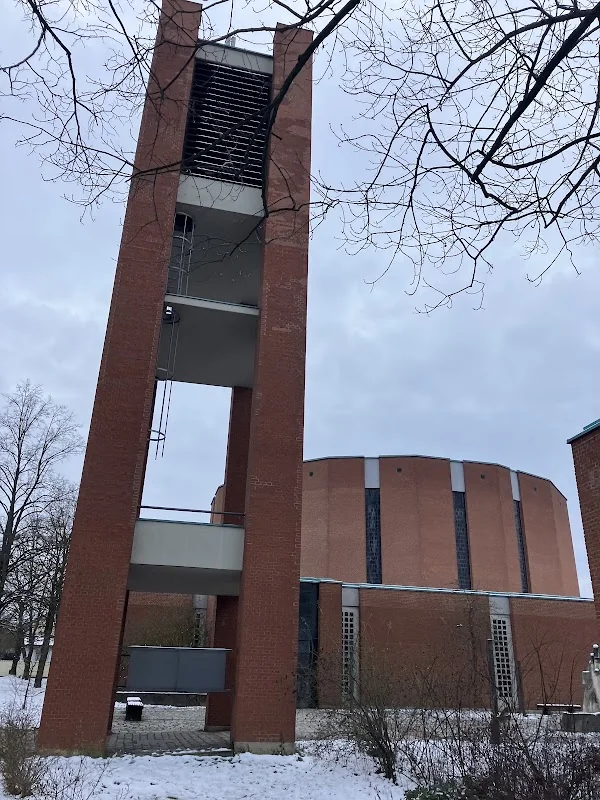
Architecturally, St. Bonifaz differs significantly from many older churches in Regensburg. The church was consecrated in 1970 because the strong population growth in the west of the city after World War II necessitated the construction of a new parish center. It was designed by Kurt and Klaus Oberberger. The building is round or cylindrical in shape and consists of reddish-brown exposed brick masonry. Inside, there is a hexadecagonal church space with a diameter of about 30 meters; above it is a tent roof made of wooden panels with 16 fields. This structure creates a very unique spatial impression: compact, modern, yet simultaneously solemn and oriented towards the liturgy. The architecture is therefore not a decorative end in itself but part of a post-war church idea that aims to bring together community, function, and symbolism. This is precisely what makes the Bonifaz church interesting for many visitors who, when searching for photos or interior views, want to discover not just a building but a special language of forms. ([de.wikipedia.org](https://de.wikipedia.org/wiki/St._Bonifaz_%28Regensburg%29))
Among the special details are the Marian chapel with a Catalan-Romanesque Madonna and Child from the 13th century, as well as the ceramic Stations of the Cross by Otto Schafarschik from Munich. Additionally, there are 14 windows designed by Josef Oberberger. The bell tower is square and 21 meters high. In the ecclesiastical perception, this creates an exciting contrast: externally a modern post-war building, internally a space with strong liturgical and art-historical accents. The Madonna connects the church with medieval piety, the Stations of the Cross with modern sacred art, and the windows with a consciously designed lighting concept. The organ is also an important part of the overall impression: it was built in 1970 by Josef Zeilhuber, the auxiliary work was added in 1982 by Reinhard Weise, and the system is controlled via a mobile two-manual console with electric action. This shows how carefully the equipment has been tailored to the musical use of the church. For visitors looking for photos, these elements are often the photogenic and identity-forming motifs: round shape, brick, tower, altar area, and light. ([de.wikipedia.org](https://de.wikipedia.org/wiki/St._Bonifaz_%28Regensburg%29))
The official church description also emphasizes that the building complex not only includes the church itself but also the parish center, parish courtyard, parish home, youth rooms, and kindergarten. This is architecturally and functionally important because the church does not stand isolated but must be understood as part of a larger community campus. This is a core aspect of its character: St. Bonifaz is not just a sacred solitary but an ensemble that brings together the religious, educational, and social everyday life of the parish. Those interested in construction history will discover here a post-war church that was deliberately oriented towards community and use. Those interested in details will find the exciting balance between the clear design of the 1970s and the art-historical elements inside. And those looking for sights will quickly realize that St. Bonifaz is not a museum but a living space whose architecture is still shaped by the use of services, music, and community meetings. This is what makes this church special: it is modern in construction yet rich in history, symbolism, and liturgical depth. ([de.wikipedia.org](https://de.wikipedia.org/wiki/St._Bonifaz_%28Regensburg%29))
Parish Center, Large Parish Hall, and Community Life
A third central theme in search queries is the parish center. St. Bonifaz is explicitly designed as a complete facility, not just as a church space. The parish describes the building complex with parish center, parish courtyard, parish home, youth rooms, and kindergarten. This structure explains why St. Bonifaz is much more than a place for Sunday services in everyday life. Here, group meetings, choir rehearsals, meetings, children's and family offerings, senior activities, and pastoral encounters take place. The parish maintains numerous groups and initiatives, including children's choir, youth choir, church choir, altar servers, family circles, senior working groups, Bible study groups, women's circles, Kolping, neighborhood assistance, and further formats. The parish center is thus the organizational heart of the community. It connects faith and everyday life, liturgy and education, community and assistance. Therefore, those searching for church st bonifaz parish center are actually looking for a place where church work happens practically. ([de.wikipedia.org](https://de.wikipedia.org/wiki/St._Bonifaz_%28Regensburg%29))
This function is particularly visible in the large parish hall. For example, book fairs and Easter markets take place there, where the parish presents Easter candles, palm branches, fair trade goods, jams, coffee, and cakes. Such events showcase a parish that not only offers religious services but also creates social and community meeting points. The parish hall is thus an important space for encounters, fundraising, and lived neighborhood. Conventions, lectures, and meetings are also held at St. Bonifaz; additionally, the parish lists events such as hikes, gymnastics and course offerings, family gatherings, and musical evenings. This is relevant for search behavior because many people search for events, tickets, or programs without knowing that the location is also used for smaller formats and internal community events. St. Bonifaz is thus not a pure event hall but a church multipurpose facility with a strong community connection. This mix makes the place functional and human at the same time. ([st-bonifaz-regensburg.de](https://www.st-bonifaz-regensburg.de/component/jem/event/1886-b%C3%BCcherflohmarkt-%E2%80%93-ostermarkt.html?utm_source=openai))
The parish itself also appears to be well-organized. The parish office is published on the website with opening hours, phone number, and email, and there is a clear infrastructure for contact, administration, and pastoral care. In the background, a church administration organizes the assets, buildings, and material needs of the parish. This may sound factual at first, but it is essential for the use of the location: a church that regularly hosts services, baptisms, weddings, concerts, and group work needs reliable structures. St. Bonifaz visibly and openly fulfills this task. Therefore, when visiting the place, one experiences not only a beautiful church space but also a functioning community with office, administration, volunteer work, and meeting points. The location of the rooms, the extensive use of the parish center, and the multitude of initiatives make the church a social center of the district. This also explains why search queries often do not stop at liturgy but quickly expand to parking, events, photos, or reviews. People are looking for a church here that proves itself in everyday life and does not just exist on paper. ([st-bonifaz-regensburg.de](https://st-bonifaz-regensburg.de/unsere-pfarrei/pfarrbuero.html?utm_source=openai))
Photos, Impressions, and Practical Information for Visitors
Many search queries related to St. Bonifaz revolve around photos, impressions, and the first visual impression. This is understandable because the church architecturally deviates significantly from classic old town churches. Those photographing or searching for St. Bonifaz encounter the round silhouette, the reddish-brown exposed brick masonry, the distinctive tower, and the bright interior with clear lighting design. The official website features a section with impressions from the parish that underscores the vibrant character of the place. Additionally, image files of St. Bonifaz are documented on Wikimedia Commons, further increasing the visual presence of the church online. This is precisely why the keyword photo is so relevant: the location is not only interesting in terms of location but also visually recognizable. For a first impression, it is worthwhile to look at the exterior view as well as interior photos, as the combination of modern form, sacred art, and community life shapes the character of the church. ([st-bonifaz-regensburg.de](https://www.st-bonifaz-regensburg.de/?utm_source=openai))
Practically, it is especially important for visitors that the church functions within the community system and is not isolated. The parish publishes the current services online and refers to the parish bulletin for details. Therefore, anyone planning a visit should check the schedule in advance, as services, baptisms, weddings, concerts, and other events utilize the space differently. For regular visitors, the church is also a familiar place for music and community life. The church choir rehearses there, the Bible study group meets in the church, and special celebrations such as first communion, confirmation, or Corpus Christi are regularly held there. This means: St. Bonifaz is not only beautiful to look at but is also densely scheduled and vibrant in everyday life. Therefore, those searching for reviews primarily find a place with active use, clear contact information, and many recurring events. This speaks more for a well-established community than for a tourist backdrop. ([st-bonifaz-regensburg.de](https://www.st-bonifaz-regensburg.de/liturgie-und-seelsorge/gottesdienste.html))
For travel, the address and intersection are the most important anchor points. The church is located at Killermannstraße 26 in the district of Prüfening, and some community events additionally name the Bonifaz parking lot as a meeting point. Therefore, those coming by car, on foot, or by bicycle should best orient themselves to the parish address and the intersection of Killermannstraße/Roter-Brach-Weg. The clear location indication is also important because St. Bonifaz, through the combination of church, parish center, and other community rooms, is more than just a single building. Visitors who want to take photos or participate in an event benefit from checking the correct address early and considering the respective use of the space. Especially for markets, concerts, or liturgical celebrations, the building complex may be accessed differently. However, those who consciously visit the place quickly experience why St. Bonifaz is so frequently searched in the west of Regensburg: the church is visually striking, well-connected organizationally, and firmly anchored in the everyday life of the parish. ([st-bonifaz-regensburg.de](https://www.st-bonifaz-regensburg.de/kontakt.html))
St. Bonifaz, St. Georg, and the Monastic Roots of the Parish
Those searching for st bonifaz regensburg or st georg st bonifaz regensburg encounter a parish with deeper historical roots. The official chronicle describes the emergence of the parish as a development from two monastic roots. On one hand, the Benedictine monastery St. Emmeram with its possessions in the west of Regensburg played a role, and on the other hand, the monastery Prüfening with St. Georg is important. The parish reminds us that in 1109 the monastery St. Georg Prüfening was founded, and the later parish history emerged from it. After the secularization, the former monastery church St. Georg became the parish church of the older Prüfening structures. St. Bonifaz was added as a modern parish church in the post-war period to serve the growing district. Thus, historical and modern church spaces arose side by side, which today together belong to the parish of St. Bonifaz – St. Georg. This connection is important for understanding the location because it shows that St. Bonifaz does not stand alone but is part of a developed ecclesiastical structure. ([st-bonifaz-regensburg.de](https://www.st-bonifaz-regensburg.de/unsere-pfarrei/pfarrei-chronik.html))
Additionally, the parish includes the St. Anna Church in Großprüfening and the pilgrimage church of the Assumption of Mary in Dechbetten. The churches on the parish page describe these places with historical brief information, clearly showing how closely regional history, pastoral care, and current use are interconnected. St. Anna dates back to 1488 and features Gothic wing altars; the Assumption of Mary was rebuilt in 1726 in baroque style on old foundations. For visitors interested in the overall history, this creates a very dense picture: St. Bonifaz is the modern core, St. Georg the old monastic center, St. Anna the village-historical complement, and Dechbetten the baroque pilgrimage dimension. The place name Prüfening thus refers not only to a district but to a spiritual space with long continuity. This historical depth makes the church interesting in search behavior because many users want to discover not just a building but the entire historical context of the west of Regensburg. ([st-bonifaz-regensburg.de](https://www.st-bonifaz-regensburg.de/unsere-pfarrei/kirchen-in-der-pfarrei.html))
From an SEO perspective, this historical and pastoral embedding also explains why search queries like catholic st bonifatius or catholic church st bonifaz mainz appear. People often search for the holy name and then land at various places with similar name structures. Therefore, it is important for the Regensburg location to clearly communicate the official spelling St. Bonifaz and always keep the location Regensburg in mind. The place is not just a church building but the center of a parish with several liturgical sites, groups, and social offerings. The official website, the contact page, and the churches in the parish page make this transparent. This is precisely why St. Bonifaz is so relevant for seekers: here, a modern parish church, an active community, and a historically grown environment come together. Therefore, when visiting the church, one does not simply see a building from the 1970s but a place where regional church history continues to be written to this day. ([st-bonifaz-regensburg.de](https://www.st-bonifaz-regensburg.de/kontakt.html))
Sources:
Mehr anzeigenWeniger anzeigen
Catholic Church St. Bonifaz | Regensburg & Photos
The Catholic Church St. Bonifaz is one of the prominent ecclesiastical places in the west of Regensburg and is closely connected to the district of Prüfening. Those searching for the church are often looking not only for a sacred building but also for a vibrant community meeting point with services, groups, music, and established points of contact in everyday life. Officially, the church belongs to the parish of St. Bonifaz – St. Georg, which sees itself as a young community with monastic roots. This blend of modern parish church, established tradition, and active community work makes St. Bonifaz interesting for many visitors, believers, and seekers. The parish explicitly invites people to get to know the community, its services, initiatives, and groups; the website features sections such as News, Services, Parish Bulletin, Events, and Impressions from the parish. ([st-bonifaz-regensburg.de](https://www.st-bonifaz-regensburg.de/?utm_source=openai))
Where is the Catholic Church St. Bonifaz located in Regensburg?
The primary search intent behind the keywords is clearly the location. The church is located at Killermannstraße 26, 93049 Regensburg, in the western district or the district of Prüfening. Several official and event-related pages of the parish also mention the intersection of Killermannstraße/Roter-Brach-Weg as a reference point. This is particularly helpful for visitors, as it allows the church to be easily situated within the local street network. So, anyone searching for the address, the church in Prüfening, or the church name plus Regensburg will find the same place here. The official contact pages also mention the parish office St. Bonifaz – St. Georg at exactly the same address, which shows that the church building and parish office are closely connected spatially. In practice, this means: St. Bonifaz is not just a place for services, but a common focal point of the parish with a clear address, clear responsibility, and a well-defined location in the western part of Regensburg. Current event notices, such as for the Bible study group or concerts, also repeatedly locate the church at this address and at the same intersection. This confirms the image of a church that is firmly anchored in the neighborhood and is regularly used by the community as a meeting point, liturgical place, and event venue. ([st-bonifaz-regensburg.de](https://www.st-bonifaz-regensburg.de/kontakt.html))
For SEO analysis, these local terms are particularly important: Regensburg, Prüfening, Killermannstraße, and the combination of church and address. Search queries like catholic church st bonifaz regensburg, church st bonifaz address, or catholic church st bonifaz killermannstraße regensburg show that many users first seek the exact location before they are interested in history or programs. This is logical because churches usually involve practical questions: Where is the entrance? Which street leads there? What is the name of the district? The parish itself supports this orientation by not describing the location abstractly on its website but repeatedly connecting it to the specific site. Especially for a modern church located somewhat away from the historic old town, this clear addressing is valuable. It not only facilitates visits but also the planning of baptisms, first communions, confirmations, concerts, markets, or meetings of various groups. Therefore, those looking for St. Bonifaz are almost always also searching for the district of Prüfening. And this is precisely the strongest geographical anchor of this location. ([st-bonifaz-regensburg.de](https://www.st-bonifaz-regensburg.de/kontakt.html))
Content-wise, it is also interesting that the parish cannot be reduced to St. Bonifaz alone. The parish also includes the old parish church St. Georg in Prüfening, the St. Anna Church in Großprüfening, and the pilgrimage church of the Assumption of Mary in Dechbetten. This creates a church network that extends far beyond a single building. For visitors, this means that St. Bonifaz is usually the modern, easily accessible center of the parish, while the other churches complement the historical and regional context. This also explains why many search queries begin with the location Regensburg: users want to understand the modern parish church in a larger context and quickly know where it is specifically located. The official website addresses this mix by consolidating community life, services, groups, and contacts in one place. Thus, the address becomes not only a navigable position on the map but also an organizational center of the entire parish. ([st-bonifaz-regensburg.de](https://www.st-bonifaz-regensburg.de/unsere-pfarrei/kirchen-in-der-pfarrei.html))
Services, Bible Study Group, and Vibrant Parish
A second major keyword theme is liturgical and communal life. The service page of the parish shows that St. Bonifaz is important not only for Sunday masses but also as a place with regular and diverse spiritual offerings. The parish website lists mass celebrations, evening masses, baptisms, weddings, and special celebrations; at the same time, the website refers to the respective parish bulletin for exact details. This is typical for an active community where dates are not static but are oriented around the church year, school times, festivals, and specific occasions. This is particularly evident in events like the Bible study group St. Bonifaz, which takes place in June 2026 in the parish church, or the Corpus Christi procession, which begins with a festive service at St. Bonifaz and moves through the district from there. Such formats show that the church is used as a starting point for faith discussions, liturgy, and public testimony. ([st-bonifaz-regensburg.de](https://www.st-bonifaz-regensburg.de/liturgie-und-seelsorge/gottesdienste.html))
Those searching for church st bonifaz services usually want to know how vibrant the parish actually is. The official pages provide a clear answer: very vibrant. The parish lists on its website, in addition to services, family and children's liturgy, children's choir, youth choir, project choir, church choir, altar servers, and various groups, circles, and associations. This is a clear sign that St. Bonifaz does not only function on Sunday mornings but is present as a religious and social place throughout the week. The connection of liturgy and music is particularly noticeable. The church choir rehearses in the Bonifaz church, sings at services and parish celebrations, and thus supports the liturgical quality of the community. Additionally, there are offerings such as Bible study, sermons, spiritual thoughts, women's discussion groups, senior work, and neighborhood assistance. For visitors, this creates an image of the church as a space for encounters, not just as a mere building. Therefore, those who come here often experience not only a service but also a network of volunteer work, music, conversation, and willingness to help. This diversity is one of the main reasons why the church is so present in search behavior. ([st-bonifaz-regensburg.de](https://www.st-bonifaz-regensburg.de/kontakt.html))
The parish's motto for 2026 is Love. Simple. Real. Strong. This also fits the community's orientation, as it does not set a great distance but rather emphasizes closeness and credibility. In the website's schedule, alongside the classic services, tables, conventions, workshops, children's offerings, family formats, and musical evenings also appear. This creates a contemporary image of parish life that is both rooted and open. Especially for people looking for review or program information, this diversity is relevant: here, the church is not experienced as a rigid monument but as a place that changes throughout the year and continually offers new access points. Therefore, those wanting to know what is happening at St. Bonifaz should not only look for a service schedule but also for Bible study, church music, first communion, confirmation, or Corpus Christi. These search terms reflect the practical use of the church. They show that St. Bonifaz is a hub of the parish both spiritually and organizationally and culturally. ([st-bonifaz-regensburg.de](https://www.st-bonifaz-regensburg.de/?utm_source=openai))
Architecture, Construction History, and Special Details
Architecturally, St. Bonifaz differs significantly from many older churches in Regensburg. The church was consecrated in 1970 because the strong population growth in the west of the city after World War II necessitated the construction of a new parish center. It was designed by Kurt and Klaus Oberberger. The building is round or cylindrical in shape and consists of reddish-brown exposed brick masonry. Inside, there is a hexadecagonal church space with a diameter of about 30 meters; above it is a tent roof made of wooden panels with 16 fields. This structure creates a very unique spatial impression: compact, modern, yet simultaneously solemn and oriented towards the liturgy. The architecture is therefore not a decorative end in itself but part of a post-war church idea that aims to bring together community, function, and symbolism. This is precisely what makes the Bonifaz church interesting for many visitors who, when searching for photos or interior views, want to discover not just a building but a special language of forms. ([de.wikipedia.org](https://de.wikipedia.org/wiki/St._Bonifaz_%28Regensburg%29))
Among the special details are the Marian chapel with a Catalan-Romanesque Madonna and Child from the 13th century, as well as the ceramic Stations of the Cross by Otto Schafarschik from Munich. Additionally, there are 14 windows designed by Josef Oberberger. The bell tower is square and 21 meters high. In the ecclesiastical perception, this creates an exciting contrast: externally a modern post-war building, internally a space with strong liturgical and art-historical accents. The Madonna connects the church with medieval piety, the Stations of the Cross with modern sacred art, and the windows with a consciously designed lighting concept. The organ is also an important part of the overall impression: it was built in 1970 by Josef Zeilhuber, the auxiliary work was added in 1982 by Reinhard Weise, and the system is controlled via a mobile two-manual console with electric action. This shows how carefully the equipment has been tailored to the musical use of the church. For visitors looking for photos, these elements are often the photogenic and identity-forming motifs: round shape, brick, tower, altar area, and light. ([de.wikipedia.org](https://de.wikipedia.org/wiki/St._Bonifaz_%28Regensburg%29))
The official church description also emphasizes that the building complex not only includes the church itself but also the parish center, parish courtyard, parish home, youth rooms, and kindergarten. This is architecturally and functionally important because the church does not stand isolated but must be understood as part of a larger community campus. This is a core aspect of its character: St. Bonifaz is not just a sacred solitary but an ensemble that brings together the religious, educational, and social everyday life of the parish. Those interested in construction history will discover here a post-war church that was deliberately oriented towards community and use. Those interested in details will find the exciting balance between the clear design of the 1970s and the art-historical elements inside. And those looking for sights will quickly realize that St. Bonifaz is not a museum but a living space whose architecture is still shaped by the use of services, music, and community meetings. This is what makes this church special: it is modern in construction yet rich in history, symbolism, and liturgical depth. ([de.wikipedia.org](https://de.wikipedia.org/wiki/St._Bonifaz_%28Regensburg%29))
Parish Center, Large Parish Hall, and Community Life
A third central theme in search queries is the parish center. St. Bonifaz is explicitly designed as a complete facility, not just as a church space. The parish describes the building complex with parish center, parish courtyard, parish home, youth rooms, and kindergarten. This structure explains why St. Bonifaz is much more than a place for Sunday services in everyday life. Here, group meetings, choir rehearsals, meetings, children's and family offerings, senior activities, and pastoral encounters take place. The parish maintains numerous groups and initiatives, including children's choir, youth choir, church choir, altar servers, family circles, senior working groups, Bible study groups, women's circles, Kolping, neighborhood assistance, and further formats. The parish center is thus the organizational heart of the community. It connects faith and everyday life, liturgy and education, community and assistance. Therefore, those searching for church st bonifaz parish center are actually looking for a place where church work happens practically. ([de.wikipedia.org](https://de.wikipedia.org/wiki/St._Bonifaz_%28Regensburg%29))
This function is particularly visible in the large parish hall. For example, book fairs and Easter markets take place there, where the parish presents Easter candles, palm branches, fair trade goods, jams, coffee, and cakes. Such events showcase a parish that not only offers religious services but also creates social and community meeting points. The parish hall is thus an important space for encounters, fundraising, and lived neighborhood. Conventions, lectures, and meetings are also held at St. Bonifaz; additionally, the parish lists events such as hikes, gymnastics and course offerings, family gatherings, and musical evenings. This is relevant for search behavior because many people search for events, tickets, or programs without knowing that the location is also used for smaller formats and internal community events. St. Bonifaz is thus not a pure event hall but a church multipurpose facility with a strong community connection. This mix makes the place functional and human at the same time. ([st-bonifaz-regensburg.de](https://www.st-bonifaz-regensburg.de/component/jem/event/1886-b%C3%BCcherflohmarkt-%E2%80%93-ostermarkt.html?utm_source=openai))
The parish itself also appears to be well-organized. The parish office is published on the website with opening hours, phone number, and email, and there is a clear infrastructure for contact, administration, and pastoral care. In the background, a church administration organizes the assets, buildings, and material needs of the parish. This may sound factual at first, but it is essential for the use of the location: a church that regularly hosts services, baptisms, weddings, concerts, and group work needs reliable structures. St. Bonifaz visibly and openly fulfills this task. Therefore, when visiting the place, one experiences not only a beautiful church space but also a functioning community with office, administration, volunteer work, and meeting points. The location of the rooms, the extensive use of the parish center, and the multitude of initiatives make the church a social center of the district. This also explains why search queries often do not stop at liturgy but quickly expand to parking, events, photos, or reviews. People are looking for a church here that proves itself in everyday life and does not just exist on paper. ([st-bonifaz-regensburg.de](https://st-bonifaz-regensburg.de/unsere-pfarrei/pfarrbuero.html?utm_source=openai))
Photos, Impressions, and Practical Information for Visitors
Many search queries related to St. Bonifaz revolve around photos, impressions, and the first visual impression. This is understandable because the church architecturally deviates significantly from classic old town churches. Those photographing or searching for St. Bonifaz encounter the round silhouette, the reddish-brown exposed brick masonry, the distinctive tower, and the bright interior with clear lighting design. The official website features a section with impressions from the parish that underscores the vibrant character of the place. Additionally, image files of St. Bonifaz are documented on Wikimedia Commons, further increasing the visual presence of the church online. This is precisely why the keyword photo is so relevant: the location is not only interesting in terms of location but also visually recognizable. For a first impression, it is worthwhile to look at the exterior view as well as interior photos, as the combination of modern form, sacred art, and community life shapes the character of the church. ([st-bonifaz-regensburg.de](https://www.st-bonifaz-regensburg.de/?utm_source=openai))
Practically, it is especially important for visitors that the church functions within the community system and is not isolated. The parish publishes the current services online and refers to the parish bulletin for details. Therefore, anyone planning a visit should check the schedule in advance, as services, baptisms, weddings, concerts, and other events utilize the space differently. For regular visitors, the church is also a familiar place for music and community life. The church choir rehearses there, the Bible study group meets in the church, and special celebrations such as first communion, confirmation, or Corpus Christi are regularly held there. This means: St. Bonifaz is not only beautiful to look at but is also densely scheduled and vibrant in everyday life. Therefore, those searching for reviews primarily find a place with active use, clear contact information, and many recurring events. This speaks more for a well-established community than for a tourist backdrop. ([st-bonifaz-regensburg.de](https://www.st-bonifaz-regensburg.de/liturgie-und-seelsorge/gottesdienste.html))
For travel, the address and intersection are the most important anchor points. The church is located at Killermannstraße 26 in the district of Prüfening, and some community events additionally name the Bonifaz parking lot as a meeting point. Therefore, those coming by car, on foot, or by bicycle should best orient themselves to the parish address and the intersection of Killermannstraße/Roter-Brach-Weg. The clear location indication is also important because St. Bonifaz, through the combination of church, parish center, and other community rooms, is more than just a single building. Visitors who want to take photos or participate in an event benefit from checking the correct address early and considering the respective use of the space. Especially for markets, concerts, or liturgical celebrations, the building complex may be accessed differently. However, those who consciously visit the place quickly experience why St. Bonifaz is so frequently searched in the west of Regensburg: the church is visually striking, well-connected organizationally, and firmly anchored in the everyday life of the parish. ([st-bonifaz-regensburg.de](https://www.st-bonifaz-regensburg.de/kontakt.html))
St. Bonifaz, St. Georg, and the Monastic Roots of the Parish
Those searching for st bonifaz regensburg or st georg st bonifaz regensburg encounter a parish with deeper historical roots. The official chronicle describes the emergence of the parish as a development from two monastic roots. On one hand, the Benedictine monastery St. Emmeram with its possessions in the west of Regensburg played a role, and on the other hand, the monastery Prüfening with St. Georg is important. The parish reminds us that in 1109 the monastery St. Georg Prüfening was founded, and the later parish history emerged from it. After the secularization, the former monastery church St. Georg became the parish church of the older Prüfening structures. St. Bonifaz was added as a modern parish church in the post-war period to serve the growing district. Thus, historical and modern church spaces arose side by side, which today together belong to the parish of St. Bonifaz – St. Georg. This connection is important for understanding the location because it shows that St. Bonifaz does not stand alone but is part of a developed ecclesiastical structure. ([st-bonifaz-regensburg.de](https://www.st-bonifaz-regensburg.de/unsere-pfarrei/pfarrei-chronik.html))
Additionally, the parish includes the St. Anna Church in Großprüfening and the pilgrimage church of the Assumption of Mary in Dechbetten. The churches on the parish page describe these places with historical brief information, clearly showing how closely regional history, pastoral care, and current use are interconnected. St. Anna dates back to 1488 and features Gothic wing altars; the Assumption of Mary was rebuilt in 1726 in baroque style on old foundations. For visitors interested in the overall history, this creates a very dense picture: St. Bonifaz is the modern core, St. Georg the old monastic center, St. Anna the village-historical complement, and Dechbetten the baroque pilgrimage dimension. The place name Prüfening thus refers not only to a district but to a spiritual space with long continuity. This historical depth makes the church interesting in search behavior because many users want to discover not just a building but the entire historical context of the west of Regensburg. ([st-bonifaz-regensburg.de](https://www.st-bonifaz-regensburg.de/unsere-pfarrei/kirchen-in-der-pfarrei.html))
From an SEO perspective, this historical and pastoral embedding also explains why search queries like catholic st bonifatius or catholic church st bonifaz mainz appear. People often search for the holy name and then land at various places with similar name structures. Therefore, it is important for the Regensburg location to clearly communicate the official spelling St. Bonifaz and always keep the location Regensburg in mind. The place is not just a church building but the center of a parish with several liturgical sites, groups, and social offerings. The official website, the contact page, and the churches in the parish page make this transparent. This is precisely why St. Bonifaz is so relevant for seekers: here, a modern parish church, an active community, and a historically grown environment come together. Therefore, when visiting the church, one does not simply see a building from the 1970s but a place where regional church history continues to be written to this day. ([st-bonifaz-regensburg.de](https://www.st-bonifaz-regensburg.de/kontakt.html))
Sources:
Catholic Church St. Bonifaz | Regensburg & Photos
The Catholic Church St. Bonifaz is one of the prominent ecclesiastical places in the west of Regensburg and is closely connected to the district of Prüfening. Those searching for the church are often looking not only for a sacred building but also for a vibrant community meeting point with services, groups, music, and established points of contact in everyday life. Officially, the church belongs to the parish of St. Bonifaz – St. Georg, which sees itself as a young community with monastic roots. This blend of modern parish church, established tradition, and active community work makes St. Bonifaz interesting for many visitors, believers, and seekers. The parish explicitly invites people to get to know the community, its services, initiatives, and groups; the website features sections such as News, Services, Parish Bulletin, Events, and Impressions from the parish. ([st-bonifaz-regensburg.de](https://www.st-bonifaz-regensburg.de/?utm_source=openai))
Where is the Catholic Church St. Bonifaz located in Regensburg?
The primary search intent behind the keywords is clearly the location. The church is located at Killermannstraße 26, 93049 Regensburg, in the western district or the district of Prüfening. Several official and event-related pages of the parish also mention the intersection of Killermannstraße/Roter-Brach-Weg as a reference point. This is particularly helpful for visitors, as it allows the church to be easily situated within the local street network. So, anyone searching for the address, the church in Prüfening, or the church name plus Regensburg will find the same place here. The official contact pages also mention the parish office St. Bonifaz – St. Georg at exactly the same address, which shows that the church building and parish office are closely connected spatially. In practice, this means: St. Bonifaz is not just a place for services, but a common focal point of the parish with a clear address, clear responsibility, and a well-defined location in the western part of Regensburg. Current event notices, such as for the Bible study group or concerts, also repeatedly locate the church at this address and at the same intersection. This confirms the image of a church that is firmly anchored in the neighborhood and is regularly used by the community as a meeting point, liturgical place, and event venue. ([st-bonifaz-regensburg.de](https://www.st-bonifaz-regensburg.de/kontakt.html))
For SEO analysis, these local terms are particularly important: Regensburg, Prüfening, Killermannstraße, and the combination of church and address. Search queries like catholic church st bonifaz regensburg, church st bonifaz address, or catholic church st bonifaz killermannstraße regensburg show that many users first seek the exact location before they are interested in history or programs. This is logical because churches usually involve practical questions: Where is the entrance? Which street leads there? What is the name of the district? The parish itself supports this orientation by not describing the location abstractly on its website but repeatedly connecting it to the specific site. Especially for a modern church located somewhat away from the historic old town, this clear addressing is valuable. It not only facilitates visits but also the planning of baptisms, first communions, confirmations, concerts, markets, or meetings of various groups. Therefore, those looking for St. Bonifaz are almost always also searching for the district of Prüfening. And this is precisely the strongest geographical anchor of this location. ([st-bonifaz-regensburg.de](https://www.st-bonifaz-regensburg.de/kontakt.html))
Content-wise, it is also interesting that the parish cannot be reduced to St. Bonifaz alone. The parish also includes the old parish church St. Georg in Prüfening, the St. Anna Church in Großprüfening, and the pilgrimage church of the Assumption of Mary in Dechbetten. This creates a church network that extends far beyond a single building. For visitors, this means that St. Bonifaz is usually the modern, easily accessible center of the parish, while the other churches complement the historical and regional context. This also explains why many search queries begin with the location Regensburg: users want to understand the modern parish church in a larger context and quickly know where it is specifically located. The official website addresses this mix by consolidating community life, services, groups, and contacts in one place. Thus, the address becomes not only a navigable position on the map but also an organizational center of the entire parish. ([st-bonifaz-regensburg.de](https://www.st-bonifaz-regensburg.de/unsere-pfarrei/kirchen-in-der-pfarrei.html))
Services, Bible Study Group, and Vibrant Parish
A second major keyword theme is liturgical and communal life. The service page of the parish shows that St. Bonifaz is important not only for Sunday masses but also as a place with regular and diverse spiritual offerings. The parish website lists mass celebrations, evening masses, baptisms, weddings, and special celebrations; at the same time, the website refers to the respective parish bulletin for exact details. This is typical for an active community where dates are not static but are oriented around the church year, school times, festivals, and specific occasions. This is particularly evident in events like the Bible study group St. Bonifaz, which takes place in June 2026 in the parish church, or the Corpus Christi procession, which begins with a festive service at St. Bonifaz and moves through the district from there. Such formats show that the church is used as a starting point for faith discussions, liturgy, and public testimony. ([st-bonifaz-regensburg.de](https://www.st-bonifaz-regensburg.de/liturgie-und-seelsorge/gottesdienste.html))
Those searching for church st bonifaz services usually want to know how vibrant the parish actually is. The official pages provide a clear answer: very vibrant. The parish lists on its website, in addition to services, family and children's liturgy, children's choir, youth choir, project choir, church choir, altar servers, and various groups, circles, and associations. This is a clear sign that St. Bonifaz does not only function on Sunday mornings but is present as a religious and social place throughout the week. The connection of liturgy and music is particularly noticeable. The church choir rehearses in the Bonifaz church, sings at services and parish celebrations, and thus supports the liturgical quality of the community. Additionally, there are offerings such as Bible study, sermons, spiritual thoughts, women's discussion groups, senior work, and neighborhood assistance. For visitors, this creates an image of the church as a space for encounters, not just as a mere building. Therefore, those who come here often experience not only a service but also a network of volunteer work, music, conversation, and willingness to help. This diversity is one of the main reasons why the church is so present in search behavior. ([st-bonifaz-regensburg.de](https://www.st-bonifaz-regensburg.de/kontakt.html))
The parish's motto for 2026 is Love. Simple. Real. Strong. This also fits the community's orientation, as it does not set a great distance but rather emphasizes closeness and credibility. In the website's schedule, alongside the classic services, tables, conventions, workshops, children's offerings, family formats, and musical evenings also appear. This creates a contemporary image of parish life that is both rooted and open. Especially for people looking for review or program information, this diversity is relevant: here, the church is not experienced as a rigid monument but as a place that changes throughout the year and continually offers new access points. Therefore, those wanting to know what is happening at St. Bonifaz should not only look for a service schedule but also for Bible study, church music, first communion, confirmation, or Corpus Christi. These search terms reflect the practical use of the church. They show that St. Bonifaz is a hub of the parish both spiritually and organizationally and culturally. ([st-bonifaz-regensburg.de](https://www.st-bonifaz-regensburg.de/?utm_source=openai))
Architecture, Construction History, and Special Details
Architecturally, St. Bonifaz differs significantly from many older churches in Regensburg. The church was consecrated in 1970 because the strong population growth in the west of the city after World War II necessitated the construction of a new parish center. It was designed by Kurt and Klaus Oberberger. The building is round or cylindrical in shape and consists of reddish-brown exposed brick masonry. Inside, there is a hexadecagonal church space with a diameter of about 30 meters; above it is a tent roof made of wooden panels with 16 fields. This structure creates a very unique spatial impression: compact, modern, yet simultaneously solemn and oriented towards the liturgy. The architecture is therefore not a decorative end in itself but part of a post-war church idea that aims to bring together community, function, and symbolism. This is precisely what makes the Bonifaz church interesting for many visitors who, when searching for photos or interior views, want to discover not just a building but a special language of forms. ([de.wikipedia.org](https://de.wikipedia.org/wiki/St._Bonifaz_%28Regensburg%29))
Among the special details are the Marian chapel with a Catalan-Romanesque Madonna and Child from the 13th century, as well as the ceramic Stations of the Cross by Otto Schafarschik from Munich. Additionally, there are 14 windows designed by Josef Oberberger. The bell tower is square and 21 meters high. In the ecclesiastical perception, this creates an exciting contrast: externally a modern post-war building, internally a space with strong liturgical and art-historical accents. The Madonna connects the church with medieval piety, the Stations of the Cross with modern sacred art, and the windows with a consciously designed lighting concept. The organ is also an important part of the overall impression: it was built in 1970 by Josef Zeilhuber, the auxiliary work was added in 1982 by Reinhard Weise, and the system is controlled via a mobile two-manual console with electric action. This shows how carefully the equipment has been tailored to the musical use of the church. For visitors looking for photos, these elements are often the photogenic and identity-forming motifs: round shape, brick, tower, altar area, and light. ([de.wikipedia.org](https://de.wikipedia.org/wiki/St._Bonifaz_%28Regensburg%29))
The official church description also emphasizes that the building complex not only includes the church itself but also the parish center, parish courtyard, parish home, youth rooms, and kindergarten. This is architecturally and functionally important because the church does not stand isolated but must be understood as part of a larger community campus. This is a core aspect of its character: St. Bonifaz is not just a sacred solitary but an ensemble that brings together the religious, educational, and social everyday life of the parish. Those interested in construction history will discover here a post-war church that was deliberately oriented towards community and use. Those interested in details will find the exciting balance between the clear design of the 1970s and the art-historical elements inside. And those looking for sights will quickly realize that St. Bonifaz is not a museum but a living space whose architecture is still shaped by the use of services, music, and community meetings. This is what makes this church special: it is modern in construction yet rich in history, symbolism, and liturgical depth. ([de.wikipedia.org](https://de.wikipedia.org/wiki/St._Bonifaz_%28Regensburg%29))
Parish Center, Large Parish Hall, and Community Life
A third central theme in search queries is the parish center. St. Bonifaz is explicitly designed as a complete facility, not just as a church space. The parish describes the building complex with parish center, parish courtyard, parish home, youth rooms, and kindergarten. This structure explains why St. Bonifaz is much more than a place for Sunday services in everyday life. Here, group meetings, choir rehearsals, meetings, children's and family offerings, senior activities, and pastoral encounters take place. The parish maintains numerous groups and initiatives, including children's choir, youth choir, church choir, altar servers, family circles, senior working groups, Bible study groups, women's circles, Kolping, neighborhood assistance, and further formats. The parish center is thus the organizational heart of the community. It connects faith and everyday life, liturgy and education, community and assistance. Therefore, those searching for church st bonifaz parish center are actually looking for a place where church work happens practically. ([de.wikipedia.org](https://de.wikipedia.org/wiki/St._Bonifaz_%28Regensburg%29))
This function is particularly visible in the large parish hall. For example, book fairs and Easter markets take place there, where the parish presents Easter candles, palm branches, fair trade goods, jams, coffee, and cakes. Such events showcase a parish that not only offers religious services but also creates social and community meeting points. The parish hall is thus an important space for encounters, fundraising, and lived neighborhood. Conventions, lectures, and meetings are also held at St. Bonifaz; additionally, the parish lists events such as hikes, gymnastics and course offerings, family gatherings, and musical evenings. This is relevant for search behavior because many people search for events, tickets, or programs without knowing that the location is also used for smaller formats and internal community events. St. Bonifaz is thus not a pure event hall but a church multipurpose facility with a strong community connection. This mix makes the place functional and human at the same time. ([st-bonifaz-regensburg.de](https://www.st-bonifaz-regensburg.de/component/jem/event/1886-b%C3%BCcherflohmarkt-%E2%80%93-ostermarkt.html?utm_source=openai))
The parish itself also appears to be well-organized. The parish office is published on the website with opening hours, phone number, and email, and there is a clear infrastructure for contact, administration, and pastoral care. In the background, a church administration organizes the assets, buildings, and material needs of the parish. This may sound factual at first, but it is essential for the use of the location: a church that regularly hosts services, baptisms, weddings, concerts, and group work needs reliable structures. St. Bonifaz visibly and openly fulfills this task. Therefore, when visiting the place, one experiences not only a beautiful church space but also a functioning community with office, administration, volunteer work, and meeting points. The location of the rooms, the extensive use of the parish center, and the multitude of initiatives make the church a social center of the district. This also explains why search queries often do not stop at liturgy but quickly expand to parking, events, photos, or reviews. People are looking for a church here that proves itself in everyday life and does not just exist on paper. ([st-bonifaz-regensburg.de](https://st-bonifaz-regensburg.de/unsere-pfarrei/pfarrbuero.html?utm_source=openai))
Photos, Impressions, and Practical Information for Visitors
Many search queries related to St. Bonifaz revolve around photos, impressions, and the first visual impression. This is understandable because the church architecturally deviates significantly from classic old town churches. Those photographing or searching for St. Bonifaz encounter the round silhouette, the reddish-brown exposed brick masonry, the distinctive tower, and the bright interior with clear lighting design. The official website features a section with impressions from the parish that underscores the vibrant character of the place. Additionally, image files of St. Bonifaz are documented on Wikimedia Commons, further increasing the visual presence of the church online. This is precisely why the keyword photo is so relevant: the location is not only interesting in terms of location but also visually recognizable. For a first impression, it is worthwhile to look at the exterior view as well as interior photos, as the combination of modern form, sacred art, and community life shapes the character of the church. ([st-bonifaz-regensburg.de](https://www.st-bonifaz-regensburg.de/?utm_source=openai))
Practically, it is especially important for visitors that the church functions within the community system and is not isolated. The parish publishes the current services online and refers to the parish bulletin for details. Therefore, anyone planning a visit should check the schedule in advance, as services, baptisms, weddings, concerts, and other events utilize the space differently. For regular visitors, the church is also a familiar place for music and community life. The church choir rehearses there, the Bible study group meets in the church, and special celebrations such as first communion, confirmation, or Corpus Christi are regularly held there. This means: St. Bonifaz is not only beautiful to look at but is also densely scheduled and vibrant in everyday life. Therefore, those searching for reviews primarily find a place with active use, clear contact information, and many recurring events. This speaks more for a well-established community than for a tourist backdrop. ([st-bonifaz-regensburg.de](https://www.st-bonifaz-regensburg.de/liturgie-und-seelsorge/gottesdienste.html))
For travel, the address and intersection are the most important anchor points. The church is located at Killermannstraße 26 in the district of Prüfening, and some community events additionally name the Bonifaz parking lot as a meeting point. Therefore, those coming by car, on foot, or by bicycle should best orient themselves to the parish address and the intersection of Killermannstraße/Roter-Brach-Weg. The clear location indication is also important because St. Bonifaz, through the combination of church, parish center, and other community rooms, is more than just a single building. Visitors who want to take photos or participate in an event benefit from checking the correct address early and considering the respective use of the space. Especially for markets, concerts, or liturgical celebrations, the building complex may be accessed differently. However, those who consciously visit the place quickly experience why St. Bonifaz is so frequently searched in the west of Regensburg: the church is visually striking, well-connected organizationally, and firmly anchored in the everyday life of the parish. ([st-bonifaz-regensburg.de](https://www.st-bonifaz-regensburg.de/kontakt.html))
St. Bonifaz, St. Georg, and the Monastic Roots of the Parish
Those searching for st bonifaz regensburg or st georg st bonifaz regensburg encounter a parish with deeper historical roots. The official chronicle describes the emergence of the parish as a development from two monastic roots. On one hand, the Benedictine monastery St. Emmeram with its possessions in the west of Regensburg played a role, and on the other hand, the monastery Prüfening with St. Georg is important. The parish reminds us that in 1109 the monastery St. Georg Prüfening was founded, and the later parish history emerged from it. After the secularization, the former monastery church St. Georg became the parish church of the older Prüfening structures. St. Bonifaz was added as a modern parish church in the post-war period to serve the growing district. Thus, historical and modern church spaces arose side by side, which today together belong to the parish of St. Bonifaz – St. Georg. This connection is important for understanding the location because it shows that St. Bonifaz does not stand alone but is part of a developed ecclesiastical structure. ([st-bonifaz-regensburg.de](https://www.st-bonifaz-regensburg.de/unsere-pfarrei/pfarrei-chronik.html))
Additionally, the parish includes the St. Anna Church in Großprüfening and the pilgrimage church of the Assumption of Mary in Dechbetten. The churches on the parish page describe these places with historical brief information, clearly showing how closely regional history, pastoral care, and current use are interconnected. St. Anna dates back to 1488 and features Gothic wing altars; the Assumption of Mary was rebuilt in 1726 in baroque style on old foundations. For visitors interested in the overall history, this creates a very dense picture: St. Bonifaz is the modern core, St. Georg the old monastic center, St. Anna the village-historical complement, and Dechbetten the baroque pilgrimage dimension. The place name Prüfening thus refers not only to a district but to a spiritual space with long continuity. This historical depth makes the church interesting in search behavior because many users want to discover not just a building but the entire historical context of the west of Regensburg. ([st-bonifaz-regensburg.de](https://www.st-bonifaz-regensburg.de/unsere-pfarrei/kirchen-in-der-pfarrei.html))
From an SEO perspective, this historical and pastoral embedding also explains why search queries like catholic st bonifatius or catholic church st bonifaz mainz appear. People often search for the holy name and then land at various places with similar name structures. Therefore, it is important for the Regensburg location to clearly communicate the official spelling St. Bonifaz and always keep the location Regensburg in mind. The place is not just a church building but the center of a parish with several liturgical sites, groups, and social offerings. The official website, the contact page, and the churches in the parish page make this transparent. This is precisely why St. Bonifaz is so relevant for seekers: here, a modern parish church, an active community, and a historically grown environment come together. Therefore, when visiting the church, one does not simply see a building from the 1970s but a place where regional church history continues to be written to this day. ([st-bonifaz-regensburg.de](https://www.st-bonifaz-regensburg.de/kontakt.html))
Sources:
Upcoming Events
No events found
Frequently Asked Questions
Reviews
tom staufer
26. April 2026
The memorial service was top-notch, I've never experienced anything like it, the pastor spoke exactly about the deceased, it wasn't boring, motorcycles etc. were set up in the church, thank you very much
Theresa Schirling
25. October 2021
A very modern but beautiful church with fantastic acoustics. The only complaint is one point: the church is not heated. The church is very tall, I understand the high heating costs. I would have appreciated a heads-up about this in advance.
clovis costa
1. September 2022
Parish that I am now attending and becoming a part of. The layout reminds me of the cathedral of S.Dimas in São José dos Campos
Enigma rbs
29. May 2022
Very modern church, Pastor Stempfhuber makes a great effort to create a relaxed service.
Adler
11. July 2021
Also suitable for wheelchair users to attend a service. Restrooms available.