
Regensburg
Bischof-Wittmann-Straße 24A, 93051 Regensburg, Deutschland
Catholic Church St. Wolfgang Regensburg | Services & History
The Catholic Church St. Wolfgang Regensburg is much more than a place of worship in the southwestern part of Regensburg. Those who enter the ensemble on Bischof-Wittmann-Straße experience a place where modern church architecture, vibrant parish work, and the history of Kumpfmühl are closely intertwined. The parish church, built by Dominikus Böhm from 1938 to 1940, is considered a milestone of modern church construction; today, the parish includes the church, crypt, parish hall, and rectory as a cohesive center. The parish website clearly shows that St. Wolfgang is not just an address, but a spiritual and urban landmark. In the everyday life of the community, liturgy, pastoral care, encounters, and memories of a long local development connect here, ranging from the earliest settlement traces in Kumpfmühl to the present-day parish. ([wolfgangskirche-regensburg.de](https://www.wolfgangskirche-regensburg.de/pfarrkirche-st-wolfgang/))
Parish Church St. Wolfgang: Architecture by Dominikus Böhm
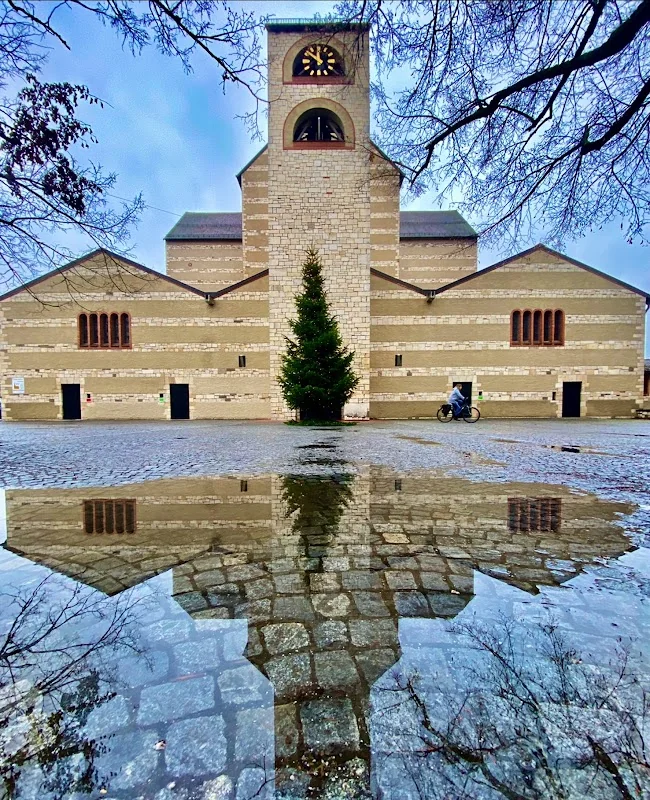
The parish church St. Wolfgang is architecturally the heart of the entire complex. The fundamental idea of the building already shows why this church space in Regensburg continues to have such a strong impact today: The altar is at the center, not as a decorative detail, but as a clear theological and spatial center of the community. Dominikus Böhm designed the church between 1938 and 1940 as a central building that consciously differs from many traditional longitudinal churches. Four large window rosettes, the distinctive cross shape, and the bell tower give the building its unmistakable silhouette. It is precisely this combination of severity and symbolism that makes St. Wolfgang an important example of modern sacred architecture in Germany. The church is not only large but is consistently oriented towards participation, gathering, and liturgical center in its language of form. Anyone who observes it quickly realizes that this is not just a building, but a spiritual concept made of stone, light, and space. ([wolfgangskirche-regensburg.de](https://www.wolfgangskirche-regensburg.de/pfarrkirche-st-wolfgang/))
This claim is also visible inside. The Liturgical Movement, the participation of the congregation, and the Christ-centeredness shape the spatial concept of the Wolfgang Church long before such ideas became widely spread through the Second Vatican Council. Two ambons emphasize the word of God, the baptismal font has its own place in the baptistery, and the community is oriented towards participation rather than distance. As a result, the space does not appear monumental in the classical sense but concentrated and dialogical. The east and west references, the rosettes, the smooth wall surfaces, and the clear structure together form an architecture that can be read both symbolically and functionally. For visitors, this is particularly fascinating because the church in Kumpfmühl stands out powerfully from its surroundings while remaining embedded in the history of the place and the parish. The building tells not only of aesthetics but also of ecclesiastical renewal, perseverance in difficult times, and an architecture that aims to make faith visible. ([wolfgangskirche-regensburg.de](https://www.wolfgangskirche-regensburg.de/pfarrei-geschichte/))
Services and Spiritual Life in St. Wolfgang
For many people, the Catholic Church St. Wolfgang Regensburg is not primarily an architectural monument but a vibrant place of worship. The parish publishes a clear and regular service schedule: on Sundays and holidays, masses are celebrated at 08:30, 10:00, 11:00, and 19:00; on weekdays at 08:00 in the crypt and at 19:00 in the parish church, and on Saturdays at 08:00 in the crypt and at 18:15 as a vigil mass. This structure shows how strongly community life is oriented towards reliable liturgy. At the same time, there is a welcoming service before the 10 o'clock services, which underscores the open character of the parish. Thus, St. Wolfgang is not only a space for special occasions but a place where regular celebration, devotion, and personal encounters come together. ([wolfgangskirche-regensburg.de](https://www.wolfgangskirche-regensburg.de/gottesdienste/))
The spiritual life of the parish goes far beyond individual mass times. The website points to a rich offering of pastoral care, confession, communion, confirmation, blessings, and mass intentions, making it clear that St. Wolfgang carries a broad pastoral infrastructure. Additionally, the parish newsletter informs and connects the community, as does the parish's presence online, which has existed since 1999. This continuity reflects the commitment to not only bring people to worship but to permanently integrate them into a vibrant faith community. The history of Sunday masses, the renovations of the church space, and the many liturgical forms over the decades show that St. Wolfgang has repeatedly responded to new social situations without losing its center. For visitors and believers, this results in a church place that appears open, traditional, and surprisingly close to everyday life. ([wolfgangskirche-regensburg.de](https://www.wolfgangskirche-regensburg.de/rundgang-wolfgangskirche/))
Location, Access, and Orientation in Southern Regensburg
The location of the Catholic Church St. Wolfgang Regensburg is an important part of its identity. The parish is located in the southwest of the city and includes, among other areas, Kumpfmühl and Neuprüll; further connections exist towards the university, OTH, university hospital, and district hospital. Thus, St. Wolfgang is situated in an urban area characterized by housing, education, medicine, and church life. The address of the church and the parish center is provided on the website as Bischof-Wittmann-Straße 24a and 24b, which makes orientation easier. It is particularly helpful for visitors that the parish offers a site plan for the church, crypt, parish hall, and rectory. This suggests that the entire ensemble is to be understood as a cohesive place and not as a standalone building without reference to the surroundings. Especially in a district with diverse paths and occasions, this clarity is valuable for first-time visitors. ([wolfgangskirche-regensburg.de](https://www.wolfgangskirche-regensburg.de/wolfgangskirche/))
Historically, the site stands on an exceptionally charged ground. Kumpfmühl is considered the oldest district of Regensburg, and the parish itself points out that here Roman, early medieval, and modern layers intersect. Two peace columns near the Wolfgang Church mark a former boundary between the imperial city of Regensburg and electoral territory. At the same time, the parish history shows how much the district has changed since the 19th century due to railway connections, industrialization, and new residential areas. The church is therefore not isolated but situated in a developed urban space. Today, those who visit Bischof-Wittmann-Straße experience not only an address for worship and pastoral care but a place where city history, topography, and ecclesiastical development visibly converge. This connection makes St. Wolfgang so characteristic for Regensburg. ([wolfgangskirche-regensburg.de](https://www.wolfgangskirche-regensburg.de/kumpfmuehl-geschichte/))
Parish Office, Contact, and Vibrant Community
Those looking for the parish office St. Wolfgang Regensburg will find a community with clear contacts and a surprisingly diverse structure. The parish describes itself as a Catholic community in the southern city, open to seekers and committed Christians, with nearly 5,500 Catholics. The parish team consists of pastors, parish vicars, pastoral assistants, church musicians, parish secretaries, church caretakers, and sacristans. This mix shows that St. Wolfgang is not just a liturgical institution but a complexly organized living space for pastoral care, administration, and volunteer work. For inquiries, the parish office is available at the well-known address and phone number, and the website also makes email contact routes transparent. For visitors who want to inform themselves before a service or seek the right contact person, this is a great advantage as the structure of the parish remains easy to understand. ([wolfgangskirche-regensburg.de](https://www.wolfgangskirche-regensburg.de/wer_wir_sind/))
The community life itself is broadly established. The parish points to groups, associations, music, facilities, and protection concepts, thus creating a network that goes far beyond Sunday worship. The history of the parish also shows that lay work, parish councils, associations, and youth groups have been influential for decades. Even in earlier decades, makeshift solutions such as cellars, provisional halls, or rented rooms were used before a dedicated parish hall was built. Today, a stable infrastructure remains that enables contact, encounters, and counseling. Especially in a large urban parish area with high mobility and many residential changes, this form of closeness is crucial. St. Wolfgang thus sees itself as a community that keeps its doors open, responds to new life situations, and still maintains a clear spiritual center. The parish office is the first address for anyone seeking information, support, or an entry into the parish. ([wolfgangskirche-regensburg.de](https://www.wolfgangskirche-regensburg.de/pfarrei/))
Crypt, Parish Hall, and Facilities of the Parish
The Catholic Church St. Wolfgang Regensburg includes not only the main church space but also a functionally and symbolically important lower church, the crypt. The regular service schedule shows that it is used for weekday masses and Saturday morning masses. The renovation between 2001 and 2005 explicitly included the crypt, the church interior, the exterior plaster, and other components. Thus, the crypt is not just an annex but a vital part of the liturgical everyday life. The parish also reports that the crypt was open for the liturgy of a Romanian Orthodox community in 2001, highlighting the ecumenical and hospitable dimension of the space. The history of the building shows that there is not just a structural component present but a religious space with its own biography and great adaptability. ([wolfgangskirche-regensburg.de](https://www.wolfgangskirche-regensburg.de/gottesdienste/))
The parish hall complements this structure in a convincing way. It was inaugurated in 1998, designed by Peter Böhm, and understood as an architectural counterpart to the church; the website even emphasizes that three generations of the Böhm family contributed to the overall project in St. Wolfgang. In content, the parish hall is conceived as a forum and meeting place for the parish community, practical and closely related to the church. The rooms can be booked via a scheduling plan, which underscores the event character of the building. The description highlights light, glass, colonnades, a labyrinth, and a clear facade structure, so the parish hall does not appear as a mere functional building but as a consciously designed counterpart to the church. This is a great asset for groups, meetings, education, culture, and community life. Together, the church, crypt, and parish hall form an ensemble that connects sacred space, everyday use, and community communication with rare clarity. ([wolfgangskirche-regensburg.de](https://www.wolfgangskirche-regensburg.de/pfarrheim/))
Saint Wolfgang and the History of Kumpfmühl
The name of the church refers to Saint Wolfgang, the patron saint of the parish and a significant bishop of Regensburg. The parish describes him as one of the outstanding figures of the 10th century, characterized by education, piety, monastic reform, and clear decisions as a bishop. His work is closely related to Regensburg and the ecclesiastical history of Southern Germany. For the community, the patron is therefore not just a namesake but a theological reference point. The biographical stations on the website make it clear how strongly his life path unfolds between education, monastic life, priestly ordination, mission, and the episcopate. That the parish has chosen him as its patron fits well with a church that emphasizes its altar, the participation of the community, and the spiritual center so consistently. Saint Wolfgang is not decoration here but the core of identity. ([wolfgangskirche-regensburg.de](https://www.wolfgangskirche-regensburg.de/pfarrpatron/))
The history of Kumpfmühl impressively complements this patronage story. The parish was established in 1921 in an area that unites Roman finds, Neolithic traces, and later urban developments. Initially, there was an emergency church, consecrated in 1922, before the current parish church was built between 1938 and 1940. After World War II, there followed a new beginning, community growth, renovations, and finally the construction of the parish hall. The parish history also describes how Kumpfmühl changed due to railway connections, new residential areas, and the development of the district. This is precisely how St. Wolfgang gains its special position: The place is young as a parish but old as a settlement area; modern as architecture but deeply rooted in the history of the district. Thus, when visiting St. Wolfgang, one does not only see a church but the condensed narrative of an entire district that has continually reinvented itself while preserving its center. ([wolfgangskirche-regensburg.de](https://www.wolfgangskirche-regensburg.de/kumpfmuehl-geschichte/))
Sources:
- Parish St. Wolfgang Regensburg - Official Website ([wolfgangskirche-regensburg.de](https://www.wolfgangskirche-regensburg.de/?utm_source=openai))
- Parish Church St. Wolfgang - Parish St. Wolfgang Regensburg ([wolfgangskirche-regensburg.de](https://www.wolfgangskirche-regensburg.de/pfarrkirche-st-wolfgang/))
- History of the Parish St. Wolfgang - Parish St. Wolfgang Regensburg ([wolfgangskirche-regensburg.de](https://www.wolfgangskirche-regensburg.de/pfarrei-geschichte/))
- Services - Parish St. Wolfgang Regensburg ([wolfgangskirche-regensburg.de](https://www.wolfgangskirche-regensburg.de/gottesdienste/))
- Parish Hall - Parish St. Wolfgang Regensburg ([wolfgangskirche-regensburg.de](https://www.wolfgangskirche-regensburg.de/pfarrheim/))
- Kumpfmühl History - Parish St. Wolfgang Regensburg ([wolfgangskirche-regensburg.de](https://www.wolfgangskirche-regensburg.de/kumpfmuehl-geschichte/))
Mehr anzeigenWeniger anzeigen
Catholic Church St. Wolfgang Regensburg | Services & History
The Catholic Church St. Wolfgang Regensburg is much more than a place of worship in the southwestern part of Regensburg. Those who enter the ensemble on Bischof-Wittmann-Straße experience a place where modern church architecture, vibrant parish work, and the history of Kumpfmühl are closely intertwined. The parish church, built by Dominikus Böhm from 1938 to 1940, is considered a milestone of modern church construction; today, the parish includes the church, crypt, parish hall, and rectory as a cohesive center. The parish website clearly shows that St. Wolfgang is not just an address, but a spiritual and urban landmark. In the everyday life of the community, liturgy, pastoral care, encounters, and memories of a long local development connect here, ranging from the earliest settlement traces in Kumpfmühl to the present-day parish. ([wolfgangskirche-regensburg.de](https://www.wolfgangskirche-regensburg.de/pfarrkirche-st-wolfgang/))
Parish Church St. Wolfgang: Architecture by Dominikus Böhm
The parish church St. Wolfgang is architecturally the heart of the entire complex. The fundamental idea of the building already shows why this church space in Regensburg continues to have such a strong impact today: The altar is at the center, not as a decorative detail, but as a clear theological and spatial center of the community. Dominikus Böhm designed the church between 1938 and 1940 as a central building that consciously differs from many traditional longitudinal churches. Four large window rosettes, the distinctive cross shape, and the bell tower give the building its unmistakable silhouette. It is precisely this combination of severity and symbolism that makes St. Wolfgang an important example of modern sacred architecture in Germany. The church is not only large but is consistently oriented towards participation, gathering, and liturgical center in its language of form. Anyone who observes it quickly realizes that this is not just a building, but a spiritual concept made of stone, light, and space. ([wolfgangskirche-regensburg.de](https://www.wolfgangskirche-regensburg.de/pfarrkirche-st-wolfgang/))
This claim is also visible inside. The Liturgical Movement, the participation of the congregation, and the Christ-centeredness shape the spatial concept of the Wolfgang Church long before such ideas became widely spread through the Second Vatican Council. Two ambons emphasize the word of God, the baptismal font has its own place in the baptistery, and the community is oriented towards participation rather than distance. As a result, the space does not appear monumental in the classical sense but concentrated and dialogical. The east and west references, the rosettes, the smooth wall surfaces, and the clear structure together form an architecture that can be read both symbolically and functionally. For visitors, this is particularly fascinating because the church in Kumpfmühl stands out powerfully from its surroundings while remaining embedded in the history of the place and the parish. The building tells not only of aesthetics but also of ecclesiastical renewal, perseverance in difficult times, and an architecture that aims to make faith visible. ([wolfgangskirche-regensburg.de](https://www.wolfgangskirche-regensburg.de/pfarrei-geschichte/))
Services and Spiritual Life in St. Wolfgang
For many people, the Catholic Church St. Wolfgang Regensburg is not primarily an architectural monument but a vibrant place of worship. The parish publishes a clear and regular service schedule: on Sundays and holidays, masses are celebrated at 08:30, 10:00, 11:00, and 19:00; on weekdays at 08:00 in the crypt and at 19:00 in the parish church, and on Saturdays at 08:00 in the crypt and at 18:15 as a vigil mass. This structure shows how strongly community life is oriented towards reliable liturgy. At the same time, there is a welcoming service before the 10 o'clock services, which underscores the open character of the parish. Thus, St. Wolfgang is not only a space for special occasions but a place where regular celebration, devotion, and personal encounters come together. ([wolfgangskirche-regensburg.de](https://www.wolfgangskirche-regensburg.de/gottesdienste/))
The spiritual life of the parish goes far beyond individual mass times. The website points to a rich offering of pastoral care, confession, communion, confirmation, blessings, and mass intentions, making it clear that St. Wolfgang carries a broad pastoral infrastructure. Additionally, the parish newsletter informs and connects the community, as does the parish's presence online, which has existed since 1999. This continuity reflects the commitment to not only bring people to worship but to permanently integrate them into a vibrant faith community. The history of Sunday masses, the renovations of the church space, and the many liturgical forms over the decades show that St. Wolfgang has repeatedly responded to new social situations without losing its center. For visitors and believers, this results in a church place that appears open, traditional, and surprisingly close to everyday life. ([wolfgangskirche-regensburg.de](https://www.wolfgangskirche-regensburg.de/rundgang-wolfgangskirche/))
Location, Access, and Orientation in Southern Regensburg
The location of the Catholic Church St. Wolfgang Regensburg is an important part of its identity. The parish is located in the southwest of the city and includes, among other areas, Kumpfmühl and Neuprüll; further connections exist towards the university, OTH, university hospital, and district hospital. Thus, St. Wolfgang is situated in an urban area characterized by housing, education, medicine, and church life. The address of the church and the parish center is provided on the website as Bischof-Wittmann-Straße 24a and 24b, which makes orientation easier. It is particularly helpful for visitors that the parish offers a site plan for the church, crypt, parish hall, and rectory. This suggests that the entire ensemble is to be understood as a cohesive place and not as a standalone building without reference to the surroundings. Especially in a district with diverse paths and occasions, this clarity is valuable for first-time visitors. ([wolfgangskirche-regensburg.de](https://www.wolfgangskirche-regensburg.de/wolfgangskirche/))
Historically, the site stands on an exceptionally charged ground. Kumpfmühl is considered the oldest district of Regensburg, and the parish itself points out that here Roman, early medieval, and modern layers intersect. Two peace columns near the Wolfgang Church mark a former boundary between the imperial city of Regensburg and electoral territory. At the same time, the parish history shows how much the district has changed since the 19th century due to railway connections, industrialization, and new residential areas. The church is therefore not isolated but situated in a developed urban space. Today, those who visit Bischof-Wittmann-Straße experience not only an address for worship and pastoral care but a place where city history, topography, and ecclesiastical development visibly converge. This connection makes St. Wolfgang so characteristic for Regensburg. ([wolfgangskirche-regensburg.de](https://www.wolfgangskirche-regensburg.de/kumpfmuehl-geschichte/))
Parish Office, Contact, and Vibrant Community
Those looking for the parish office St. Wolfgang Regensburg will find a community with clear contacts and a surprisingly diverse structure. The parish describes itself as a Catholic community in the southern city, open to seekers and committed Christians, with nearly 5,500 Catholics. The parish team consists of pastors, parish vicars, pastoral assistants, church musicians, parish secretaries, church caretakers, and sacristans. This mix shows that St. Wolfgang is not just a liturgical institution but a complexly organized living space for pastoral care, administration, and volunteer work. For inquiries, the parish office is available at the well-known address and phone number, and the website also makes email contact routes transparent. For visitors who want to inform themselves before a service or seek the right contact person, this is a great advantage as the structure of the parish remains easy to understand. ([wolfgangskirche-regensburg.de](https://www.wolfgangskirche-regensburg.de/wer_wir_sind/))
The community life itself is broadly established. The parish points to groups, associations, music, facilities, and protection concepts, thus creating a network that goes far beyond Sunday worship. The history of the parish also shows that lay work, parish councils, associations, and youth groups have been influential for decades. Even in earlier decades, makeshift solutions such as cellars, provisional halls, or rented rooms were used before a dedicated parish hall was built. Today, a stable infrastructure remains that enables contact, encounters, and counseling. Especially in a large urban parish area with high mobility and many residential changes, this form of closeness is crucial. St. Wolfgang thus sees itself as a community that keeps its doors open, responds to new life situations, and still maintains a clear spiritual center. The parish office is the first address for anyone seeking information, support, or an entry into the parish. ([wolfgangskirche-regensburg.de](https://www.wolfgangskirche-regensburg.de/pfarrei/))
Crypt, Parish Hall, and Facilities of the Parish
The Catholic Church St. Wolfgang Regensburg includes not only the main church space but also a functionally and symbolically important lower church, the crypt. The regular service schedule shows that it is used for weekday masses and Saturday morning masses. The renovation between 2001 and 2005 explicitly included the crypt, the church interior, the exterior plaster, and other components. Thus, the crypt is not just an annex but a vital part of the liturgical everyday life. The parish also reports that the crypt was open for the liturgy of a Romanian Orthodox community in 2001, highlighting the ecumenical and hospitable dimension of the space. The history of the building shows that there is not just a structural component present but a religious space with its own biography and great adaptability. ([wolfgangskirche-regensburg.de](https://www.wolfgangskirche-regensburg.de/gottesdienste/))
The parish hall complements this structure in a convincing way. It was inaugurated in 1998, designed by Peter Böhm, and understood as an architectural counterpart to the church; the website even emphasizes that three generations of the Böhm family contributed to the overall project in St. Wolfgang. In content, the parish hall is conceived as a forum and meeting place for the parish community, practical and closely related to the church. The rooms can be booked via a scheduling plan, which underscores the event character of the building. The description highlights light, glass, colonnades, a labyrinth, and a clear facade structure, so the parish hall does not appear as a mere functional building but as a consciously designed counterpart to the church. This is a great asset for groups, meetings, education, culture, and community life. Together, the church, crypt, and parish hall form an ensemble that connects sacred space, everyday use, and community communication with rare clarity. ([wolfgangskirche-regensburg.de](https://www.wolfgangskirche-regensburg.de/pfarrheim/))
Saint Wolfgang and the History of Kumpfmühl
The name of the church refers to Saint Wolfgang, the patron saint of the parish and a significant bishop of Regensburg. The parish describes him as one of the outstanding figures of the 10th century, characterized by education, piety, monastic reform, and clear decisions as a bishop. His work is closely related to Regensburg and the ecclesiastical history of Southern Germany. For the community, the patron is therefore not just a namesake but a theological reference point. The biographical stations on the website make it clear how strongly his life path unfolds between education, monastic life, priestly ordination, mission, and the episcopate. That the parish has chosen him as its patron fits well with a church that emphasizes its altar, the participation of the community, and the spiritual center so consistently. Saint Wolfgang is not decoration here but the core of identity. ([wolfgangskirche-regensburg.de](https://www.wolfgangskirche-regensburg.de/pfarrpatron/))
The history of Kumpfmühl impressively complements this patronage story. The parish was established in 1921 in an area that unites Roman finds, Neolithic traces, and later urban developments. Initially, there was an emergency church, consecrated in 1922, before the current parish church was built between 1938 and 1940. After World War II, there followed a new beginning, community growth, renovations, and finally the construction of the parish hall. The parish history also describes how Kumpfmühl changed due to railway connections, new residential areas, and the development of the district. This is precisely how St. Wolfgang gains its special position: The place is young as a parish but old as a settlement area; modern as architecture but deeply rooted in the history of the district. Thus, when visiting St. Wolfgang, one does not only see a church but the condensed narrative of an entire district that has continually reinvented itself while preserving its center. ([wolfgangskirche-regensburg.de](https://www.wolfgangskirche-regensburg.de/kumpfmuehl-geschichte/))
Sources:
- Parish St. Wolfgang Regensburg - Official Website ([wolfgangskirche-regensburg.de](https://www.wolfgangskirche-regensburg.de/?utm_source=openai))
- Parish Church St. Wolfgang - Parish St. Wolfgang Regensburg ([wolfgangskirche-regensburg.de](https://www.wolfgangskirche-regensburg.de/pfarrkirche-st-wolfgang/))
- History of the Parish St. Wolfgang - Parish St. Wolfgang Regensburg ([wolfgangskirche-regensburg.de](https://www.wolfgangskirche-regensburg.de/pfarrei-geschichte/))
- Services - Parish St. Wolfgang Regensburg ([wolfgangskirche-regensburg.de](https://www.wolfgangskirche-regensburg.de/gottesdienste/))
- Parish Hall - Parish St. Wolfgang Regensburg ([wolfgangskirche-regensburg.de](https://www.wolfgangskirche-regensburg.de/pfarrheim/))
- Kumpfmühl History - Parish St. Wolfgang Regensburg ([wolfgangskirche-regensburg.de](https://www.wolfgangskirche-regensburg.de/kumpfmuehl-geschichte/))
Catholic Church St. Wolfgang Regensburg | Services & History
The Catholic Church St. Wolfgang Regensburg is much more than a place of worship in the southwestern part of Regensburg. Those who enter the ensemble on Bischof-Wittmann-Straße experience a place where modern church architecture, vibrant parish work, and the history of Kumpfmühl are closely intertwined. The parish church, built by Dominikus Böhm from 1938 to 1940, is considered a milestone of modern church construction; today, the parish includes the church, crypt, parish hall, and rectory as a cohesive center. The parish website clearly shows that St. Wolfgang is not just an address, but a spiritual and urban landmark. In the everyday life of the community, liturgy, pastoral care, encounters, and memories of a long local development connect here, ranging from the earliest settlement traces in Kumpfmühl to the present-day parish. ([wolfgangskirche-regensburg.de](https://www.wolfgangskirche-regensburg.de/pfarrkirche-st-wolfgang/))
Parish Church St. Wolfgang: Architecture by Dominikus Böhm
The parish church St. Wolfgang is architecturally the heart of the entire complex. The fundamental idea of the building already shows why this church space in Regensburg continues to have such a strong impact today: The altar is at the center, not as a decorative detail, but as a clear theological and spatial center of the community. Dominikus Böhm designed the church between 1938 and 1940 as a central building that consciously differs from many traditional longitudinal churches. Four large window rosettes, the distinctive cross shape, and the bell tower give the building its unmistakable silhouette. It is precisely this combination of severity and symbolism that makes St. Wolfgang an important example of modern sacred architecture in Germany. The church is not only large but is consistently oriented towards participation, gathering, and liturgical center in its language of form. Anyone who observes it quickly realizes that this is not just a building, but a spiritual concept made of stone, light, and space. ([wolfgangskirche-regensburg.de](https://www.wolfgangskirche-regensburg.de/pfarrkirche-st-wolfgang/))
This claim is also visible inside. The Liturgical Movement, the participation of the congregation, and the Christ-centeredness shape the spatial concept of the Wolfgang Church long before such ideas became widely spread through the Second Vatican Council. Two ambons emphasize the word of God, the baptismal font has its own place in the baptistery, and the community is oriented towards participation rather than distance. As a result, the space does not appear monumental in the classical sense but concentrated and dialogical. The east and west references, the rosettes, the smooth wall surfaces, and the clear structure together form an architecture that can be read both symbolically and functionally. For visitors, this is particularly fascinating because the church in Kumpfmühl stands out powerfully from its surroundings while remaining embedded in the history of the place and the parish. The building tells not only of aesthetics but also of ecclesiastical renewal, perseverance in difficult times, and an architecture that aims to make faith visible. ([wolfgangskirche-regensburg.de](https://www.wolfgangskirche-regensburg.de/pfarrei-geschichte/))
Services and Spiritual Life in St. Wolfgang
For many people, the Catholic Church St. Wolfgang Regensburg is not primarily an architectural monument but a vibrant place of worship. The parish publishes a clear and regular service schedule: on Sundays and holidays, masses are celebrated at 08:30, 10:00, 11:00, and 19:00; on weekdays at 08:00 in the crypt and at 19:00 in the parish church, and on Saturdays at 08:00 in the crypt and at 18:15 as a vigil mass. This structure shows how strongly community life is oriented towards reliable liturgy. At the same time, there is a welcoming service before the 10 o'clock services, which underscores the open character of the parish. Thus, St. Wolfgang is not only a space for special occasions but a place where regular celebration, devotion, and personal encounters come together. ([wolfgangskirche-regensburg.de](https://www.wolfgangskirche-regensburg.de/gottesdienste/))
The spiritual life of the parish goes far beyond individual mass times. The website points to a rich offering of pastoral care, confession, communion, confirmation, blessings, and mass intentions, making it clear that St. Wolfgang carries a broad pastoral infrastructure. Additionally, the parish newsletter informs and connects the community, as does the parish's presence online, which has existed since 1999. This continuity reflects the commitment to not only bring people to worship but to permanently integrate them into a vibrant faith community. The history of Sunday masses, the renovations of the church space, and the many liturgical forms over the decades show that St. Wolfgang has repeatedly responded to new social situations without losing its center. For visitors and believers, this results in a church place that appears open, traditional, and surprisingly close to everyday life. ([wolfgangskirche-regensburg.de](https://www.wolfgangskirche-regensburg.de/rundgang-wolfgangskirche/))
Location, Access, and Orientation in Southern Regensburg
The location of the Catholic Church St. Wolfgang Regensburg is an important part of its identity. The parish is located in the southwest of the city and includes, among other areas, Kumpfmühl and Neuprüll; further connections exist towards the university, OTH, university hospital, and district hospital. Thus, St. Wolfgang is situated in an urban area characterized by housing, education, medicine, and church life. The address of the church and the parish center is provided on the website as Bischof-Wittmann-Straße 24a and 24b, which makes orientation easier. It is particularly helpful for visitors that the parish offers a site plan for the church, crypt, parish hall, and rectory. This suggests that the entire ensemble is to be understood as a cohesive place and not as a standalone building without reference to the surroundings. Especially in a district with diverse paths and occasions, this clarity is valuable for first-time visitors. ([wolfgangskirche-regensburg.de](https://www.wolfgangskirche-regensburg.de/wolfgangskirche/))
Historically, the site stands on an exceptionally charged ground. Kumpfmühl is considered the oldest district of Regensburg, and the parish itself points out that here Roman, early medieval, and modern layers intersect. Two peace columns near the Wolfgang Church mark a former boundary between the imperial city of Regensburg and electoral territory. At the same time, the parish history shows how much the district has changed since the 19th century due to railway connections, industrialization, and new residential areas. The church is therefore not isolated but situated in a developed urban space. Today, those who visit Bischof-Wittmann-Straße experience not only an address for worship and pastoral care but a place where city history, topography, and ecclesiastical development visibly converge. This connection makes St. Wolfgang so characteristic for Regensburg. ([wolfgangskirche-regensburg.de](https://www.wolfgangskirche-regensburg.de/kumpfmuehl-geschichte/))
Parish Office, Contact, and Vibrant Community
Those looking for the parish office St. Wolfgang Regensburg will find a community with clear contacts and a surprisingly diverse structure. The parish describes itself as a Catholic community in the southern city, open to seekers and committed Christians, with nearly 5,500 Catholics. The parish team consists of pastors, parish vicars, pastoral assistants, church musicians, parish secretaries, church caretakers, and sacristans. This mix shows that St. Wolfgang is not just a liturgical institution but a complexly organized living space for pastoral care, administration, and volunteer work. For inquiries, the parish office is available at the well-known address and phone number, and the website also makes email contact routes transparent. For visitors who want to inform themselves before a service or seek the right contact person, this is a great advantage as the structure of the parish remains easy to understand. ([wolfgangskirche-regensburg.de](https://www.wolfgangskirche-regensburg.de/wer_wir_sind/))
The community life itself is broadly established. The parish points to groups, associations, music, facilities, and protection concepts, thus creating a network that goes far beyond Sunday worship. The history of the parish also shows that lay work, parish councils, associations, and youth groups have been influential for decades. Even in earlier decades, makeshift solutions such as cellars, provisional halls, or rented rooms were used before a dedicated parish hall was built. Today, a stable infrastructure remains that enables contact, encounters, and counseling. Especially in a large urban parish area with high mobility and many residential changes, this form of closeness is crucial. St. Wolfgang thus sees itself as a community that keeps its doors open, responds to new life situations, and still maintains a clear spiritual center. The parish office is the first address for anyone seeking information, support, or an entry into the parish. ([wolfgangskirche-regensburg.de](https://www.wolfgangskirche-regensburg.de/pfarrei/))
Crypt, Parish Hall, and Facilities of the Parish
The Catholic Church St. Wolfgang Regensburg includes not only the main church space but also a functionally and symbolically important lower church, the crypt. The regular service schedule shows that it is used for weekday masses and Saturday morning masses. The renovation between 2001 and 2005 explicitly included the crypt, the church interior, the exterior plaster, and other components. Thus, the crypt is not just an annex but a vital part of the liturgical everyday life. The parish also reports that the crypt was open for the liturgy of a Romanian Orthodox community in 2001, highlighting the ecumenical and hospitable dimension of the space. The history of the building shows that there is not just a structural component present but a religious space with its own biography and great adaptability. ([wolfgangskirche-regensburg.de](https://www.wolfgangskirche-regensburg.de/gottesdienste/))
The parish hall complements this structure in a convincing way. It was inaugurated in 1998, designed by Peter Böhm, and understood as an architectural counterpart to the church; the website even emphasizes that three generations of the Böhm family contributed to the overall project in St. Wolfgang. In content, the parish hall is conceived as a forum and meeting place for the parish community, practical and closely related to the church. The rooms can be booked via a scheduling plan, which underscores the event character of the building. The description highlights light, glass, colonnades, a labyrinth, and a clear facade structure, so the parish hall does not appear as a mere functional building but as a consciously designed counterpart to the church. This is a great asset for groups, meetings, education, culture, and community life. Together, the church, crypt, and parish hall form an ensemble that connects sacred space, everyday use, and community communication with rare clarity. ([wolfgangskirche-regensburg.de](https://www.wolfgangskirche-regensburg.de/pfarrheim/))
Saint Wolfgang and the History of Kumpfmühl
The name of the church refers to Saint Wolfgang, the patron saint of the parish and a significant bishop of Regensburg. The parish describes him as one of the outstanding figures of the 10th century, characterized by education, piety, monastic reform, and clear decisions as a bishop. His work is closely related to Regensburg and the ecclesiastical history of Southern Germany. For the community, the patron is therefore not just a namesake but a theological reference point. The biographical stations on the website make it clear how strongly his life path unfolds between education, monastic life, priestly ordination, mission, and the episcopate. That the parish has chosen him as its patron fits well with a church that emphasizes its altar, the participation of the community, and the spiritual center so consistently. Saint Wolfgang is not decoration here but the core of identity. ([wolfgangskirche-regensburg.de](https://www.wolfgangskirche-regensburg.de/pfarrpatron/))
The history of Kumpfmühl impressively complements this patronage story. The parish was established in 1921 in an area that unites Roman finds, Neolithic traces, and later urban developments. Initially, there was an emergency church, consecrated in 1922, before the current parish church was built between 1938 and 1940. After World War II, there followed a new beginning, community growth, renovations, and finally the construction of the parish hall. The parish history also describes how Kumpfmühl changed due to railway connections, new residential areas, and the development of the district. This is precisely how St. Wolfgang gains its special position: The place is young as a parish but old as a settlement area; modern as architecture but deeply rooted in the history of the district. Thus, when visiting St. Wolfgang, one does not only see a church but the condensed narrative of an entire district that has continually reinvented itself while preserving its center. ([wolfgangskirche-regensburg.de](https://www.wolfgangskirche-regensburg.de/kumpfmuehl-geschichte/))
Sources:
- Parish St. Wolfgang Regensburg - Official Website ([wolfgangskirche-regensburg.de](https://www.wolfgangskirche-regensburg.de/?utm_source=openai))
- Parish Church St. Wolfgang - Parish St. Wolfgang Regensburg ([wolfgangskirche-regensburg.de](https://www.wolfgangskirche-regensburg.de/pfarrkirche-st-wolfgang/))
- History of the Parish St. Wolfgang - Parish St. Wolfgang Regensburg ([wolfgangskirche-regensburg.de](https://www.wolfgangskirche-regensburg.de/pfarrei-geschichte/))
- Services - Parish St. Wolfgang Regensburg ([wolfgangskirche-regensburg.de](https://www.wolfgangskirche-regensburg.de/gottesdienste/))
- Parish Hall - Parish St. Wolfgang Regensburg ([wolfgangskirche-regensburg.de](https://www.wolfgangskirche-regensburg.de/pfarrheim/))
- Kumpfmühl History - Parish St. Wolfgang Regensburg ([wolfgangskirche-regensburg.de](https://www.wolfgangskirche-regensburg.de/kumpfmuehl-geschichte/))
Frequently Asked Questions
Reviews
No reviews found