
Bischof-Wittmann-Straße 24A, Regensburg
Bischof-Wittmann-Straße 24A, 93051 Regensburg, Germany
Catholic Parish Church of St. Wolfgang | Parish Office & Services
The Catholic Parish Church of St. Wolfgang in Regensburg is much more than a prominent place of worship in the Kumpfmühl district. It is a vibrant center of the parish, an architectural key work of modernity, and a place where liturgy, community life, and family work are closely intertwined. The official website of the parish makes this clear at first glance: in addition to services and parish newsletters, it also features events, pastoral care, music, kindergartens, and contact information. This blend of spiritual space and everyday community practice makes St. Wolfgang exciting for visitors, believers, and architecture enthusiasts alike. The church was built by Dominikus Böhm between 1938 and 1940 and is considered a milestone in modern church architecture in the parish description. At the same time, it is firmly rooted in the history of Kumpfmühl, which received its own parish with the growth of Regensburg in the 20th century. Today, regular services, an active parish newsletter, the two kindergartens, and a number of special art and spatial details shape the image of this church. ([wolfgangskirche-regensburg.de](https://www.wolfgangskirche-regensburg.de/))
Services and Parish Newsletter: What Happens Regularly at St. Wolfgang
Those searching for the keywords services or parish newsletter will find clear and well-maintained information at St. Wolfgang. The official service schedule lists masses on Sundays and holidays at 08:30, 10:00, 11:00, and 19:00. During the week, the church is also used intensively: from Monday to Friday, there is a mass in the crypt at 08:00, and there is also an evening mass at 19:00 every weekday. On Saturdays, there is also a service in the crypt in the morning, and in the evening, there is a vigil mass at 18:15. For holiday periods, the parish explicitly points out that the 8 o'clock mass is canceled. This regular schedule shows that St. Wolfgang is not just a monument church, but a place that remains constantly present in the everyday life of the community. Additionally, there is a welcoming service before the 10 o'clock services, where believers are present at the main portal to greet visitors. ([wolfgangskirche-regensburg.de](https://www.wolfgangskirche-regensburg.de/gottesdienste/))
The parish newsletter plays a central role in this. It is offered on the website as a current source of information, can be downloaded or subscribed to via email, and is also available at the literature stand in the Wolfgang Church. The archive shows how continuously the parish maintains its communication; older editions are also documented. This is important for local search intent because many visitors are not only looking for a church but also want to know what actually happens there throughout the year. St. Wolfgang provides exactly this answer through the interplay of services, parish newsletter, events, and current news. Even topics such as the secularization of the former St. Theresia Church are transparently explained on the service page, allowing interested parties to understand the current pastoral structure well. Therefore, anyone entering the keywords parish newsletter St. Wolfgang or services St. Wolfgang will not find a static church map here, but a current community system with regular liturgy and ongoing information. ([wolfgangskirche-regensburg.de](https://www.wolfgangskirche-regensburg.de/pfarrbrief/))
Parish Office St. Wolfgang: Contact, Opening Hours, and Ways to the Community
For search queries like parish office St. Wolfgang Regensburg or contact parish office, the official page is particularly helpful. There, the parish office is listed with the address Bischof-Wittmann-Straße 24a, 93051 Regensburg, the phone number +49 941 97088, and the email address pfarramt@wolfgangskirche-regensburg.de. The parish church itself is listed separately at Bischof-Wittmann-Straße 24b. This clear separation is practical because it immediately shows visitors that the church and parish office are closely related but organized at different house numbers. Additionally, the information page about the church on Straße der Moderne lists the opening hours for the parish office as Monday to Friday from 08:00 to 12:00 and from 14:00 to 16:30. Those wishing to clarify appointments, baptisms, weddings, mass intentions, or questions about groups and facilities will find reliable contact paths. ([wolfgangskirche-regensburg.de](https://www.wolfgangskirche-regensburg.de/))
The family-related facilities are also an important part of the parish office profile. Kindergarten St. Wolfgang 1 is located next to the Wolfgang Church; Lydia Fröhlich is named as the contact person. Kindergarten St. Wolfgang 2 is located near the St. Wolfgang Elementary School and is led by Kerstin Dorfmeister. Thus, the parish is not only a place of worship but also a bearer of a developed local network for children and parents. From an SEO perspective, this is significant because many users search not only for the church but also for kindergartens, parish offices, or directions. St. Wolfgang addresses these topics in a structured manner with current contact details. The parish presents itself as a place where pastoral care, education, and community are closely connected. In Regensburg-Kumpfmühl, this creates the impression of a church that is not limited to Sunday liturgy but shapes the everyday life of a neighborhood. ([wolfgangskirche-regensburg.de](https://www.wolfgangskirche-regensburg.de/kiga-st-wolfgang-1/))
Dominikus Böhm, Modern Church Architecture, and the Altar at the Center
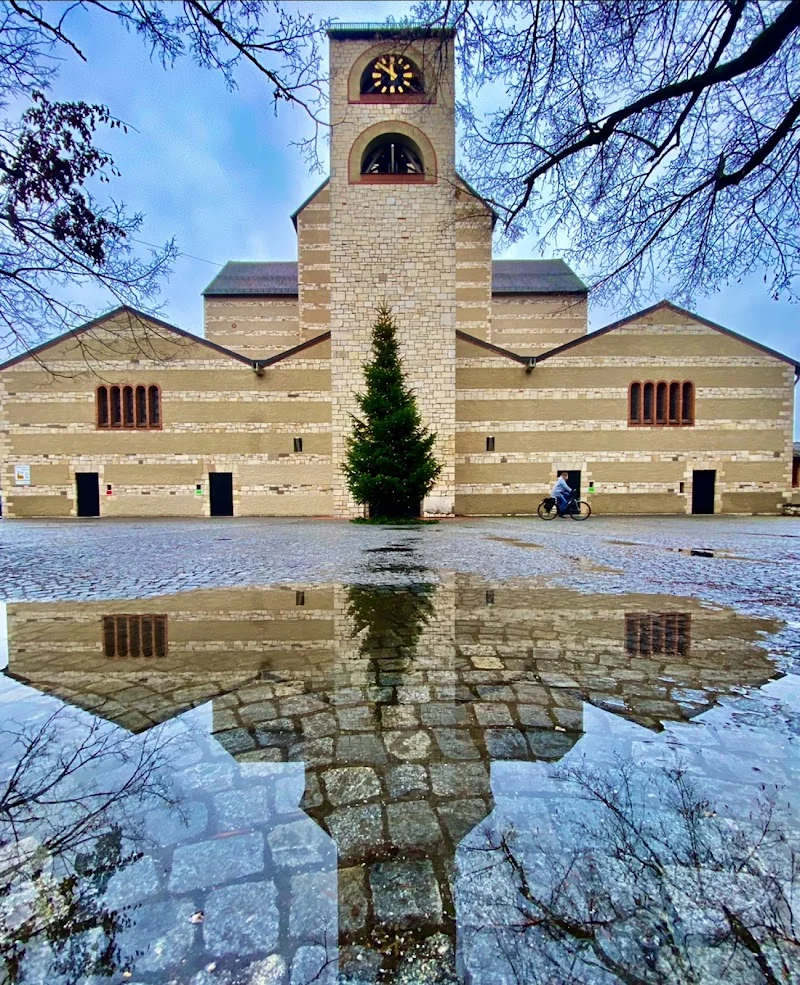
The architectural significance of St. Wolfgang is extraordinary. On the parish page, the church is explicitly described as a building that has freed church architecture from previous traditions and placed the altar at the center of the community. It was built between 1938 and 1940 by Dominikus Böhm from Cologne. The parish refers to him as the defining master builder of the 20th century in the German-speaking world and points out that St. Wolfgang is considered one of the most important church buildings of his later creative phase. The Straße der Moderne also categorizes the church as a modern key work: it explains that Dominikus Böhm combined Latin, Orthodox, and liturgically modern spatial ideas. Particularly important is the idea that the church is not only striking from the outside but is also ordered from the inside towards the common celebration. The history of the building is also part of this: after the establishment of the parish community in 1921, a provisional church in 1922, and the later new construction, St. Wolfgang gradually developed into the monumental church space known today. ([wolfgangskirche-regensburg.de](https://www.wolfgangskirche-regensburg.de/pfarrei-geschichte/))
The specific form language is also impressive. According to the parish, the church takes the shape of a large cross and features four massive rose windows and a bell tower. The gilded weather vane sits almost 48 meters high on the needle of the bell tower. Inside, the altar block is located precisely at the intersection of the cross arms; the church hall reaches a height of almost 24 meters and is the highest church space in the diocese after the cathedral. The west rose window alone measures nine meters in diameter and consists of 17,274 leaded glass pieces. The color scheme focuses on red, green, and blue, interspersed with golden-yellow glasses. This combination of severity, symbolism, and light effects explains why St. Wolfgang is considered an outstanding example of modern sacred architecture. Not only the external silhouette but also the spatial dramaturgy follows a clear idea: the community should gather around the altar while light, form, and material make the sacred character of the building visible. ([wolfgangskirche-regensburg.de](https://www.wolfgangskirche-regensburg.de/pfarrkirche-st-wolfgang/))
Baptism Chapel, Crypt, and Organ: The Special Spaces of St. Wolfgang
Those searching for baptism chapel, crypt, or organ will encounter true highlights at St. Wolfgang. The baptism chapel is described by the parish as a particularly precious jewel that is rarely found in newer churches. Its floor plan is based on a circle within the square of the outer walls; the diameter is 6.40 meters. The dome creates a remarkable acoustic effect. The baptismal font stands on a marble block that reflects the cross shape of the church, and the chapel gained additional symbolic significance when it was blessed on October 31, 2001, by Joseph Cardinal Ratzinger, the later Pope Benedict XVI. Such details show how consciously St. Wolfgang intertwines space, symbol, and liturgy. The baptism chapel is thus not only functional but also an architectural and theological focal point in the overall concept of the complex. ([wolfgangskirche-regensburg.de](https://www.wolfgangskirche-regensburg.de/pfarrkirche-st-wolfgang/))
The crypt and the organ are also defining elements. The Wolfgang Crypt at the parish home is described on the website as a space with an elegant ceiling structure that offers groups a spiritual atmosphere. This is particularly relevant because the crypt is not only part of the building's history but also a real space used for community groups. The parish church also houses the largest preserved organ work of the organ builder Willibald Siemann & Co. Munich-Regensburg; the prospect of the main organ is even considered the largest in the diocese. Together with the stained glass windows, the rose windows, the figure of Christ, the Peter motifs, and the Stations of the Cross, a multifaceted picture emerges: St. Wolfgang is not simply a church space but a curated place of spiritual art. Particularly the stained glass windows and the west rose connect light and narrative into a unity that makes the visit worthwhile even for people without religious ties. Those wishing to experience architecture will find precisely designed spaces here that function liturgically while also impressing artistically. ([wolfgangskirche-regensburg.de](https://www.wolfgangskirche-regensburg.de/pfarrkirche-st-wolfgang/))
Directions, Surroundings, and Parking on Bischof-Wittmann-Straße
When searching for directions or parking, the location itself is initially important. The church is located on Bischof-Wittmann-Straße in Regensburg-Kumpfmühl; the parish church is listed on the official site under 24b, the parish office under 24a. The Kumpfmühl district is a historically grown area of Regensburg, and the church is located directly adjacent to the Karl-Bauer-Park, which, according to the city of Regensburg, is bordered to the west by St. Wolfgang Church. This location makes the visit pleasant, as a church visit can easily be combined with a short walk. Especially for families, walkers, and anyone who does not just want to go in and out quickly, the surroundings provide a quiet setting. The proximity to the park and the integration into the character of the neighborhood are important practical arguments to consider when planning a visit. ([wolfgangskirche-regensburg.de](https://www.wolfgangskirche-regensburg.de/))
No parking rates or fixed parking space information can be found on the official pages. However, a visitor report mentions free parking spaces and barrier-free access, which fits with the experience that the church, as a neighborhood and community church, is usually easily accessible. Those arriving by car should still expect the current situation on-site and plan some buffer time, especially during service times or events. For orientation, the address of the church is very clear, and the proximity to the park helps with navigation. Those who prefer to walk can easily combine their visit with the Karl-Bauer-Park; those arriving by public transport or taxi will also find a clear destination address. For search queries like parking St. Wolfgang Regensburg, the honest answer is: there are indications of good parking opportunities in visitor reports, but the parish does not publish its own parking rate page. For this reason, it is worth not planning the arrival at the last minute. ([wanderlog.com](https://wanderlog.com/place/details/13412185/kath-pfarrkirche-st-wolfgang?utm_source=openai))
Kindergarten, Community Life, and Events Around St. Wolfgang
The parish of St. Wolfgang is not just a church but a whole community system. The homepage makes this clear by listing not only services and parish newsletters but also kindergartens, pastoral care, music, and events. The parish's slogan emphasizes that faith and community have given many generations a sense of home for over 100 years. This formulation is not an empty phrase but fits well with the structure of the parish: Kindergarten St. Wolfgang 1 is located directly next to the church, and Kindergarten St. Wolfgang 2 is near the St. Wolfgang Elementary School. This creates a space where church, children's work, and everyday life closely intersect. This is an important factor for families because the parish is thus relevant not only for Sunday services but also for the early life world of children. ([wolfgangskirche-regensburg.de](https://www.wolfgangskirche-regensburg.de/))
The event life is also remarkable. The website features its own events page, where several entries and navigation functions for monthly and daily views are visible. In addition, there are regular news from the parish, Lenten sermons, celebrations, and processional routes such as Corpus Christi or pilgrimages that are documented on the website. The parish works with classic church formats but connects them with current online communication. For the search intent events St. Wolfgang, this is particularly relevant because it does not only refer to individual dates but to an ongoing rhythm of liturgy, community festivals, educational offerings, and spiritual impulses. St. Wolfgang clearly shows that a parish church in the 21st century can be a spiritual place, a social meeting point, and a cultural memory at the same time. Those looking for a lively impression of Regensburg-Kumpfmühl will find here an address where historical significance and current use do not exclude but complement each other. ([wolfgangskirche-regensburg.de](https://www.wolfgangskirche-regensburg.de/veranstaltungen/))
Why the Catholic Parish Church of St. Wolfgang in Regensburg is Worth a Visit
St. Wolfgang combines many elements that make a strong location: clear identity, real history, striking architecture, and an active community life. The church is a work of Dominikus Böhm, built during a difficult time between 1938 and 1940, and has preserved its architectural power despite all circumstances. Inside, the space is focused on the altar, while the exterior is characterized by the cross shape, rose windows, and bell tower. Additionally, details such as the baptism chapel, crypt, organ, and window art make the visit interesting even for those who only wanted to take a quick look. At the same time, the parish is not a museum but a place with services, parish newsletters, pastoral care, music, and two kindergartens. This combination of architectural culture and everyday life makes the Catholic Parish Church of St. Wolfgang an ideal destination for people who want to experience not just tourist attractions in Regensburg but places with character. ([wolfgangskirche-regensburg.de](https://www.wolfgangskirche-regensburg.de/pfarrkirche-st-wolfgang/))
Therefore, those visiting the church take away more than just a brief impression. One experiences a space that is theologically thought-out, historically significant, and functionally alive. The parish provides orientation about services and parish newsletters, makes contact easy, and presents a broad community structure through events and kindergartens. Especially for Regensburg search queries focusing on parish office, church, services, directions, or parking, St. Wolfgang provides an unusually complete answer. It is a place that impresses architecturally, is spiritually open, and remains firmly anchored in the everyday life of a neighborhood. For this reason, the site is worthwhile for believers as well as for culture enthusiasts, families, and anyone wanting to experience modern church architecture in its purest form. ([wolfgangskirche-regensburg.de](https://www.wolfgangskirche-regensburg.de/gottesdienste/))
Sources:
Show moreShow less
Catholic Parish Church of St. Wolfgang | Parish Office & Services
The Catholic Parish Church of St. Wolfgang in Regensburg is much more than a prominent place of worship in the Kumpfmühl district. It is a vibrant center of the parish, an architectural key work of modernity, and a place where liturgy, community life, and family work are closely intertwined. The official website of the parish makes this clear at first glance: in addition to services and parish newsletters, it also features events, pastoral care, music, kindergartens, and contact information. This blend of spiritual space and everyday community practice makes St. Wolfgang exciting for visitors, believers, and architecture enthusiasts alike. The church was built by Dominikus Böhm between 1938 and 1940 and is considered a milestone in modern church architecture in the parish description. At the same time, it is firmly rooted in the history of Kumpfmühl, which received its own parish with the growth of Regensburg in the 20th century. Today, regular services, an active parish newsletter, the two kindergartens, and a number of special art and spatial details shape the image of this church. ([wolfgangskirche-regensburg.de](https://www.wolfgangskirche-regensburg.de/))
Services and Parish Newsletter: What Happens Regularly at St. Wolfgang
Those searching for the keywords services or parish newsletter will find clear and well-maintained information at St. Wolfgang. The official service schedule lists masses on Sundays and holidays at 08:30, 10:00, 11:00, and 19:00. During the week, the church is also used intensively: from Monday to Friday, there is a mass in the crypt at 08:00, and there is also an evening mass at 19:00 every weekday. On Saturdays, there is also a service in the crypt in the morning, and in the evening, there is a vigil mass at 18:15. For holiday periods, the parish explicitly points out that the 8 o'clock mass is canceled. This regular schedule shows that St. Wolfgang is not just a monument church, but a place that remains constantly present in the everyday life of the community. Additionally, there is a welcoming service before the 10 o'clock services, where believers are present at the main portal to greet visitors. ([wolfgangskirche-regensburg.de](https://www.wolfgangskirche-regensburg.de/gottesdienste/))
The parish newsletter plays a central role in this. It is offered on the website as a current source of information, can be downloaded or subscribed to via email, and is also available at the literature stand in the Wolfgang Church. The archive shows how continuously the parish maintains its communication; older editions are also documented. This is important for local search intent because many visitors are not only looking for a church but also want to know what actually happens there throughout the year. St. Wolfgang provides exactly this answer through the interplay of services, parish newsletter, events, and current news. Even topics such as the secularization of the former St. Theresia Church are transparently explained on the service page, allowing interested parties to understand the current pastoral structure well. Therefore, anyone entering the keywords parish newsletter St. Wolfgang or services St. Wolfgang will not find a static church map here, but a current community system with regular liturgy and ongoing information. ([wolfgangskirche-regensburg.de](https://www.wolfgangskirche-regensburg.de/pfarrbrief/))
Parish Office St. Wolfgang: Contact, Opening Hours, and Ways to the Community
For search queries like parish office St. Wolfgang Regensburg or contact parish office, the official page is particularly helpful. There, the parish office is listed with the address Bischof-Wittmann-Straße 24a, 93051 Regensburg, the phone number +49 941 97088, and the email address pfarramt@wolfgangskirche-regensburg.de. The parish church itself is listed separately at Bischof-Wittmann-Straße 24b. This clear separation is practical because it immediately shows visitors that the church and parish office are closely related but organized at different house numbers. Additionally, the information page about the church on Straße der Moderne lists the opening hours for the parish office as Monday to Friday from 08:00 to 12:00 and from 14:00 to 16:30. Those wishing to clarify appointments, baptisms, weddings, mass intentions, or questions about groups and facilities will find reliable contact paths. ([wolfgangskirche-regensburg.de](https://www.wolfgangskirche-regensburg.de/))
The family-related facilities are also an important part of the parish office profile. Kindergarten St. Wolfgang 1 is located next to the Wolfgang Church; Lydia Fröhlich is named as the contact person. Kindergarten St. Wolfgang 2 is located near the St. Wolfgang Elementary School and is led by Kerstin Dorfmeister. Thus, the parish is not only a place of worship but also a bearer of a developed local network for children and parents. From an SEO perspective, this is significant because many users search not only for the church but also for kindergartens, parish offices, or directions. St. Wolfgang addresses these topics in a structured manner with current contact details. The parish presents itself as a place where pastoral care, education, and community are closely connected. In Regensburg-Kumpfmühl, this creates the impression of a church that is not limited to Sunday liturgy but shapes the everyday life of a neighborhood. ([wolfgangskirche-regensburg.de](https://www.wolfgangskirche-regensburg.de/kiga-st-wolfgang-1/))
Dominikus Böhm, Modern Church Architecture, and the Altar at the Center
The architectural significance of St. Wolfgang is extraordinary. On the parish page, the church is explicitly described as a building that has freed church architecture from previous traditions and placed the altar at the center of the community. It was built between 1938 and 1940 by Dominikus Böhm from Cologne. The parish refers to him as the defining master builder of the 20th century in the German-speaking world and points out that St. Wolfgang is considered one of the most important church buildings of his later creative phase. The Straße der Moderne also categorizes the church as a modern key work: it explains that Dominikus Böhm combined Latin, Orthodox, and liturgically modern spatial ideas. Particularly important is the idea that the church is not only striking from the outside but is also ordered from the inside towards the common celebration. The history of the building is also part of this: after the establishment of the parish community in 1921, a provisional church in 1922, and the later new construction, St. Wolfgang gradually developed into the monumental church space known today. ([wolfgangskirche-regensburg.de](https://www.wolfgangskirche-regensburg.de/pfarrei-geschichte/))
The specific form language is also impressive. According to the parish, the church takes the shape of a large cross and features four massive rose windows and a bell tower. The gilded weather vane sits almost 48 meters high on the needle of the bell tower. Inside, the altar block is located precisely at the intersection of the cross arms; the church hall reaches a height of almost 24 meters and is the highest church space in the diocese after the cathedral. The west rose window alone measures nine meters in diameter and consists of 17,274 leaded glass pieces. The color scheme focuses on red, green, and blue, interspersed with golden-yellow glasses. This combination of severity, symbolism, and light effects explains why St. Wolfgang is considered an outstanding example of modern sacred architecture. Not only the external silhouette but also the spatial dramaturgy follows a clear idea: the community should gather around the altar while light, form, and material make the sacred character of the building visible. ([wolfgangskirche-regensburg.de](https://www.wolfgangskirche-regensburg.de/pfarrkirche-st-wolfgang/))
Baptism Chapel, Crypt, and Organ: The Special Spaces of St. Wolfgang
Those searching for baptism chapel, crypt, or organ will encounter true highlights at St. Wolfgang. The baptism chapel is described by the parish as a particularly precious jewel that is rarely found in newer churches. Its floor plan is based on a circle within the square of the outer walls; the diameter is 6.40 meters. The dome creates a remarkable acoustic effect. The baptismal font stands on a marble block that reflects the cross shape of the church, and the chapel gained additional symbolic significance when it was blessed on October 31, 2001, by Joseph Cardinal Ratzinger, the later Pope Benedict XVI. Such details show how consciously St. Wolfgang intertwines space, symbol, and liturgy. The baptism chapel is thus not only functional but also an architectural and theological focal point in the overall concept of the complex. ([wolfgangskirche-regensburg.de](https://www.wolfgangskirche-regensburg.de/pfarrkirche-st-wolfgang/))
The crypt and the organ are also defining elements. The Wolfgang Crypt at the parish home is described on the website as a space with an elegant ceiling structure that offers groups a spiritual atmosphere. This is particularly relevant because the crypt is not only part of the building's history but also a real space used for community groups. The parish church also houses the largest preserved organ work of the organ builder Willibald Siemann & Co. Munich-Regensburg; the prospect of the main organ is even considered the largest in the diocese. Together with the stained glass windows, the rose windows, the figure of Christ, the Peter motifs, and the Stations of the Cross, a multifaceted picture emerges: St. Wolfgang is not simply a church space but a curated place of spiritual art. Particularly the stained glass windows and the west rose connect light and narrative into a unity that makes the visit worthwhile even for people without religious ties. Those wishing to experience architecture will find precisely designed spaces here that function liturgically while also impressing artistically. ([wolfgangskirche-regensburg.de](https://www.wolfgangskirche-regensburg.de/pfarrkirche-st-wolfgang/))
Directions, Surroundings, and Parking on Bischof-Wittmann-Straße
When searching for directions or parking, the location itself is initially important. The church is located on Bischof-Wittmann-Straße in Regensburg-Kumpfmühl; the parish church is listed on the official site under 24b, the parish office under 24a. The Kumpfmühl district is a historically grown area of Regensburg, and the church is located directly adjacent to the Karl-Bauer-Park, which, according to the city of Regensburg, is bordered to the west by St. Wolfgang Church. This location makes the visit pleasant, as a church visit can easily be combined with a short walk. Especially for families, walkers, and anyone who does not just want to go in and out quickly, the surroundings provide a quiet setting. The proximity to the park and the integration into the character of the neighborhood are important practical arguments to consider when planning a visit. ([wolfgangskirche-regensburg.de](https://www.wolfgangskirche-regensburg.de/))
No parking rates or fixed parking space information can be found on the official pages. However, a visitor report mentions free parking spaces and barrier-free access, which fits with the experience that the church, as a neighborhood and community church, is usually easily accessible. Those arriving by car should still expect the current situation on-site and plan some buffer time, especially during service times or events. For orientation, the address of the church is very clear, and the proximity to the park helps with navigation. Those who prefer to walk can easily combine their visit with the Karl-Bauer-Park; those arriving by public transport or taxi will also find a clear destination address. For search queries like parking St. Wolfgang Regensburg, the honest answer is: there are indications of good parking opportunities in visitor reports, but the parish does not publish its own parking rate page. For this reason, it is worth not planning the arrival at the last minute. ([wanderlog.com](https://wanderlog.com/place/details/13412185/kath-pfarrkirche-st-wolfgang?utm_source=openai))
Kindergarten, Community Life, and Events Around St. Wolfgang
The parish of St. Wolfgang is not just a church but a whole community system. The homepage makes this clear by listing not only services and parish newsletters but also kindergartens, pastoral care, music, and events. The parish's slogan emphasizes that faith and community have given many generations a sense of home for over 100 years. This formulation is not an empty phrase but fits well with the structure of the parish: Kindergarten St. Wolfgang 1 is located directly next to the church, and Kindergarten St. Wolfgang 2 is near the St. Wolfgang Elementary School. This creates a space where church, children's work, and everyday life closely intersect. This is an important factor for families because the parish is thus relevant not only for Sunday services but also for the early life world of children. ([wolfgangskirche-regensburg.de](https://www.wolfgangskirche-regensburg.de/))
The event life is also remarkable. The website features its own events page, where several entries and navigation functions for monthly and daily views are visible. In addition, there are regular news from the parish, Lenten sermons, celebrations, and processional routes such as Corpus Christi or pilgrimages that are documented on the website. The parish works with classic church formats but connects them with current online communication. For the search intent events St. Wolfgang, this is particularly relevant because it does not only refer to individual dates but to an ongoing rhythm of liturgy, community festivals, educational offerings, and spiritual impulses. St. Wolfgang clearly shows that a parish church in the 21st century can be a spiritual place, a social meeting point, and a cultural memory at the same time. Those looking for a lively impression of Regensburg-Kumpfmühl will find here an address where historical significance and current use do not exclude but complement each other. ([wolfgangskirche-regensburg.de](https://www.wolfgangskirche-regensburg.de/veranstaltungen/))
Why the Catholic Parish Church of St. Wolfgang in Regensburg is Worth a Visit
St. Wolfgang combines many elements that make a strong location: clear identity, real history, striking architecture, and an active community life. The church is a work of Dominikus Böhm, built during a difficult time between 1938 and 1940, and has preserved its architectural power despite all circumstances. Inside, the space is focused on the altar, while the exterior is characterized by the cross shape, rose windows, and bell tower. Additionally, details such as the baptism chapel, crypt, organ, and window art make the visit interesting even for those who only wanted to take a quick look. At the same time, the parish is not a museum but a place with services, parish newsletters, pastoral care, music, and two kindergartens. This combination of architectural culture and everyday life makes the Catholic Parish Church of St. Wolfgang an ideal destination for people who want to experience not just tourist attractions in Regensburg but places with character. ([wolfgangskirche-regensburg.de](https://www.wolfgangskirche-regensburg.de/pfarrkirche-st-wolfgang/))
Therefore, those visiting the church take away more than just a brief impression. One experiences a space that is theologically thought-out, historically significant, and functionally alive. The parish provides orientation about services and parish newsletters, makes contact easy, and presents a broad community structure through events and kindergartens. Especially for Regensburg search queries focusing on parish office, church, services, directions, or parking, St. Wolfgang provides an unusually complete answer. It is a place that impresses architecturally, is spiritually open, and remains firmly anchored in the everyday life of a neighborhood. For this reason, the site is worthwhile for believers as well as for culture enthusiasts, families, and anyone wanting to experience modern church architecture in its purest form. ([wolfgangskirche-regensburg.de](https://www.wolfgangskirche-regensburg.de/gottesdienste/))
Sources:
Catholic Parish Church of St. Wolfgang | Parish Office & Services
The Catholic Parish Church of St. Wolfgang in Regensburg is much more than a prominent place of worship in the Kumpfmühl district. It is a vibrant center of the parish, an architectural key work of modernity, and a place where liturgy, community life, and family work are closely intertwined. The official website of the parish makes this clear at first glance: in addition to services and parish newsletters, it also features events, pastoral care, music, kindergartens, and contact information. This blend of spiritual space and everyday community practice makes St. Wolfgang exciting for visitors, believers, and architecture enthusiasts alike. The church was built by Dominikus Böhm between 1938 and 1940 and is considered a milestone in modern church architecture in the parish description. At the same time, it is firmly rooted in the history of Kumpfmühl, which received its own parish with the growth of Regensburg in the 20th century. Today, regular services, an active parish newsletter, the two kindergartens, and a number of special art and spatial details shape the image of this church. ([wolfgangskirche-regensburg.de](https://www.wolfgangskirche-regensburg.de/))
Services and Parish Newsletter: What Happens Regularly at St. Wolfgang
Those searching for the keywords services or parish newsletter will find clear and well-maintained information at St. Wolfgang. The official service schedule lists masses on Sundays and holidays at 08:30, 10:00, 11:00, and 19:00. During the week, the church is also used intensively: from Monday to Friday, there is a mass in the crypt at 08:00, and there is also an evening mass at 19:00 every weekday. On Saturdays, there is also a service in the crypt in the morning, and in the evening, there is a vigil mass at 18:15. For holiday periods, the parish explicitly points out that the 8 o'clock mass is canceled. This regular schedule shows that St. Wolfgang is not just a monument church, but a place that remains constantly present in the everyday life of the community. Additionally, there is a welcoming service before the 10 o'clock services, where believers are present at the main portal to greet visitors. ([wolfgangskirche-regensburg.de](https://www.wolfgangskirche-regensburg.de/gottesdienste/))
The parish newsletter plays a central role in this. It is offered on the website as a current source of information, can be downloaded or subscribed to via email, and is also available at the literature stand in the Wolfgang Church. The archive shows how continuously the parish maintains its communication; older editions are also documented. This is important for local search intent because many visitors are not only looking for a church but also want to know what actually happens there throughout the year. St. Wolfgang provides exactly this answer through the interplay of services, parish newsletter, events, and current news. Even topics such as the secularization of the former St. Theresia Church are transparently explained on the service page, allowing interested parties to understand the current pastoral structure well. Therefore, anyone entering the keywords parish newsletter St. Wolfgang or services St. Wolfgang will not find a static church map here, but a current community system with regular liturgy and ongoing information. ([wolfgangskirche-regensburg.de](https://www.wolfgangskirche-regensburg.de/pfarrbrief/))
Parish Office St. Wolfgang: Contact, Opening Hours, and Ways to the Community
For search queries like parish office St. Wolfgang Regensburg or contact parish office, the official page is particularly helpful. There, the parish office is listed with the address Bischof-Wittmann-Straße 24a, 93051 Regensburg, the phone number +49 941 97088, and the email address pfarramt@wolfgangskirche-regensburg.de. The parish church itself is listed separately at Bischof-Wittmann-Straße 24b. This clear separation is practical because it immediately shows visitors that the church and parish office are closely related but organized at different house numbers. Additionally, the information page about the church on Straße der Moderne lists the opening hours for the parish office as Monday to Friday from 08:00 to 12:00 and from 14:00 to 16:30. Those wishing to clarify appointments, baptisms, weddings, mass intentions, or questions about groups and facilities will find reliable contact paths. ([wolfgangskirche-regensburg.de](https://www.wolfgangskirche-regensburg.de/))
The family-related facilities are also an important part of the parish office profile. Kindergarten St. Wolfgang 1 is located next to the Wolfgang Church; Lydia Fröhlich is named as the contact person. Kindergarten St. Wolfgang 2 is located near the St. Wolfgang Elementary School and is led by Kerstin Dorfmeister. Thus, the parish is not only a place of worship but also a bearer of a developed local network for children and parents. From an SEO perspective, this is significant because many users search not only for the church but also for kindergartens, parish offices, or directions. St. Wolfgang addresses these topics in a structured manner with current contact details. The parish presents itself as a place where pastoral care, education, and community are closely connected. In Regensburg-Kumpfmühl, this creates the impression of a church that is not limited to Sunday liturgy but shapes the everyday life of a neighborhood. ([wolfgangskirche-regensburg.de](https://www.wolfgangskirche-regensburg.de/kiga-st-wolfgang-1/))
Dominikus Böhm, Modern Church Architecture, and the Altar at the Center
The architectural significance of St. Wolfgang is extraordinary. On the parish page, the church is explicitly described as a building that has freed church architecture from previous traditions and placed the altar at the center of the community. It was built between 1938 and 1940 by Dominikus Böhm from Cologne. The parish refers to him as the defining master builder of the 20th century in the German-speaking world and points out that St. Wolfgang is considered one of the most important church buildings of his later creative phase. The Straße der Moderne also categorizes the church as a modern key work: it explains that Dominikus Böhm combined Latin, Orthodox, and liturgically modern spatial ideas. Particularly important is the idea that the church is not only striking from the outside but is also ordered from the inside towards the common celebration. The history of the building is also part of this: after the establishment of the parish community in 1921, a provisional church in 1922, and the later new construction, St. Wolfgang gradually developed into the monumental church space known today. ([wolfgangskirche-regensburg.de](https://www.wolfgangskirche-regensburg.de/pfarrei-geschichte/))
The specific form language is also impressive. According to the parish, the church takes the shape of a large cross and features four massive rose windows and a bell tower. The gilded weather vane sits almost 48 meters high on the needle of the bell tower. Inside, the altar block is located precisely at the intersection of the cross arms; the church hall reaches a height of almost 24 meters and is the highest church space in the diocese after the cathedral. The west rose window alone measures nine meters in diameter and consists of 17,274 leaded glass pieces. The color scheme focuses on red, green, and blue, interspersed with golden-yellow glasses. This combination of severity, symbolism, and light effects explains why St. Wolfgang is considered an outstanding example of modern sacred architecture. Not only the external silhouette but also the spatial dramaturgy follows a clear idea: the community should gather around the altar while light, form, and material make the sacred character of the building visible. ([wolfgangskirche-regensburg.de](https://www.wolfgangskirche-regensburg.de/pfarrkirche-st-wolfgang/))
Baptism Chapel, Crypt, and Organ: The Special Spaces of St. Wolfgang
Those searching for baptism chapel, crypt, or organ will encounter true highlights at St. Wolfgang. The baptism chapel is described by the parish as a particularly precious jewel that is rarely found in newer churches. Its floor plan is based on a circle within the square of the outer walls; the diameter is 6.40 meters. The dome creates a remarkable acoustic effect. The baptismal font stands on a marble block that reflects the cross shape of the church, and the chapel gained additional symbolic significance when it was blessed on October 31, 2001, by Joseph Cardinal Ratzinger, the later Pope Benedict XVI. Such details show how consciously St. Wolfgang intertwines space, symbol, and liturgy. The baptism chapel is thus not only functional but also an architectural and theological focal point in the overall concept of the complex. ([wolfgangskirche-regensburg.de](https://www.wolfgangskirche-regensburg.de/pfarrkirche-st-wolfgang/))
The crypt and the organ are also defining elements. The Wolfgang Crypt at the parish home is described on the website as a space with an elegant ceiling structure that offers groups a spiritual atmosphere. This is particularly relevant because the crypt is not only part of the building's history but also a real space used for community groups. The parish church also houses the largest preserved organ work of the organ builder Willibald Siemann & Co. Munich-Regensburg; the prospect of the main organ is even considered the largest in the diocese. Together with the stained glass windows, the rose windows, the figure of Christ, the Peter motifs, and the Stations of the Cross, a multifaceted picture emerges: St. Wolfgang is not simply a church space but a curated place of spiritual art. Particularly the stained glass windows and the west rose connect light and narrative into a unity that makes the visit worthwhile even for people without religious ties. Those wishing to experience architecture will find precisely designed spaces here that function liturgically while also impressing artistically. ([wolfgangskirche-regensburg.de](https://www.wolfgangskirche-regensburg.de/pfarrkirche-st-wolfgang/))
Directions, Surroundings, and Parking on Bischof-Wittmann-Straße
When searching for directions or parking, the location itself is initially important. The church is located on Bischof-Wittmann-Straße in Regensburg-Kumpfmühl; the parish church is listed on the official site under 24b, the parish office under 24a. The Kumpfmühl district is a historically grown area of Regensburg, and the church is located directly adjacent to the Karl-Bauer-Park, which, according to the city of Regensburg, is bordered to the west by St. Wolfgang Church. This location makes the visit pleasant, as a church visit can easily be combined with a short walk. Especially for families, walkers, and anyone who does not just want to go in and out quickly, the surroundings provide a quiet setting. The proximity to the park and the integration into the character of the neighborhood are important practical arguments to consider when planning a visit. ([wolfgangskirche-regensburg.de](https://www.wolfgangskirche-regensburg.de/))
No parking rates or fixed parking space information can be found on the official pages. However, a visitor report mentions free parking spaces and barrier-free access, which fits with the experience that the church, as a neighborhood and community church, is usually easily accessible. Those arriving by car should still expect the current situation on-site and plan some buffer time, especially during service times or events. For orientation, the address of the church is very clear, and the proximity to the park helps with navigation. Those who prefer to walk can easily combine their visit with the Karl-Bauer-Park; those arriving by public transport or taxi will also find a clear destination address. For search queries like parking St. Wolfgang Regensburg, the honest answer is: there are indications of good parking opportunities in visitor reports, but the parish does not publish its own parking rate page. For this reason, it is worth not planning the arrival at the last minute. ([wanderlog.com](https://wanderlog.com/place/details/13412185/kath-pfarrkirche-st-wolfgang?utm_source=openai))
Kindergarten, Community Life, and Events Around St. Wolfgang
The parish of St. Wolfgang is not just a church but a whole community system. The homepage makes this clear by listing not only services and parish newsletters but also kindergartens, pastoral care, music, and events. The parish's slogan emphasizes that faith and community have given many generations a sense of home for over 100 years. This formulation is not an empty phrase but fits well with the structure of the parish: Kindergarten St. Wolfgang 1 is located directly next to the church, and Kindergarten St. Wolfgang 2 is near the St. Wolfgang Elementary School. This creates a space where church, children's work, and everyday life closely intersect. This is an important factor for families because the parish is thus relevant not only for Sunday services but also for the early life world of children. ([wolfgangskirche-regensburg.de](https://www.wolfgangskirche-regensburg.de/))
The event life is also remarkable. The website features its own events page, where several entries and navigation functions for monthly and daily views are visible. In addition, there are regular news from the parish, Lenten sermons, celebrations, and processional routes such as Corpus Christi or pilgrimages that are documented on the website. The parish works with classic church formats but connects them with current online communication. For the search intent events St. Wolfgang, this is particularly relevant because it does not only refer to individual dates but to an ongoing rhythm of liturgy, community festivals, educational offerings, and spiritual impulses. St. Wolfgang clearly shows that a parish church in the 21st century can be a spiritual place, a social meeting point, and a cultural memory at the same time. Those looking for a lively impression of Regensburg-Kumpfmühl will find here an address where historical significance and current use do not exclude but complement each other. ([wolfgangskirche-regensburg.de](https://www.wolfgangskirche-regensburg.de/veranstaltungen/))
Why the Catholic Parish Church of St. Wolfgang in Regensburg is Worth a Visit
St. Wolfgang combines many elements that make a strong location: clear identity, real history, striking architecture, and an active community life. The church is a work of Dominikus Böhm, built during a difficult time between 1938 and 1940, and has preserved its architectural power despite all circumstances. Inside, the space is focused on the altar, while the exterior is characterized by the cross shape, rose windows, and bell tower. Additionally, details such as the baptism chapel, crypt, organ, and window art make the visit interesting even for those who only wanted to take a quick look. At the same time, the parish is not a museum but a place with services, parish newsletters, pastoral care, music, and two kindergartens. This combination of architectural culture and everyday life makes the Catholic Parish Church of St. Wolfgang an ideal destination for people who want to experience not just tourist attractions in Regensburg but places with character. ([wolfgangskirche-regensburg.de](https://www.wolfgangskirche-regensburg.de/pfarrkirche-st-wolfgang/))
Therefore, those visiting the church take away more than just a brief impression. One experiences a space that is theologically thought-out, historically significant, and functionally alive. The parish provides orientation about services and parish newsletters, makes contact easy, and presents a broad community structure through events and kindergartens. Especially for Regensburg search queries focusing on parish office, church, services, directions, or parking, St. Wolfgang provides an unusually complete answer. It is a place that impresses architecturally, is spiritually open, and remains firmly anchored in the everyday life of a neighborhood. For this reason, the site is worthwhile for believers as well as for culture enthusiasts, families, and anyone wanting to experience modern church architecture in its purest form. ([wolfgangskirche-regensburg.de](https://www.wolfgangskirche-regensburg.de/gottesdienste/))
Sources:
Frequently Asked Questions
Reviews
Pointman Ops
10. April 2019
A small Catholic church within a great community. This church doesn't only cater to church members, it also hosts different events throughout the year from its Kindergarten activities, Bazaars, meetings, Mass, etc. If you are in its vicinity, do stop by and take a look at the great architecture of the church at the very least. Parking is free and available. Wheelchair accessible. There is a restaurant and a public park right across from it. Makes it convenient to those who have children or those who simply want to enjoy a walk or a meal after church.
Jason Roach
30. May 2019
Beautiful place of worship
Cristian Dodea
4. December 2016
Nice architecture!
Brigitte Barth
12. October 2025
I discovered this church quite by chance. The rose window impressed me from the outside. Inside, it's simply enchanting. The round arches, the large holy water font, and the vastness... a truly very special church. Maybe I'll come to a service sometime.
DO T
31. May 2025
If you're already there, you can certainly take a look inside. The windows are especially beautiful to look at when the sun is shining.