
Regensburg
Neupfarrpl., 93047 Regensburg, Germany
Neupfarrplatz | Christkindlmarkt & Parking
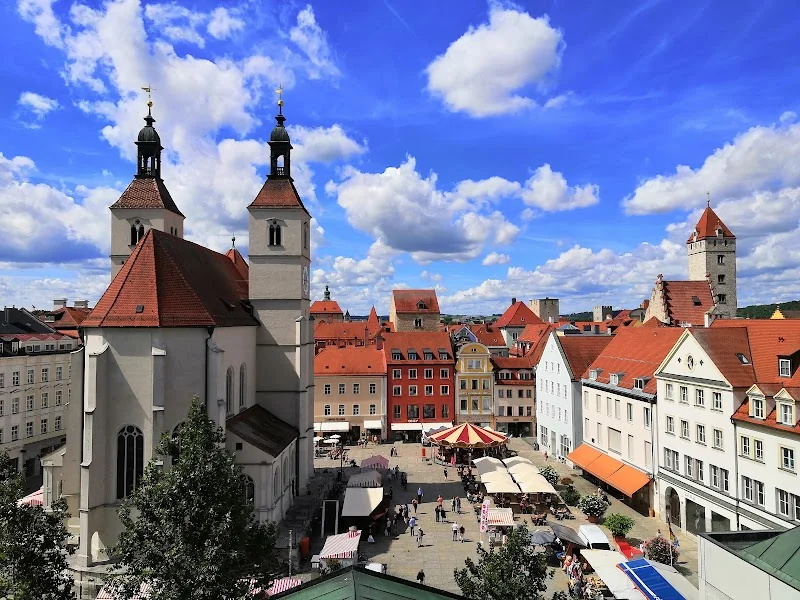
The Neupfarrplatz is one of the most well-known places in Regensburg and at the same time a square where history, everyday life, trade, and events overlap in a small space. When you arrive here, you stand in the middle of the Regensburg pedestrian zone, in one of the liveliest areas of the old town. The city of Regensburg describes the square as the center of a district that today houses more than 500 cafés, restaurants, shops, and department stores. This very mix makes the place so interesting: the Neupfarrplatz is not just a waypoint on the map, but a space that can be consciously experienced. During the day, shop windows, gastronomy, and pedestrian flows shape the image; in winter, lights, stalls, and the Christkindlmarkt are added. At the same time, the square is historically charged, as beneath the current cityscape lie traces of Roman buildings, the Jewish quarter, and the later development of the old town. Therefore, anyone visiting the Neupfarrplatz sees not only a bustling square but a compact piece of Regensburg identity. ([regensburg.de](https://www.regensburg.de/leben/agenda-2030/nachhaltigkeitspfad-regensburg/station-14))
Christkindlmarkt at Neupfarrplatz: Opening Hours, Tradition, and Atmosphere
The Christkindlmarkt at Neupfarrplatz is the most famous seasonal attraction of the square. The city of Regensburg refers to it as the oldest Christmas market in the city and attributes a tradition of more than 200 years to it. For 2026, the market is scheduled according to the city's announcement from Monday, November 23, 2026, to Wednesday, December 23, 2026. Already in the city information, it becomes clear what role the market plays in Regensburg: the Neupfarrplatz transforms into a place during Advent, framed by festively decorated and illuminated stalls from the Protestant Neupfarrkirche. This image is typical for Regensburg, as here not only is there selling, but also staging. Visitors experience an atmosphere strongly shaped by light, craftsmanship, and regional culinary delights. ([regensburg.de](https://www.regensburg.de/aktuelles/christkindlmarkt/bewerbung))
The city also describes the Christkindlmarkt as a place of artisanal diversity. Mentioned are potters, glassblowers, candle makers, carvers, and other artisans who demonstrate and sell their work. Culinary classics such as mulled wine, bratwurst, roasted almonds, and roasted chestnuts are also available. The city’s event information makes it clear that the market is not intended as a mere sales format, but as an experiential space with rituals, music, and special occasions. Thus, in 2025, the market was open daily from 10 a.m. to 8 p.m., and on Thursdays to Saturdays even until 9 p.m.; additionally, the Neupfarrkirche is illuminated in the evenings, and on certain days, there are program points such as music or children's days. These details show why the search term Neupfarrplatz Christkindlmarkt is so strongly associated with the square: the market is not just an addition, but a fixed part of the identity of the place. Those traveling to Regensburg during Advent experience at Neupfarrplatz the most famous connection of tradition, cityscape, and winter atmosphere. ([regensburg.de](https://www.regensburg.de/aktuelles/christkindlmarkt/bewerbung))
Beyond the market itself, the square remains present in winter. In the official Christmas market overviews, the city lists the Christkindlmarkt at Neupfarrplatz alongside other Regensburg Advent markets such as the Lucrezia market, the Advent market at St. Katharinen Hospital, and the Christmas market at Thurn and Taxis Castle. This makes it clear that the Neupfarrplatz is part of a larger seasonal system, but still forms the historical core. So, when searching for Neupfarrplatz Christmas market opening hours, one is usually looking for this traditional market at the central old town square. For planning, it is important to note: the annual dates and times are published by the city and may change slightly, but the role of the square remains constant. It is the classic location for the Regensburg Christkindlmarkt and thus one of the most important winter addresses in the city. ([regensburg.de](https://www.regensburg.de/aktuelles/christkindlmarkt/weihnachtsmaerkte))
History of Neupfarrplatz: From the Jewish Quarter to the Heart of the Old Town
Hardly any other place in Regensburg bundles so much city history in such a small space as the Neupfarrplatz. The Regensburg Tourism GmbH describes the area as a place that reflects the 2,000-year history of the city. Already in antiquity and late antiquity, there were officer residences of the Roman camp Castra Regina. In the Middle Ages, the Jewish quarter of Regensburg was located here; a Jewish settlement in Regensburg has been documented since the year 981, making it one of the earliest well-documented Jewish living spaces in the German-speaking area. The quarter consisted of about 39 houses, including public buildings such as the synagogue. This historical depth is not only present in books but is also preserved in the ground of the square itself. ([tourismus.regensburg.de](https://tourismus.regensburg.de/en/experience-discover/unesco-world-heritage-/-sightseeing/neupfarrplatz))
After the destruction of the Jewish quarter in 1519, a new, religiously and politically motivated chapter of city history began on the site. A Catholic pilgrimage church was to be built on the site of the synagogue; however, the construction work was interrupted, and the unfinished building was later used as the first Protestant parish church in the city. The Neupfarrkirche still shapes the square today. The city of Regensburg and the Regensburg Tourism GmbH describe that the building served as the first Protestant parish church in 1542 and was completed in its current form in 1860. Thus, the church stands not only architecturally but also confessionally for a deep cut in urban development. Therefore, when viewing the square, one sees not only a church but the materially visible consequence of a historical upheaval that has changed Regensburg's religious and urban self-understanding for centuries. ([regensburg.de](https://www.regensburg.de/regensburg-507/sehenswert/der-regensburger-neupfarrplatz))
The history of the place becomes particularly impressive in the document Neupfarrplatz. During the excavations from 1995 to 1998, the most extensive urban core excavation in Regensburg was conducted with around 3,000 square meters of investigation area. Large parts of the medieval cellar facilities of the Jewish quarter were uncovered, as well as the Gothic synagogue and its Romanesque predecessor. Beneath the square are also remains of the Roman legion camp and traces of a ring bunker from the Nazi era. The tourism page of the city points out that visitors today can view three Jewish cellar rooms, 2,000-year-old legion camp walls, and the relics of the ring bunker as part of guided tours. Additionally, there is the spectacular treasure of gold consisting of 624 coins from the late 14th century, which was discovered during the excavations. This mixture of Roman, Jewish, early modern, and modern history is one of the reasons why the Neupfarrplatz is so significant for city tours, education, and culture. ([tourismus.regensburg.de](https://tourismus.regensburg.de/erleben-entdecken/kunst-kultur/document-neupfarrplatz))
The more recent urban development has also left clear traces. The city of Regensburg states that in the 19th century, the Neupfarrplatz developed into a modern business center after trade had shifted from markets to fixed shops. Later, the square was temporarily heavily influenced by traffic before excavations and redesign in the 1990s led to a calming of traffic. Today, the Neupfarrplatz is an open, spacious place with shops, market stalls, and quality of stay. This connection between historical underground and contemporary use makes the square so special: it is neither just a monument nor just a shopping place, but an urban memory with a present. ([regensburg.de](https://www.regensburg.de/regensburg-507/sehenswert/der-regensburger-neupfarrplatz))
Parking, Route, and Maps: How to Reach Neupfarrplatz
Those looking to park at Neupfarrplatz Regensburg or search for a route should first understand the location. The square is located in the center of the pedestrian zone, an area that is consciously oriented towards pedestrians. The city provides the coordinates 49.018541, 12.096771 for the location and shows the area on its city map, among other things, as Neupfarrplatz/Wahlenstraße and Neupfarrplatz/Drei-Helm-Gasse. This information is useful as it facilitates orientation and shows that the square is accessible from several sides but does not function as a classic thoroughfare. Therefore, those arriving by car should not plan to park directly at the square itself but rather consider the surrounding parking garages or park-and-ride options. This is not a theory but a logical consequence of the city’s downtown and traffic regulations. ([regensburg.de](https://www.regensburg.de/leben/agenda-2030/nachhaltigkeitspfad-regensburg/station-14))
Official parking options nearby include the Dachauplatz parking garage and the Arnulfsplatz underground garage. The Dachauplatz parking garage is open 24 hours, has no restrictions on parking duration, and is also subject to the environmental zone, meaning only vehicles with a green particulate matter sticker are allowed to enter. The Arnulfsplatz underground garage is also open 24 hours, without restrictions on parking duration, and is also located in the environmental zone. For visitors to Neupfarrplatz, these garages are particularly important as they connect the old town visit with a realistic arrival. Both locations are in Regensburg 93047 and are thus well integrated into the official visitor routes. Those planning a visit around the Christkindlmarkt, shopping spree, or city tour have a reliable basis for arrival. ([regensburg.de](https://www.regensburg.de/leben/verkehr-u-mobilitaet/parken/parkhaus-dachauplatz))
For the final leg into the old town, the free old town bus EMIL is recommended. The city of Regensburg explains that since April 28, 2025, the old town bus line B complements the mobility offer and travels through the Old Kornmarkt, the Cathedral, the Old Town Hall, Haidplatz, Gutenbergplatz, Neupfarrplatz, Domplatz, and the Thundorferstraße stop, among others. This means that Neupfarrplatz is directly integrated into the city's downtown network. Particularly important for planning: during the Christkindlmarkt, EMIL operates on extended hours, which the city states as 8:45 a.m. to 8:00 p.m. This provides a clear practical advantage, especially for those looking to avoid downtown traffic or those with mobility restrictions. Therefore, anyone searching for a route to Neupfarrplatz should best combine parking garage, walking, and old town bus. This way, the arrival becomes an uncomplicated part of the visit rather than a stress factor. ([regensburg.de](https://www.regensburg.de/leben/verkehr-u-mobilitaet/bus-und-bahn/e-bus-emil-fuer-die-regensburger-altstadt))
The city’s traffic regulations further emphasize this logic. The downtown area of Regensburg is divided into several zones with binding rules, and the Neupfarrplatz is located in a sensitive, pedestrian-oriented core area. For visitors, this means: not parking directly at the destination, but rather the interplay of garage, bus, and a short walk is the realistic strategy. This planning is particularly sensible during high visitor traffic, such as in Advent or on event days. Those using maps or the city plan should therefore orient themselves according to the official markings and the pedestrian zone structure. Neupfarrplatz is not hard to find, but is intentionally organized so that it is experienced on foot. This is part of the character of the place. ([regensburg.de](https://www.regensburg.de/leben/verkehr-u-mobilitaet/auto/verkehrs-u-parkregelung))
Shops, Cafés, and Old Town Life Around Neupfarrplatz
The Neupfarrplatz is not only a historical and seasonal place but above all a center of everyday life in the old town. The city of Regensburg explicitly states that more than 500 cafés, restaurants, shops, and department stores are located on the square and in the many narrow streets around it. This number is remarkable because it makes the square visible as an urban hub. Those moving around here are in an environment that closely links trade, gastronomy, and leisure. The Neupfarrplatz is thus the right place for anyone looking for shops at Neupfarrplatz Regensburg, as the square, together with the pedestrian zone, forms the heart of the old town economy. In practice, this means: shopping, having coffee, meeting up, taking a short break, or simply strolling through the old town all naturally belong together here. ([regensburg.de](https://www.regensburg.de/leben/agenda-2030/nachhaltigkeitspfad-regensburg/station-14))
The city also describes the Neupfarrplatz as the central square in the best location in the heart of the old town and as part of the central pedestrian zone. This classification is important because it explains why the square is so heavily frequented. Historically, the area was a marketplace, later a business center, and this function continues to resonate today. Even though retail has changed in recent years, the square remains a place of high attention and urban significance. The large department store complex at Neupfarrplatz was a retail magnet for decades, and even though its future is now being discussed differently, this history already shows how important the location is for the Regensburg center. For visitors, this means: around Neupfarrplatz, one does not find an isolated sight, but a vibrant downtown center with a dense offering and high foot traffic. ([tourismus.regensburg.de](https://tourismus.regensburg.de/erleben-entdecken/kunst-kultur/document-neupfarrplatz))
The special quality of the square includes that it is traffic-calmed and openly designed. The city describes the Neupfarrplatz as a spacious place with numerous shops, market stalls, a small kiosk, and plenty of space to sit and enjoy. This relationship between movement space and quality of stay makes the square pleasant. Here, one can not only walk from A to B but also orient oneself in peace, admire the facades, and let the atmosphere of the old town take effect. The combination of pedestrian zone, trade, and historical sightlines is rarely as clearly felt in Regensburg as here. Those searching for Neupfarrplatz Regensburg maps often seek not only the way but also the relationship between the square, streets, and adjacent shopping areas. This is exactly what the place is suitable for: as a starting point for a stroll, as a meeting point before the market, or as an anchor point for a whole old town visit. ([regensburg.de](https://www.regensburg.de/regensburg-507/sehenswert/der-regensburger-neupfarrplatz))
Notable neighbors also shape the cityscape. The tourism page highlights the Palais Löschenkohl, the Neupfarrkirche, the fountain with the imperial eagle and city coat of arms, and the ground work by Dani Karavan. These elements set cultural accents in the middle of the trading space. This is exactly what distinguishes the Neupfarrplatz from an ordinary shopping place: it unites everyday use with monument value and urban aesthetics. Those staying here experience Regensburg as the city understands it in its center, namely as a lively mix of world heritage, trade, gastronomy, and public space. Therefore, the square is interesting not only for tourists but also for locals who consciously use the downtown everyday life. ([tourismus.regensburg.de](https://tourismus.regensburg.de/en/experience-discover/unesco-world-heritage-/-sightseeing/neupfarrplatz))
Events, Sights, and Practical Tips for the Visit
The Neupfarrplatz is regularly used by the city for events. The most visible is this in Advent with the Christkindlmarkt, but other formats such as the autumn festival at Neupfarrplatz also show that the square is a flexible event space. This gives it a dual function: on the one hand, it is the daily focal point of the pedestrian zone, and on the other hand, a stage for seasonal markets and special city moments. Therefore, those searching for events at Neupfarrplatz Regensburg almost always encounter two levels: the ongoing city life and the occasional events that repeatedly enliven the square throughout the year. This use is not coincidental but follows the significance of the place as a central area in the old town. ([regensburg.de](https://www.regensburg.de/veranstaltungen/detail/606867?utm_source=openai))
Among the most important sights at the square are the Neupfarrkirche and the document Neupfarrplatz. The tourism page emphasizes that visitors can descend into the depths of the place during guided tours to see the remains of the Jewish quarter, Roman wall sections, and other archaeological traces. This makes the visit particularly exciting because the view is not only directed at the surface of the square but also below it. The city also refers to the ground work of the artist Dani Karavan, which reminds of the former synagogue. Together with the fountain and the Palais Löschenkohl, an ensemble is created that connects art, memory, and urban space. Therefore, those using Neupfarrplatz as a photo location, cultural site, or starting point for an old town tour experience far more than just a beautiful square area. ([tourismus.regensburg.de](https://tourismus.regensburg.de/en/experience-discover/unesco-world-heritage-/-sightseeing/neupfarrplatz))
Practically speaking, it is worth planning the visit depending on the goal. Those wanting to see the Christkindlmarkt should keep an eye on the city’s opening hours and special times. Those wishing to experience the square more quietly benefit from the off-peak times outside the largest visitor crowds. Those arriving by car should plan for a parking garage outside the pedestrian zone and rely on walking or EMIL for the last stretch. Those wanting to deepen their knowledge of history should book a guided tour of the document Neupfarrplatz; according to tourism, access is only possible as part of a guided tour, and tickets are available at the tourist info at the town hall square. This makes it clear: the Neupfarrplatz is not just a place to pass by but a square that can be used very differently depending on interest. ([tourismus.regensburg.de](https://tourismus.regensburg.de/erleben-entdecken/kunst-kultur/document-neupfarrplatz))
In the end, the impression remains of a place that holds a special position in Regensburg. The Neupfarrplatz is the center of the pedestrian zone, a historical memory bearer, a market area, a shopping place, and a meeting point at the same time. It stands for the density of the Regensburg old town, for its narratives, and for its current everyday use. Precisely for this reason, it is equally relevant for city visitors, culture enthusiasts, Christmas market fans, and people simply looking for a central place. Those wanting to understand Regensburg should not only search for the Neupfarrplatz on the map but truly visit it, walk through it, and ideally experience it both during the day and in the Advent season. Then it becomes particularly clear why this square has been a centerpiece of the city for centuries. ([regensburg.de](https://www.regensburg.de/leben/agenda-2030/nachhaltigkeitspfad-regensburg/station-14))
Sources:
Mehr anzeigenWeniger anzeigen
Neupfarrplatz | Christkindlmarkt & Parking
The Neupfarrplatz is one of the most well-known places in Regensburg and at the same time a square where history, everyday life, trade, and events overlap in a small space. When you arrive here, you stand in the middle of the Regensburg pedestrian zone, in one of the liveliest areas of the old town. The city of Regensburg describes the square as the center of a district that today houses more than 500 cafés, restaurants, shops, and department stores. This very mix makes the place so interesting: the Neupfarrplatz is not just a waypoint on the map, but a space that can be consciously experienced. During the day, shop windows, gastronomy, and pedestrian flows shape the image; in winter, lights, stalls, and the Christkindlmarkt are added. At the same time, the square is historically charged, as beneath the current cityscape lie traces of Roman buildings, the Jewish quarter, and the later development of the old town. Therefore, anyone visiting the Neupfarrplatz sees not only a bustling square but a compact piece of Regensburg identity. ([regensburg.de](https://www.regensburg.de/leben/agenda-2030/nachhaltigkeitspfad-regensburg/station-14))
Christkindlmarkt at Neupfarrplatz: Opening Hours, Tradition, and Atmosphere
The Christkindlmarkt at Neupfarrplatz is the most famous seasonal attraction of the square. The city of Regensburg refers to it as the oldest Christmas market in the city and attributes a tradition of more than 200 years to it. For 2026, the market is scheduled according to the city's announcement from Monday, November 23, 2026, to Wednesday, December 23, 2026. Already in the city information, it becomes clear what role the market plays in Regensburg: the Neupfarrplatz transforms into a place during Advent, framed by festively decorated and illuminated stalls from the Protestant Neupfarrkirche. This image is typical for Regensburg, as here not only is there selling, but also staging. Visitors experience an atmosphere strongly shaped by light, craftsmanship, and regional culinary delights. ([regensburg.de](https://www.regensburg.de/aktuelles/christkindlmarkt/bewerbung))
The city also describes the Christkindlmarkt as a place of artisanal diversity. Mentioned are potters, glassblowers, candle makers, carvers, and other artisans who demonstrate and sell their work. Culinary classics such as mulled wine, bratwurst, roasted almonds, and roasted chestnuts are also available. The city’s event information makes it clear that the market is not intended as a mere sales format, but as an experiential space with rituals, music, and special occasions. Thus, in 2025, the market was open daily from 10 a.m. to 8 p.m., and on Thursdays to Saturdays even until 9 p.m.; additionally, the Neupfarrkirche is illuminated in the evenings, and on certain days, there are program points such as music or children's days. These details show why the search term Neupfarrplatz Christkindlmarkt is so strongly associated with the square: the market is not just an addition, but a fixed part of the identity of the place. Those traveling to Regensburg during Advent experience at Neupfarrplatz the most famous connection of tradition, cityscape, and winter atmosphere. ([regensburg.de](https://www.regensburg.de/aktuelles/christkindlmarkt/bewerbung))
Beyond the market itself, the square remains present in winter. In the official Christmas market overviews, the city lists the Christkindlmarkt at Neupfarrplatz alongside other Regensburg Advent markets such as the Lucrezia market, the Advent market at St. Katharinen Hospital, and the Christmas market at Thurn and Taxis Castle. This makes it clear that the Neupfarrplatz is part of a larger seasonal system, but still forms the historical core. So, when searching for Neupfarrplatz Christmas market opening hours, one is usually looking for this traditional market at the central old town square. For planning, it is important to note: the annual dates and times are published by the city and may change slightly, but the role of the square remains constant. It is the classic location for the Regensburg Christkindlmarkt and thus one of the most important winter addresses in the city. ([regensburg.de](https://www.regensburg.de/aktuelles/christkindlmarkt/weihnachtsmaerkte))
History of Neupfarrplatz: From the Jewish Quarter to the Heart of the Old Town
Hardly any other place in Regensburg bundles so much city history in such a small space as the Neupfarrplatz. The Regensburg Tourism GmbH describes the area as a place that reflects the 2,000-year history of the city. Already in antiquity and late antiquity, there were officer residences of the Roman camp Castra Regina. In the Middle Ages, the Jewish quarter of Regensburg was located here; a Jewish settlement in Regensburg has been documented since the year 981, making it one of the earliest well-documented Jewish living spaces in the German-speaking area. The quarter consisted of about 39 houses, including public buildings such as the synagogue. This historical depth is not only present in books but is also preserved in the ground of the square itself. ([tourismus.regensburg.de](https://tourismus.regensburg.de/en/experience-discover/unesco-world-heritage-/-sightseeing/neupfarrplatz))
After the destruction of the Jewish quarter in 1519, a new, religiously and politically motivated chapter of city history began on the site. A Catholic pilgrimage church was to be built on the site of the synagogue; however, the construction work was interrupted, and the unfinished building was later used as the first Protestant parish church in the city. The Neupfarrkirche still shapes the square today. The city of Regensburg and the Regensburg Tourism GmbH describe that the building served as the first Protestant parish church in 1542 and was completed in its current form in 1860. Thus, the church stands not only architecturally but also confessionally for a deep cut in urban development. Therefore, when viewing the square, one sees not only a church but the materially visible consequence of a historical upheaval that has changed Regensburg's religious and urban self-understanding for centuries. ([regensburg.de](https://www.regensburg.de/regensburg-507/sehenswert/der-regensburger-neupfarrplatz))
The history of the place becomes particularly impressive in the document Neupfarrplatz. During the excavations from 1995 to 1998, the most extensive urban core excavation in Regensburg was conducted with around 3,000 square meters of investigation area. Large parts of the medieval cellar facilities of the Jewish quarter were uncovered, as well as the Gothic synagogue and its Romanesque predecessor. Beneath the square are also remains of the Roman legion camp and traces of a ring bunker from the Nazi era. The tourism page of the city points out that visitors today can view three Jewish cellar rooms, 2,000-year-old legion camp walls, and the relics of the ring bunker as part of guided tours. Additionally, there is the spectacular treasure of gold consisting of 624 coins from the late 14th century, which was discovered during the excavations. This mixture of Roman, Jewish, early modern, and modern history is one of the reasons why the Neupfarrplatz is so significant for city tours, education, and culture. ([tourismus.regensburg.de](https://tourismus.regensburg.de/erleben-entdecken/kunst-kultur/document-neupfarrplatz))
The more recent urban development has also left clear traces. The city of Regensburg states that in the 19th century, the Neupfarrplatz developed into a modern business center after trade had shifted from markets to fixed shops. Later, the square was temporarily heavily influenced by traffic before excavations and redesign in the 1990s led to a calming of traffic. Today, the Neupfarrplatz is an open, spacious place with shops, market stalls, and quality of stay. This connection between historical underground and contemporary use makes the square so special: it is neither just a monument nor just a shopping place, but an urban memory with a present. ([regensburg.de](https://www.regensburg.de/regensburg-507/sehenswert/der-regensburger-neupfarrplatz))
Parking, Route, and Maps: How to Reach Neupfarrplatz
Those looking to park at Neupfarrplatz Regensburg or search for a route should first understand the location. The square is located in the center of the pedestrian zone, an area that is consciously oriented towards pedestrians. The city provides the coordinates 49.018541, 12.096771 for the location and shows the area on its city map, among other things, as Neupfarrplatz/Wahlenstraße and Neupfarrplatz/Drei-Helm-Gasse. This information is useful as it facilitates orientation and shows that the square is accessible from several sides but does not function as a classic thoroughfare. Therefore, those arriving by car should not plan to park directly at the square itself but rather consider the surrounding parking garages or park-and-ride options. This is not a theory but a logical consequence of the city’s downtown and traffic regulations. ([regensburg.de](https://www.regensburg.de/leben/agenda-2030/nachhaltigkeitspfad-regensburg/station-14))
Official parking options nearby include the Dachauplatz parking garage and the Arnulfsplatz underground garage. The Dachauplatz parking garage is open 24 hours, has no restrictions on parking duration, and is also subject to the environmental zone, meaning only vehicles with a green particulate matter sticker are allowed to enter. The Arnulfsplatz underground garage is also open 24 hours, without restrictions on parking duration, and is also located in the environmental zone. For visitors to Neupfarrplatz, these garages are particularly important as they connect the old town visit with a realistic arrival. Both locations are in Regensburg 93047 and are thus well integrated into the official visitor routes. Those planning a visit around the Christkindlmarkt, shopping spree, or city tour have a reliable basis for arrival. ([regensburg.de](https://www.regensburg.de/leben/verkehr-u-mobilitaet/parken/parkhaus-dachauplatz))
For the final leg into the old town, the free old town bus EMIL is recommended. The city of Regensburg explains that since April 28, 2025, the old town bus line B complements the mobility offer and travels through the Old Kornmarkt, the Cathedral, the Old Town Hall, Haidplatz, Gutenbergplatz, Neupfarrplatz, Domplatz, and the Thundorferstraße stop, among others. This means that Neupfarrplatz is directly integrated into the city's downtown network. Particularly important for planning: during the Christkindlmarkt, EMIL operates on extended hours, which the city states as 8:45 a.m. to 8:00 p.m. This provides a clear practical advantage, especially for those looking to avoid downtown traffic or those with mobility restrictions. Therefore, anyone searching for a route to Neupfarrplatz should best combine parking garage, walking, and old town bus. This way, the arrival becomes an uncomplicated part of the visit rather than a stress factor. ([regensburg.de](https://www.regensburg.de/leben/verkehr-u-mobilitaet/bus-und-bahn/e-bus-emil-fuer-die-regensburger-altstadt))
The city’s traffic regulations further emphasize this logic. The downtown area of Regensburg is divided into several zones with binding rules, and the Neupfarrplatz is located in a sensitive, pedestrian-oriented core area. For visitors, this means: not parking directly at the destination, but rather the interplay of garage, bus, and a short walk is the realistic strategy. This planning is particularly sensible during high visitor traffic, such as in Advent or on event days. Those using maps or the city plan should therefore orient themselves according to the official markings and the pedestrian zone structure. Neupfarrplatz is not hard to find, but is intentionally organized so that it is experienced on foot. This is part of the character of the place. ([regensburg.de](https://www.regensburg.de/leben/verkehr-u-mobilitaet/auto/verkehrs-u-parkregelung))
Shops, Cafés, and Old Town Life Around Neupfarrplatz
The Neupfarrplatz is not only a historical and seasonal place but above all a center of everyday life in the old town. The city of Regensburg explicitly states that more than 500 cafés, restaurants, shops, and department stores are located on the square and in the many narrow streets around it. This number is remarkable because it makes the square visible as an urban hub. Those moving around here are in an environment that closely links trade, gastronomy, and leisure. The Neupfarrplatz is thus the right place for anyone looking for shops at Neupfarrplatz Regensburg, as the square, together with the pedestrian zone, forms the heart of the old town economy. In practice, this means: shopping, having coffee, meeting up, taking a short break, or simply strolling through the old town all naturally belong together here. ([regensburg.de](https://www.regensburg.de/leben/agenda-2030/nachhaltigkeitspfad-regensburg/station-14))
The city also describes the Neupfarrplatz as the central square in the best location in the heart of the old town and as part of the central pedestrian zone. This classification is important because it explains why the square is so heavily frequented. Historically, the area was a marketplace, later a business center, and this function continues to resonate today. Even though retail has changed in recent years, the square remains a place of high attention and urban significance. The large department store complex at Neupfarrplatz was a retail magnet for decades, and even though its future is now being discussed differently, this history already shows how important the location is for the Regensburg center. For visitors, this means: around Neupfarrplatz, one does not find an isolated sight, but a vibrant downtown center with a dense offering and high foot traffic. ([tourismus.regensburg.de](https://tourismus.regensburg.de/erleben-entdecken/kunst-kultur/document-neupfarrplatz))
The special quality of the square includes that it is traffic-calmed and openly designed. The city describes the Neupfarrplatz as a spacious place with numerous shops, market stalls, a small kiosk, and plenty of space to sit and enjoy. This relationship between movement space and quality of stay makes the square pleasant. Here, one can not only walk from A to B but also orient oneself in peace, admire the facades, and let the atmosphere of the old town take effect. The combination of pedestrian zone, trade, and historical sightlines is rarely as clearly felt in Regensburg as here. Those searching for Neupfarrplatz Regensburg maps often seek not only the way but also the relationship between the square, streets, and adjacent shopping areas. This is exactly what the place is suitable for: as a starting point for a stroll, as a meeting point before the market, or as an anchor point for a whole old town visit. ([regensburg.de](https://www.regensburg.de/regensburg-507/sehenswert/der-regensburger-neupfarrplatz))
Notable neighbors also shape the cityscape. The tourism page highlights the Palais Löschenkohl, the Neupfarrkirche, the fountain with the imperial eagle and city coat of arms, and the ground work by Dani Karavan. These elements set cultural accents in the middle of the trading space. This is exactly what distinguishes the Neupfarrplatz from an ordinary shopping place: it unites everyday use with monument value and urban aesthetics. Those staying here experience Regensburg as the city understands it in its center, namely as a lively mix of world heritage, trade, gastronomy, and public space. Therefore, the square is interesting not only for tourists but also for locals who consciously use the downtown everyday life. ([tourismus.regensburg.de](https://tourismus.regensburg.de/en/experience-discover/unesco-world-heritage-/-sightseeing/neupfarrplatz))
Events, Sights, and Practical Tips for the Visit
The Neupfarrplatz is regularly used by the city for events. The most visible is this in Advent with the Christkindlmarkt, but other formats such as the autumn festival at Neupfarrplatz also show that the square is a flexible event space. This gives it a dual function: on the one hand, it is the daily focal point of the pedestrian zone, and on the other hand, a stage for seasonal markets and special city moments. Therefore, those searching for events at Neupfarrplatz Regensburg almost always encounter two levels: the ongoing city life and the occasional events that repeatedly enliven the square throughout the year. This use is not coincidental but follows the significance of the place as a central area in the old town. ([regensburg.de](https://www.regensburg.de/veranstaltungen/detail/606867?utm_source=openai))
Among the most important sights at the square are the Neupfarrkirche and the document Neupfarrplatz. The tourism page emphasizes that visitors can descend into the depths of the place during guided tours to see the remains of the Jewish quarter, Roman wall sections, and other archaeological traces. This makes the visit particularly exciting because the view is not only directed at the surface of the square but also below it. The city also refers to the ground work of the artist Dani Karavan, which reminds of the former synagogue. Together with the fountain and the Palais Löschenkohl, an ensemble is created that connects art, memory, and urban space. Therefore, those using Neupfarrplatz as a photo location, cultural site, or starting point for an old town tour experience far more than just a beautiful square area. ([tourismus.regensburg.de](https://tourismus.regensburg.de/en/experience-discover/unesco-world-heritage-/-sightseeing/neupfarrplatz))
Practically speaking, it is worth planning the visit depending on the goal. Those wanting to see the Christkindlmarkt should keep an eye on the city’s opening hours and special times. Those wishing to experience the square more quietly benefit from the off-peak times outside the largest visitor crowds. Those arriving by car should plan for a parking garage outside the pedestrian zone and rely on walking or EMIL for the last stretch. Those wanting to deepen their knowledge of history should book a guided tour of the document Neupfarrplatz; according to tourism, access is only possible as part of a guided tour, and tickets are available at the tourist info at the town hall square. This makes it clear: the Neupfarrplatz is not just a place to pass by but a square that can be used very differently depending on interest. ([tourismus.regensburg.de](https://tourismus.regensburg.de/erleben-entdecken/kunst-kultur/document-neupfarrplatz))
In the end, the impression remains of a place that holds a special position in Regensburg. The Neupfarrplatz is the center of the pedestrian zone, a historical memory bearer, a market area, a shopping place, and a meeting point at the same time. It stands for the density of the Regensburg old town, for its narratives, and for its current everyday use. Precisely for this reason, it is equally relevant for city visitors, culture enthusiasts, Christmas market fans, and people simply looking for a central place. Those wanting to understand Regensburg should not only search for the Neupfarrplatz on the map but truly visit it, walk through it, and ideally experience it both during the day and in the Advent season. Then it becomes particularly clear why this square has been a centerpiece of the city for centuries. ([regensburg.de](https://www.regensburg.de/leben/agenda-2030/nachhaltigkeitspfad-regensburg/station-14))
Sources:
Neupfarrplatz | Christkindlmarkt & Parking
The Neupfarrplatz is one of the most well-known places in Regensburg and at the same time a square where history, everyday life, trade, and events overlap in a small space. When you arrive here, you stand in the middle of the Regensburg pedestrian zone, in one of the liveliest areas of the old town. The city of Regensburg describes the square as the center of a district that today houses more than 500 cafés, restaurants, shops, and department stores. This very mix makes the place so interesting: the Neupfarrplatz is not just a waypoint on the map, but a space that can be consciously experienced. During the day, shop windows, gastronomy, and pedestrian flows shape the image; in winter, lights, stalls, and the Christkindlmarkt are added. At the same time, the square is historically charged, as beneath the current cityscape lie traces of Roman buildings, the Jewish quarter, and the later development of the old town. Therefore, anyone visiting the Neupfarrplatz sees not only a bustling square but a compact piece of Regensburg identity. ([regensburg.de](https://www.regensburg.de/leben/agenda-2030/nachhaltigkeitspfad-regensburg/station-14))
Christkindlmarkt at Neupfarrplatz: Opening Hours, Tradition, and Atmosphere
The Christkindlmarkt at Neupfarrplatz is the most famous seasonal attraction of the square. The city of Regensburg refers to it as the oldest Christmas market in the city and attributes a tradition of more than 200 years to it. For 2026, the market is scheduled according to the city's announcement from Monday, November 23, 2026, to Wednesday, December 23, 2026. Already in the city information, it becomes clear what role the market plays in Regensburg: the Neupfarrplatz transforms into a place during Advent, framed by festively decorated and illuminated stalls from the Protestant Neupfarrkirche. This image is typical for Regensburg, as here not only is there selling, but also staging. Visitors experience an atmosphere strongly shaped by light, craftsmanship, and regional culinary delights. ([regensburg.de](https://www.regensburg.de/aktuelles/christkindlmarkt/bewerbung))
The city also describes the Christkindlmarkt as a place of artisanal diversity. Mentioned are potters, glassblowers, candle makers, carvers, and other artisans who demonstrate and sell their work. Culinary classics such as mulled wine, bratwurst, roasted almonds, and roasted chestnuts are also available. The city’s event information makes it clear that the market is not intended as a mere sales format, but as an experiential space with rituals, music, and special occasions. Thus, in 2025, the market was open daily from 10 a.m. to 8 p.m., and on Thursdays to Saturdays even until 9 p.m.; additionally, the Neupfarrkirche is illuminated in the evenings, and on certain days, there are program points such as music or children's days. These details show why the search term Neupfarrplatz Christkindlmarkt is so strongly associated with the square: the market is not just an addition, but a fixed part of the identity of the place. Those traveling to Regensburg during Advent experience at Neupfarrplatz the most famous connection of tradition, cityscape, and winter atmosphere. ([regensburg.de](https://www.regensburg.de/aktuelles/christkindlmarkt/bewerbung))
Beyond the market itself, the square remains present in winter. In the official Christmas market overviews, the city lists the Christkindlmarkt at Neupfarrplatz alongside other Regensburg Advent markets such as the Lucrezia market, the Advent market at St. Katharinen Hospital, and the Christmas market at Thurn and Taxis Castle. This makes it clear that the Neupfarrplatz is part of a larger seasonal system, but still forms the historical core. So, when searching for Neupfarrplatz Christmas market opening hours, one is usually looking for this traditional market at the central old town square. For planning, it is important to note: the annual dates and times are published by the city and may change slightly, but the role of the square remains constant. It is the classic location for the Regensburg Christkindlmarkt and thus one of the most important winter addresses in the city. ([regensburg.de](https://www.regensburg.de/aktuelles/christkindlmarkt/weihnachtsmaerkte))
History of Neupfarrplatz: From the Jewish Quarter to the Heart of the Old Town
Hardly any other place in Regensburg bundles so much city history in such a small space as the Neupfarrplatz. The Regensburg Tourism GmbH describes the area as a place that reflects the 2,000-year history of the city. Already in antiquity and late antiquity, there were officer residences of the Roman camp Castra Regina. In the Middle Ages, the Jewish quarter of Regensburg was located here; a Jewish settlement in Regensburg has been documented since the year 981, making it one of the earliest well-documented Jewish living spaces in the German-speaking area. The quarter consisted of about 39 houses, including public buildings such as the synagogue. This historical depth is not only present in books but is also preserved in the ground of the square itself. ([tourismus.regensburg.de](https://tourismus.regensburg.de/en/experience-discover/unesco-world-heritage-/-sightseeing/neupfarrplatz))
After the destruction of the Jewish quarter in 1519, a new, religiously and politically motivated chapter of city history began on the site. A Catholic pilgrimage church was to be built on the site of the synagogue; however, the construction work was interrupted, and the unfinished building was later used as the first Protestant parish church in the city. The Neupfarrkirche still shapes the square today. The city of Regensburg and the Regensburg Tourism GmbH describe that the building served as the first Protestant parish church in 1542 and was completed in its current form in 1860. Thus, the church stands not only architecturally but also confessionally for a deep cut in urban development. Therefore, when viewing the square, one sees not only a church but the materially visible consequence of a historical upheaval that has changed Regensburg's religious and urban self-understanding for centuries. ([regensburg.de](https://www.regensburg.de/regensburg-507/sehenswert/der-regensburger-neupfarrplatz))
The history of the place becomes particularly impressive in the document Neupfarrplatz. During the excavations from 1995 to 1998, the most extensive urban core excavation in Regensburg was conducted with around 3,000 square meters of investigation area. Large parts of the medieval cellar facilities of the Jewish quarter were uncovered, as well as the Gothic synagogue and its Romanesque predecessor. Beneath the square are also remains of the Roman legion camp and traces of a ring bunker from the Nazi era. The tourism page of the city points out that visitors today can view three Jewish cellar rooms, 2,000-year-old legion camp walls, and the relics of the ring bunker as part of guided tours. Additionally, there is the spectacular treasure of gold consisting of 624 coins from the late 14th century, which was discovered during the excavations. This mixture of Roman, Jewish, early modern, and modern history is one of the reasons why the Neupfarrplatz is so significant for city tours, education, and culture. ([tourismus.regensburg.de](https://tourismus.regensburg.de/erleben-entdecken/kunst-kultur/document-neupfarrplatz))
The more recent urban development has also left clear traces. The city of Regensburg states that in the 19th century, the Neupfarrplatz developed into a modern business center after trade had shifted from markets to fixed shops. Later, the square was temporarily heavily influenced by traffic before excavations and redesign in the 1990s led to a calming of traffic. Today, the Neupfarrplatz is an open, spacious place with shops, market stalls, and quality of stay. This connection between historical underground and contemporary use makes the square so special: it is neither just a monument nor just a shopping place, but an urban memory with a present. ([regensburg.de](https://www.regensburg.de/regensburg-507/sehenswert/der-regensburger-neupfarrplatz))
Parking, Route, and Maps: How to Reach Neupfarrplatz
Those looking to park at Neupfarrplatz Regensburg or search for a route should first understand the location. The square is located in the center of the pedestrian zone, an area that is consciously oriented towards pedestrians. The city provides the coordinates 49.018541, 12.096771 for the location and shows the area on its city map, among other things, as Neupfarrplatz/Wahlenstraße and Neupfarrplatz/Drei-Helm-Gasse. This information is useful as it facilitates orientation and shows that the square is accessible from several sides but does not function as a classic thoroughfare. Therefore, those arriving by car should not plan to park directly at the square itself but rather consider the surrounding parking garages or park-and-ride options. This is not a theory but a logical consequence of the city’s downtown and traffic regulations. ([regensburg.de](https://www.regensburg.de/leben/agenda-2030/nachhaltigkeitspfad-regensburg/station-14))
Official parking options nearby include the Dachauplatz parking garage and the Arnulfsplatz underground garage. The Dachauplatz parking garage is open 24 hours, has no restrictions on parking duration, and is also subject to the environmental zone, meaning only vehicles with a green particulate matter sticker are allowed to enter. The Arnulfsplatz underground garage is also open 24 hours, without restrictions on parking duration, and is also located in the environmental zone. For visitors to Neupfarrplatz, these garages are particularly important as they connect the old town visit with a realistic arrival. Both locations are in Regensburg 93047 and are thus well integrated into the official visitor routes. Those planning a visit around the Christkindlmarkt, shopping spree, or city tour have a reliable basis for arrival. ([regensburg.de](https://www.regensburg.de/leben/verkehr-u-mobilitaet/parken/parkhaus-dachauplatz))
For the final leg into the old town, the free old town bus EMIL is recommended. The city of Regensburg explains that since April 28, 2025, the old town bus line B complements the mobility offer and travels through the Old Kornmarkt, the Cathedral, the Old Town Hall, Haidplatz, Gutenbergplatz, Neupfarrplatz, Domplatz, and the Thundorferstraße stop, among others. This means that Neupfarrplatz is directly integrated into the city's downtown network. Particularly important for planning: during the Christkindlmarkt, EMIL operates on extended hours, which the city states as 8:45 a.m. to 8:00 p.m. This provides a clear practical advantage, especially for those looking to avoid downtown traffic or those with mobility restrictions. Therefore, anyone searching for a route to Neupfarrplatz should best combine parking garage, walking, and old town bus. This way, the arrival becomes an uncomplicated part of the visit rather than a stress factor. ([regensburg.de](https://www.regensburg.de/leben/verkehr-u-mobilitaet/bus-und-bahn/e-bus-emil-fuer-die-regensburger-altstadt))
The city’s traffic regulations further emphasize this logic. The downtown area of Regensburg is divided into several zones with binding rules, and the Neupfarrplatz is located in a sensitive, pedestrian-oriented core area. For visitors, this means: not parking directly at the destination, but rather the interplay of garage, bus, and a short walk is the realistic strategy. This planning is particularly sensible during high visitor traffic, such as in Advent or on event days. Those using maps or the city plan should therefore orient themselves according to the official markings and the pedestrian zone structure. Neupfarrplatz is not hard to find, but is intentionally organized so that it is experienced on foot. This is part of the character of the place. ([regensburg.de](https://www.regensburg.de/leben/verkehr-u-mobilitaet/auto/verkehrs-u-parkregelung))
Shops, Cafés, and Old Town Life Around Neupfarrplatz
The Neupfarrplatz is not only a historical and seasonal place but above all a center of everyday life in the old town. The city of Regensburg explicitly states that more than 500 cafés, restaurants, shops, and department stores are located on the square and in the many narrow streets around it. This number is remarkable because it makes the square visible as an urban hub. Those moving around here are in an environment that closely links trade, gastronomy, and leisure. The Neupfarrplatz is thus the right place for anyone looking for shops at Neupfarrplatz Regensburg, as the square, together with the pedestrian zone, forms the heart of the old town economy. In practice, this means: shopping, having coffee, meeting up, taking a short break, or simply strolling through the old town all naturally belong together here. ([regensburg.de](https://www.regensburg.de/leben/agenda-2030/nachhaltigkeitspfad-regensburg/station-14))
The city also describes the Neupfarrplatz as the central square in the best location in the heart of the old town and as part of the central pedestrian zone. This classification is important because it explains why the square is so heavily frequented. Historically, the area was a marketplace, later a business center, and this function continues to resonate today. Even though retail has changed in recent years, the square remains a place of high attention and urban significance. The large department store complex at Neupfarrplatz was a retail magnet for decades, and even though its future is now being discussed differently, this history already shows how important the location is for the Regensburg center. For visitors, this means: around Neupfarrplatz, one does not find an isolated sight, but a vibrant downtown center with a dense offering and high foot traffic. ([tourismus.regensburg.de](https://tourismus.regensburg.de/erleben-entdecken/kunst-kultur/document-neupfarrplatz))
The special quality of the square includes that it is traffic-calmed and openly designed. The city describes the Neupfarrplatz as a spacious place with numerous shops, market stalls, a small kiosk, and plenty of space to sit and enjoy. This relationship between movement space and quality of stay makes the square pleasant. Here, one can not only walk from A to B but also orient oneself in peace, admire the facades, and let the atmosphere of the old town take effect. The combination of pedestrian zone, trade, and historical sightlines is rarely as clearly felt in Regensburg as here. Those searching for Neupfarrplatz Regensburg maps often seek not only the way but also the relationship between the square, streets, and adjacent shopping areas. This is exactly what the place is suitable for: as a starting point for a stroll, as a meeting point before the market, or as an anchor point for a whole old town visit. ([regensburg.de](https://www.regensburg.de/regensburg-507/sehenswert/der-regensburger-neupfarrplatz))
Notable neighbors also shape the cityscape. The tourism page highlights the Palais Löschenkohl, the Neupfarrkirche, the fountain with the imperial eagle and city coat of arms, and the ground work by Dani Karavan. These elements set cultural accents in the middle of the trading space. This is exactly what distinguishes the Neupfarrplatz from an ordinary shopping place: it unites everyday use with monument value and urban aesthetics. Those staying here experience Regensburg as the city understands it in its center, namely as a lively mix of world heritage, trade, gastronomy, and public space. Therefore, the square is interesting not only for tourists but also for locals who consciously use the downtown everyday life. ([tourismus.regensburg.de](https://tourismus.regensburg.de/en/experience-discover/unesco-world-heritage-/-sightseeing/neupfarrplatz))
Events, Sights, and Practical Tips for the Visit
The Neupfarrplatz is regularly used by the city for events. The most visible is this in Advent with the Christkindlmarkt, but other formats such as the autumn festival at Neupfarrplatz also show that the square is a flexible event space. This gives it a dual function: on the one hand, it is the daily focal point of the pedestrian zone, and on the other hand, a stage for seasonal markets and special city moments. Therefore, those searching for events at Neupfarrplatz Regensburg almost always encounter two levels: the ongoing city life and the occasional events that repeatedly enliven the square throughout the year. This use is not coincidental but follows the significance of the place as a central area in the old town. ([regensburg.de](https://www.regensburg.de/veranstaltungen/detail/606867?utm_source=openai))
Among the most important sights at the square are the Neupfarrkirche and the document Neupfarrplatz. The tourism page emphasizes that visitors can descend into the depths of the place during guided tours to see the remains of the Jewish quarter, Roman wall sections, and other archaeological traces. This makes the visit particularly exciting because the view is not only directed at the surface of the square but also below it. The city also refers to the ground work of the artist Dani Karavan, which reminds of the former synagogue. Together with the fountain and the Palais Löschenkohl, an ensemble is created that connects art, memory, and urban space. Therefore, those using Neupfarrplatz as a photo location, cultural site, or starting point for an old town tour experience far more than just a beautiful square area. ([tourismus.regensburg.de](https://tourismus.regensburg.de/en/experience-discover/unesco-world-heritage-/-sightseeing/neupfarrplatz))
Practically speaking, it is worth planning the visit depending on the goal. Those wanting to see the Christkindlmarkt should keep an eye on the city’s opening hours and special times. Those wishing to experience the square more quietly benefit from the off-peak times outside the largest visitor crowds. Those arriving by car should plan for a parking garage outside the pedestrian zone and rely on walking or EMIL for the last stretch. Those wanting to deepen their knowledge of history should book a guided tour of the document Neupfarrplatz; according to tourism, access is only possible as part of a guided tour, and tickets are available at the tourist info at the town hall square. This makes it clear: the Neupfarrplatz is not just a place to pass by but a square that can be used very differently depending on interest. ([tourismus.regensburg.de](https://tourismus.regensburg.de/erleben-entdecken/kunst-kultur/document-neupfarrplatz))
In the end, the impression remains of a place that holds a special position in Regensburg. The Neupfarrplatz is the center of the pedestrian zone, a historical memory bearer, a market area, a shopping place, and a meeting point at the same time. It stands for the density of the Regensburg old town, for its narratives, and for its current everyday use. Precisely for this reason, it is equally relevant for city visitors, culture enthusiasts, Christmas market fans, and people simply looking for a central place. Those wanting to understand Regensburg should not only search for the Neupfarrplatz on the map but truly visit it, walk through it, and ideally experience it both during the day and in the Advent season. Then it becomes particularly clear why this square has been a centerpiece of the city for centuries. ([regensburg.de](https://www.regensburg.de/leben/agenda-2030/nachhaltigkeitspfad-regensburg/station-14))
Sources:
Upcoming Events
No events found
Frequently Asked Questions
Reviews
No reviews found