
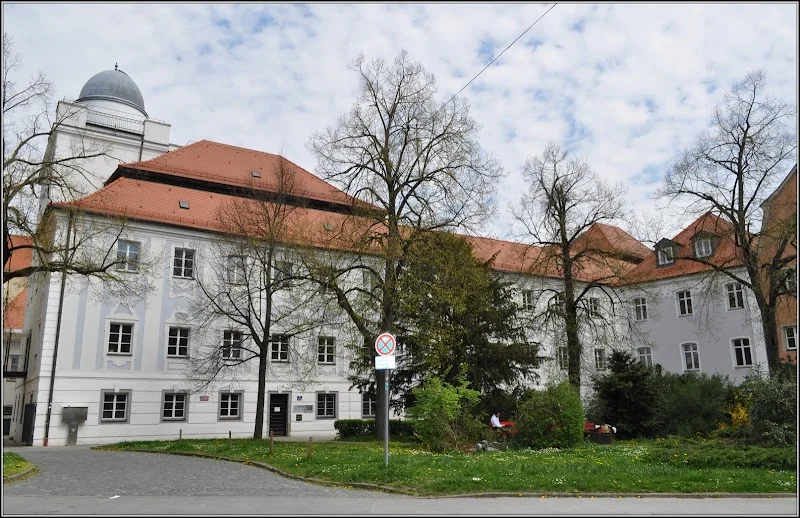
Ägidienpl. 2, Regensburg
Ägidienpl. 2, 93047 Regensburg, Germany
Public Observatory Regensburg | Tours & Opening Hours
The Public Observatory Regensburg, officially known as Sternwarte Regensburg, is a historical public observatory located at Ägidienplatz 2 in the old town of Regensburg. It serves as a bridge between astronomical research and the public, combining tours, lectures, and exhibitions with a vibrant volunteer operation. Visitors to this place not only experience telescopes and the night sky but also a piece of scientific history right in the historical center of the city. ([sternwarte-regensburg.de](https://sternwarte-regensburg.de/startseite/))
What is particularly noteworthy is the connection between tradition and the present: The observatory points to a long astronomical history in Regensburg while simultaneously emphasizing current educational offerings, public opening hours, lecture series, and special formats for groups on its website. For inquiries regarding Sternwarte Regensburg, opening hours, tours, directions, parking, and accessibility, the institution provides clear, practical information directly from the source. ([sternwarte-regensburg.de](https://sternwarte-regensburg.de/sternwarte/geschichte/))
Opening Hours, Tours, and Admission
Those wishing to visit the Sternwarte Regensburg will find an surprisingly clear and regular visiting model. Every Friday evening, the observatory is open regardless of the weather. From September to April, the evening begins at 8:00 PM, and from May to August at 9:00 PM. Admission starts approximately 15 minutes before the beginning, and a tour lasts about two hours. This reliability makes the observatory attractive to many people: One does not have to wait for a rare event but can plan a fixed weekly appointment and still get a different nature experience each time, depending on the sky, the evening's theme, and the current observation situation. ([sternwarte-regensburg.de](https://sternwarte-regensburg.de/fuehrungen/))
Additionally, the observatory consciously operates at a low threshold. No prior registration is required for the regular Friday evenings, reservations are not possible, and admission is free. Since the observatory is run entirely by volunteers, it appreciates donations. The focus is not on rapid mass operation but on a calm, explanatory, and personal format: People come, ring the doorbell, are welcomed, and receive an introduction to astronomy. On holidays and during the summer break from June 1 to July 15, the observatory remains closed. The association also points out that the number of people per tour is limited and that on days with monthly lectures, more visitors should be expected. This creates a clear mix of accessibility, tradition, and an orderly visiting process. ([sternwarte-regensburg.de](https://sternwarte-regensburg.de/fuehrungen/))
Another search term relevant for many visitors is the lecture program. Here, too, the observatory provides a fixed format: Once a month, a special lecture replaces the regular introductory lecture on astronomy. These monthly lectures begin during regular opening hours and each cover a specific topic. The website regularly announces upcoming dates, showcasing the observatory not only as a place for observation but also as an active site for knowledge transfer. For visitors, this means: A Friday evening can be a classic tour evening, a themed evening, or an evening with an extended lecture focus, depending on the program. This approach is particularly valuable for people who want to understand something beyond just looking through a telescope at an observatory. ([sternwarte-regensburg.de](https://sternwarte-regensburg.de/fuehrungen/))
Directions, Parking, and Accessibility
The journey to the Sternwarte Regensburg is well described and relatively easy to plan given its city center location. The nearest stop is Bismarckplatz; it is served by lines 2, 6, and A and is about 100 meters from the entrance. Also nearby is Arnulfsplatz, where lines 1, 4, and 11 also stop. Those arriving by train can reach the observatory from the main train station on foot in about 15 to 20 minutes via Sankt-Peters-Weg. This makes the observatory easily accessible by public transport for both Regensburg residents and visitors from the region and allows for easy integration into a city stroll through the old town. ([sternwarte-regensburg.de](https://sternwarte-regensburg.de/startseite/))
For drivers, it is especially important to know that the observatory does not offer visitor parking. A short stop is usually possible, but those wishing to stay longer should plan to use the neighboring parking garages at Bismarckplatz or Arnulfsplatz. Free parking options are also mentioned on the website: at Dultplatz with about a 25-minute walk and at lower Wöhrd or the old ice rink with about a 30-minute walk, provided no events are taking place there. This is a realistic, helpful hint for anyone looking to park near Sternwarte Regensburg and not wanting to circle spontaneously in the old town. The observatory therefore recommends early arrival and a clear time buffer, especially on well-attended evenings. ([sternwarte-regensburg.de](https://sternwarte-regensburg.de/startseite/))
Practical planning also includes looking at accessibility. The observatory is located on the 3rd to 5th floors of a historic building over 200 years old and is therefore not equipped with an elevator. For this reason, access is unfortunately not barrier-free. Those with limited mobility should definitely consider this information and coordinate their visit well in advance. Especially since the observatory operates in a heritage-rich old town environment, the architectural heritage is clearly palpable. This historical substance is part of its charm but also brings structural limitations. For those searching for accessibility at Sternwarte Regensburg, the honest answer is therefore clear and important: The place is fascinating but not barrier-free accessible. ([sternwarte-regensburg.de](https://sternwarte-regensburg.de/fuehrungen/))
History of the Public Observatory Regensburg
The history of the observatory extends far beyond today's visitor operations. The official history page first describes the astronomical tradition of Regensburg, which begins as early as the High Middle Ages. Monks from the St. Emmeram monastery observed the night sky and passed on their knowledge. A particularly significant testament is the astrolabe of Wilhelm von Hirsau, which is now exhibited in the Historical Museum and is considered the oldest such instrument in Germany. Johannes Kepler is also closely associated with Regensburg: He visited the city several times, stayed here with his family, and died in 1630 during a stay in Regensburg. This early scientific history forms the backdrop for the fact that astronomy in the city does not appear as a marginal topic but as a long-standing part of cultural identity. ([sternwarte-regensburg.de](https://sternwarte-regensburg.de/sternwarte/geschichte/))
In the 18th and 19th centuries, this tradition continued to develop. Extensive natural science collections were established at the St. Emmeram monastery, meteorological and astronomical measurements were conducted, and lectures were held. After the secularization in 1810, the Kingdom of Bavaria replaced the monastery with a new academic structure at the lyceum. Later, a tower of the medieval city wall, the so-called Placidus Tower, was used for astronomical observations. When this location had to give way to new traffic conditions in 1902, the lyceum built a dome on the building at Ägidienplatz 2. This dome, measuring four and a half meters, was constructed by the Dresden company Heyde and equipped with a 150-millimeter refractor from Reinfelder, which is now exhibited in the auditorium of the observatory. Even at this point, it becomes clear: The observatory is not a modern purpose-built structure but a developed scientific heritage spanning several epochs. ([sternwarte-regensburg.de](https://sternwarte-regensburg.de/sternwarte/geschichte/))
The decisive step towards a public observatory was taken by Professor Karl Stöckl. On January 12, 1920, he held his first public and accessible lecture on the Milky Way there. This marked the first time the institution opened itself consistently to the citizens of the city. Stöckl quickly established Friday evening as the opening time and made visits possible without prior registration and without admission fees. January 12, 1920, is therefore considered the founding date of the Public Observatory Regensburg. After Stöckl's death in 1959, Bernhard Heß and Alois Menath continued the operation; in 1976, the Friends of the Sternwarte Regensburg e.V. was founded, which has independently supported the institution to this day. In the 1980s, the premises were renovated, and the dome was renovated in 1982. As light pollution increased, an external branch was even established in the Bavarian Forest in the 1990s. This explains why the observatory today is both a historical city observatory and a vibrant educational institution. ([sternwarte-regensburg.de](https://sternwarte-regensburg.de/sternwarte/geschichte/))
Telescopes, Planetarium, and Exhibition Rooms
A large part of the fascination of the Sternwarte Regensburg lies in its instruments. According to the official instrument page, the dome houses a refractor by Lichtenknecker with a diameter of 150 millimeters and a focal length of 2250 millimeters, as well as a Cassegrain with a diameter of 12.5 inches and a focal length of 4750 millimeters. Outside the dome, additional devices are used: a Meade LX200 as a Schmidt-Cassegrain reflecting telescope with a 12-inch aperture and a focal length of 3048 millimeters, a Heritage as a Newtonian reflecting telescope with a 130-millimeter aperture and a focal length of 650 millimeters, a Coronado solar telescope with an H-alpha filter, a self-built Dobson with an 8-inch aperture built by members, and a Celestron C11 as a Schmidt-Cassegrain with an 11-inch aperture and a focal length of 2800 millimeters. This range shows that there is not just a single historical telescope here but a whole workshop of astronomical observation. ([sternwarte-regensburg.de](https://sternwarte-regensburg.de/sternwarte/instrumente/))
The exhibition rooms are also clearly designed for knowledge transfer. The planetarium offers a comprehensive insight into our solar system. There, one can find not only images but also globes, 3D models of the planets, a collection of rocket models and telescopes, as well as representations of historical and modern technology. The Stellarium further leads visitors into the development and end of stars, explains large structures of the universe, and works with topics such as star formation, galaxies, the plasma ball, or the true extent of the constellation Orion. The geological showcase, on the other hand, connects sky and earth: It presents solidified lava, minerals, crystals, and real meteorites, including a three-kilogram stone from space and moon rock. Therefore, those searching for planetarium regensburg, stellarium regensburg, or geological showcase will find here not just a simple list of names but a coherent educational offering around cosmos, material, and time. ([sternwarte-regensburg.de](https://sternwarte-regensburg.de/sternwarte/ausstellungsraeume/planetarium/))
This mixture of observation and exhibition makes the place extraordinary. One can not only look through telescopes but also understand what one sees. The historical instruments in the dome, the mobile telescopes on the platform, and the didactically structured exhibition rooms form a sequence of learning stations that complement each other well. For many guests, this is important because astronomy does not remain abstract here. A look at the moon, Jupiter, or the star formation region in Orion is suddenly connected with models, rocks, meteorites, and the history of observation itself. This is exactly how the observatory becomes a place where scientific curiosity, vivid presentation, and immediate seeing come together. ([sternwarte-regensburg.de](https://sternwarte-regensburg.de/sternwarte/instrumente/))
Lectures, Special Tours, and Educational Offerings
The Sternwarte Regensburg is more than just a place for the regular Friday evening. The website prominently lists tours & lectures, monthly lectures, astronomy courses, and offerings for schools and kindergartens. Once a month, a special lecture replaces the regular introductory lecture on astronomy. In addition, there are additional events aimed at various target groups. This makes the observatory a permanent educational location and not just a tourist attraction with opening hours. Those searching online for lecture program sternwarte regensburg or astronomy courses regensburg will therefore find a broad public learning offer that goes beyond the classic visit. ([sternwarte-regensburg.de](https://sternwarte-regensburg.de/fuehrungen/))
Especially relevant for groups is the offer of special tours. For groups of 15 or more, the observatory offers special tours from Monday to Thursday outside of regular opening hours for a donation. Requests should be made at least two weeks in advance, as the observatory operates entirely on a volunteer basis and cannot accept every requested date. Tours are usually offered in German; however, with sufficient notice, English-speaking tours are also possible. This detail is particularly valuable for international guests, school groups, and university groups. The observatory also points out that it is not an educational institution, and sufficient supervision is required for larger groups of children. This creates a realistic, reliable format for organized visits that operates with voluntary engagement and clear rules. ([sternwarte-regensburg.de](https://sternwarte-regensburg.de/fuehrungen/))
The observatory's collaborations further emphasize its educational mission. According to the official association page, there are connections to the city of Regensburg, the Kepler Museum, cultural tours, donumenta e.V., VHS Regensburg Land, the University of Regensburg, OTH Regensburg, MINT-Haus Regensburg, as well as several schools and kindergartens. Collaborations within the framework of MINT-Girls with OTH and the university are also mentioned. Furthermore, the observatory is a member of the Association of Star Friends e.V. and is connected in friendship with other observatories and planetariums. Therefore, those searching for public astronomy, urban historical education, or regional scientific culture quickly recognize: This institution is firmly anchored in the educational network of the region. ([sternwarte-regensburg.de](https://sternwarte-regensburg.de/verein/kooperationen/))
Why a Visit to Regensburg is Worthwhile
The Sternwarte Regensburg is a place where history, volunteer work, and astronomy come together naturally. The official website describes it as the oldest public observatory in southern Germany and one of the oldest in the world. The University of Regensburg also refers to the institution as one of the oldest public observatories in Germany. This dual classification explains why the observatory is not only interesting for specialists but also for anyone who wants to experience cultural history and science communication in an urban space. The fact that admission is free, the operation is voluntary, and the observatory has been publicly operating since 1920 makes the visit additionally appealing. ([sternwarte-regensburg.de](https://sternwarte-regensburg.de/))
At the same time, the observatory is not a static museum but a lively place. In 2025, a Day of Astronomy, a program with lectures, telescopes, and exhibition rooms, as well as a reopening after renovation work with a 27-kilogram meteorite were announced. Such examples show that the observatory regularly creates occasions for visitors to experience the sky, current topics, and collection pieces simultaneously. Therefore, anyone planning an evening in Regensburg will find here not just a mere obligatory stop but a place with atmosphere, professional depth, and surprisingly much proximity to practice. ([sternwarte-regensburg.de](https://sternwarte-regensburg.de/2025/03/02/tag-der-astronomie-am-29-maerz-2025-sofi/))
For families, school groups, amateur astronomers, and curious city visitors, the observatory is therefore a very good choice. Those interested in tours should plan for Friday evening; those wishing to register a group should consider the lead time; those arriving by car should use parking garages or public transport; and those dependent on accessibility should be aware of the structural limitations. This mixture of honest information and exciting experience makes the observatory so trustworthy. It is not a staged theme park but a real learning place with a view of the sky and a look into history. ([sternwarte-regensburg.de](https://sternwarte-regensburg.de/fuehrungen/))
Sources:
- Sternwarte Regensburg - Official Homepage
- Sternwarte Regensburg - Directions & Contact
- Sternwarte Regensburg - Tours & Opening Hours
- Sternwarte Regensburg - History
- Sternwarte Regensburg - Instruments
- Sternwarte Regensburg - Planetarium
- Sternwarte Regensburg - Stellarium
- Sternwarte Regensburg - Geological Showcase
- University of Regensburg - Impressions from our tour in the observatory
Show moreShow less
Public Observatory Regensburg | Tours & Opening Hours
The Public Observatory Regensburg, officially known as Sternwarte Regensburg, is a historical public observatory located at Ägidienplatz 2 in the old town of Regensburg. It serves as a bridge between astronomical research and the public, combining tours, lectures, and exhibitions with a vibrant volunteer operation. Visitors to this place not only experience telescopes and the night sky but also a piece of scientific history right in the historical center of the city. ([sternwarte-regensburg.de](https://sternwarte-regensburg.de/startseite/))
What is particularly noteworthy is the connection between tradition and the present: The observatory points to a long astronomical history in Regensburg while simultaneously emphasizing current educational offerings, public opening hours, lecture series, and special formats for groups on its website. For inquiries regarding Sternwarte Regensburg, opening hours, tours, directions, parking, and accessibility, the institution provides clear, practical information directly from the source. ([sternwarte-regensburg.de](https://sternwarte-regensburg.de/sternwarte/geschichte/))
Opening Hours, Tours, and Admission
Those wishing to visit the Sternwarte Regensburg will find an surprisingly clear and regular visiting model. Every Friday evening, the observatory is open regardless of the weather. From September to April, the evening begins at 8:00 PM, and from May to August at 9:00 PM. Admission starts approximately 15 minutes before the beginning, and a tour lasts about two hours. This reliability makes the observatory attractive to many people: One does not have to wait for a rare event but can plan a fixed weekly appointment and still get a different nature experience each time, depending on the sky, the evening's theme, and the current observation situation. ([sternwarte-regensburg.de](https://sternwarte-regensburg.de/fuehrungen/))
Additionally, the observatory consciously operates at a low threshold. No prior registration is required for the regular Friday evenings, reservations are not possible, and admission is free. Since the observatory is run entirely by volunteers, it appreciates donations. The focus is not on rapid mass operation but on a calm, explanatory, and personal format: People come, ring the doorbell, are welcomed, and receive an introduction to astronomy. On holidays and during the summer break from June 1 to July 15, the observatory remains closed. The association also points out that the number of people per tour is limited and that on days with monthly lectures, more visitors should be expected. This creates a clear mix of accessibility, tradition, and an orderly visiting process. ([sternwarte-regensburg.de](https://sternwarte-regensburg.de/fuehrungen/))
Another search term relevant for many visitors is the lecture program. Here, too, the observatory provides a fixed format: Once a month, a special lecture replaces the regular introductory lecture on astronomy. These monthly lectures begin during regular opening hours and each cover a specific topic. The website regularly announces upcoming dates, showcasing the observatory not only as a place for observation but also as an active site for knowledge transfer. For visitors, this means: A Friday evening can be a classic tour evening, a themed evening, or an evening with an extended lecture focus, depending on the program. This approach is particularly valuable for people who want to understand something beyond just looking through a telescope at an observatory. ([sternwarte-regensburg.de](https://sternwarte-regensburg.de/fuehrungen/))
Directions, Parking, and Accessibility
The journey to the Sternwarte Regensburg is well described and relatively easy to plan given its city center location. The nearest stop is Bismarckplatz; it is served by lines 2, 6, and A and is about 100 meters from the entrance. Also nearby is Arnulfsplatz, where lines 1, 4, and 11 also stop. Those arriving by train can reach the observatory from the main train station on foot in about 15 to 20 minutes via Sankt-Peters-Weg. This makes the observatory easily accessible by public transport for both Regensburg residents and visitors from the region and allows for easy integration into a city stroll through the old town. ([sternwarte-regensburg.de](https://sternwarte-regensburg.de/startseite/))
For drivers, it is especially important to know that the observatory does not offer visitor parking. A short stop is usually possible, but those wishing to stay longer should plan to use the neighboring parking garages at Bismarckplatz or Arnulfsplatz. Free parking options are also mentioned on the website: at Dultplatz with about a 25-minute walk and at lower Wöhrd or the old ice rink with about a 30-minute walk, provided no events are taking place there. This is a realistic, helpful hint for anyone looking to park near Sternwarte Regensburg and not wanting to circle spontaneously in the old town. The observatory therefore recommends early arrival and a clear time buffer, especially on well-attended evenings. ([sternwarte-regensburg.de](https://sternwarte-regensburg.de/startseite/))
Practical planning also includes looking at accessibility. The observatory is located on the 3rd to 5th floors of a historic building over 200 years old and is therefore not equipped with an elevator. For this reason, access is unfortunately not barrier-free. Those with limited mobility should definitely consider this information and coordinate their visit well in advance. Especially since the observatory operates in a heritage-rich old town environment, the architectural heritage is clearly palpable. This historical substance is part of its charm but also brings structural limitations. For those searching for accessibility at Sternwarte Regensburg, the honest answer is therefore clear and important: The place is fascinating but not barrier-free accessible. ([sternwarte-regensburg.de](https://sternwarte-regensburg.de/fuehrungen/))
History of the Public Observatory Regensburg
The history of the observatory extends far beyond today's visitor operations. The official history page first describes the astronomical tradition of Regensburg, which begins as early as the High Middle Ages. Monks from the St. Emmeram monastery observed the night sky and passed on their knowledge. A particularly significant testament is the astrolabe of Wilhelm von Hirsau, which is now exhibited in the Historical Museum and is considered the oldest such instrument in Germany. Johannes Kepler is also closely associated with Regensburg: He visited the city several times, stayed here with his family, and died in 1630 during a stay in Regensburg. This early scientific history forms the backdrop for the fact that astronomy in the city does not appear as a marginal topic but as a long-standing part of cultural identity. ([sternwarte-regensburg.de](https://sternwarte-regensburg.de/sternwarte/geschichte/))
In the 18th and 19th centuries, this tradition continued to develop. Extensive natural science collections were established at the St. Emmeram monastery, meteorological and astronomical measurements were conducted, and lectures were held. After the secularization in 1810, the Kingdom of Bavaria replaced the monastery with a new academic structure at the lyceum. Later, a tower of the medieval city wall, the so-called Placidus Tower, was used for astronomical observations. When this location had to give way to new traffic conditions in 1902, the lyceum built a dome on the building at Ägidienplatz 2. This dome, measuring four and a half meters, was constructed by the Dresden company Heyde and equipped with a 150-millimeter refractor from Reinfelder, which is now exhibited in the auditorium of the observatory. Even at this point, it becomes clear: The observatory is not a modern purpose-built structure but a developed scientific heritage spanning several epochs. ([sternwarte-regensburg.de](https://sternwarte-regensburg.de/sternwarte/geschichte/))
The decisive step towards a public observatory was taken by Professor Karl Stöckl. On January 12, 1920, he held his first public and accessible lecture on the Milky Way there. This marked the first time the institution opened itself consistently to the citizens of the city. Stöckl quickly established Friday evening as the opening time and made visits possible without prior registration and without admission fees. January 12, 1920, is therefore considered the founding date of the Public Observatory Regensburg. After Stöckl's death in 1959, Bernhard Heß and Alois Menath continued the operation; in 1976, the Friends of the Sternwarte Regensburg e.V. was founded, which has independently supported the institution to this day. In the 1980s, the premises were renovated, and the dome was renovated in 1982. As light pollution increased, an external branch was even established in the Bavarian Forest in the 1990s. This explains why the observatory today is both a historical city observatory and a vibrant educational institution. ([sternwarte-regensburg.de](https://sternwarte-regensburg.de/sternwarte/geschichte/))
Telescopes, Planetarium, and Exhibition Rooms
A large part of the fascination of the Sternwarte Regensburg lies in its instruments. According to the official instrument page, the dome houses a refractor by Lichtenknecker with a diameter of 150 millimeters and a focal length of 2250 millimeters, as well as a Cassegrain with a diameter of 12.5 inches and a focal length of 4750 millimeters. Outside the dome, additional devices are used: a Meade LX200 as a Schmidt-Cassegrain reflecting telescope with a 12-inch aperture and a focal length of 3048 millimeters, a Heritage as a Newtonian reflecting telescope with a 130-millimeter aperture and a focal length of 650 millimeters, a Coronado solar telescope with an H-alpha filter, a self-built Dobson with an 8-inch aperture built by members, and a Celestron C11 as a Schmidt-Cassegrain with an 11-inch aperture and a focal length of 2800 millimeters. This range shows that there is not just a single historical telescope here but a whole workshop of astronomical observation. ([sternwarte-regensburg.de](https://sternwarte-regensburg.de/sternwarte/instrumente/))
The exhibition rooms are also clearly designed for knowledge transfer. The planetarium offers a comprehensive insight into our solar system. There, one can find not only images but also globes, 3D models of the planets, a collection of rocket models and telescopes, as well as representations of historical and modern technology. The Stellarium further leads visitors into the development and end of stars, explains large structures of the universe, and works with topics such as star formation, galaxies, the plasma ball, or the true extent of the constellation Orion. The geological showcase, on the other hand, connects sky and earth: It presents solidified lava, minerals, crystals, and real meteorites, including a three-kilogram stone from space and moon rock. Therefore, those searching for planetarium regensburg, stellarium regensburg, or geological showcase will find here not just a simple list of names but a coherent educational offering around cosmos, material, and time. ([sternwarte-regensburg.de](https://sternwarte-regensburg.de/sternwarte/ausstellungsraeume/planetarium/))
This mixture of observation and exhibition makes the place extraordinary. One can not only look through telescopes but also understand what one sees. The historical instruments in the dome, the mobile telescopes on the platform, and the didactically structured exhibition rooms form a sequence of learning stations that complement each other well. For many guests, this is important because astronomy does not remain abstract here. A look at the moon, Jupiter, or the star formation region in Orion is suddenly connected with models, rocks, meteorites, and the history of observation itself. This is exactly how the observatory becomes a place where scientific curiosity, vivid presentation, and immediate seeing come together. ([sternwarte-regensburg.de](https://sternwarte-regensburg.de/sternwarte/instrumente/))
Lectures, Special Tours, and Educational Offerings
The Sternwarte Regensburg is more than just a place for the regular Friday evening. The website prominently lists tours & lectures, monthly lectures, astronomy courses, and offerings for schools and kindergartens. Once a month, a special lecture replaces the regular introductory lecture on astronomy. In addition, there are additional events aimed at various target groups. This makes the observatory a permanent educational location and not just a tourist attraction with opening hours. Those searching online for lecture program sternwarte regensburg or astronomy courses regensburg will therefore find a broad public learning offer that goes beyond the classic visit. ([sternwarte-regensburg.de](https://sternwarte-regensburg.de/fuehrungen/))
Especially relevant for groups is the offer of special tours. For groups of 15 or more, the observatory offers special tours from Monday to Thursday outside of regular opening hours for a donation. Requests should be made at least two weeks in advance, as the observatory operates entirely on a volunteer basis and cannot accept every requested date. Tours are usually offered in German; however, with sufficient notice, English-speaking tours are also possible. This detail is particularly valuable for international guests, school groups, and university groups. The observatory also points out that it is not an educational institution, and sufficient supervision is required for larger groups of children. This creates a realistic, reliable format for organized visits that operates with voluntary engagement and clear rules. ([sternwarte-regensburg.de](https://sternwarte-regensburg.de/fuehrungen/))
The observatory's collaborations further emphasize its educational mission. According to the official association page, there are connections to the city of Regensburg, the Kepler Museum, cultural tours, donumenta e.V., VHS Regensburg Land, the University of Regensburg, OTH Regensburg, MINT-Haus Regensburg, as well as several schools and kindergartens. Collaborations within the framework of MINT-Girls with OTH and the university are also mentioned. Furthermore, the observatory is a member of the Association of Star Friends e.V. and is connected in friendship with other observatories and planetariums. Therefore, those searching for public astronomy, urban historical education, or regional scientific culture quickly recognize: This institution is firmly anchored in the educational network of the region. ([sternwarte-regensburg.de](https://sternwarte-regensburg.de/verein/kooperationen/))
Why a Visit to Regensburg is Worthwhile
The Sternwarte Regensburg is a place where history, volunteer work, and astronomy come together naturally. The official website describes it as the oldest public observatory in southern Germany and one of the oldest in the world. The University of Regensburg also refers to the institution as one of the oldest public observatories in Germany. This dual classification explains why the observatory is not only interesting for specialists but also for anyone who wants to experience cultural history and science communication in an urban space. The fact that admission is free, the operation is voluntary, and the observatory has been publicly operating since 1920 makes the visit additionally appealing. ([sternwarte-regensburg.de](https://sternwarte-regensburg.de/))
At the same time, the observatory is not a static museum but a lively place. In 2025, a Day of Astronomy, a program with lectures, telescopes, and exhibition rooms, as well as a reopening after renovation work with a 27-kilogram meteorite were announced. Such examples show that the observatory regularly creates occasions for visitors to experience the sky, current topics, and collection pieces simultaneously. Therefore, anyone planning an evening in Regensburg will find here not just a mere obligatory stop but a place with atmosphere, professional depth, and surprisingly much proximity to practice. ([sternwarte-regensburg.de](https://sternwarte-regensburg.de/2025/03/02/tag-der-astronomie-am-29-maerz-2025-sofi/))
For families, school groups, amateur astronomers, and curious city visitors, the observatory is therefore a very good choice. Those interested in tours should plan for Friday evening; those wishing to register a group should consider the lead time; those arriving by car should use parking garages or public transport; and those dependent on accessibility should be aware of the structural limitations. This mixture of honest information and exciting experience makes the observatory so trustworthy. It is not a staged theme park but a real learning place with a view of the sky and a look into history. ([sternwarte-regensburg.de](https://sternwarte-regensburg.de/fuehrungen/))
Sources:
- Sternwarte Regensburg - Official Homepage
- Sternwarte Regensburg - Directions & Contact
- Sternwarte Regensburg - Tours & Opening Hours
- Sternwarte Regensburg - History
- Sternwarte Regensburg - Instruments
- Sternwarte Regensburg - Planetarium
- Sternwarte Regensburg - Stellarium
- Sternwarte Regensburg - Geological Showcase
- University of Regensburg - Impressions from our tour in the observatory
Public Observatory Regensburg | Tours & Opening Hours
The Public Observatory Regensburg, officially known as Sternwarte Regensburg, is a historical public observatory located at Ägidienplatz 2 in the old town of Regensburg. It serves as a bridge between astronomical research and the public, combining tours, lectures, and exhibitions with a vibrant volunteer operation. Visitors to this place not only experience telescopes and the night sky but also a piece of scientific history right in the historical center of the city. ([sternwarte-regensburg.de](https://sternwarte-regensburg.de/startseite/))
What is particularly noteworthy is the connection between tradition and the present: The observatory points to a long astronomical history in Regensburg while simultaneously emphasizing current educational offerings, public opening hours, lecture series, and special formats for groups on its website. For inquiries regarding Sternwarte Regensburg, opening hours, tours, directions, parking, and accessibility, the institution provides clear, practical information directly from the source. ([sternwarte-regensburg.de](https://sternwarte-regensburg.de/sternwarte/geschichte/))
Opening Hours, Tours, and Admission
Those wishing to visit the Sternwarte Regensburg will find an surprisingly clear and regular visiting model. Every Friday evening, the observatory is open regardless of the weather. From September to April, the evening begins at 8:00 PM, and from May to August at 9:00 PM. Admission starts approximately 15 minutes before the beginning, and a tour lasts about two hours. This reliability makes the observatory attractive to many people: One does not have to wait for a rare event but can plan a fixed weekly appointment and still get a different nature experience each time, depending on the sky, the evening's theme, and the current observation situation. ([sternwarte-regensburg.de](https://sternwarte-regensburg.de/fuehrungen/))
Additionally, the observatory consciously operates at a low threshold. No prior registration is required for the regular Friday evenings, reservations are not possible, and admission is free. Since the observatory is run entirely by volunteers, it appreciates donations. The focus is not on rapid mass operation but on a calm, explanatory, and personal format: People come, ring the doorbell, are welcomed, and receive an introduction to astronomy. On holidays and during the summer break from June 1 to July 15, the observatory remains closed. The association also points out that the number of people per tour is limited and that on days with monthly lectures, more visitors should be expected. This creates a clear mix of accessibility, tradition, and an orderly visiting process. ([sternwarte-regensburg.de](https://sternwarte-regensburg.de/fuehrungen/))
Another search term relevant for many visitors is the lecture program. Here, too, the observatory provides a fixed format: Once a month, a special lecture replaces the regular introductory lecture on astronomy. These monthly lectures begin during regular opening hours and each cover a specific topic. The website regularly announces upcoming dates, showcasing the observatory not only as a place for observation but also as an active site for knowledge transfer. For visitors, this means: A Friday evening can be a classic tour evening, a themed evening, or an evening with an extended lecture focus, depending on the program. This approach is particularly valuable for people who want to understand something beyond just looking through a telescope at an observatory. ([sternwarte-regensburg.de](https://sternwarte-regensburg.de/fuehrungen/))
Directions, Parking, and Accessibility
The journey to the Sternwarte Regensburg is well described and relatively easy to plan given its city center location. The nearest stop is Bismarckplatz; it is served by lines 2, 6, and A and is about 100 meters from the entrance. Also nearby is Arnulfsplatz, where lines 1, 4, and 11 also stop. Those arriving by train can reach the observatory from the main train station on foot in about 15 to 20 minutes via Sankt-Peters-Weg. This makes the observatory easily accessible by public transport for both Regensburg residents and visitors from the region and allows for easy integration into a city stroll through the old town. ([sternwarte-regensburg.de](https://sternwarte-regensburg.de/startseite/))
For drivers, it is especially important to know that the observatory does not offer visitor parking. A short stop is usually possible, but those wishing to stay longer should plan to use the neighboring parking garages at Bismarckplatz or Arnulfsplatz. Free parking options are also mentioned on the website: at Dultplatz with about a 25-minute walk and at lower Wöhrd or the old ice rink with about a 30-minute walk, provided no events are taking place there. This is a realistic, helpful hint for anyone looking to park near Sternwarte Regensburg and not wanting to circle spontaneously in the old town. The observatory therefore recommends early arrival and a clear time buffer, especially on well-attended evenings. ([sternwarte-regensburg.de](https://sternwarte-regensburg.de/startseite/))
Practical planning also includes looking at accessibility. The observatory is located on the 3rd to 5th floors of a historic building over 200 years old and is therefore not equipped with an elevator. For this reason, access is unfortunately not barrier-free. Those with limited mobility should definitely consider this information and coordinate their visit well in advance. Especially since the observatory operates in a heritage-rich old town environment, the architectural heritage is clearly palpable. This historical substance is part of its charm but also brings structural limitations. For those searching for accessibility at Sternwarte Regensburg, the honest answer is therefore clear and important: The place is fascinating but not barrier-free accessible. ([sternwarte-regensburg.de](https://sternwarte-regensburg.de/fuehrungen/))
History of the Public Observatory Regensburg
The history of the observatory extends far beyond today's visitor operations. The official history page first describes the astronomical tradition of Regensburg, which begins as early as the High Middle Ages. Monks from the St. Emmeram monastery observed the night sky and passed on their knowledge. A particularly significant testament is the astrolabe of Wilhelm von Hirsau, which is now exhibited in the Historical Museum and is considered the oldest such instrument in Germany. Johannes Kepler is also closely associated with Regensburg: He visited the city several times, stayed here with his family, and died in 1630 during a stay in Regensburg. This early scientific history forms the backdrop for the fact that astronomy in the city does not appear as a marginal topic but as a long-standing part of cultural identity. ([sternwarte-regensburg.de](https://sternwarte-regensburg.de/sternwarte/geschichte/))
In the 18th and 19th centuries, this tradition continued to develop. Extensive natural science collections were established at the St. Emmeram monastery, meteorological and astronomical measurements were conducted, and lectures were held. After the secularization in 1810, the Kingdom of Bavaria replaced the monastery with a new academic structure at the lyceum. Later, a tower of the medieval city wall, the so-called Placidus Tower, was used for astronomical observations. When this location had to give way to new traffic conditions in 1902, the lyceum built a dome on the building at Ägidienplatz 2. This dome, measuring four and a half meters, was constructed by the Dresden company Heyde and equipped with a 150-millimeter refractor from Reinfelder, which is now exhibited in the auditorium of the observatory. Even at this point, it becomes clear: The observatory is not a modern purpose-built structure but a developed scientific heritage spanning several epochs. ([sternwarte-regensburg.de](https://sternwarte-regensburg.de/sternwarte/geschichte/))
The decisive step towards a public observatory was taken by Professor Karl Stöckl. On January 12, 1920, he held his first public and accessible lecture on the Milky Way there. This marked the first time the institution opened itself consistently to the citizens of the city. Stöckl quickly established Friday evening as the opening time and made visits possible without prior registration and without admission fees. January 12, 1920, is therefore considered the founding date of the Public Observatory Regensburg. After Stöckl's death in 1959, Bernhard Heß and Alois Menath continued the operation; in 1976, the Friends of the Sternwarte Regensburg e.V. was founded, which has independently supported the institution to this day. In the 1980s, the premises were renovated, and the dome was renovated in 1982. As light pollution increased, an external branch was even established in the Bavarian Forest in the 1990s. This explains why the observatory today is both a historical city observatory and a vibrant educational institution. ([sternwarte-regensburg.de](https://sternwarte-regensburg.de/sternwarte/geschichte/))
Telescopes, Planetarium, and Exhibition Rooms
A large part of the fascination of the Sternwarte Regensburg lies in its instruments. According to the official instrument page, the dome houses a refractor by Lichtenknecker with a diameter of 150 millimeters and a focal length of 2250 millimeters, as well as a Cassegrain with a diameter of 12.5 inches and a focal length of 4750 millimeters. Outside the dome, additional devices are used: a Meade LX200 as a Schmidt-Cassegrain reflecting telescope with a 12-inch aperture and a focal length of 3048 millimeters, a Heritage as a Newtonian reflecting telescope with a 130-millimeter aperture and a focal length of 650 millimeters, a Coronado solar telescope with an H-alpha filter, a self-built Dobson with an 8-inch aperture built by members, and a Celestron C11 as a Schmidt-Cassegrain with an 11-inch aperture and a focal length of 2800 millimeters. This range shows that there is not just a single historical telescope here but a whole workshop of astronomical observation. ([sternwarte-regensburg.de](https://sternwarte-regensburg.de/sternwarte/instrumente/))
The exhibition rooms are also clearly designed for knowledge transfer. The planetarium offers a comprehensive insight into our solar system. There, one can find not only images but also globes, 3D models of the planets, a collection of rocket models and telescopes, as well as representations of historical and modern technology. The Stellarium further leads visitors into the development and end of stars, explains large structures of the universe, and works with topics such as star formation, galaxies, the plasma ball, or the true extent of the constellation Orion. The geological showcase, on the other hand, connects sky and earth: It presents solidified lava, minerals, crystals, and real meteorites, including a three-kilogram stone from space and moon rock. Therefore, those searching for planetarium regensburg, stellarium regensburg, or geological showcase will find here not just a simple list of names but a coherent educational offering around cosmos, material, and time. ([sternwarte-regensburg.de](https://sternwarte-regensburg.de/sternwarte/ausstellungsraeume/planetarium/))
This mixture of observation and exhibition makes the place extraordinary. One can not only look through telescopes but also understand what one sees. The historical instruments in the dome, the mobile telescopes on the platform, and the didactically structured exhibition rooms form a sequence of learning stations that complement each other well. For many guests, this is important because astronomy does not remain abstract here. A look at the moon, Jupiter, or the star formation region in Orion is suddenly connected with models, rocks, meteorites, and the history of observation itself. This is exactly how the observatory becomes a place where scientific curiosity, vivid presentation, and immediate seeing come together. ([sternwarte-regensburg.de](https://sternwarte-regensburg.de/sternwarte/instrumente/))
Lectures, Special Tours, and Educational Offerings
The Sternwarte Regensburg is more than just a place for the regular Friday evening. The website prominently lists tours & lectures, monthly lectures, astronomy courses, and offerings for schools and kindergartens. Once a month, a special lecture replaces the regular introductory lecture on astronomy. In addition, there are additional events aimed at various target groups. This makes the observatory a permanent educational location and not just a tourist attraction with opening hours. Those searching online for lecture program sternwarte regensburg or astronomy courses regensburg will therefore find a broad public learning offer that goes beyond the classic visit. ([sternwarte-regensburg.de](https://sternwarte-regensburg.de/fuehrungen/))
Especially relevant for groups is the offer of special tours. For groups of 15 or more, the observatory offers special tours from Monday to Thursday outside of regular opening hours for a donation. Requests should be made at least two weeks in advance, as the observatory operates entirely on a volunteer basis and cannot accept every requested date. Tours are usually offered in German; however, with sufficient notice, English-speaking tours are also possible. This detail is particularly valuable for international guests, school groups, and university groups. The observatory also points out that it is not an educational institution, and sufficient supervision is required for larger groups of children. This creates a realistic, reliable format for organized visits that operates with voluntary engagement and clear rules. ([sternwarte-regensburg.de](https://sternwarte-regensburg.de/fuehrungen/))
The observatory's collaborations further emphasize its educational mission. According to the official association page, there are connections to the city of Regensburg, the Kepler Museum, cultural tours, donumenta e.V., VHS Regensburg Land, the University of Regensburg, OTH Regensburg, MINT-Haus Regensburg, as well as several schools and kindergartens. Collaborations within the framework of MINT-Girls with OTH and the university are also mentioned. Furthermore, the observatory is a member of the Association of Star Friends e.V. and is connected in friendship with other observatories and planetariums. Therefore, those searching for public astronomy, urban historical education, or regional scientific culture quickly recognize: This institution is firmly anchored in the educational network of the region. ([sternwarte-regensburg.de](https://sternwarte-regensburg.de/verein/kooperationen/))
Why a Visit to Regensburg is Worthwhile
The Sternwarte Regensburg is a place where history, volunteer work, and astronomy come together naturally. The official website describes it as the oldest public observatory in southern Germany and one of the oldest in the world. The University of Regensburg also refers to the institution as one of the oldest public observatories in Germany. This dual classification explains why the observatory is not only interesting for specialists but also for anyone who wants to experience cultural history and science communication in an urban space. The fact that admission is free, the operation is voluntary, and the observatory has been publicly operating since 1920 makes the visit additionally appealing. ([sternwarte-regensburg.de](https://sternwarte-regensburg.de/))
At the same time, the observatory is not a static museum but a lively place. In 2025, a Day of Astronomy, a program with lectures, telescopes, and exhibition rooms, as well as a reopening after renovation work with a 27-kilogram meteorite were announced. Such examples show that the observatory regularly creates occasions for visitors to experience the sky, current topics, and collection pieces simultaneously. Therefore, anyone planning an evening in Regensburg will find here not just a mere obligatory stop but a place with atmosphere, professional depth, and surprisingly much proximity to practice. ([sternwarte-regensburg.de](https://sternwarte-regensburg.de/2025/03/02/tag-der-astronomie-am-29-maerz-2025-sofi/))
For families, school groups, amateur astronomers, and curious city visitors, the observatory is therefore a very good choice. Those interested in tours should plan for Friday evening; those wishing to register a group should consider the lead time; those arriving by car should use parking garages or public transport; and those dependent on accessibility should be aware of the structural limitations. This mixture of honest information and exciting experience makes the observatory so trustworthy. It is not a staged theme park but a real learning place with a view of the sky and a look into history. ([sternwarte-regensburg.de](https://sternwarte-regensburg.de/fuehrungen/))
Sources:
- Sternwarte Regensburg - Official Homepage
- Sternwarte Regensburg - Directions & Contact
- Sternwarte Regensburg - Tours & Opening Hours
- Sternwarte Regensburg - History
- Sternwarte Regensburg - Instruments
- Sternwarte Regensburg - Planetarium
- Sternwarte Regensburg - Stellarium
- Sternwarte Regensburg - Geological Showcase
- University of Regensburg - Impressions from our tour in the observatory
Upcoming Events
No events found
Frequently Asked Questions
Reviews
Carlos Hof
1. February 2025
Incredible place, for all space, stars, planet lovers, this place is great. For starters or experienced, it is really nice. Second oldest observatory in Germany, really nice people who work as volunteers and explain everything regarding space and the telescopes. They have lectures to explain things in space and have a nice museum, new meteorite, and really nice pictures. Worth going for a visit.
Arne Trautmann
13. August 2017
One of the things I was not even sure existed in Regensburg. There is lots to learn there and there are great views. Excursions are guided and typically rather late in the evening (it is about stars after all). Very interesting for adults and (not too young) kids.
Julia Z.
20. February 2022
Mega!
Bella Stangl
21. February 2026
All members are very nice; when you're new, everything is explained in detail and you immediately feel like you belong.
Marc Vincenz
9. November 2025
What a wonder of a world we live in! Here, everyone realizes how small we actually are. It was breathtaking. Attending a lecture is definitely worthwhile.