
Rathauspl. 1, Regensburg
Rathauspl. 1, 93047 Regensburg, Germany
Reichstag in the Old Town Hall | Tickets & Tour
Those searching for the Reichstag in the Old Town Hall of Regensburg find themselves in a place where European history is not only explained but also experienced spatially. This is not about the Berlin Reichstag, but about the historical document Reichstag in the Old Town Hall, right in the UNESCO World Heritage Site of Regensburg's Old Town. The building served for centuries as the seat of the city council, administration, and judiciary, with a prison and interrogation room in the basement, and from 1663 to 1806, the Permanent Reichstag convened here. The rooms that can be visited today combine political history, city history, and architecture into a tour that is as exciting for first-time visitors as it is for those who already know Regensburg. The location is in the heart of a city whose Old Town and Stadtamhof are protected as a World Heritage Site and whose historical building fabric ranges from the High Middle Ages to modern times. That is why the visit is more than just a museum stop: it is a concentrated look at the political role of Regensburg in the Holy Roman Empire and the significance of the Old Town Hall as a historical site. ([regensburg.de](https://www.regensburg.de/museen/die-museen/documente/document-reichstag))
History of the Permanent Reichstag in the Old Town Hall
The Old Town Hall is one of the most important secular buildings in Regensburg. The city was elevated to a Free Imperial City in 1245, and it was in this historical context that the town hall gained its outstanding position. The oldest part of the ensemble is the 55-meter-high tower. The Reichssaal building was constructed around 1320 to 1330, originally planned as a dance hall. Later, this room became the place where imperial estates, envoys, and political actors gathered. The official tourism presentation describes the building as a place where the heart of the Free Imperial City beat and where history has been preserved to this day. The architecture itself thus tells of change, representation, and power. The Reichstag that took place here was not just any local event, but a central component of the political order of the empire. The fact that Regensburg was permanently chosen as the seat made the city a place of power in Europe for almost a century and a half. ([tourismus.regensburg.de](https://tourismus.regensburg.de/en/experience-discover/unesco-world-heritage-/-sightseeing/old-town-hall))
Particularly important is the period from 1663 to 1806, when the Permanent Reichstag convened in the Old Town Hall. The name is programmatic: from an originally time-limited imperial assembly, a permanently anchored political process in Regensburg emerged. The city thus gained a format that is often described in retrospect as a precursor to modern parliamentary culture. The major questions of imperial politics were concentrated in the Old Town Hall, and official descriptions emphasize that representatives of major German and European politics came together here. Today, a newly designed permanent exhibition from 2003 conveys the structure and function of the Reichstag. This makes the visit educationally valuable, as it not only shows rooms but also explains power relations, decision-making processes, and historical sequences. Anyone interested in imperial history, imperial cities, diplomacy, or early forms of European political public will find here an authentic place with an extraordinarily dense historical context. ([regensburg.de](https://www.regensburg.de/museen/die-museen/documente/document-reichstag))
Guided Tours, Opening Hours, and Tickets at the document Reichstag
The visit to the document Reichstag is clearly organized: access is only possible as part of guided tours. This is not a disadvantage, but part of the concept, as the historical rooms remain protected and can be conveyed expertly. The city of Regensburg publishes fixed time slots for the tours. From April 1 to October 31, several daily appointments are available, including an English tour at 2:00 PM. In the off-peak and winter months, reduced time slots apply: from November 1 to January 6 and from March 1 to March 31, there are also daily tours, and from January 7 to February 28/29, a slightly smaller schedule. On certain days, the area remains closed, including on January 1, Shrove Tuesday, and December 24 and 25. The official pages also point out that events and receptions take place in the Old Town Hall, which may temporarily restrict access to the museum rooms. Therefore, those who want to plan securely should check the current times before their visit. ([regensburg.de](https://www.regensburg.de/museen/die-museen/documente/document-reichstag))
The ticket structure is also transparent. For the standard tour, there are regular, reduced, and family rates; additionally, there is a short tour that focuses on the interrogation room and prison cells and does not include the rooms of the Permanent Reichstag. Tickets can be obtained through the Tourist Info at the Town Hall Square or through the museum tours of the city of Regensburg. For groups and barrier-free tours, a phone reservation is recommended to coordinate the processes well. It is also important to note that free admission to the museums of the city of Regensburg on the first Sunday of the month does not apply to the document Reichstag. This shows that this place is understood as an independent offering within the city's museum landscape. For visitors, this is practical: one knows in advance which tour is booked, what it includes, and which areas are open. This creates a visit that is planable, historically grounded, and can be well integrated into a day in the Old Town. ([regensburg.de](https://www.regensburg.de/museen/die-museen/documente/document-reichstag))
Access, Public Transport, and Parking at the Old Town Hall
Getting to the Old Town Hall is relatively uncomplicated thanks to its central location in Regensburg's Old Town, although one should be aware that they are moving in a historical and traffic-calmed city center. The public transport stops Old Town Hall and Fish Market are the main points of contact. According to the official travel information, one can initially continue by bus from Regensburg Central Station; alternatively, the walk through the city center is also feasible and takes about 15 minutes. This is interesting for visitors who want to experience Regensburg as an Old Town, as the path itself leads through the historical center. Those visiting the city for the first time should keep in mind that the paths in the Old Town are organized more for pedestrians than for cars. Therefore, it is often more pleasant to combine the museum visit with a walk rather than wanting to drive directly to the door. ([regensburg.de](https://www.regensburg.de/sixcms/media.php/464/Anfahrtsinformation.pdf))
By car, there are several recommended options, but not directly in the historical core. The official travel information mentions the underground garage at the theater for the route via the A93 with about a five-minute walk and the parking garage Dachauplatz for the route via the A3 with about a ten-minute walk. This also fits the character of the city center: one parks on the outskirts of the Old Town and walks the last meters. This often makes the visit more relaxed, as one becomes more aware of the historical surroundings. For many guests, this is an advantage, as the Reichstag in the Old Town Hall has the strongest impact when one does not have to drive into the immediate vicinity by car. Therefore, those planning a city tour should rather arrive by bus or train or use the parking garage as a starting point. This way, the visit can be well combined with other stops in the Old Town without wasting time searching for parking. ([regensburg.de](https://www.regensburg.de/sixcms/media.php/464/Anfahrtsinformation.pdf))
Reichs Hall, Consultation Rooms, and Interrogation Room: What Visitors See on the Tour
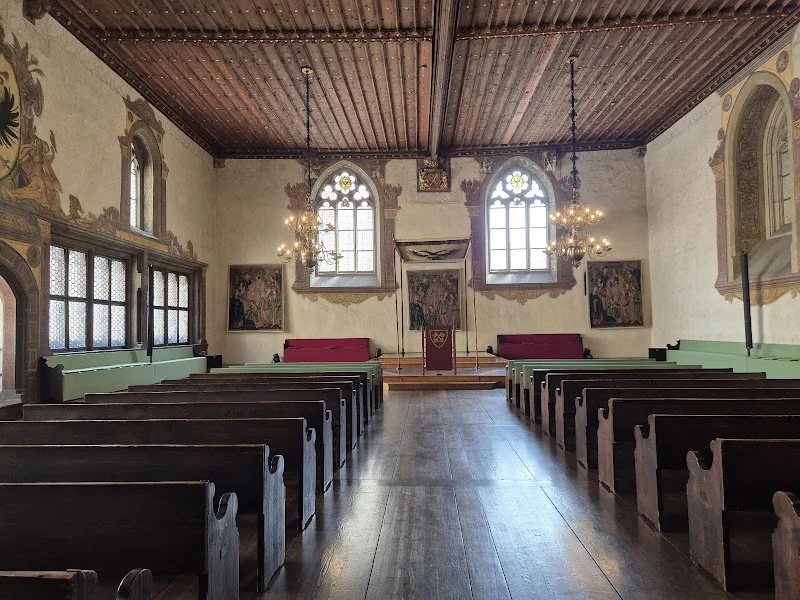
The real charm of the document Reichstag lies in the spatiality. The historical rooms on the first floor convey the atmosphere of the Permanent Reichstag very directly. These include the Reichs Hall and the consultation rooms where the political processes of the old empire took place. The official texts emphasize that the atmosphere of the Reichstag is still palpable there today. This is complemented by a permanent exhibition that explains the structure and function of the Reichstag. This is particularly valuable for visitors who do not just want to see beautiful rooms but want to understand how work was done here. Once standing in such a room, one quickly realizes that political history is not just made up of data but of architecture, seating arrangements, rituals, and communication. The Reichs Hall was originally not planned as a parliamentary hall but developed into a place where decisions with regional impact were prepared and negotiated. It is precisely this connection between built space and political practice that makes the tour so impressive. ([regensburg.de](https://www.regensburg.de/museen/die-museen/documente/document-reichstag))
In the basement lies the interrogation room, the area of medieval judiciary. There were also prison rooms, and the interrogation room with the historical torture instruments is preserved in its original form. This is one of the most striking but also most impressive parts of the visit because it shows the other side of urban order: alongside representation and politics, there is also jurisdiction, punishment, and power. The tours thus link courtly and civic history, political and legal functions, light and shadow of the same house. It is also important to note the accessibility: the rooms of the Permanent Reichstag on the first floor are accessible, but the basement with the judiciary is not. Those who rely on a barrier-free tour should coordinate the tour by phone in advance. This clear differentiation makes the visit well planable, as visitors already know in advance which areas they can experience without problems and where there are restrictions. ([regensburg.de](https://www.regensburg.de/museen/die-museen/documente/document-reichstag))
Reichstag in English: English Tours for Visitors
The keyword Reichstag in English is indeed relevant for Regensburg, as the document Reichstag does not only appeal to German-speaking guests. An English tour is scheduled during the official tour times, usually at 2:00 PM in the specified periods. This makes the visit significantly more accessible for international guests, exchange students, travel groups, and anyone who wants to experience Regensburg in English. Especially in such a place that requires explanation, an English tour makes sense, as the political structures of the Holy Roman Empire, the function of the Reichstag, and the various rooms are much easier to understand in dialogue than through a quick tour alone. So, if you bring friends or colleagues from abroad, you have a reliable option to convey the historical depth of the place linguistically well. ([regensburg.de](https://www.regensburg.de/museen/die-museen/documente/document-reichstag))
It is also practical that the tour is not reduced to mere sightseeing. The official permanent exhibition provides background information on the structure and function of the Reichstag, and the rooms themselves are the actual material for observation. For visitors who want to understand Regensburg in a short time, this is ideal: in a single historical complex, a large part of the political city history can be conveyed. Those traveling with a small group should plan the tour early, especially if accessibility, special dates, or the English tour are desired. The museum tours of the city of Regensburg point out that group appointments are possible depending on availability and can also take place by arrangement outside of regular times. This makes the document Reichstag a location that works for both individual visitors and organized tours. Especially for international travel groups, this is a strong argument, as language options, historical relevance, and central location come together here. ([tourismus.regensburg.de](https://tourismus.regensburg.de/en/experience-discover/art-culture/document-imperial-diet))
UNESCO Old Town, Location, and Why the Visit is Worth It
The Old Town Hall is not isolated but located in the historical core of a city whose Old Town and Stadtamhof are part of the UNESCO World Heritage Site. UNESCO describes Regensburg as an outstanding example of a Central European trading center and emphasizes the urban continuity from Roman times through Romanesque and Gothic to modern times. Particularly highlighted are the architecture shaped by the 11th to 13th centuries, the narrow alleys, the strong fortifications, and the historical role as a place of imperial assemblies. It is precisely in this environment that the Old Town Hall stands as one of the most significant secular building complexes in the city. This means that the visit to the Reichstag is not just a single museum visit but a key to understanding the entire Old Town. When one enters the building, they move through a place that is in a UNESCO context and whose history extends far beyond Regensburg. ([whc.unesco.org](https://whc.unesco.org/en/list/1155/))
The immediate surroundings also make the visit attractive. Official tourism sources mention the statue of Don Juan de Austria nearby and point out that one of the first coffee houses in Germany opened its doors across from the historic town hall in 1686. Such details give the place additional depth, as they show how closely politics, urban society, and everyday culture were intertwined. The Old Town Hall is thus not just an administrative building of the past but an ensemble of history, space, and memory. Those exploring the Old Town in a day can easily combine the Reichstag with other classic Regensburg motifs without losing the historical character of the visit. Precisely because the place is so centrally located and has so much substance, the detour is worthwhile for cultural travelers, families, school groups, and anyone who prefers historical places with real content. In the end, the impression remains of a house that has shaped Regensburg's political and urban identity for centuries and continues to live on as a documented memorial site. ([tourismus.regensburg.de](https://tourismus.regensburg.de/en/experience-discover/unesco-world-heritage-/-sightseeing/old-town-hall))
Sources:
Show moreShow less
Reichstag in the Old Town Hall | Tickets & Tour
Those searching for the Reichstag in the Old Town Hall of Regensburg find themselves in a place where European history is not only explained but also experienced spatially. This is not about the Berlin Reichstag, but about the historical document Reichstag in the Old Town Hall, right in the UNESCO World Heritage Site of Regensburg's Old Town. The building served for centuries as the seat of the city council, administration, and judiciary, with a prison and interrogation room in the basement, and from 1663 to 1806, the Permanent Reichstag convened here. The rooms that can be visited today combine political history, city history, and architecture into a tour that is as exciting for first-time visitors as it is for those who already know Regensburg. The location is in the heart of a city whose Old Town and Stadtamhof are protected as a World Heritage Site and whose historical building fabric ranges from the High Middle Ages to modern times. That is why the visit is more than just a museum stop: it is a concentrated look at the political role of Regensburg in the Holy Roman Empire and the significance of the Old Town Hall as a historical site. ([regensburg.de](https://www.regensburg.de/museen/die-museen/documente/document-reichstag))
History of the Permanent Reichstag in the Old Town Hall
The Old Town Hall is one of the most important secular buildings in Regensburg. The city was elevated to a Free Imperial City in 1245, and it was in this historical context that the town hall gained its outstanding position. The oldest part of the ensemble is the 55-meter-high tower. The Reichssaal building was constructed around 1320 to 1330, originally planned as a dance hall. Later, this room became the place where imperial estates, envoys, and political actors gathered. The official tourism presentation describes the building as a place where the heart of the Free Imperial City beat and where history has been preserved to this day. The architecture itself thus tells of change, representation, and power. The Reichstag that took place here was not just any local event, but a central component of the political order of the empire. The fact that Regensburg was permanently chosen as the seat made the city a place of power in Europe for almost a century and a half. ([tourismus.regensburg.de](https://tourismus.regensburg.de/en/experience-discover/unesco-world-heritage-/-sightseeing/old-town-hall))
Particularly important is the period from 1663 to 1806, when the Permanent Reichstag convened in the Old Town Hall. The name is programmatic: from an originally time-limited imperial assembly, a permanently anchored political process in Regensburg emerged. The city thus gained a format that is often described in retrospect as a precursor to modern parliamentary culture. The major questions of imperial politics were concentrated in the Old Town Hall, and official descriptions emphasize that representatives of major German and European politics came together here. Today, a newly designed permanent exhibition from 2003 conveys the structure and function of the Reichstag. This makes the visit educationally valuable, as it not only shows rooms but also explains power relations, decision-making processes, and historical sequences. Anyone interested in imperial history, imperial cities, diplomacy, or early forms of European political public will find here an authentic place with an extraordinarily dense historical context. ([regensburg.de](https://www.regensburg.de/museen/die-museen/documente/document-reichstag))
Guided Tours, Opening Hours, and Tickets at the document Reichstag
The visit to the document Reichstag is clearly organized: access is only possible as part of guided tours. This is not a disadvantage, but part of the concept, as the historical rooms remain protected and can be conveyed expertly. The city of Regensburg publishes fixed time slots for the tours. From April 1 to October 31, several daily appointments are available, including an English tour at 2:00 PM. In the off-peak and winter months, reduced time slots apply: from November 1 to January 6 and from March 1 to March 31, there are also daily tours, and from January 7 to February 28/29, a slightly smaller schedule. On certain days, the area remains closed, including on January 1, Shrove Tuesday, and December 24 and 25. The official pages also point out that events and receptions take place in the Old Town Hall, which may temporarily restrict access to the museum rooms. Therefore, those who want to plan securely should check the current times before their visit. ([regensburg.de](https://www.regensburg.de/museen/die-museen/documente/document-reichstag))
The ticket structure is also transparent. For the standard tour, there are regular, reduced, and family rates; additionally, there is a short tour that focuses on the interrogation room and prison cells and does not include the rooms of the Permanent Reichstag. Tickets can be obtained through the Tourist Info at the Town Hall Square or through the museum tours of the city of Regensburg. For groups and barrier-free tours, a phone reservation is recommended to coordinate the processes well. It is also important to note that free admission to the museums of the city of Regensburg on the first Sunday of the month does not apply to the document Reichstag. This shows that this place is understood as an independent offering within the city's museum landscape. For visitors, this is practical: one knows in advance which tour is booked, what it includes, and which areas are open. This creates a visit that is planable, historically grounded, and can be well integrated into a day in the Old Town. ([regensburg.de](https://www.regensburg.de/museen/die-museen/documente/document-reichstag))
Access, Public Transport, and Parking at the Old Town Hall
Getting to the Old Town Hall is relatively uncomplicated thanks to its central location in Regensburg's Old Town, although one should be aware that they are moving in a historical and traffic-calmed city center. The public transport stops Old Town Hall and Fish Market are the main points of contact. According to the official travel information, one can initially continue by bus from Regensburg Central Station; alternatively, the walk through the city center is also feasible and takes about 15 minutes. This is interesting for visitors who want to experience Regensburg as an Old Town, as the path itself leads through the historical center. Those visiting the city for the first time should keep in mind that the paths in the Old Town are organized more for pedestrians than for cars. Therefore, it is often more pleasant to combine the museum visit with a walk rather than wanting to drive directly to the door. ([regensburg.de](https://www.regensburg.de/sixcms/media.php/464/Anfahrtsinformation.pdf))
By car, there are several recommended options, but not directly in the historical core. The official travel information mentions the underground garage at the theater for the route via the A93 with about a five-minute walk and the parking garage Dachauplatz for the route via the A3 with about a ten-minute walk. This also fits the character of the city center: one parks on the outskirts of the Old Town and walks the last meters. This often makes the visit more relaxed, as one becomes more aware of the historical surroundings. For many guests, this is an advantage, as the Reichstag in the Old Town Hall has the strongest impact when one does not have to drive into the immediate vicinity by car. Therefore, those planning a city tour should rather arrive by bus or train or use the parking garage as a starting point. This way, the visit can be well combined with other stops in the Old Town without wasting time searching for parking. ([regensburg.de](https://www.regensburg.de/sixcms/media.php/464/Anfahrtsinformation.pdf))
Reichs Hall, Consultation Rooms, and Interrogation Room: What Visitors See on the Tour
The real charm of the document Reichstag lies in the spatiality. The historical rooms on the first floor convey the atmosphere of the Permanent Reichstag very directly. These include the Reichs Hall and the consultation rooms where the political processes of the old empire took place. The official texts emphasize that the atmosphere of the Reichstag is still palpable there today. This is complemented by a permanent exhibition that explains the structure and function of the Reichstag. This is particularly valuable for visitors who do not just want to see beautiful rooms but want to understand how work was done here. Once standing in such a room, one quickly realizes that political history is not just made up of data but of architecture, seating arrangements, rituals, and communication. The Reichs Hall was originally not planned as a parliamentary hall but developed into a place where decisions with regional impact were prepared and negotiated. It is precisely this connection between built space and political practice that makes the tour so impressive. ([regensburg.de](https://www.regensburg.de/museen/die-museen/documente/document-reichstag))
In the basement lies the interrogation room, the area of medieval judiciary. There were also prison rooms, and the interrogation room with the historical torture instruments is preserved in its original form. This is one of the most striking but also most impressive parts of the visit because it shows the other side of urban order: alongside representation and politics, there is also jurisdiction, punishment, and power. The tours thus link courtly and civic history, political and legal functions, light and shadow of the same house. It is also important to note the accessibility: the rooms of the Permanent Reichstag on the first floor are accessible, but the basement with the judiciary is not. Those who rely on a barrier-free tour should coordinate the tour by phone in advance. This clear differentiation makes the visit well planable, as visitors already know in advance which areas they can experience without problems and where there are restrictions. ([regensburg.de](https://www.regensburg.de/museen/die-museen/documente/document-reichstag))
Reichstag in English: English Tours for Visitors
The keyword Reichstag in English is indeed relevant for Regensburg, as the document Reichstag does not only appeal to German-speaking guests. An English tour is scheduled during the official tour times, usually at 2:00 PM in the specified periods. This makes the visit significantly more accessible for international guests, exchange students, travel groups, and anyone who wants to experience Regensburg in English. Especially in such a place that requires explanation, an English tour makes sense, as the political structures of the Holy Roman Empire, the function of the Reichstag, and the various rooms are much easier to understand in dialogue than through a quick tour alone. So, if you bring friends or colleagues from abroad, you have a reliable option to convey the historical depth of the place linguistically well. ([regensburg.de](https://www.regensburg.de/museen/die-museen/documente/document-reichstag))
It is also practical that the tour is not reduced to mere sightseeing. The official permanent exhibition provides background information on the structure and function of the Reichstag, and the rooms themselves are the actual material for observation. For visitors who want to understand Regensburg in a short time, this is ideal: in a single historical complex, a large part of the political city history can be conveyed. Those traveling with a small group should plan the tour early, especially if accessibility, special dates, or the English tour are desired. The museum tours of the city of Regensburg point out that group appointments are possible depending on availability and can also take place by arrangement outside of regular times. This makes the document Reichstag a location that works for both individual visitors and organized tours. Especially for international travel groups, this is a strong argument, as language options, historical relevance, and central location come together here. ([tourismus.regensburg.de](https://tourismus.regensburg.de/en/experience-discover/art-culture/document-imperial-diet))
UNESCO Old Town, Location, and Why the Visit is Worth It
The Old Town Hall is not isolated but located in the historical core of a city whose Old Town and Stadtamhof are part of the UNESCO World Heritage Site. UNESCO describes Regensburg as an outstanding example of a Central European trading center and emphasizes the urban continuity from Roman times through Romanesque and Gothic to modern times. Particularly highlighted are the architecture shaped by the 11th to 13th centuries, the narrow alleys, the strong fortifications, and the historical role as a place of imperial assemblies. It is precisely in this environment that the Old Town Hall stands as one of the most significant secular building complexes in the city. This means that the visit to the Reichstag is not just a single museum visit but a key to understanding the entire Old Town. When one enters the building, they move through a place that is in a UNESCO context and whose history extends far beyond Regensburg. ([whc.unesco.org](https://whc.unesco.org/en/list/1155/))
The immediate surroundings also make the visit attractive. Official tourism sources mention the statue of Don Juan de Austria nearby and point out that one of the first coffee houses in Germany opened its doors across from the historic town hall in 1686. Such details give the place additional depth, as they show how closely politics, urban society, and everyday culture were intertwined. The Old Town Hall is thus not just an administrative building of the past but an ensemble of history, space, and memory. Those exploring the Old Town in a day can easily combine the Reichstag with other classic Regensburg motifs without losing the historical character of the visit. Precisely because the place is so centrally located and has so much substance, the detour is worthwhile for cultural travelers, families, school groups, and anyone who prefers historical places with real content. In the end, the impression remains of a house that has shaped Regensburg's political and urban identity for centuries and continues to live on as a documented memorial site. ([tourismus.regensburg.de](https://tourismus.regensburg.de/en/experience-discover/unesco-world-heritage-/-sightseeing/old-town-hall))
Sources:
Reichstag in the Old Town Hall | Tickets & Tour
Those searching for the Reichstag in the Old Town Hall of Regensburg find themselves in a place where European history is not only explained but also experienced spatially. This is not about the Berlin Reichstag, but about the historical document Reichstag in the Old Town Hall, right in the UNESCO World Heritage Site of Regensburg's Old Town. The building served for centuries as the seat of the city council, administration, and judiciary, with a prison and interrogation room in the basement, and from 1663 to 1806, the Permanent Reichstag convened here. The rooms that can be visited today combine political history, city history, and architecture into a tour that is as exciting for first-time visitors as it is for those who already know Regensburg. The location is in the heart of a city whose Old Town and Stadtamhof are protected as a World Heritage Site and whose historical building fabric ranges from the High Middle Ages to modern times. That is why the visit is more than just a museum stop: it is a concentrated look at the political role of Regensburg in the Holy Roman Empire and the significance of the Old Town Hall as a historical site. ([regensburg.de](https://www.regensburg.de/museen/die-museen/documente/document-reichstag))
History of the Permanent Reichstag in the Old Town Hall
The Old Town Hall is one of the most important secular buildings in Regensburg. The city was elevated to a Free Imperial City in 1245, and it was in this historical context that the town hall gained its outstanding position. The oldest part of the ensemble is the 55-meter-high tower. The Reichssaal building was constructed around 1320 to 1330, originally planned as a dance hall. Later, this room became the place where imperial estates, envoys, and political actors gathered. The official tourism presentation describes the building as a place where the heart of the Free Imperial City beat and where history has been preserved to this day. The architecture itself thus tells of change, representation, and power. The Reichstag that took place here was not just any local event, but a central component of the political order of the empire. The fact that Regensburg was permanently chosen as the seat made the city a place of power in Europe for almost a century and a half. ([tourismus.regensburg.de](https://tourismus.regensburg.de/en/experience-discover/unesco-world-heritage-/-sightseeing/old-town-hall))
Particularly important is the period from 1663 to 1806, when the Permanent Reichstag convened in the Old Town Hall. The name is programmatic: from an originally time-limited imperial assembly, a permanently anchored political process in Regensburg emerged. The city thus gained a format that is often described in retrospect as a precursor to modern parliamentary culture. The major questions of imperial politics were concentrated in the Old Town Hall, and official descriptions emphasize that representatives of major German and European politics came together here. Today, a newly designed permanent exhibition from 2003 conveys the structure and function of the Reichstag. This makes the visit educationally valuable, as it not only shows rooms but also explains power relations, decision-making processes, and historical sequences. Anyone interested in imperial history, imperial cities, diplomacy, or early forms of European political public will find here an authentic place with an extraordinarily dense historical context. ([regensburg.de](https://www.regensburg.de/museen/die-museen/documente/document-reichstag))
Guided Tours, Opening Hours, and Tickets at the document Reichstag
The visit to the document Reichstag is clearly organized: access is only possible as part of guided tours. This is not a disadvantage, but part of the concept, as the historical rooms remain protected and can be conveyed expertly. The city of Regensburg publishes fixed time slots for the tours. From April 1 to October 31, several daily appointments are available, including an English tour at 2:00 PM. In the off-peak and winter months, reduced time slots apply: from November 1 to January 6 and from March 1 to March 31, there are also daily tours, and from January 7 to February 28/29, a slightly smaller schedule. On certain days, the area remains closed, including on January 1, Shrove Tuesday, and December 24 and 25. The official pages also point out that events and receptions take place in the Old Town Hall, which may temporarily restrict access to the museum rooms. Therefore, those who want to plan securely should check the current times before their visit. ([regensburg.de](https://www.regensburg.de/museen/die-museen/documente/document-reichstag))
The ticket structure is also transparent. For the standard tour, there are regular, reduced, and family rates; additionally, there is a short tour that focuses on the interrogation room and prison cells and does not include the rooms of the Permanent Reichstag. Tickets can be obtained through the Tourist Info at the Town Hall Square or through the museum tours of the city of Regensburg. For groups and barrier-free tours, a phone reservation is recommended to coordinate the processes well. It is also important to note that free admission to the museums of the city of Regensburg on the first Sunday of the month does not apply to the document Reichstag. This shows that this place is understood as an independent offering within the city's museum landscape. For visitors, this is practical: one knows in advance which tour is booked, what it includes, and which areas are open. This creates a visit that is planable, historically grounded, and can be well integrated into a day in the Old Town. ([regensburg.de](https://www.regensburg.de/museen/die-museen/documente/document-reichstag))
Access, Public Transport, and Parking at the Old Town Hall
Getting to the Old Town Hall is relatively uncomplicated thanks to its central location in Regensburg's Old Town, although one should be aware that they are moving in a historical and traffic-calmed city center. The public transport stops Old Town Hall and Fish Market are the main points of contact. According to the official travel information, one can initially continue by bus from Regensburg Central Station; alternatively, the walk through the city center is also feasible and takes about 15 minutes. This is interesting for visitors who want to experience Regensburg as an Old Town, as the path itself leads through the historical center. Those visiting the city for the first time should keep in mind that the paths in the Old Town are organized more for pedestrians than for cars. Therefore, it is often more pleasant to combine the museum visit with a walk rather than wanting to drive directly to the door. ([regensburg.de](https://www.regensburg.de/sixcms/media.php/464/Anfahrtsinformation.pdf))
By car, there are several recommended options, but not directly in the historical core. The official travel information mentions the underground garage at the theater for the route via the A93 with about a five-minute walk and the parking garage Dachauplatz for the route via the A3 with about a ten-minute walk. This also fits the character of the city center: one parks on the outskirts of the Old Town and walks the last meters. This often makes the visit more relaxed, as one becomes more aware of the historical surroundings. For many guests, this is an advantage, as the Reichstag in the Old Town Hall has the strongest impact when one does not have to drive into the immediate vicinity by car. Therefore, those planning a city tour should rather arrive by bus or train or use the parking garage as a starting point. This way, the visit can be well combined with other stops in the Old Town without wasting time searching for parking. ([regensburg.de](https://www.regensburg.de/sixcms/media.php/464/Anfahrtsinformation.pdf))
Reichs Hall, Consultation Rooms, and Interrogation Room: What Visitors See on the Tour
The real charm of the document Reichstag lies in the spatiality. The historical rooms on the first floor convey the atmosphere of the Permanent Reichstag very directly. These include the Reichs Hall and the consultation rooms where the political processes of the old empire took place. The official texts emphasize that the atmosphere of the Reichstag is still palpable there today. This is complemented by a permanent exhibition that explains the structure and function of the Reichstag. This is particularly valuable for visitors who do not just want to see beautiful rooms but want to understand how work was done here. Once standing in such a room, one quickly realizes that political history is not just made up of data but of architecture, seating arrangements, rituals, and communication. The Reichs Hall was originally not planned as a parliamentary hall but developed into a place where decisions with regional impact were prepared and negotiated. It is precisely this connection between built space and political practice that makes the tour so impressive. ([regensburg.de](https://www.regensburg.de/museen/die-museen/documente/document-reichstag))
In the basement lies the interrogation room, the area of medieval judiciary. There were also prison rooms, and the interrogation room with the historical torture instruments is preserved in its original form. This is one of the most striking but also most impressive parts of the visit because it shows the other side of urban order: alongside representation and politics, there is also jurisdiction, punishment, and power. The tours thus link courtly and civic history, political and legal functions, light and shadow of the same house. It is also important to note the accessibility: the rooms of the Permanent Reichstag on the first floor are accessible, but the basement with the judiciary is not. Those who rely on a barrier-free tour should coordinate the tour by phone in advance. This clear differentiation makes the visit well planable, as visitors already know in advance which areas they can experience without problems and where there are restrictions. ([regensburg.de](https://www.regensburg.de/museen/die-museen/documente/document-reichstag))
Reichstag in English: English Tours for Visitors
The keyword Reichstag in English is indeed relevant for Regensburg, as the document Reichstag does not only appeal to German-speaking guests. An English tour is scheduled during the official tour times, usually at 2:00 PM in the specified periods. This makes the visit significantly more accessible for international guests, exchange students, travel groups, and anyone who wants to experience Regensburg in English. Especially in such a place that requires explanation, an English tour makes sense, as the political structures of the Holy Roman Empire, the function of the Reichstag, and the various rooms are much easier to understand in dialogue than through a quick tour alone. So, if you bring friends or colleagues from abroad, you have a reliable option to convey the historical depth of the place linguistically well. ([regensburg.de](https://www.regensburg.de/museen/die-museen/documente/document-reichstag))
It is also practical that the tour is not reduced to mere sightseeing. The official permanent exhibition provides background information on the structure and function of the Reichstag, and the rooms themselves are the actual material for observation. For visitors who want to understand Regensburg in a short time, this is ideal: in a single historical complex, a large part of the political city history can be conveyed. Those traveling with a small group should plan the tour early, especially if accessibility, special dates, or the English tour are desired. The museum tours of the city of Regensburg point out that group appointments are possible depending on availability and can also take place by arrangement outside of regular times. This makes the document Reichstag a location that works for both individual visitors and organized tours. Especially for international travel groups, this is a strong argument, as language options, historical relevance, and central location come together here. ([tourismus.regensburg.de](https://tourismus.regensburg.de/en/experience-discover/art-culture/document-imperial-diet))
UNESCO Old Town, Location, and Why the Visit is Worth It
The Old Town Hall is not isolated but located in the historical core of a city whose Old Town and Stadtamhof are part of the UNESCO World Heritage Site. UNESCO describes Regensburg as an outstanding example of a Central European trading center and emphasizes the urban continuity from Roman times through Romanesque and Gothic to modern times. Particularly highlighted are the architecture shaped by the 11th to 13th centuries, the narrow alleys, the strong fortifications, and the historical role as a place of imperial assemblies. It is precisely in this environment that the Old Town Hall stands as one of the most significant secular building complexes in the city. This means that the visit to the Reichstag is not just a single museum visit but a key to understanding the entire Old Town. When one enters the building, they move through a place that is in a UNESCO context and whose history extends far beyond Regensburg. ([whc.unesco.org](https://whc.unesco.org/en/list/1155/))
The immediate surroundings also make the visit attractive. Official tourism sources mention the statue of Don Juan de Austria nearby and point out that one of the first coffee houses in Germany opened its doors across from the historic town hall in 1686. Such details give the place additional depth, as they show how closely politics, urban society, and everyday culture were intertwined. The Old Town Hall is thus not just an administrative building of the past but an ensemble of history, space, and memory. Those exploring the Old Town in a day can easily combine the Reichstag with other classic Regensburg motifs without losing the historical character of the visit. Precisely because the place is so centrally located and has so much substance, the detour is worthwhile for cultural travelers, families, school groups, and anyone who prefers historical places with real content. In the end, the impression remains of a house that has shaped Regensburg's political and urban identity for centuries and continues to live on as a documented memorial site. ([tourismus.regensburg.de](https://tourismus.regensburg.de/en/experience-discover/unesco-world-heritage-/-sightseeing/old-town-hall))
Sources:
Upcoming Events
No events found
Frequently Asked Questions
Reviews
Eric Garland
8. December 2025
Very interesting tour. Well worth a visit to learn about the history of this historic beautiful town.
Coral Ouellette
23. April 2025
Guide was very informative with our indoor tour of the rooms used and explanation of the methods of extracting a confession.
Laura Lieber
8. September 2024
Super fun, especially for kids, but the tour guide was great for adults, too.
Friedr Morandell
21. January 2018
It's worth a visit for its importance in the history of Germany. Audioguides are available in many languages and are very informative but the guide doesn't give you enough time to hear.
Petra Vallone
16. October 2024
Very informative and interesting tour through History. Your guide was very knowledgeable.