
Regensburg
Keplerstraße 1, 93047 Regensburg, Deutschland
Runtingerhaus | Events & History
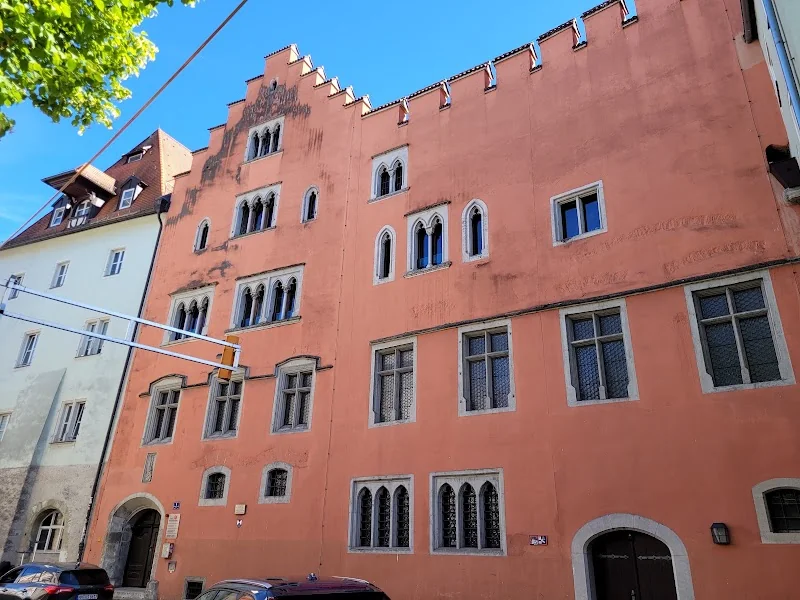
The Runtingerhaus in Regensburg is much more than just a historical address at Keplerstraße 1. It is a place where city history, archival work, and cultural events converge at a single location. When someone looks for the Runtingerhaus, they usually mean this special mix of a medieval patrician house, urban memory, and a traditional event space, the Great Runtingersaal. The house is one of the most prominent historical buildings in the old town and has been the seat of the Regensburg City Archive since the 1970s. At the same time, it is a venue for lectures, exhibitions, and concerts, creating an atmosphere through its historical substance that cannot be replicated in modern locations. This connection between authenticity and practical use makes the Runtingerhaus equally exciting for visitors, organizers, and history enthusiasts. Therefore, anyone interested in Runtingerhaus Regensburg, Runtingersaal, directions, parking, or photos will not find just any conference venue here, but a true piece of Regensburg identity. ([regensburg.de](https://www.regensburg.de/regensburg-507/nah-dran/das-stadtarchiv-wird-digital))
History of the Runtingerhaus and the Runtinger Family
The history of the Runtingerhaus essentially begins around the year 1200, when the Gothic patrician castle of the long-distance trading family Runtinger was built. Around 1400, it was expanded, so that several layers of Regensburg's city history overlap in today's building. The house exemplifies the rise of the urban upper class in the Middle Ages, which made its wealth, international contacts, and influence visible not only in trade but also in representative architecture. The Runtinger family itself was one of the most significant merchant dynasties in the city. Matthäus Runtinger, born around 1350 and died in 1407, is considered the richest long-distance merchant in Regensburg. His trading company maintained relationships throughout Europe, and the trading book kept between 1383 and 1407 is one of the most important sources for the economic history of the Middle Ages. Therefore, the Runtingerhaus is not just a beautiful old town building for Regensburg, but a material testimony to the time when long-distance trade, politics, and urban self-assertion were closely linked. The official city history also emphasizes that Runtinger's name is still associated with luxury trade, social prestige, and the economic rise of the city. ([regensburg.de](https://www.regensburg.de/fm/121/denkmaltag-2021-prospekt.pdf))
The later development of the house also shows how closely monument preservation and historical use are interconnected. In the 1940s and again from the 1960s onwards, the building was restored according to the ideas of the time; according to city documentation, this sometimes resulted in losses of furnishings and free reconstructions. At the same time, important historical traces were made visible again during the renovation between 1962 and 1976. A particularly illustrative example is the draw well in the courtyard of the Runtingerhaus. It is a reconstruction of the well that was demolished in 1907; parts of the well were rediscovered during the renovation and reinstalled. This gives the house a strong historical presence not only in its facade but also in the courtyard. This mix of original substance, reconstruction, and museum-like mediation ensures that the Runtingerhaus does not appear as a rigid monument but as a house that actively tells its past. Therefore, anyone looking for photos of the Runtingerhaus will find particularly in the area of the courtyard, the well area, and the historical exterior architecture the motifs that best capture the character of the place. ([regensburg.de](https://www.regensburg.de/fm/121/denkmaltag-2021-prospekt.pdf))
Events in the Great Runtingersaal
The Great Runtingersaal is one of the main reasons why the Runtingerhaus in Regensburg is still regularly sought after today. The official event venue entry lists the room with 194 square meters of space and a capacity of 180 people. Types of use include lectures, exhibitions, and concerts. Thus, the hall is one of those historical spaces that cannot be limited to a single purpose but function very differently depending on the program. This is precisely its charm: a specialist lecture on city history, a cultural-historical exhibition, a concert with an intimate atmosphere, or a public discussion do not feel like foreign bodies in this room but like a consistent continuation of the historical environment. The Regensburg Autumn Symposium for Art, History, and Monument Preservation also shows how established the place is for scientifically and culturally shaped formats. For the 2025 event, the Great Runtingersaal was explicitly named as the venue for sectional and evening lectures. This proves that the room is not only decorative but has a real, recurring function in urban cultural life. So, anyone searching for Runtingerhaus events or Runtingersaal Regensburg is truly looking for a place where history and present come together in one hall. ([regensburg.de](https://www.regensburg.de/fm/RBG_INTER1S_VM.a.253.de/r_upload/Veranstaltungsorte-Regensburg.pdf))
The special event profile of the house is also visible through the municipal and institutional programs that take place there. In the context of Regensburg's culture and monument preservation, the Great Runtingersaal repeatedly appears as a venue for lectures, conferences, and public presentations. The hall is particularly suitable for formats where content, atmosphere, and spatial dignity must fit together. Unlike in a neutral event location, a credible connection between theme and space is created here. Especially for historical, archival, and monument preservation events, this is a clear added value. The official building documentation and event overviews also show that the Runtingerhaus is not an isolated museum but an actively used urban place. Visitors therefore experience not just a backdrop but a lively space where the city addresses its history while also organizing contemporary culture. For search queries related to Runtingersaal, Runtingerhaus events, and Runtingerhaus Regensburg, this is the central information: There are regularly formats with a public character that are supported by the city of Regensburg and its partners. ([regensburg.de](https://www.regensburg.de/fm/RBG_INTER1S_VM.a.253.de/r_upload/Veranstaltungsorte-Regensburg.pdf))
Directions, Bus, and Parking at Runtingerhaus
The Runtingerhaus is located in the heart of Regensburg's old town, and this gives rise to the practically most important questions regarding access. Officially, the building is listed at Keplerstraße 1, 93047 Regensburg. For public transport, the city pages mention the stops Altes Rathaus and Fischmarkt; on another archive page, Fischmarkt is additionally listed as a stop for the city archive. Therefore, anyone coming on foot from the old town can reach the house very directly via the surrounding alleys and squares. For many visitors, this is the most pleasant solution because the location is in the historical center and can be combined with a stroll through the old town or a visit to other cultural sites. For those specifically looking for directions to Runtingerhaus, this provides the most important orientation: The house is centrally located but situated in a developed old town area, and that is why the way by public transport and on foot is usually the most straightforward choice. ([regensburg.de](https://www.regensburg.de/kultur/stadtarchiv-und-denkmalpflege))
When it comes to parking at Runtingerhaus, one should plan realistically. No regular visitor parking spaces are designated directly at the house. The Stadtwerk Regensburg refers to several parking garages for the old town and mentions, among others, the Petersweg parking garage, the Dachauplatz parking garage, and the underground garage at the theater. These garages are located in the environmental zone of the city of Regensburg, where only vehicles with a green particulate matter sticker are allowed to drive and park. This is important practical information for old town visits as it influences the choice of parking space. Particularly, the Dachauplatz parking garage is interesting as a central old town garage; the Stadtwerk page lists 700 parking spaces on six levels there. For visitors to the Runtingerhaus, this means: arrive on time, choose the old town parking garage as a starting point, and plan the remaining way on foot. This keeps the journey relaxed and fits well with an appointment in the historical center. Those arriving with larger luggage, delicate clothing, or for an evening appointment should not leave the journey to the last moment, as old town traffic, one-way regulations, and limited parking spaces in Regensburg always play a role. Therefore, for the frequent search terms Runtingerhaus parking and Runtingerhaus Regensburg directions, the best answer is: bus or old town garage, not direct parking at the house. ([das-stadtwerk-regensburg.de](https://www.das-stadtwerk-regensburg.de/parken/parkhaeuser-p-r))
City Archive in the Runtingerhaus: Opening Hours, Research, and Visit
A significant part of the importance of the Runtingerhaus arises from its use as the seat of the Regensburg City Archive. The official city page describes the city archive as one of the major municipal archival institutions in Bavaria and as a central point of contact for questions about the history of Regensburg. Since the 1970s, the archive has been housed in the Runtingerhaus at Keplerstraße. The holdings include around 9,500 running meters from the 13th century to the present day. Particularly noteworthy are the so-called Runtinger book and other sources on city, economic, and administrative history. Through the city archive portal, about 150,000 data records can be researched, and more than 4,000 archival materials can be viewed completely digitally. Thus, the Runtingerhaus is not only a historical monument but also an active knowledge center. Therefore, anyone searching for Runtingerhaus city archive will find here not just an address but a genuine research and service facility with lasting public benefit. ([regensburg.de](https://www.regensburg.de/regensburg-507/nah-dran/das-stadtarchiv-wird-digital))
For visitors, the opening hours of the reading room are also clearly regulated. According to the official page of the city archive, the reading room is open Monday to Thursday from 10:00 to 16:00 and Friday from 9:00 to 12:00. On the broader page of the city archive and monument preservation, additional opening hours are mentioned for the office, but the note makes it clear that the reading room times are crucial for visitor traffic. Therefore, anyone wishing to view files, historical documents, or digital holdings should orient themselves to these times in advance and plan for a phone inquiry or registration if necessary. It is also practical that the city pages directly refer to the research portal and thus show how strongly the archive is now also digitally positioned. This fits very well with today's usage behavior: many users come not only for classic file inspections but also for preliminary research, family research, or scientific work. The Runtingerhaus is thus a place where historical material and modern research methods go hand in hand. ([regensburg.de](https://www.regensburg.de/stadtarchiv))
An important practical point is accessibility. The city of Regensburg explicitly points out that the building at Keplerstraße 1 is not equipped for the disabled. The city archive and the monument preservation department are only accessible via stairs. At the same time, there is a solution for people with severe mobility impairments or wheelchair users: the reading room can be made accessible via a freight elevator upon prior telephone registration. For the search intent Runtingerhaus accessible, this is the honest and complete answer: the building has structural limitations, but visiting the reading room can be facilitated under certain conditions. Anyone planning a tour, research, or an event in the Runtingerhaus should take this information into account early on. Especially with historical buildings, transparency is important here, and the city's notes are correspondingly clear. This helps avoid unpleasant surprises and allows for better preparation for the visit. ([regensburg.de](https://www.regensburg.de/rathaus/aemteruebersicht/kulturreferat/amt-fuer-kulturelles-erbe/tag-des-offenen-denkmals-2024/531571/399824/tagesaktuelle-hinweise.html))
Photos, Architecture, and Special Impressions in the Runtingerhaus
Those looking for Runtingerhaus photos are usually looking for an impression of how history feels architecturally. The house offers several strong motifs for this. It is particularly noteworthy that the Gothic patrician castle of the Runtinger family essentially dates back to around 1200 and was expanded around 1400. This early dating makes the building one of the oldest and at the same time most representative houses in the city. The official description of the monument day also emphasizes that the magnificent appearance is shaped by the late Romanesque tower, which was created around 1200 as the oldest building element. This is important for photographers and visitors because it provides a clear architectural anchor point: the house not only shows old town charm but also a real, visible long construction history. The courtyard with the reconstructed draw well adds a very atmospheric, almost intimate perspective to this picture. Standing there, one experiences not just a monument but a space that makes the former courtyard and house function comprehensible. ([regensburg.de](https://www.regensburg.de/fm/121/denkmaltag-2021-prospekt.pdf))
As an event venue, the Runtingerhaus also has a special visual character. It is not an anonymous hall building but a historical patrician house that stood for the successful trade of a wealthy merchant family and today serves as a place of urban memory. This dual function is an essential part of its charm. Anyone attending a lecture, exhibition, or cultural event in the Great Runtingersaal does not experience it in a neutral environment but in a room with historical depth. This adds additional weight to the content and makes the visit for many guests more than just an appointment. Therefore, for the search terms Runtingersaal Regensburg and Runtingerhaus photos, the core of the answer is not just that the place looks beautiful, but that it visibly tells history. Anyone making their way to Keplerstraße should not only focus on the facade but also on details, the courtyard, the tower, and the atmosphere of the old patrician house. This transforms a simple site visit into a small cultural-historical experience. ([regensburg.de](https://www.regensburg.de/kultur/kulturdatenbank/eintrag/118924))
Sources:
- City of Regensburg – City Archive and Monument Preservation
- City of Regensburg – Department of City Archive
- City of Regensburg – Cultural Database: City Archive
- City of Regensburg – Cultural Database: Matthäus Runtinger
- City of Regensburg – Event Venues in the City of Regensburg
- City of Regensburg – Being and Appearance, Monument Day 2021
- the Stadtwerk.Regensburg – Parking Garages / P+R
- the Stadtwerk.Regensburg – Dachauplatz Parking Garage
- City of Regensburg – Regensburg Autumn Symposium 2025
Show moreShow less
Runtingerhaus | Events & History
The Runtingerhaus in Regensburg is much more than just a historical address at Keplerstraße 1. It is a place where city history, archival work, and cultural events converge at a single location. When someone looks for the Runtingerhaus, they usually mean this special mix of a medieval patrician house, urban memory, and a traditional event space, the Great Runtingersaal. The house is one of the most prominent historical buildings in the old town and has been the seat of the Regensburg City Archive since the 1970s. At the same time, it is a venue for lectures, exhibitions, and concerts, creating an atmosphere through its historical substance that cannot be replicated in modern locations. This connection between authenticity and practical use makes the Runtingerhaus equally exciting for visitors, organizers, and history enthusiasts. Therefore, anyone interested in Runtingerhaus Regensburg, Runtingersaal, directions, parking, or photos will not find just any conference venue here, but a true piece of Regensburg identity. ([regensburg.de](https://www.regensburg.de/regensburg-507/nah-dran/das-stadtarchiv-wird-digital))
History of the Runtingerhaus and the Runtinger Family
The history of the Runtingerhaus essentially begins around the year 1200, when the Gothic patrician castle of the long-distance trading family Runtinger was built. Around 1400, it was expanded, so that several layers of Regensburg's city history overlap in today's building. The house exemplifies the rise of the urban upper class in the Middle Ages, which made its wealth, international contacts, and influence visible not only in trade but also in representative architecture. The Runtinger family itself was one of the most significant merchant dynasties in the city. Matthäus Runtinger, born around 1350 and died in 1407, is considered the richest long-distance merchant in Regensburg. His trading company maintained relationships throughout Europe, and the trading book kept between 1383 and 1407 is one of the most important sources for the economic history of the Middle Ages. Therefore, the Runtingerhaus is not just a beautiful old town building for Regensburg, but a material testimony to the time when long-distance trade, politics, and urban self-assertion were closely linked. The official city history also emphasizes that Runtinger's name is still associated with luxury trade, social prestige, and the economic rise of the city. ([regensburg.de](https://www.regensburg.de/fm/121/denkmaltag-2021-prospekt.pdf))
The later development of the house also shows how closely monument preservation and historical use are interconnected. In the 1940s and again from the 1960s onwards, the building was restored according to the ideas of the time; according to city documentation, this sometimes resulted in losses of furnishings and free reconstructions. At the same time, important historical traces were made visible again during the renovation between 1962 and 1976. A particularly illustrative example is the draw well in the courtyard of the Runtingerhaus. It is a reconstruction of the well that was demolished in 1907; parts of the well were rediscovered during the renovation and reinstalled. This gives the house a strong historical presence not only in its facade but also in the courtyard. This mix of original substance, reconstruction, and museum-like mediation ensures that the Runtingerhaus does not appear as a rigid monument but as a house that actively tells its past. Therefore, anyone looking for photos of the Runtingerhaus will find particularly in the area of the courtyard, the well area, and the historical exterior architecture the motifs that best capture the character of the place. ([regensburg.de](https://www.regensburg.de/fm/121/denkmaltag-2021-prospekt.pdf))
Events in the Great Runtingersaal
The Great Runtingersaal is one of the main reasons why the Runtingerhaus in Regensburg is still regularly sought after today. The official event venue entry lists the room with 194 square meters of space and a capacity of 180 people. Types of use include lectures, exhibitions, and concerts. Thus, the hall is one of those historical spaces that cannot be limited to a single purpose but function very differently depending on the program. This is precisely its charm: a specialist lecture on city history, a cultural-historical exhibition, a concert with an intimate atmosphere, or a public discussion do not feel like foreign bodies in this room but like a consistent continuation of the historical environment. The Regensburg Autumn Symposium for Art, History, and Monument Preservation also shows how established the place is for scientifically and culturally shaped formats. For the 2025 event, the Great Runtingersaal was explicitly named as the venue for sectional and evening lectures. This proves that the room is not only decorative but has a real, recurring function in urban cultural life. So, anyone searching for Runtingerhaus events or Runtingersaal Regensburg is truly looking for a place where history and present come together in one hall. ([regensburg.de](https://www.regensburg.de/fm/RBG_INTER1S_VM.a.253.de/r_upload/Veranstaltungsorte-Regensburg.pdf))
The special event profile of the house is also visible through the municipal and institutional programs that take place there. In the context of Regensburg's culture and monument preservation, the Great Runtingersaal repeatedly appears as a venue for lectures, conferences, and public presentations. The hall is particularly suitable for formats where content, atmosphere, and spatial dignity must fit together. Unlike in a neutral event location, a credible connection between theme and space is created here. Especially for historical, archival, and monument preservation events, this is a clear added value. The official building documentation and event overviews also show that the Runtingerhaus is not an isolated museum but an actively used urban place. Visitors therefore experience not just a backdrop but a lively space where the city addresses its history while also organizing contemporary culture. For search queries related to Runtingersaal, Runtingerhaus events, and Runtingerhaus Regensburg, this is the central information: There are regularly formats with a public character that are supported by the city of Regensburg and its partners. ([regensburg.de](https://www.regensburg.de/fm/RBG_INTER1S_VM.a.253.de/r_upload/Veranstaltungsorte-Regensburg.pdf))
Directions, Bus, and Parking at Runtingerhaus
The Runtingerhaus is located in the heart of Regensburg's old town, and this gives rise to the practically most important questions regarding access. Officially, the building is listed at Keplerstraße 1, 93047 Regensburg. For public transport, the city pages mention the stops Altes Rathaus and Fischmarkt; on another archive page, Fischmarkt is additionally listed as a stop for the city archive. Therefore, anyone coming on foot from the old town can reach the house very directly via the surrounding alleys and squares. For many visitors, this is the most pleasant solution because the location is in the historical center and can be combined with a stroll through the old town or a visit to other cultural sites. For those specifically looking for directions to Runtingerhaus, this provides the most important orientation: The house is centrally located but situated in a developed old town area, and that is why the way by public transport and on foot is usually the most straightforward choice. ([regensburg.de](https://www.regensburg.de/kultur/stadtarchiv-und-denkmalpflege))
When it comes to parking at Runtingerhaus, one should plan realistically. No regular visitor parking spaces are designated directly at the house. The Stadtwerk Regensburg refers to several parking garages for the old town and mentions, among others, the Petersweg parking garage, the Dachauplatz parking garage, and the underground garage at the theater. These garages are located in the environmental zone of the city of Regensburg, where only vehicles with a green particulate matter sticker are allowed to drive and park. This is important practical information for old town visits as it influences the choice of parking space. Particularly, the Dachauplatz parking garage is interesting as a central old town garage; the Stadtwerk page lists 700 parking spaces on six levels there. For visitors to the Runtingerhaus, this means: arrive on time, choose the old town parking garage as a starting point, and plan the remaining way on foot. This keeps the journey relaxed and fits well with an appointment in the historical center. Those arriving with larger luggage, delicate clothing, or for an evening appointment should not leave the journey to the last moment, as old town traffic, one-way regulations, and limited parking spaces in Regensburg always play a role. Therefore, for the frequent search terms Runtingerhaus parking and Runtingerhaus Regensburg directions, the best answer is: bus or old town garage, not direct parking at the house. ([das-stadtwerk-regensburg.de](https://www.das-stadtwerk-regensburg.de/parken/parkhaeuser-p-r))
City Archive in the Runtingerhaus: Opening Hours, Research, and Visit
A significant part of the importance of the Runtingerhaus arises from its use as the seat of the Regensburg City Archive. The official city page describes the city archive as one of the major municipal archival institutions in Bavaria and as a central point of contact for questions about the history of Regensburg. Since the 1970s, the archive has been housed in the Runtingerhaus at Keplerstraße. The holdings include around 9,500 running meters from the 13th century to the present day. Particularly noteworthy are the so-called Runtinger book and other sources on city, economic, and administrative history. Through the city archive portal, about 150,000 data records can be researched, and more than 4,000 archival materials can be viewed completely digitally. Thus, the Runtingerhaus is not only a historical monument but also an active knowledge center. Therefore, anyone searching for Runtingerhaus city archive will find here not just an address but a genuine research and service facility with lasting public benefit. ([regensburg.de](https://www.regensburg.de/regensburg-507/nah-dran/das-stadtarchiv-wird-digital))
For visitors, the opening hours of the reading room are also clearly regulated. According to the official page of the city archive, the reading room is open Monday to Thursday from 10:00 to 16:00 and Friday from 9:00 to 12:00. On the broader page of the city archive and monument preservation, additional opening hours are mentioned for the office, but the note makes it clear that the reading room times are crucial for visitor traffic. Therefore, anyone wishing to view files, historical documents, or digital holdings should orient themselves to these times in advance and plan for a phone inquiry or registration if necessary. It is also practical that the city pages directly refer to the research portal and thus show how strongly the archive is now also digitally positioned. This fits very well with today's usage behavior: many users come not only for classic file inspections but also for preliminary research, family research, or scientific work. The Runtingerhaus is thus a place where historical material and modern research methods go hand in hand. ([regensburg.de](https://www.regensburg.de/stadtarchiv))
An important practical point is accessibility. The city of Regensburg explicitly points out that the building at Keplerstraße 1 is not equipped for the disabled. The city archive and the monument preservation department are only accessible via stairs. At the same time, there is a solution for people with severe mobility impairments or wheelchair users: the reading room can be made accessible via a freight elevator upon prior telephone registration. For the search intent Runtingerhaus accessible, this is the honest and complete answer: the building has structural limitations, but visiting the reading room can be facilitated under certain conditions. Anyone planning a tour, research, or an event in the Runtingerhaus should take this information into account early on. Especially with historical buildings, transparency is important here, and the city's notes are correspondingly clear. This helps avoid unpleasant surprises and allows for better preparation for the visit. ([regensburg.de](https://www.regensburg.de/rathaus/aemteruebersicht/kulturreferat/amt-fuer-kulturelles-erbe/tag-des-offenen-denkmals-2024/531571/399824/tagesaktuelle-hinweise.html))
Photos, Architecture, and Special Impressions in the Runtingerhaus
Those looking for Runtingerhaus photos are usually looking for an impression of how history feels architecturally. The house offers several strong motifs for this. It is particularly noteworthy that the Gothic patrician castle of the Runtinger family essentially dates back to around 1200 and was expanded around 1400. This early dating makes the building one of the oldest and at the same time most representative houses in the city. The official description of the monument day also emphasizes that the magnificent appearance is shaped by the late Romanesque tower, which was created around 1200 as the oldest building element. This is important for photographers and visitors because it provides a clear architectural anchor point: the house not only shows old town charm but also a real, visible long construction history. The courtyard with the reconstructed draw well adds a very atmospheric, almost intimate perspective to this picture. Standing there, one experiences not just a monument but a space that makes the former courtyard and house function comprehensible. ([regensburg.de](https://www.regensburg.de/fm/121/denkmaltag-2021-prospekt.pdf))
As an event venue, the Runtingerhaus also has a special visual character. It is not an anonymous hall building but a historical patrician house that stood for the successful trade of a wealthy merchant family and today serves as a place of urban memory. This dual function is an essential part of its charm. Anyone attending a lecture, exhibition, or cultural event in the Great Runtingersaal does not experience it in a neutral environment but in a room with historical depth. This adds additional weight to the content and makes the visit for many guests more than just an appointment. Therefore, for the search terms Runtingersaal Regensburg and Runtingerhaus photos, the core of the answer is not just that the place looks beautiful, but that it visibly tells history. Anyone making their way to Keplerstraße should not only focus on the facade but also on details, the courtyard, the tower, and the atmosphere of the old patrician house. This transforms a simple site visit into a small cultural-historical experience. ([regensburg.de](https://www.regensburg.de/kultur/kulturdatenbank/eintrag/118924))
Sources:
- City of Regensburg – City Archive and Monument Preservation
- City of Regensburg – Department of City Archive
- City of Regensburg – Cultural Database: City Archive
- City of Regensburg – Cultural Database: Matthäus Runtinger
- City of Regensburg – Event Venues in the City of Regensburg
- City of Regensburg – Being and Appearance, Monument Day 2021
- the Stadtwerk.Regensburg – Parking Garages / P+R
- the Stadtwerk.Regensburg – Dachauplatz Parking Garage
- City of Regensburg – Regensburg Autumn Symposium 2025
Runtingerhaus | Events & History
The Runtingerhaus in Regensburg is much more than just a historical address at Keplerstraße 1. It is a place where city history, archival work, and cultural events converge at a single location. When someone looks for the Runtingerhaus, they usually mean this special mix of a medieval patrician house, urban memory, and a traditional event space, the Great Runtingersaal. The house is one of the most prominent historical buildings in the old town and has been the seat of the Regensburg City Archive since the 1970s. At the same time, it is a venue for lectures, exhibitions, and concerts, creating an atmosphere through its historical substance that cannot be replicated in modern locations. This connection between authenticity and practical use makes the Runtingerhaus equally exciting for visitors, organizers, and history enthusiasts. Therefore, anyone interested in Runtingerhaus Regensburg, Runtingersaal, directions, parking, or photos will not find just any conference venue here, but a true piece of Regensburg identity. ([regensburg.de](https://www.regensburg.de/regensburg-507/nah-dran/das-stadtarchiv-wird-digital))
History of the Runtingerhaus and the Runtinger Family
The history of the Runtingerhaus essentially begins around the year 1200, when the Gothic patrician castle of the long-distance trading family Runtinger was built. Around 1400, it was expanded, so that several layers of Regensburg's city history overlap in today's building. The house exemplifies the rise of the urban upper class in the Middle Ages, which made its wealth, international contacts, and influence visible not only in trade but also in representative architecture. The Runtinger family itself was one of the most significant merchant dynasties in the city. Matthäus Runtinger, born around 1350 and died in 1407, is considered the richest long-distance merchant in Regensburg. His trading company maintained relationships throughout Europe, and the trading book kept between 1383 and 1407 is one of the most important sources for the economic history of the Middle Ages. Therefore, the Runtingerhaus is not just a beautiful old town building for Regensburg, but a material testimony to the time when long-distance trade, politics, and urban self-assertion were closely linked. The official city history also emphasizes that Runtinger's name is still associated with luxury trade, social prestige, and the economic rise of the city. ([regensburg.de](https://www.regensburg.de/fm/121/denkmaltag-2021-prospekt.pdf))
The later development of the house also shows how closely monument preservation and historical use are interconnected. In the 1940s and again from the 1960s onwards, the building was restored according to the ideas of the time; according to city documentation, this sometimes resulted in losses of furnishings and free reconstructions. At the same time, important historical traces were made visible again during the renovation between 1962 and 1976. A particularly illustrative example is the draw well in the courtyard of the Runtingerhaus. It is a reconstruction of the well that was demolished in 1907; parts of the well were rediscovered during the renovation and reinstalled. This gives the house a strong historical presence not only in its facade but also in the courtyard. This mix of original substance, reconstruction, and museum-like mediation ensures that the Runtingerhaus does not appear as a rigid monument but as a house that actively tells its past. Therefore, anyone looking for photos of the Runtingerhaus will find particularly in the area of the courtyard, the well area, and the historical exterior architecture the motifs that best capture the character of the place. ([regensburg.de](https://www.regensburg.de/fm/121/denkmaltag-2021-prospekt.pdf))
Events in the Great Runtingersaal
The Great Runtingersaal is one of the main reasons why the Runtingerhaus in Regensburg is still regularly sought after today. The official event venue entry lists the room with 194 square meters of space and a capacity of 180 people. Types of use include lectures, exhibitions, and concerts. Thus, the hall is one of those historical spaces that cannot be limited to a single purpose but function very differently depending on the program. This is precisely its charm: a specialist lecture on city history, a cultural-historical exhibition, a concert with an intimate atmosphere, or a public discussion do not feel like foreign bodies in this room but like a consistent continuation of the historical environment. The Regensburg Autumn Symposium for Art, History, and Monument Preservation also shows how established the place is for scientifically and culturally shaped formats. For the 2025 event, the Great Runtingersaal was explicitly named as the venue for sectional and evening lectures. This proves that the room is not only decorative but has a real, recurring function in urban cultural life. So, anyone searching for Runtingerhaus events or Runtingersaal Regensburg is truly looking for a place where history and present come together in one hall. ([regensburg.de](https://www.regensburg.de/fm/RBG_INTER1S_VM.a.253.de/r_upload/Veranstaltungsorte-Regensburg.pdf))
The special event profile of the house is also visible through the municipal and institutional programs that take place there. In the context of Regensburg's culture and monument preservation, the Great Runtingersaal repeatedly appears as a venue for lectures, conferences, and public presentations. The hall is particularly suitable for formats where content, atmosphere, and spatial dignity must fit together. Unlike in a neutral event location, a credible connection between theme and space is created here. Especially for historical, archival, and monument preservation events, this is a clear added value. The official building documentation and event overviews also show that the Runtingerhaus is not an isolated museum but an actively used urban place. Visitors therefore experience not just a backdrop but a lively space where the city addresses its history while also organizing contemporary culture. For search queries related to Runtingersaal, Runtingerhaus events, and Runtingerhaus Regensburg, this is the central information: There are regularly formats with a public character that are supported by the city of Regensburg and its partners. ([regensburg.de](https://www.regensburg.de/fm/RBG_INTER1S_VM.a.253.de/r_upload/Veranstaltungsorte-Regensburg.pdf))
Directions, Bus, and Parking at Runtingerhaus
The Runtingerhaus is located in the heart of Regensburg's old town, and this gives rise to the practically most important questions regarding access. Officially, the building is listed at Keplerstraße 1, 93047 Regensburg. For public transport, the city pages mention the stops Altes Rathaus and Fischmarkt; on another archive page, Fischmarkt is additionally listed as a stop for the city archive. Therefore, anyone coming on foot from the old town can reach the house very directly via the surrounding alleys and squares. For many visitors, this is the most pleasant solution because the location is in the historical center and can be combined with a stroll through the old town or a visit to other cultural sites. For those specifically looking for directions to Runtingerhaus, this provides the most important orientation: The house is centrally located but situated in a developed old town area, and that is why the way by public transport and on foot is usually the most straightforward choice. ([regensburg.de](https://www.regensburg.de/kultur/stadtarchiv-und-denkmalpflege))
When it comes to parking at Runtingerhaus, one should plan realistically. No regular visitor parking spaces are designated directly at the house. The Stadtwerk Regensburg refers to several parking garages for the old town and mentions, among others, the Petersweg parking garage, the Dachauplatz parking garage, and the underground garage at the theater. These garages are located in the environmental zone of the city of Regensburg, where only vehicles with a green particulate matter sticker are allowed to drive and park. This is important practical information for old town visits as it influences the choice of parking space. Particularly, the Dachauplatz parking garage is interesting as a central old town garage; the Stadtwerk page lists 700 parking spaces on six levels there. For visitors to the Runtingerhaus, this means: arrive on time, choose the old town parking garage as a starting point, and plan the remaining way on foot. This keeps the journey relaxed and fits well with an appointment in the historical center. Those arriving with larger luggage, delicate clothing, or for an evening appointment should not leave the journey to the last moment, as old town traffic, one-way regulations, and limited parking spaces in Regensburg always play a role. Therefore, for the frequent search terms Runtingerhaus parking and Runtingerhaus Regensburg directions, the best answer is: bus or old town garage, not direct parking at the house. ([das-stadtwerk-regensburg.de](https://www.das-stadtwerk-regensburg.de/parken/parkhaeuser-p-r))
City Archive in the Runtingerhaus: Opening Hours, Research, and Visit
A significant part of the importance of the Runtingerhaus arises from its use as the seat of the Regensburg City Archive. The official city page describes the city archive as one of the major municipal archival institutions in Bavaria and as a central point of contact for questions about the history of Regensburg. Since the 1970s, the archive has been housed in the Runtingerhaus at Keplerstraße. The holdings include around 9,500 running meters from the 13th century to the present day. Particularly noteworthy are the so-called Runtinger book and other sources on city, economic, and administrative history. Through the city archive portal, about 150,000 data records can be researched, and more than 4,000 archival materials can be viewed completely digitally. Thus, the Runtingerhaus is not only a historical monument but also an active knowledge center. Therefore, anyone searching for Runtingerhaus city archive will find here not just an address but a genuine research and service facility with lasting public benefit. ([regensburg.de](https://www.regensburg.de/regensburg-507/nah-dran/das-stadtarchiv-wird-digital))
For visitors, the opening hours of the reading room are also clearly regulated. According to the official page of the city archive, the reading room is open Monday to Thursday from 10:00 to 16:00 and Friday from 9:00 to 12:00. On the broader page of the city archive and monument preservation, additional opening hours are mentioned for the office, but the note makes it clear that the reading room times are crucial for visitor traffic. Therefore, anyone wishing to view files, historical documents, or digital holdings should orient themselves to these times in advance and plan for a phone inquiry or registration if necessary. It is also practical that the city pages directly refer to the research portal and thus show how strongly the archive is now also digitally positioned. This fits very well with today's usage behavior: many users come not only for classic file inspections but also for preliminary research, family research, or scientific work. The Runtingerhaus is thus a place where historical material and modern research methods go hand in hand. ([regensburg.de](https://www.regensburg.de/stadtarchiv))
An important practical point is accessibility. The city of Regensburg explicitly points out that the building at Keplerstraße 1 is not equipped for the disabled. The city archive and the monument preservation department are only accessible via stairs. At the same time, there is a solution for people with severe mobility impairments or wheelchair users: the reading room can be made accessible via a freight elevator upon prior telephone registration. For the search intent Runtingerhaus accessible, this is the honest and complete answer: the building has structural limitations, but visiting the reading room can be facilitated under certain conditions. Anyone planning a tour, research, or an event in the Runtingerhaus should take this information into account early on. Especially with historical buildings, transparency is important here, and the city's notes are correspondingly clear. This helps avoid unpleasant surprises and allows for better preparation for the visit. ([regensburg.de](https://www.regensburg.de/rathaus/aemteruebersicht/kulturreferat/amt-fuer-kulturelles-erbe/tag-des-offenen-denkmals-2024/531571/399824/tagesaktuelle-hinweise.html))
Photos, Architecture, and Special Impressions in the Runtingerhaus
Those looking for Runtingerhaus photos are usually looking for an impression of how history feels architecturally. The house offers several strong motifs for this. It is particularly noteworthy that the Gothic patrician castle of the Runtinger family essentially dates back to around 1200 and was expanded around 1400. This early dating makes the building one of the oldest and at the same time most representative houses in the city. The official description of the monument day also emphasizes that the magnificent appearance is shaped by the late Romanesque tower, which was created around 1200 as the oldest building element. This is important for photographers and visitors because it provides a clear architectural anchor point: the house not only shows old town charm but also a real, visible long construction history. The courtyard with the reconstructed draw well adds a very atmospheric, almost intimate perspective to this picture. Standing there, one experiences not just a monument but a space that makes the former courtyard and house function comprehensible. ([regensburg.de](https://www.regensburg.de/fm/121/denkmaltag-2021-prospekt.pdf))
As an event venue, the Runtingerhaus also has a special visual character. It is not an anonymous hall building but a historical patrician house that stood for the successful trade of a wealthy merchant family and today serves as a place of urban memory. This dual function is an essential part of its charm. Anyone attending a lecture, exhibition, or cultural event in the Great Runtingersaal does not experience it in a neutral environment but in a room with historical depth. This adds additional weight to the content and makes the visit for many guests more than just an appointment. Therefore, for the search terms Runtingersaal Regensburg and Runtingerhaus photos, the core of the answer is not just that the place looks beautiful, but that it visibly tells history. Anyone making their way to Keplerstraße should not only focus on the facade but also on details, the courtyard, the tower, and the atmosphere of the old patrician house. This transforms a simple site visit into a small cultural-historical experience. ([regensburg.de](https://www.regensburg.de/kultur/kulturdatenbank/eintrag/118924))
Sources:
- City of Regensburg – City Archive and Monument Preservation
- City of Regensburg – Department of City Archive
- City of Regensburg – Cultural Database: City Archive
- City of Regensburg – Cultural Database: Matthäus Runtinger
- City of Regensburg – Event Venues in the City of Regensburg
- City of Regensburg – Being and Appearance, Monument Day 2021
- the Stadtwerk.Regensburg – Parking Garages / P+R
- the Stadtwerk.Regensburg – Dachauplatz Parking Garage
- City of Regensburg – Regensburg Autumn Symposium 2025
Upcoming Events
No events found
Frequently Asked Questions
Reviews
No reviews found