
Regensburg
Jakobstraße 3, 93047 Regensburg, Deutschland
Schottenkirche St. Jakob | Opening Hours & Schottenportal
The Schottenkirche St. Jakob is much more than just a place of worship in Regensburg. It serves as a seminary church, a pilgrimage site, a cultural monument, and a historical memory all at once. Upon entering the building at Jakobstraße 3, one encounters a place where medieval monastic culture, European pilgrimage movements, theological education, and extraordinary sculpture art overlap. The church is open daily, making it an accessible place for quiet visits, art historical interest, and religious reflection. Its history begins with Irish wandering monks who arrived in Regensburg around 1070 and laid the foundation for a centuries-long monastic tradition. For over four hundred years, Irish monks lived here, followed by Scottish Benedictines for nearly as long. Today, the church is part of the priest seminary and also a prominent point on the eastern Bavarian Camino de Santiago. This connection of continuity and change gives it a special charm: a space that does not display its past but continues to live it today. ([schottenkirche.de](https://www.schottenkirche.de/geschichte.html))
Opening Hours, Services, and Visiting Times
For visitors, the practical times are the first point of orientation. The official website of the Schottenkirche states clear opening hours: daily from 8:00 AM to 6:00 PM. This allows for a flexible visit to be incorporated into a tour of the old town of Regensburg, a pilgrimage route, or a church event. The service times are also publicly accessible, although the details may vary slightly depending on the source: The church's website lists Sundays and holidays at 9:00 AM, while weekdays are announced on-site. The priest seminary's page adds Monday at 6:30 PM and Tuesday and Friday at 6:30 AM. This combination shows that St. Jakob is not just a monument for sightseeing but a living church with regular liturgy. Therefore, visitors to the Schottenkirche should keep two things in mind: On one hand, the space is generally open during the day; on the other hand, services may affect access to certain areas or the course of guided tours. Especially for travelers, pilgrims, and groups, it is advisable not only to inquire about the architectural highlight but also about the current liturgical times. This way, the visit becomes not just a mere photo stop but a respectful and intense experience of a still-used sacred space. ([schottenkirche.de](https://www.schottenkirche.de/))
Guided tours are also important for a good visiting plan. The church lists several dates for 2025 without the need for registration, while the info center at Domplatz 5 offers public tours with limited group sizes for 2026. This slight difference is not a contradiction but shows that the offerings are continuously updated. Those wishing for a guided tour will find the same core on both sides: The Schottenkirche is not only open but also actively communicated. The meeting point is in the forecourt of St. Jakob, where ticket sales usually begin. This keeps the entry very accessible: One does not have to search long for the church but comes directly into contact with the guided tour at its historic entrance. For individual visitors, this means that even without prior registration, an impressive visit is possible; however, for planned groups, it is advisable to check the current information and choose time slots that allow enough quiet for the portal, interior, and possibly a service. This blend of reliability and vibrant operation makes St. Jakob a place that can be well planned yet never feels sterile. ([schottenkirche.de](https://www.schottenkirche.de/))
Address, Directions, and Location on Jakobstraße
The Schottenkirche St. Jakob is easy to locate because its address already shapes the character of the place: Jakobstraße 3, 93047 Regensburg. The location is clear, central, and well embedded in the historical urban structure. Those searching for the church will not find it in an anonymous outskirts but in an environment shaped by history and urban density. The official contact page also provides an email and phone number, which facilitates the planning of tours, group visits, or pilgrimage matters. This accessibility is important because the church today is not only a monument but also a seminary church. It thus exists in an environment that connects spiritual use, administration, and visitor operations. For orientation, this means: The name Jakobstraße is no coincidence but part of the route guidance. Approaching the building, one is already following a centuries-old trail on the city map. The church is thus located at a place where the old town, pilgrimage tradition, and ecclesiastical presence intersect. The tourism page linking the tours directly to the address Jakobstraße 3 further emphasizes how clearly this place is anchored in the cityscape. For guests from Regensburg and travelers from near and far, this is practical: The visit can be easily integrated into a city tour without the need for a long search. Thus, the journey does not become an organizational obstacle but a quiet entry into the historical context of the building. ([schottenkirche.de](https://www.schottenkirche.de/kontakt.html))
The location on Jakobstraße is also significant in content. The street name refers to the Jacob tradition, which has been shaping this church since the Middle Ages. This makes the first impression on-site particularly harmonious: Even before one examines the portal more closely, it is clear that one is at a pilgrimage and memorial site. The tourism page of Regensburg explicitly integrates St. Jakob into the UNESCO World Heritage site's attractions, highlighting its importance for the entire cityscape. For visitors, this means: The Schottenkirche is not an isolated individual object but part of a grown historical network. Thus, those who visit it experience not only a church but also a piece of city history that radiates into the present. The fact that the church is open daily reinforces this impression, as the place does not merely exist during tour times but remains tangible in everyday life. This makes St. Jakob suitable for short stops as well as for longer, in-depth visits. The combination of good addressability, clear opening hours, and spiritual function makes the church a destination that appeals to cultural travelers, pilgrims, and visitors to Regensburg alike. ([schottenkirche.de](https://www.schottenkirche.de/))
History from the Irish Monastery to Today's Seminary Church
The history of the Schottenkirche St. Jakob begins with a movement, not with a construction plan. Around 1070, the Irish wandering monks Marianus, Candidus, and Johannes of Bamberg arrived in Regensburg. Their arrival is considered the birth hour of the approximately eight-hundred-year history of the Schotten monastery. The term Schotten monastery reminds us that the Irish and Scots were grouped together under the name Scoti in the Middle Ages. From the small monastic community, a religious, cultural, and scientific center developed in Regensburg that remained effective for centuries. The current church building is thus not at the beginning of the history but is its visible core. According to the official account, the first construction began around 1090 and was consecrated in 1111 or 1120; the current building was completed around 1180. These dates make it clear that St. Jakob did not emerge as a static monument but as a structure with several development phases. For over four hundred years, Irish monks lived here, followed by Scottish Benedictines for nearly as long. The church thus remained a place of monastic self-affirmation, theological work, and European networking for a long time. Particularly impressive is that the Regensburg Schotten monks not only prayed but also emerged as scholars and maintained a significant library. Thus, the history of St. Jakob connects spirituality, education, and international outreach in a rarely dense manner. ([schottenkirche.de](https://www.schottenkirche.de/geschichte.html))
The later development shows how adaptable yet persistent this place was. Even the secularization of 1802/1803 was initially survived by the monastery because it could be claimed as Scottish national property. However, the decline could not be stopped in the long term. In 1862, the monastery was dissolved by a papal breve, and the Diocese of Regensburg paid a compensation sum. From 1866, the monastery was remodeled and partially rebuilt, and the Jakob church was extensively renovated. On October 31, 1872, the Bishop's Clerical Seminary St. Wolfgang moved into the new premises, and on May 2, 1874, Bishop Senestréy consecrated the church anew. Since then, the former Schotten monastery has been used for the education of future priests; since 2008, it has also been used for candidates of the Diocese of Passau. This development is particularly exciting from a cultural-historical perspective because it does not mark an abrupt end but a repurposing with continuity. The old monastery was not demolished and forgotten but integrated into a new ecclesiastical everyday life. This also explains the current character of the Schottenkirche: It is not a museum but a continued spiritual space whose history continues in the present seminary operation. Thus, those who visit it see a monument that has changed its function several times over centuries without losing its core. ([schottenkirche.de](https://www.schottenkirche.de/geschichte.html))
The Schottenportal: Romanesque Architecture and Riddles
The most famous feature of the Schottenkirche is undoubtedly the Schottenportal. The Regensburg tourism page describes it as one of the most significant Romanesque monuments in Germany; the info center at Domplatz 5 describes it as the most elaborate portal structure of German Romanesque before 1200. This classification already shows that it is not just any church portal but a highlight of medieval sculpture art. The portal is a 15-meter wide and 8-meter high wall zone, which, due to its abundance of figures and its iconographic density, still poses riddles today. According to experts, the figures were originally painted, partly gilded or silvered, and the drill holes were set with gemstones. Today, the portal appears more subdued, but the remaining substance creates the tension that attracts visitors so strongly. The imagery is complex: The themes of the Last Judgment, Heaven, and Hell are clearly recognizable. The twelve figures represent marginalized, stigmatized individuals and professions such as pimps, criminals, prostitutes, jugglers, dancers, gluttons, and lazy people. This representation is not only remarkable from an art historical perspective but also bold in content, as it translates societal boundaries of the Middle Ages into stone. Thus, those who view the portal see not only figures but a theologically and morally coded narrative about order, exclusion, and redemption. In this sense, St. Jakob is an open-air textbook of Romanesque art. ([tourismus.regensburg.de](https://tourismus.regensburg.de/erleben-entdecken/sehenswuerdigkeiten-unesco-welterbe/st-jakob-schottenportal))
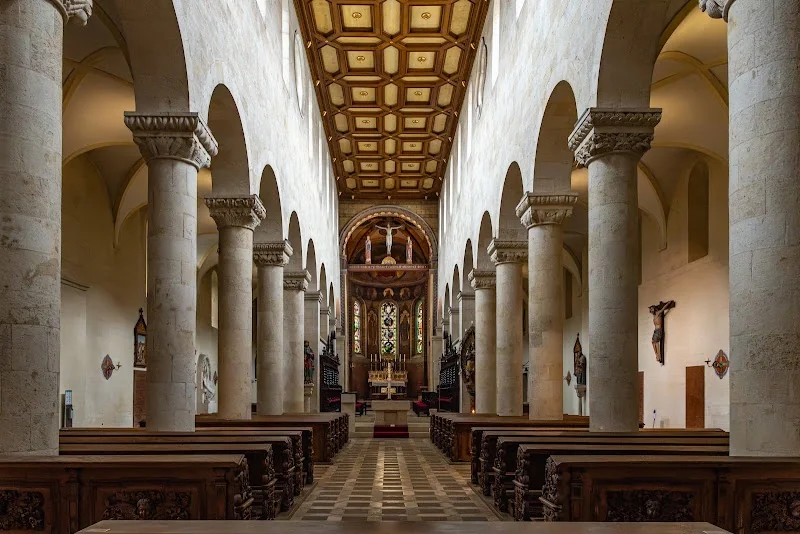
The interior also continues this artistic language. Inside the church is the relief of the monk Rydan, who presumably really lived. There are different interpretations of his exact role: Perhaps he was the master builder of the portal, perhaps a doorkeeper. This uncertainty fits well with the character of the entire place, as St. Jakob thrives on riddles, research, and open questions. The info center at Domplatz 5 also points out the imaginatively decorated capitals of the nave supports; this figurative decoration is also part of a model collection of medieval art. Thus, the church is significant not only because of its north portal but as a complete ensemble of Romanesque image and architecture. The fact that the Regensburg tourism page explicitly names the interior and the Rydan relief as highlights shows how strongly the exterior and interior complement each other. The portal entices with monumental interpretative openness, while the interior deepens this impression with a finer, quieter imagery. For art-interested visitors, St. Jakob is therefore an ideal place to experience Romanesque art not abstractly but immediately: Forms, programs, and details are not only present but also historically readable. The church thus exemplifies a type of sacred building that closely links body, space, and symbol. ([tourismus.regensburg.de](https://tourismus.regensburg.de/erleben-entdecken/sehenswuerdigkeiten-unesco-welterbe/st-jakob-schottenportal))
Pilgrimage Route, Pilgrim Stamp, and Spiritual Significance
The Schottenkirche St. Jakob is not only a destination for art lovers but also an important site on the Camino de Santiago. The priest seminary's page explicitly emphasizes that the church has marked an important point on the pilgrims' route since the Middle Ages. This is not just a historical reminiscence but a lived present. Today, pilgrims arriving can receive a pilgrim stamp at the gate of the priest seminary; a historical abbot's seal from 1700 is pressed into the pilgrim's passport. Additionally, the pilgrim's blessing is given upon request. This connection of an old symbol, concretely experienced practice, and spiritual accompaniment makes St. Jakob particularly attractive for walkers. It is not just about arriving but about confirming a journey. Especially on the Camino de Santiago, this moment counts: The place is experienced as a station, stage, and bearer of blessings. The fact that the church is open daily supports this function very practically, as pilgrims are not bound by tight visiting hours. The tourism page also highlights the pilgrim connection and explicitly names the place in the context of the UNESCO World Heritage and the noteworthy stations of Regensburg. It becomes clear that St. Jakob is embedded in the pilgrimage stream both spiritually and culturally-historically. For many visitors, this blend of movement and tranquility is appealing: Outside the path, inside the quiet church, in between the stamp as a small but significant sign of belonging. ([priesterseminar-regensburg.de](https://www.priesterseminar-regensburg.de/schottenkirche-st-jakob))
The spiritual significance of the church is also evident in that it is not only managed as a monument but used as a seminary church today. This means that in St. Jakob, faith is not only discussed but is liturgically enacted. This function continues the medieval tradition in which the monastery was not only a place of prayer but also of education. The priest seminary context gives the space a special depth, as historical monastic piety, modern priest training, and the pilgrimage practice of the Camino de Santiago intersect here. Thus, those who obtain the pilgrim stamp do not enter a folkloric side room but a place where ecclesiastical identity and practical hospitality come together. For many people, St. Jakob is therefore more than a sight: It is a station of affirmation, a quiet counterpoint to the tourist pace, and a place where the forms of the Middle Ages are still translated into action today. This makes the church a remarkable example of how a historical sacred space can have an impact in the present without losing its origins. Pilgrims, cultural travelers, and believers find different accesses here, but they all encounter the same core: a space that connects journey, tradition, and present. ([priesterseminar-regensburg.de](https://www.priesterseminar-regensburg.de/schottenkirche-st-jakob))
Guided Tours, Art Guides, and Practical Tips for Your Visit
Those who want to experience the Schottenkirche more intensively should plan for a guided tour. The info center at Domplatz 5 offers public tours for 2026 on several dates at 4 PM, including on May 1, May 25, July 12, August 15, September 6, and October 3. The tours last about 60 minutes, and the meeting point and ticket sales are shortly before the start in the forecourt of St. Jakob. This is practical because the entry takes place directly at the historic site and not at an external cash desk. At the same time, the info center's page points out that a phone registration is advisable, as the group size is limited to 20 people. Although the official church website states that no registration is required for its series of dates, the current information from the info center recommends contacting in advance for secure planning. Groups can also book individual tours; during these, the church is explored from the outside and inside, and a thematic focus can be set upon request. This makes St. Jakob particularly suitable for school groups, architecture enthusiasts, and pilgrimage groups who want more than just a quick glance at the north portal. It is also important to note that the tours cover the forecourt with the Romanesque portal wall and the church itself but not the cloister, which belongs to the living area of the priest seminary. ([domplatz-5.de](https://domplatz-5.de/kirchenfuehrungen/schottenkirche-st-jakob/))
For practical visits, there are additional useful tips. The church is linked on the official website with an art guide app from artguide.de, which offers a guide about the Schottenkirche for iOS and Android. This can be particularly helpful if one wants to dive deeper into details independently of a guided tour. Furthermore, the pages of the church, priest seminary, and tourism show that St. Jakob is regularly shaped by current ecclesiastical use. Services may influence the course of tours, and even maintenance work, such as tuning the organ, can cause short-term acoustic disturbances. Therefore, if one plans a quiet visit or a photo focus on the Schottenportal, some time flexibility should be brought along. However, this is not a disadvantage but part of the character of the house: St. Jakob is not just an exhibition object but a lively place with spiritual everyday life. The ideal visit strategy thus consists of three steps: first, practical orientation regarding address and opening hours; then a look at the current tour dates; and finally, enough time for the portal, interior, and the quiet impression of the historical atmosphere. This way, a short stop becomes a real experience. Those who visit the Schottenkirche this way quickly understand why it is so important for Regensburg: It connects great history with simple accessibility while preserving a radiance that has become rare. ([schottenkirche.de](https://www.schottenkirche.de/))
Sources:
Mehr anzeigenWeniger anzeigen
Schottenkirche St. Jakob | Opening Hours & Schottenportal
The Schottenkirche St. Jakob is much more than just a place of worship in Regensburg. It serves as a seminary church, a pilgrimage site, a cultural monument, and a historical memory all at once. Upon entering the building at Jakobstraße 3, one encounters a place where medieval monastic culture, European pilgrimage movements, theological education, and extraordinary sculpture art overlap. The church is open daily, making it an accessible place for quiet visits, art historical interest, and religious reflection. Its history begins with Irish wandering monks who arrived in Regensburg around 1070 and laid the foundation for a centuries-long monastic tradition. For over four hundred years, Irish monks lived here, followed by Scottish Benedictines for nearly as long. Today, the church is part of the priest seminary and also a prominent point on the eastern Bavarian Camino de Santiago. This connection of continuity and change gives it a special charm: a space that does not display its past but continues to live it today. ([schottenkirche.de](https://www.schottenkirche.de/geschichte.html))
Opening Hours, Services, and Visiting Times
For visitors, the practical times are the first point of orientation. The official website of the Schottenkirche states clear opening hours: daily from 8:00 AM to 6:00 PM. This allows for a flexible visit to be incorporated into a tour of the old town of Regensburg, a pilgrimage route, or a church event. The service times are also publicly accessible, although the details may vary slightly depending on the source: The church's website lists Sundays and holidays at 9:00 AM, while weekdays are announced on-site. The priest seminary's page adds Monday at 6:30 PM and Tuesday and Friday at 6:30 AM. This combination shows that St. Jakob is not just a monument for sightseeing but a living church with regular liturgy. Therefore, visitors to the Schottenkirche should keep two things in mind: On one hand, the space is generally open during the day; on the other hand, services may affect access to certain areas or the course of guided tours. Especially for travelers, pilgrims, and groups, it is advisable not only to inquire about the architectural highlight but also about the current liturgical times. This way, the visit becomes not just a mere photo stop but a respectful and intense experience of a still-used sacred space. ([schottenkirche.de](https://www.schottenkirche.de/))
Guided tours are also important for a good visiting plan. The church lists several dates for 2025 without the need for registration, while the info center at Domplatz 5 offers public tours with limited group sizes for 2026. This slight difference is not a contradiction but shows that the offerings are continuously updated. Those wishing for a guided tour will find the same core on both sides: The Schottenkirche is not only open but also actively communicated. The meeting point is in the forecourt of St. Jakob, where ticket sales usually begin. This keeps the entry very accessible: One does not have to search long for the church but comes directly into contact with the guided tour at its historic entrance. For individual visitors, this means that even without prior registration, an impressive visit is possible; however, for planned groups, it is advisable to check the current information and choose time slots that allow enough quiet for the portal, interior, and possibly a service. This blend of reliability and vibrant operation makes St. Jakob a place that can be well planned yet never feels sterile. ([schottenkirche.de](https://www.schottenkirche.de/))
Address, Directions, and Location on Jakobstraße
The Schottenkirche St. Jakob is easy to locate because its address already shapes the character of the place: Jakobstraße 3, 93047 Regensburg. The location is clear, central, and well embedded in the historical urban structure. Those searching for the church will not find it in an anonymous outskirts but in an environment shaped by history and urban density. The official contact page also provides an email and phone number, which facilitates the planning of tours, group visits, or pilgrimage matters. This accessibility is important because the church today is not only a monument but also a seminary church. It thus exists in an environment that connects spiritual use, administration, and visitor operations. For orientation, this means: The name Jakobstraße is no coincidence but part of the route guidance. Approaching the building, one is already following a centuries-old trail on the city map. The church is thus located at a place where the old town, pilgrimage tradition, and ecclesiastical presence intersect. The tourism page linking the tours directly to the address Jakobstraße 3 further emphasizes how clearly this place is anchored in the cityscape. For guests from Regensburg and travelers from near and far, this is practical: The visit can be easily integrated into a city tour without the need for a long search. Thus, the journey does not become an organizational obstacle but a quiet entry into the historical context of the building. ([schottenkirche.de](https://www.schottenkirche.de/kontakt.html))
The location on Jakobstraße is also significant in content. The street name refers to the Jacob tradition, which has been shaping this church since the Middle Ages. This makes the first impression on-site particularly harmonious: Even before one examines the portal more closely, it is clear that one is at a pilgrimage and memorial site. The tourism page of Regensburg explicitly integrates St. Jakob into the UNESCO World Heritage site's attractions, highlighting its importance for the entire cityscape. For visitors, this means: The Schottenkirche is not an isolated individual object but part of a grown historical network. Thus, those who visit it experience not only a church but also a piece of city history that radiates into the present. The fact that the church is open daily reinforces this impression, as the place does not merely exist during tour times but remains tangible in everyday life. This makes St. Jakob suitable for short stops as well as for longer, in-depth visits. The combination of good addressability, clear opening hours, and spiritual function makes the church a destination that appeals to cultural travelers, pilgrims, and visitors to Regensburg alike. ([schottenkirche.de](https://www.schottenkirche.de/))
History from the Irish Monastery to Today's Seminary Church
The history of the Schottenkirche St. Jakob begins with a movement, not with a construction plan. Around 1070, the Irish wandering monks Marianus, Candidus, and Johannes of Bamberg arrived in Regensburg. Their arrival is considered the birth hour of the approximately eight-hundred-year history of the Schotten monastery. The term Schotten monastery reminds us that the Irish and Scots were grouped together under the name Scoti in the Middle Ages. From the small monastic community, a religious, cultural, and scientific center developed in Regensburg that remained effective for centuries. The current church building is thus not at the beginning of the history but is its visible core. According to the official account, the first construction began around 1090 and was consecrated in 1111 or 1120; the current building was completed around 1180. These dates make it clear that St. Jakob did not emerge as a static monument but as a structure with several development phases. For over four hundred years, Irish monks lived here, followed by Scottish Benedictines for nearly as long. The church thus remained a place of monastic self-affirmation, theological work, and European networking for a long time. Particularly impressive is that the Regensburg Schotten monks not only prayed but also emerged as scholars and maintained a significant library. Thus, the history of St. Jakob connects spirituality, education, and international outreach in a rarely dense manner. ([schottenkirche.de](https://www.schottenkirche.de/geschichte.html))
The later development shows how adaptable yet persistent this place was. Even the secularization of 1802/1803 was initially survived by the monastery because it could be claimed as Scottish national property. However, the decline could not be stopped in the long term. In 1862, the monastery was dissolved by a papal breve, and the Diocese of Regensburg paid a compensation sum. From 1866, the monastery was remodeled and partially rebuilt, and the Jakob church was extensively renovated. On October 31, 1872, the Bishop's Clerical Seminary St. Wolfgang moved into the new premises, and on May 2, 1874, Bishop Senestréy consecrated the church anew. Since then, the former Schotten monastery has been used for the education of future priests; since 2008, it has also been used for candidates of the Diocese of Passau. This development is particularly exciting from a cultural-historical perspective because it does not mark an abrupt end but a repurposing with continuity. The old monastery was not demolished and forgotten but integrated into a new ecclesiastical everyday life. This also explains the current character of the Schottenkirche: It is not a museum but a continued spiritual space whose history continues in the present seminary operation. Thus, those who visit it see a monument that has changed its function several times over centuries without losing its core. ([schottenkirche.de](https://www.schottenkirche.de/geschichte.html))
The Schottenportal: Romanesque Architecture and Riddles
The most famous feature of the Schottenkirche is undoubtedly the Schottenportal. The Regensburg tourism page describes it as one of the most significant Romanesque monuments in Germany; the info center at Domplatz 5 describes it as the most elaborate portal structure of German Romanesque before 1200. This classification already shows that it is not just any church portal but a highlight of medieval sculpture art. The portal is a 15-meter wide and 8-meter high wall zone, which, due to its abundance of figures and its iconographic density, still poses riddles today. According to experts, the figures were originally painted, partly gilded or silvered, and the drill holes were set with gemstones. Today, the portal appears more subdued, but the remaining substance creates the tension that attracts visitors so strongly. The imagery is complex: The themes of the Last Judgment, Heaven, and Hell are clearly recognizable. The twelve figures represent marginalized, stigmatized individuals and professions such as pimps, criminals, prostitutes, jugglers, dancers, gluttons, and lazy people. This representation is not only remarkable from an art historical perspective but also bold in content, as it translates societal boundaries of the Middle Ages into stone. Thus, those who view the portal see not only figures but a theologically and morally coded narrative about order, exclusion, and redemption. In this sense, St. Jakob is an open-air textbook of Romanesque art. ([tourismus.regensburg.de](https://tourismus.regensburg.de/erleben-entdecken/sehenswuerdigkeiten-unesco-welterbe/st-jakob-schottenportal))
The interior also continues this artistic language. Inside the church is the relief of the monk Rydan, who presumably really lived. There are different interpretations of his exact role: Perhaps he was the master builder of the portal, perhaps a doorkeeper. This uncertainty fits well with the character of the entire place, as St. Jakob thrives on riddles, research, and open questions. The info center at Domplatz 5 also points out the imaginatively decorated capitals of the nave supports; this figurative decoration is also part of a model collection of medieval art. Thus, the church is significant not only because of its north portal but as a complete ensemble of Romanesque image and architecture. The fact that the Regensburg tourism page explicitly names the interior and the Rydan relief as highlights shows how strongly the exterior and interior complement each other. The portal entices with monumental interpretative openness, while the interior deepens this impression with a finer, quieter imagery. For art-interested visitors, St. Jakob is therefore an ideal place to experience Romanesque art not abstractly but immediately: Forms, programs, and details are not only present but also historically readable. The church thus exemplifies a type of sacred building that closely links body, space, and symbol. ([tourismus.regensburg.de](https://tourismus.regensburg.de/erleben-entdecken/sehenswuerdigkeiten-unesco-welterbe/st-jakob-schottenportal))
Pilgrimage Route, Pilgrim Stamp, and Spiritual Significance
The Schottenkirche St. Jakob is not only a destination for art lovers but also an important site on the Camino de Santiago. The priest seminary's page explicitly emphasizes that the church has marked an important point on the pilgrims' route since the Middle Ages. This is not just a historical reminiscence but a lived present. Today, pilgrims arriving can receive a pilgrim stamp at the gate of the priest seminary; a historical abbot's seal from 1700 is pressed into the pilgrim's passport. Additionally, the pilgrim's blessing is given upon request. This connection of an old symbol, concretely experienced practice, and spiritual accompaniment makes St. Jakob particularly attractive for walkers. It is not just about arriving but about confirming a journey. Especially on the Camino de Santiago, this moment counts: The place is experienced as a station, stage, and bearer of blessings. The fact that the church is open daily supports this function very practically, as pilgrims are not bound by tight visiting hours. The tourism page also highlights the pilgrim connection and explicitly names the place in the context of the UNESCO World Heritage and the noteworthy stations of Regensburg. It becomes clear that St. Jakob is embedded in the pilgrimage stream both spiritually and culturally-historically. For many visitors, this blend of movement and tranquility is appealing: Outside the path, inside the quiet church, in between the stamp as a small but significant sign of belonging. ([priesterseminar-regensburg.de](https://www.priesterseminar-regensburg.de/schottenkirche-st-jakob))
The spiritual significance of the church is also evident in that it is not only managed as a monument but used as a seminary church today. This means that in St. Jakob, faith is not only discussed but is liturgically enacted. This function continues the medieval tradition in which the monastery was not only a place of prayer but also of education. The priest seminary context gives the space a special depth, as historical monastic piety, modern priest training, and the pilgrimage practice of the Camino de Santiago intersect here. Thus, those who obtain the pilgrim stamp do not enter a folkloric side room but a place where ecclesiastical identity and practical hospitality come together. For many people, St. Jakob is therefore more than a sight: It is a station of affirmation, a quiet counterpoint to the tourist pace, and a place where the forms of the Middle Ages are still translated into action today. This makes the church a remarkable example of how a historical sacred space can have an impact in the present without losing its origins. Pilgrims, cultural travelers, and believers find different accesses here, but they all encounter the same core: a space that connects journey, tradition, and present. ([priesterseminar-regensburg.de](https://www.priesterseminar-regensburg.de/schottenkirche-st-jakob))
Guided Tours, Art Guides, and Practical Tips for Your Visit
Those who want to experience the Schottenkirche more intensively should plan for a guided tour. The info center at Domplatz 5 offers public tours for 2026 on several dates at 4 PM, including on May 1, May 25, July 12, August 15, September 6, and October 3. The tours last about 60 minutes, and the meeting point and ticket sales are shortly before the start in the forecourt of St. Jakob. This is practical because the entry takes place directly at the historic site and not at an external cash desk. At the same time, the info center's page points out that a phone registration is advisable, as the group size is limited to 20 people. Although the official church website states that no registration is required for its series of dates, the current information from the info center recommends contacting in advance for secure planning. Groups can also book individual tours; during these, the church is explored from the outside and inside, and a thematic focus can be set upon request. This makes St. Jakob particularly suitable for school groups, architecture enthusiasts, and pilgrimage groups who want more than just a quick glance at the north portal. It is also important to note that the tours cover the forecourt with the Romanesque portal wall and the church itself but not the cloister, which belongs to the living area of the priest seminary. ([domplatz-5.de](https://domplatz-5.de/kirchenfuehrungen/schottenkirche-st-jakob/))
For practical visits, there are additional useful tips. The church is linked on the official website with an art guide app from artguide.de, which offers a guide about the Schottenkirche for iOS and Android. This can be particularly helpful if one wants to dive deeper into details independently of a guided tour. Furthermore, the pages of the church, priest seminary, and tourism show that St. Jakob is regularly shaped by current ecclesiastical use. Services may influence the course of tours, and even maintenance work, such as tuning the organ, can cause short-term acoustic disturbances. Therefore, if one plans a quiet visit or a photo focus on the Schottenportal, some time flexibility should be brought along. However, this is not a disadvantage but part of the character of the house: St. Jakob is not just an exhibition object but a lively place with spiritual everyday life. The ideal visit strategy thus consists of three steps: first, practical orientation regarding address and opening hours; then a look at the current tour dates; and finally, enough time for the portal, interior, and the quiet impression of the historical atmosphere. This way, a short stop becomes a real experience. Those who visit the Schottenkirche this way quickly understand why it is so important for Regensburg: It connects great history with simple accessibility while preserving a radiance that has become rare. ([schottenkirche.de](https://www.schottenkirche.de/))
Sources:
Upcoming Events
Halloween Experience Tour
ESTAMPIE – 40 Years Anniversary Concert
Frequently Asked Questions
Reviews
David Dancey
24. August 2021
An old Romanesque monastery with a wonderfully impressive gate. This Romanesque beauty is to the west of the old town of Regensburg and has a magnificently grotesque gateway. The interior of the church still preserves much of the old Romanesque feel and it is quite different to the high Gothic of the cathedral or the Baroque splendour of other churches in the town. It is often quite quiet and well worth visiting if you enjoy Romanesque churches.
Evgeniia
30. November 2024
Beautiful and quiet church. A nice and ambient place. Really recommend to visit to familiarize yourself with the church style and insides.
david antoun
27. December 2023
Romanesque church from the 12th century with its famous arcade stone portal, wood ceiling and Romanesque sculptures, columns inside.
Amanda
27. October 2019
Stunning monastery! There was no crowd, we were able to walk right in. It's located away from the historic area by a few blocks so you will have a bit further to walk, but it's a great find.
Arosha Weerakkody
23. January 2024
Very interesting sculptures. My favourite is the Monk holding a key and flying on a broomstick, just next to the main door - photo attached. Free to enter.