
Regensburg
Jakobstraße 7, 93047 Regensburg, Deutschland
Schottenportal | St. Jakob & History in Regensburg
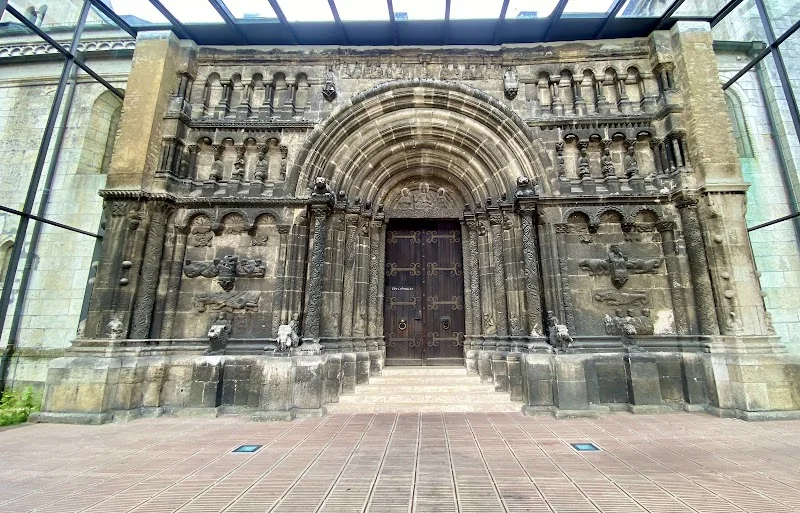
The Schottenportal in Regensburg is one of the most impressive and simultaneously enigmatic testimonies of Romanesque architecture in Bavaria. It is located on the north side of the Schottenkirche St. Jakob on Jakobstraße and forms the most well-known entrance to a former Irish and later Scottish Benedictine monastery. Those who stroll through the old town of Regensburg encounter not only a historical church portal but also a stone cycle of images that has raised questions for centuries. The figures, animals, ornaments, and reliefs appear foreign, sometimes grotesque, and often deliberately irritating. It is precisely this mixture of religious symbolism, medieval social criticism, and unresolved interpretations that makes the place a special attraction.
The Schottenkirche St. Jakob is a classic example of high Romanesque church architecture in southern Germany. Its history dates back to the 11th century and is closely linked to Irish wandering monks, Scottish Benedictines, medieval Regensburg, and the development of the former monastery. The current Schottenportal is classified as one of the most significant Romanesque monuments in Germany. The portal wall is approximately 15 meters wide and 8 meters high. A modern, largely glazed forecourt protects the valuable stone architecture from weather influences.
For visitors, the Schottenportal is particularly easy to incorporate into a tour of the old town of Regensburg. The Schottenkirche is located in a historic area that, together with Stadtamhof, is part of the UNESCO World Heritage. The visit can be combined with a walk along Jakobstraße, to Bismarckplatz, to the Cathedral, and to other attractions in the old town. Those looking for more than a brief glance at the facade can delve into the history of the monastery, the architecture of the basilica, and the various interpretations of the portal.
Schottenportal Regensburg and its Enigmatic Iconography
The most important theme surrounding the Schottenportal is its extraordinary iconography. The Romanesque portal wall consists of a round-arched portal with multiple stepped jambs, columns, ornamental details, and numerous figurative representations. Unlike many medieval church portals, the entire program cannot be clearly and conclusively explained. Research has proposed various interpretations, but a generally accepted overall interpretation does not exist. What is certain is that the imagery is associated with concepts of the Last Judgment, heaven, and hell.
The portal wall features twelve striking figures that are interpreted as outcasts or individuals excluded from entry into the kingdom of heaven. Explanations of the Schottenportal mention, among others, socially despised or stigmatized individuals and professions. These include pimps, criminals, prostitutes, jugglers, dancers, gluttons, and lazy people. The depiction is therefore not only a religious teaching image but also a mirror of medieval notions of order, morality, work, and social exclusion.
Many visitors find the figures mysterious because their postures and facial features appear unusual. Some figures seem repellent, others grotesque or almost theatrical. The stone masons left behind not a smoothly told story but a complex ensemble that compels viewers to ask their own questions. Which figure represents which sin? Which figures belong together? What significance do the animals and ornamental forms have? And how were the representations originally colored? These questions are part of the special allure of the Schottenportal.
According to experts, the figures were likely originally painted. Some sources also suggest gilding or silvering. Drill holes in certain areas may indicate that gemstones or other applications were once used. This means the portal must have appeared significantly more colorful and vibrant in the Middle Ages than the stone visible today. Although the modern forecourt alters the initial impression, it serves an important protective function. It preserves the sensitive Romanesque structure from rain, frost, air pollutants, and other stresses.
Visitors to the Schottenportal should take their time to appreciate the details. A quick glance from a distance reveals the monumental effect of the portal wall. Only upon closer inspection do the differences between relief, fully three-dimensional figures, column decorations, and ornamental framing become apparent. A guided tour can help distinguish between the various scholarly opinions. It is particularly important to avoid confusing established findings with later legends or mere conjectures. Precisely because much remains unresolved, the Schottenportal remains a vibrant object of research and remembrance.
Schottenkirche St. Jakob: History of the Irish and Scottish Monastery
The history of the Schottenkirche begins with Irish seekers of God and wandering monks. Around the year 1070, Marianus, Candidus, and Johannes arrived on their pilgrimage to Regensburg. Their arrival is considered the beginning of the more than eight hundred-year history of the Schottenkloster. The monks initially belonged to the Irish tradition, which played an important role in the founding and networking of monasteries in medieval Europe. Regensburg, due to its location on the Danube, its trade relations, and its ecclesiastical significance, was a suitable place for such a settlement.
The first community initially settled near the Stifts Obermünster. With the arrival of more monks, the location soon became too small. Therefore, the Irish, with the support of the burgrave Otto of Regensburg and respected citizens, acquired a larger building site west of the then city area. Around 1090, construction began on a larger monastery complex and a church. The site was originally located outside the Arnulfian city wall. Later, the area was more integrated into the city due to the expansion of the city fortifications.
The first church was consecrated in the early 12th century. Records exist of consecrations from the years 1111 and 1120. However, the first building was apparently not permanently stable. Sources report that it was constructed in great haste and not with sufficient care. Already after a comparatively short time, structural problems became apparent. Under Abbot Gregor, a larger and more ambitious new building was created. During this construction phase, the church developed into that significant Romanesque structure whose portal is now known as the Schottenportal.
The designation Schottenkloster should not lead to the assumption that the complex was Scottish from the beginning. For many centuries, it was primarily Irish monks who shaped the monastery. It was not until the 16th century that the Scottish phase began. Two Scottish clergymen, John Denys and John Thomson, advocated for a reorganization in Rome with the support of the city of Regensburg. In 1515, the last Irish abbot Walter Knowt was deposed, and Scottish clergy took over important offices.
The monastery gained special significance under Abbot Ninian Winzet. He was appointed abbot of St. Jakob by Pope Gregory XIII in 1577 and led the community to new prosperity. The monastery became a center of Scottish Catholic tradition and a stronghold for religious conflict in the context of the Reformation. At the same time, a distinct educational and scientific activity developed. The history of the place thus connects architecture, religion, migration, education, and European politics.
Later, the monastic independence came to an end. After secularization, the buildings were repurposed, and the seminary of the Diocese of Regensburg was housed in the former monastery buildings. The Schottenkirche St. Jakob remained as a church building. Today, the site recalls several historical layers: the Irish beginnings, the Scottish Benedictines, the changes of the Reformation period, the secularization, and the current ecclesiastical use.
Romanesque Architecture of St. Jakob in Regensburg
The Schottenkirche St. Jakob is an outstanding example of high Romanesque architecture in southern Germany. Its character is defined by clear forms, massive proportions, and a powerful spatial effect. The church is designed as a three-nave basilica and has a west transept. The Romanesque style does not rely on light, transparent spaces but on a interplay of wall mass, rhythmic arcades, round forms, and carefully set stone surfaces.
Particularly noteworthy are the sculpted capitals of the round pillars in the nave. Capitals form the transition between the column and the arch or beam above. In St. Jakob, they were designed with ornamental and figurative forms. They contribute to the architecture being impactful not only through its size but also through numerous individual observations. Those who examine the interior closely will recognize how strongly the medieval builders connected architecture and sculpture.
However, the current appearance of the church is not exclusively medieval. In the late 17th century, the church underwent changes in the Baroque style. These included the vaulting of the side aisles and a Baroque coffered ceiling in the nave. After the transition of the monastery to the Diocese of Regensburg, the interior was re-Romanized in the 19th century in the sense of historicism. This restoration continues to shape the impression of the church today. Visitors therefore see not a completely unaltered building but a historical structure in which different epochs overlap.
The former monastery area is also important for the classification of the Schottenportal. From the Romanesque monastery, particularly the cloister located south of the church has been preserved in its basic features. However, later modifications from the Gothic, Baroque, and 19th century have altered its original form. The portal was thus not intended as an isolated work of art but as part of a larger monastery complex. It marked the entrance to a religious and communal living space.
Inside the church, there is also a relief of a monk named Rydan with a key. This representation is also associated with various interpretations. Rydan could have been a real monk. In research and tourist explanations, it is suggested that he might be depicted as the master builder of the portal or as a doorkeeper. A definitive explanation is not secured. The relief thus complements the mysterious atmosphere already created by the north portal.
The architecture of St. Jakob becomes particularly understandable when one considers the exterior and interior together. Outside, the Schottenportal draws attention with its figurative density. Inside, a calmer, more rhythmic spatial arrangement unfolds. The massive pillars, round arches, and capitals form an architectural frame in which the religious function of the church remains palpable. For architecture enthusiasts, the combination of portal, basilica, remnants of the cloister, and later restoration layers is particularly valuable.
Schottenportal Opening Hours, Church Tours, and Visits
The Schottenkirche St. Jakob is generally accessible to visitors daily from Monday to Sunday between 8 AM and 6 PM. These times are indicated by the Regensburg tourism website for visiting the church and the Schottenportal. Since church spaces are also places of worship, prayer, and religious use, visitors should pay attention to maintaining an appropriate atmosphere. During services, church events, or special works, certain areas may be temporarily restricted.
A visit without a guided tour is suitable for those who want to experience the portal independently at first. The exterior view already conveys a strong impression of the size and dense iconography. The glass protective structure allows a view of the portal wall and makes the figures visible even in changeable weather. Those who take photographs should be considerate of other visitors and the sacred use of the church. A quiet, focused observation is more fitting for this place than a purely superficial photo stop.
For a deeper engagement with the Schottenportal, a church or city tour is recommended. Tours typically explain the history of the church, the Irish and Scottish monks, the architectural classification, and the different interpretations of the figures. According to regional information, public tours are offered regularly, including on the first Sunday of the month. Additionally, tours can be booked by arrangement. Since dates and registration conditions may vary, it is advisable to check the official information in advance.
The address is not uniformly specified in various information sources. The tourism website of the city of Regensburg lists the Schottenportal under Jakobstraße 3, while the provided location data states Jakobstraße 7. Therefore, for visitors, the designation Schottenkirche St. Jakob is more important than the sole house number. Those using a navigation system should search for Schottenkirche St. Jakob or Schottenportal Regensburg and choose the access on Jakobstraße.
The Schottenportal is well suited as part of a tour of the old town. Jakobstraße is located in a historically significant area west of the Regensburg Cathedral. From there, visitors can reach on foot other historical places, churches, and streets of the old town. The surroundings are part of the UNESCO World Heritage Site of the old town of Regensburg with Stadtamhof. This allows the visit to the portal to be combined with a broader exploration of the medieval city.
For families, the portal can be particularly interesting because its figures appear more unusual than classic saint representations. Children and teenagers often discover their own stories in the reliefs. Adults can use the visit to discuss medieval moral concepts, social exclusion, and the impact of religious images. A guided tour is recommended if the art historical contexts are the focus. For a brief visit, however, twenty to thirty minutes are usually sufficient, while a detailed tour can take significantly more time.
Jakobstraße, Old Town, and UNESCO World Heritage Regensburg
The Schottenportal is not isolated but situated in the midst of the historic old town of Regensburg. Regensburg possesses an exceptionally dense medieval urban structure with churches, townhouses, former monastery complexes, squares, and remnants of the city fortifications. The Schottenkirche was originally located outside the older Arnulfian city wall. With the later expansion of the city, the monastery was more integrated into the protected urban area. This development explains why the complex is now located in the middle of an urban historical environment.
Jakobstraße runs through a part of the old town characterized by historical buildings and cultural destinations. The path to the Schottenportal can be combined with a visit to Bismarckplatz, the Cathedral, or other Romanesque and Gothic churches. Even those specifically interested in medieval architecture will find numerous comparable examples in Regensburg. St. Jakob occupies a special position because here a largely preserved Romanesque church complex is connected with an extraordinary figurative portal.
Since 2006, the old town of Regensburg with Stadtamhof has been part of the UNESCO World Heritage Site. The award refers to the historical ensemble of the city and its exceptional significance. The Schottenportal is a particularly striking individual monument within this ensemble. Its importance arises not only from the age of the stones but from the connection of architectural art, religious history, and urban development. Therefore, those who visit the portal see both a work of art and a part of the long history of Regensburg.
The location in the old town makes visiting especially sensible on foot. The area is characterized by narrow historical streets, squares, and different traffic regulations. For drivers, reaching the portal may be more difficult than continuing to a parking garage on the outskirts of the old town. Since specific parking options, access routes, and fees may change, visitors should check current information from the city of Regensburg or a navigation service. For the content of the portal itself, arriving by public transport followed by a walk is often the most straightforward option.
The surrounding area is also culturally significant. The former monastery buildings now serve the seminary, and the church of St. Jakob remains a place of religious use. Thus, the Schottenportal connects tourist interest with vibrant ecclesiastical presence. It is not a reconstructed open-air object or a mere exhibition but part of a historical building complex that is still in use. This circumstance requires consideration but also makes the visit particularly authentic.
Those photographing in Regensburg should view the portal from different distances. From a greater distance, the monumental width of the portal wall becomes clear. Up close, individual figures, columns, and ornaments stand out. The glass architecture of the protective structure creates different reflections depending on the time of day. This can alter the impression of the facade. A brief observation in changing light often conveys more than a single photo.
Why the Schottenportal is One of the Most Important Attractions in Regensburg
The Schottenportal combines several characteristics that make it an extraordinary destination. It is old, architecturally significant, unusually richly decorated, and its iconography is not fully explained. Many historical buildings impress with clear inscriptions or easily identifiable figures. The Schottenportal, however, works differently: it poses questions instead of providing every meaning. Viewers must engage with fragments, symbols, and various scholarly interpretations.
Its significance also rests on the quality of Romanesque architecture. The portal wall is not merely decorative but a carefully composed transition between the outside world and the church space. Columns, archivolts, figures, and ornamental surfaces create a strong visual density. The medieval artists worked with the material stone and developed an imagery that could convey both religious instruction and social valuation.
Additionally, the European history of the site plays a role. Its beginnings lie in the Irish monk tradition. Later, Scottish Benedictines shaped the monastery. Regensburg was thus connected with religious and political developments that extended far beyond Bavaria. The monastery served as a place of education, a religious center, and a reference point for Scottish Catholics. The history of St. Jakob therefore illustrates how medieval and early modern monasteries could build international networks.
The Schottenportal is also an example of how monuments can change their significance over time. In the Middle Ages, it was part of a monastic church. In later centuries, the monastery was repurposed, and the church was restored. Today, the portal is a tourist attraction, a subject of research, and a protected monument. Each generation views the figures with new questions. The modern protective hall simultaneously shows that monument preservation does not mean simply leaving an object unchanged but creating suitable conditions for its preservation.
For a trip to Regensburg, the portal offers a strong contrast to more well-known destinations. The Cathedral and the Stone Bridge are familiar to many guests. The Schottenportal, on the other hand, appears less definitive and invites a slower contemplation. It is particularly attractive for those interested in Romanesque art, medieval art, church architecture, monastic history, or enigmatic image programs. The site is also an important component for cultural historical tours and thematic city guides.
The name Schottenportal serves both as a search term and a cultural reference. Search queries such as Schottenportal Regensburg, Schottenportal St. Jakob, Schottenkirche Regensburg, Schott Portal, or Schottnet lead to a place whose fame is primarily based on the portal and its history. Those looking for current events should note that St. Jakob is primarily a church and a historical monument. Services, guided tours, and special dates may take place but are not equivalent to the regular program of a classic event hall.
A visit is particularly worthwhile when sufficient time is planned for the old town. The portal can be the starting point for a historical quest: from the Irish monks through the construction of the Romanesque church and the Scottish monastic phase to the present use. Those who closely examine the figures, compare the interior architecture, and place the location within the World Heritage context experience more than a single facade. The Schottenportal becomes an access point to the long history of Regensburg.
Sources:
- Regensburg Tourism – St. Jakob Schottenportal
- Schottenkirche St. Jakob – History
- House of Bavarian History – Schottenkloster St. Jakob
- Technical University of Munich – Construction Research Investigation of St. Jakob
- Diocese of Regensburg – Research Project for the Preservation of the Schottenportal
- Priesterseminar Regensburg – Our House
- Regensburg Regional – Schottenportal and Church Tours
Mehr anzeigenWeniger anzeigen
Schottenportal | St. Jakob & History in Regensburg
The Schottenportal in Regensburg is one of the most impressive and simultaneously enigmatic testimonies of Romanesque architecture in Bavaria. It is located on the north side of the Schottenkirche St. Jakob on Jakobstraße and forms the most well-known entrance to a former Irish and later Scottish Benedictine monastery. Those who stroll through the old town of Regensburg encounter not only a historical church portal but also a stone cycle of images that has raised questions for centuries. The figures, animals, ornaments, and reliefs appear foreign, sometimes grotesque, and often deliberately irritating. It is precisely this mixture of religious symbolism, medieval social criticism, and unresolved interpretations that makes the place a special attraction.
The Schottenkirche St. Jakob is a classic example of high Romanesque church architecture in southern Germany. Its history dates back to the 11th century and is closely linked to Irish wandering monks, Scottish Benedictines, medieval Regensburg, and the development of the former monastery. The current Schottenportal is classified as one of the most significant Romanesque monuments in Germany. The portal wall is approximately 15 meters wide and 8 meters high. A modern, largely glazed forecourt protects the valuable stone architecture from weather influences.
For visitors, the Schottenportal is particularly easy to incorporate into a tour of the old town of Regensburg. The Schottenkirche is located in a historic area that, together with Stadtamhof, is part of the UNESCO World Heritage. The visit can be combined with a walk along Jakobstraße, to Bismarckplatz, to the Cathedral, and to other attractions in the old town. Those looking for more than a brief glance at the facade can delve into the history of the monastery, the architecture of the basilica, and the various interpretations of the portal.
Schottenportal Regensburg and its Enigmatic Iconography
The most important theme surrounding the Schottenportal is its extraordinary iconography. The Romanesque portal wall consists of a round-arched portal with multiple stepped jambs, columns, ornamental details, and numerous figurative representations. Unlike many medieval church portals, the entire program cannot be clearly and conclusively explained. Research has proposed various interpretations, but a generally accepted overall interpretation does not exist. What is certain is that the imagery is associated with concepts of the Last Judgment, heaven, and hell.
The portal wall features twelve striking figures that are interpreted as outcasts or individuals excluded from entry into the kingdom of heaven. Explanations of the Schottenportal mention, among others, socially despised or stigmatized individuals and professions. These include pimps, criminals, prostitutes, jugglers, dancers, gluttons, and lazy people. The depiction is therefore not only a religious teaching image but also a mirror of medieval notions of order, morality, work, and social exclusion.
Many visitors find the figures mysterious because their postures and facial features appear unusual. Some figures seem repellent, others grotesque or almost theatrical. The stone masons left behind not a smoothly told story but a complex ensemble that compels viewers to ask their own questions. Which figure represents which sin? Which figures belong together? What significance do the animals and ornamental forms have? And how were the representations originally colored? These questions are part of the special allure of the Schottenportal.
According to experts, the figures were likely originally painted. Some sources also suggest gilding or silvering. Drill holes in certain areas may indicate that gemstones or other applications were once used. This means the portal must have appeared significantly more colorful and vibrant in the Middle Ages than the stone visible today. Although the modern forecourt alters the initial impression, it serves an important protective function. It preserves the sensitive Romanesque structure from rain, frost, air pollutants, and other stresses.
Visitors to the Schottenportal should take their time to appreciate the details. A quick glance from a distance reveals the monumental effect of the portal wall. Only upon closer inspection do the differences between relief, fully three-dimensional figures, column decorations, and ornamental framing become apparent. A guided tour can help distinguish between the various scholarly opinions. It is particularly important to avoid confusing established findings with later legends or mere conjectures. Precisely because much remains unresolved, the Schottenportal remains a vibrant object of research and remembrance.
Schottenkirche St. Jakob: History of the Irish and Scottish Monastery
The history of the Schottenkirche begins with Irish seekers of God and wandering monks. Around the year 1070, Marianus, Candidus, and Johannes arrived on their pilgrimage to Regensburg. Their arrival is considered the beginning of the more than eight hundred-year history of the Schottenkloster. The monks initially belonged to the Irish tradition, which played an important role in the founding and networking of monasteries in medieval Europe. Regensburg, due to its location on the Danube, its trade relations, and its ecclesiastical significance, was a suitable place for such a settlement.
The first community initially settled near the Stifts Obermünster. With the arrival of more monks, the location soon became too small. Therefore, the Irish, with the support of the burgrave Otto of Regensburg and respected citizens, acquired a larger building site west of the then city area. Around 1090, construction began on a larger monastery complex and a church. The site was originally located outside the Arnulfian city wall. Later, the area was more integrated into the city due to the expansion of the city fortifications.
The first church was consecrated in the early 12th century. Records exist of consecrations from the years 1111 and 1120. However, the first building was apparently not permanently stable. Sources report that it was constructed in great haste and not with sufficient care. Already after a comparatively short time, structural problems became apparent. Under Abbot Gregor, a larger and more ambitious new building was created. During this construction phase, the church developed into that significant Romanesque structure whose portal is now known as the Schottenportal.
The designation Schottenkloster should not lead to the assumption that the complex was Scottish from the beginning. For many centuries, it was primarily Irish monks who shaped the monastery. It was not until the 16th century that the Scottish phase began. Two Scottish clergymen, John Denys and John Thomson, advocated for a reorganization in Rome with the support of the city of Regensburg. In 1515, the last Irish abbot Walter Knowt was deposed, and Scottish clergy took over important offices.
The monastery gained special significance under Abbot Ninian Winzet. He was appointed abbot of St. Jakob by Pope Gregory XIII in 1577 and led the community to new prosperity. The monastery became a center of Scottish Catholic tradition and a stronghold for religious conflict in the context of the Reformation. At the same time, a distinct educational and scientific activity developed. The history of the place thus connects architecture, religion, migration, education, and European politics.
Later, the monastic independence came to an end. After secularization, the buildings were repurposed, and the seminary of the Diocese of Regensburg was housed in the former monastery buildings. The Schottenkirche St. Jakob remained as a church building. Today, the site recalls several historical layers: the Irish beginnings, the Scottish Benedictines, the changes of the Reformation period, the secularization, and the current ecclesiastical use.
Romanesque Architecture of St. Jakob in Regensburg
The Schottenkirche St. Jakob is an outstanding example of high Romanesque architecture in southern Germany. Its character is defined by clear forms, massive proportions, and a powerful spatial effect. The church is designed as a three-nave basilica and has a west transept. The Romanesque style does not rely on light, transparent spaces but on a interplay of wall mass, rhythmic arcades, round forms, and carefully set stone surfaces.
Particularly noteworthy are the sculpted capitals of the round pillars in the nave. Capitals form the transition between the column and the arch or beam above. In St. Jakob, they were designed with ornamental and figurative forms. They contribute to the architecture being impactful not only through its size but also through numerous individual observations. Those who examine the interior closely will recognize how strongly the medieval builders connected architecture and sculpture.
However, the current appearance of the church is not exclusively medieval. In the late 17th century, the church underwent changes in the Baroque style. These included the vaulting of the side aisles and a Baroque coffered ceiling in the nave. After the transition of the monastery to the Diocese of Regensburg, the interior was re-Romanized in the 19th century in the sense of historicism. This restoration continues to shape the impression of the church today. Visitors therefore see not a completely unaltered building but a historical structure in which different epochs overlap.
The former monastery area is also important for the classification of the Schottenportal. From the Romanesque monastery, particularly the cloister located south of the church has been preserved in its basic features. However, later modifications from the Gothic, Baroque, and 19th century have altered its original form. The portal was thus not intended as an isolated work of art but as part of a larger monastery complex. It marked the entrance to a religious and communal living space.
Inside the church, there is also a relief of a monk named Rydan with a key. This representation is also associated with various interpretations. Rydan could have been a real monk. In research and tourist explanations, it is suggested that he might be depicted as the master builder of the portal or as a doorkeeper. A definitive explanation is not secured. The relief thus complements the mysterious atmosphere already created by the north portal.
The architecture of St. Jakob becomes particularly understandable when one considers the exterior and interior together. Outside, the Schottenportal draws attention with its figurative density. Inside, a calmer, more rhythmic spatial arrangement unfolds. The massive pillars, round arches, and capitals form an architectural frame in which the religious function of the church remains palpable. For architecture enthusiasts, the combination of portal, basilica, remnants of the cloister, and later restoration layers is particularly valuable.
Schottenportal Opening Hours, Church Tours, and Visits
The Schottenkirche St. Jakob is generally accessible to visitors daily from Monday to Sunday between 8 AM and 6 PM. These times are indicated by the Regensburg tourism website for visiting the church and the Schottenportal. Since church spaces are also places of worship, prayer, and religious use, visitors should pay attention to maintaining an appropriate atmosphere. During services, church events, or special works, certain areas may be temporarily restricted.
A visit without a guided tour is suitable for those who want to experience the portal independently at first. The exterior view already conveys a strong impression of the size and dense iconography. The glass protective structure allows a view of the portal wall and makes the figures visible even in changeable weather. Those who take photographs should be considerate of other visitors and the sacred use of the church. A quiet, focused observation is more fitting for this place than a purely superficial photo stop.
For a deeper engagement with the Schottenportal, a church or city tour is recommended. Tours typically explain the history of the church, the Irish and Scottish monks, the architectural classification, and the different interpretations of the figures. According to regional information, public tours are offered regularly, including on the first Sunday of the month. Additionally, tours can be booked by arrangement. Since dates and registration conditions may vary, it is advisable to check the official information in advance.
The address is not uniformly specified in various information sources. The tourism website of the city of Regensburg lists the Schottenportal under Jakobstraße 3, while the provided location data states Jakobstraße 7. Therefore, for visitors, the designation Schottenkirche St. Jakob is more important than the sole house number. Those using a navigation system should search for Schottenkirche St. Jakob or Schottenportal Regensburg and choose the access on Jakobstraße.
The Schottenportal is well suited as part of a tour of the old town. Jakobstraße is located in a historically significant area west of the Regensburg Cathedral. From there, visitors can reach on foot other historical places, churches, and streets of the old town. The surroundings are part of the UNESCO World Heritage Site of the old town of Regensburg with Stadtamhof. This allows the visit to the portal to be combined with a broader exploration of the medieval city.
For families, the portal can be particularly interesting because its figures appear more unusual than classic saint representations. Children and teenagers often discover their own stories in the reliefs. Adults can use the visit to discuss medieval moral concepts, social exclusion, and the impact of religious images. A guided tour is recommended if the art historical contexts are the focus. For a brief visit, however, twenty to thirty minutes are usually sufficient, while a detailed tour can take significantly more time.
Jakobstraße, Old Town, and UNESCO World Heritage Regensburg
The Schottenportal is not isolated but situated in the midst of the historic old town of Regensburg. Regensburg possesses an exceptionally dense medieval urban structure with churches, townhouses, former monastery complexes, squares, and remnants of the city fortifications. The Schottenkirche was originally located outside the older Arnulfian city wall. With the later expansion of the city, the monastery was more integrated into the protected urban area. This development explains why the complex is now located in the middle of an urban historical environment.
Jakobstraße runs through a part of the old town characterized by historical buildings and cultural destinations. The path to the Schottenportal can be combined with a visit to Bismarckplatz, the Cathedral, or other Romanesque and Gothic churches. Even those specifically interested in medieval architecture will find numerous comparable examples in Regensburg. St. Jakob occupies a special position because here a largely preserved Romanesque church complex is connected with an extraordinary figurative portal.
Since 2006, the old town of Regensburg with Stadtamhof has been part of the UNESCO World Heritage Site. The award refers to the historical ensemble of the city and its exceptional significance. The Schottenportal is a particularly striking individual monument within this ensemble. Its importance arises not only from the age of the stones but from the connection of architectural art, religious history, and urban development. Therefore, those who visit the portal see both a work of art and a part of the long history of Regensburg.
The location in the old town makes visiting especially sensible on foot. The area is characterized by narrow historical streets, squares, and different traffic regulations. For drivers, reaching the portal may be more difficult than continuing to a parking garage on the outskirts of the old town. Since specific parking options, access routes, and fees may change, visitors should check current information from the city of Regensburg or a navigation service. For the content of the portal itself, arriving by public transport followed by a walk is often the most straightforward option.
The surrounding area is also culturally significant. The former monastery buildings now serve the seminary, and the church of St. Jakob remains a place of religious use. Thus, the Schottenportal connects tourist interest with vibrant ecclesiastical presence. It is not a reconstructed open-air object or a mere exhibition but part of a historical building complex that is still in use. This circumstance requires consideration but also makes the visit particularly authentic.
Those photographing in Regensburg should view the portal from different distances. From a greater distance, the monumental width of the portal wall becomes clear. Up close, individual figures, columns, and ornaments stand out. The glass architecture of the protective structure creates different reflections depending on the time of day. This can alter the impression of the facade. A brief observation in changing light often conveys more than a single photo.
Why the Schottenportal is One of the Most Important Attractions in Regensburg
The Schottenportal combines several characteristics that make it an extraordinary destination. It is old, architecturally significant, unusually richly decorated, and its iconography is not fully explained. Many historical buildings impress with clear inscriptions or easily identifiable figures. The Schottenportal, however, works differently: it poses questions instead of providing every meaning. Viewers must engage with fragments, symbols, and various scholarly interpretations.
Its significance also rests on the quality of Romanesque architecture. The portal wall is not merely decorative but a carefully composed transition between the outside world and the church space. Columns, archivolts, figures, and ornamental surfaces create a strong visual density. The medieval artists worked with the material stone and developed an imagery that could convey both religious instruction and social valuation.
Additionally, the European history of the site plays a role. Its beginnings lie in the Irish monk tradition. Later, Scottish Benedictines shaped the monastery. Regensburg was thus connected with religious and political developments that extended far beyond Bavaria. The monastery served as a place of education, a religious center, and a reference point for Scottish Catholics. The history of St. Jakob therefore illustrates how medieval and early modern monasteries could build international networks.
The Schottenportal is also an example of how monuments can change their significance over time. In the Middle Ages, it was part of a monastic church. In later centuries, the monastery was repurposed, and the church was restored. Today, the portal is a tourist attraction, a subject of research, and a protected monument. Each generation views the figures with new questions. The modern protective hall simultaneously shows that monument preservation does not mean simply leaving an object unchanged but creating suitable conditions for its preservation.
For a trip to Regensburg, the portal offers a strong contrast to more well-known destinations. The Cathedral and the Stone Bridge are familiar to many guests. The Schottenportal, on the other hand, appears less definitive and invites a slower contemplation. It is particularly attractive for those interested in Romanesque art, medieval art, church architecture, monastic history, or enigmatic image programs. The site is also an important component for cultural historical tours and thematic city guides.
The name Schottenportal serves both as a search term and a cultural reference. Search queries such as Schottenportal Regensburg, Schottenportal St. Jakob, Schottenkirche Regensburg, Schott Portal, or Schottnet lead to a place whose fame is primarily based on the portal and its history. Those looking for current events should note that St. Jakob is primarily a church and a historical monument. Services, guided tours, and special dates may take place but are not equivalent to the regular program of a classic event hall.
A visit is particularly worthwhile when sufficient time is planned for the old town. The portal can be the starting point for a historical quest: from the Irish monks through the construction of the Romanesque church and the Scottish monastic phase to the present use. Those who closely examine the figures, compare the interior architecture, and place the location within the World Heritage context experience more than a single facade. The Schottenportal becomes an access point to the long history of Regensburg.
Sources:
- Regensburg Tourism – St. Jakob Schottenportal
- Schottenkirche St. Jakob – History
- House of Bavarian History – Schottenkloster St. Jakob
- Technical University of Munich – Construction Research Investigation of St. Jakob
- Diocese of Regensburg – Research Project for the Preservation of the Schottenportal
- Priesterseminar Regensburg – Our House
- Regensburg Regional – Schottenportal and Church Tours
Frequently Asked Questions
Reviews
Kai Sauer
6. August 2026
If you love Romanesque architecture, you have to come here! The portal is being renovated, but you can still see a lot of interesting and unusual things, and the condition of the stone (black) makes the restoration necessary. By the way, I saw Mrs. Malzahn at a church portal for the first time... The church also exudes the calm and stability of Romanesque architecture and allows you to draw strength for the many exciting Baroque elements.
Sven Krafft
1. September 2026
Very appealing... beautiful building... currently, the entrance is being spruced up a bit... so you can't miss the whole thing.
D D
26. May 2024
The Scottish portal, the entrance to the Scottish church, is one of the most significant Romanesque monuments in Germany. All the figures of the portal were once painted and adorned with gemstones. Experts do not agree on the meaning of the depicted figures.
Michael Hamke
21. August 2024
It's more for art historians. In other words: The beauty of the portal isn't obvious to everyone.
Freddy Katzenstein
4. April 2024
Very impressive Romanesque church with the interesting Scottish portal, where scholars are still puzzling over the meaning of individual figures. A must-see!