
Regensburg
Andreasstraße 13, 93059 Regensburg, Deutschland
St. Mang | Church & Directions
St. Mang in Regensburg is more than just a point on the map: The place connects Stadtamhof, church history, baroque architecture, and lived parish tradition in a small space. Anyone visiting Andreasstraße 13 is in a part of the city that has been shaped for centuries by its proximity to the Stone Bridge, the Danube, and the historic buildings at the northern edge of the old town. The parish refers to the place as St. Magn, but in many searches and everyday life, St. Mang is used. This tension between traditional church, vibrant community, and urban location is what makes it appealing. The Church of St. Andreas is not only a religious space but also a testament to the reconstruction after destruction, the baroque design will, and its later use as a study church. At the same time, St. Mang is firmly anchored in the neighborhood: with parish office, parish hall, services, and events that make community life visible. Therefore, those interested in directions, parking, history, or service times will find here not just a church but a historically grown ensemble with clear practical paths for visitors and believers. ([pg-dank.de](https://pg-dank.de/pfarreien/st-magn/geschichte))
Services and Current Dates at St. Mang
St. Mang is not only a historic place but a lively parish community. The parish's pages publish current dates in the section Current Dates and in the parish newsletter; regular mass celebrations, vespers, and other offerings of community life appear there. This is practical for all who wish to not only visit the church but also plan a service, a church celebration, or an event of the parish community. Since the times are oriented to the liturgical calendar and specific events, the current view of the official date page is the most reliable solution. At the same time, the variety of offerings shows that St. Mang is more than just a mere sight: The church is a place of prayer, music, and community activities in the Stadtamhof district. Those seeking a quiet atmosphere will experience a classic city church setting here; those looking for an appointment will find an organized parish with recurring service times and an active parish newsletter. The website makes it clear that community life is distributed over Sunday masses, weekday celebrations, and special liturgical occasions, thus remaining continuously present. ([pg-dank.de](https://pg-dank.de/pfarreien/st-magn/kirchenverwaltung))
For the search intent St. Mang service, it is important that the church is regularly used liturgically and that the official website transparently communicates the dates. The current excerpts from the page list mass celebrations, a vespers, and other services; additionally, the parish refers to its parish newsletter, which bundles festivals, special celebrations, and community events. Therefore, anyone planning a visit should always check the current information shortly before the date, as a church with an active parish life naturally works with changing times. However, this is also its advantage: One does not encounter a decommissioned attraction but a place where the space still serves its original purpose. St. Mang is thus a good point of contact for people seeking church music, liturgy, quiet reflection, or a family service in a historically impressive environment. The place thrives on return and reliability, but also on the willingness to respond to the rhythm of the church year. Anyone looking for a celebration, a musical service, or a special church appointment in Regensburg will find a comprehensible and well-maintained information offering here. ([pg-dank.de](https://pg-dank.de/pfarreien/st-magn/kirchenverwaltung))
Directions and Parking around St. Mang in Stadtamhof
Anyone wishing to visit St. Mang in Regensburg should consider the location in Stadtamhof from the beginning. The official parish recommends the route by car via Frankenstraße and then over the Protzenweiher Bridge towards the city center. Parking options directly at the church are limited, so the parish names several practical alternatives: Stadtamhof itself, the Gräßlschleife, or as a free option, the Regensburg Dultplatz. From there, a short walk is necessary, about five minutes from Stadtamhof or the Gräßlschleife and around ten minutes from the Dultplatz. These hints are particularly valuable because the neighborhood has grown historically and is spatially tightly structured. Those arriving with a time buffer avoid stress, find a parking space more easily, and can enjoy the walk over the bridge or through the district at leisure. The official site thus makes it clear that a visit here does not rely on large parking areas but on clever urban logistics and short paths. The practical effect is pleasant: Instead of searching for a parking space for a long time, one can already begin the church visit on the way there and consciously perceive the historic surroundings. ([pg-dank.de](https://pg-dank.de/start?catid=13&id=94%3Astm-pfarrhaus-st-magn&view=article&utm_source=openai))
St. Mang is also easily accessible by public transport. According to the parish, the RVV line 17 stops at the Stadtamhof station, just a few meters from the church and HfKM. For pedestrians, this is an advantage because the paths in the district are compact and the Stone Bridge, the Danube arms, and the historic streets create a very direct city experience. Therefore, anyone wishing to avoid parking can conveniently reach the church on foot or by bus and focus entirely on the visit. This is particularly helpful for events, services, or visits to the parish office. The practical recommendation is therefore: do not plan too tightly, use the official route, and in bad weather or during peak times, rather resort to the Dultplatz or public transport. This makes the visit not only easier but also more relaxed. The Stadtamhof district is known for its short distance between traffic junctions, bridges, and church spaces, and that is why good orientation in advance is particularly sensible. ([pg-dank.de](https://pg-dank.de/start?catid=13&id=94%3Astm-pfarrhaus-st-magn&view=article&utm_source=openai))
History of St. Mang, St. Andreas, and the Old Monastery
The history of St. Mang goes far back before the present parish and begins with an early religious use of the place. The official history page already mentions a wayside chapel for the year 1051. Later, Ulrich von Zell left a plot of land near the Magnus Church in Stadtamhof to his relative Gebhard, on which he founded a monastery in 1138 according to the rules of the Augustinian canons. Even this early phase shows that the place did not arise by chance but emerged from religious, topographical, and later also political development. For 1156, an altar consecration in honor of Saint Andrew is also recorded. In the 15th century, the historian Andreas von Regensburg worked here, which makes the place important for regional historiography. St. Mang is thus not only a church name but a long-grown space of remembrance where medieval piety, monastic life, and urban history overlap. The early foundation and later significance as a spiritual site explain why the place is still so deeply anchored in the identity of Stadtamhof. ([pg-dank.de](https://pg-dank.de/pfarreien/st-magn/geschichte))
A deep rupture was brought by the Thirty Years' War. The church and the monastery were destroyed or severely damaged from November 1633 to July 1634. Subsequently, a Loreto chapel was built in 1643, where the pilgrimage to the Beautiful Mary was resumed for a few years. Only in 1695, during cleanup work in the ruins, were the relics of Saint Magnus discovered; this led to a new chapter in the history of the place. In 1697, the reconstruction began under Andreas Pichelmeier, by 1702 the new church was already in half vaulting, and in 1717 the solemn consecration of the single-nave, late baroque wall pillar church took place. This sequence explains why St. Mang today has such strong historical depth: The place is the result of destruction, reconstruction, and artistic condensation. Later followed the dissolution of the monastery in 1803, the founding of the parish in 1912, and its use as a study church from 1977. Thus, St. Mang connects several epochs in a building ensemble. This makes the place as exciting for history enthusiasts as for visitors who simply want to experience a special church in Regensburg. ([pg-dank.de](https://pg-dank.de/pfarreien/st-magn/geschichte))
The ecclesiastical identity of the community is also remarkable. The official historical presentation emphasizes that St. Magn is the only parish in the Diocese of Regensburg that has Saint Magnus as its second parish patron. In addition, the community today comprises approximately 1250 Catholic Christians and is divided into two spatially separate areas because the construction of the Danube Canal effectively made Stadtamhof an island. These details are important if one wants to understand St. Mang not just as a sight but as a real community. Here it becomes evident that historical development still shapes everyday life: the district, the parish boundaries, the paths to the church, and even the atmosphere of the neighborhood follow a historical logic that dates back to the Middle Ages. This creates a very unique character. St. Mang is neither an anonymous house of worship nor a detached monument but a place where historical continuity, community life, and the topography of the city are intertwined. ([pg-dank.de](https://pg-dank.de/pfarreien/st-magn/geschichte))
Baroque Furnishings, Rococo, and Study Church
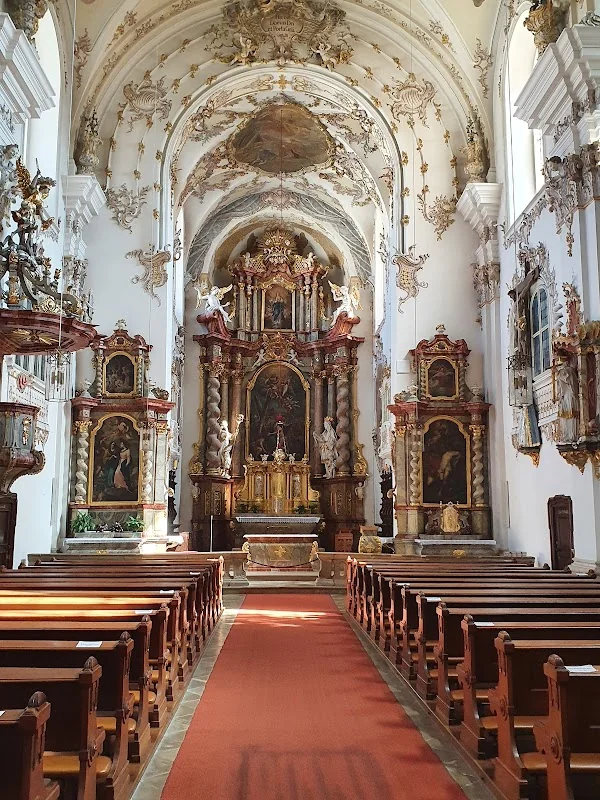
Architecturally, St. Mang is primarily shaped by the reconstruction of the late 17th and early 18th centuries. The Church of St. Andreas is described on the official page as a single-nave, late baroque wall pillar church, which was further designed in the Rococo style starting in 1751. Thus, it is a good example of how baroque basic disposition and rococo refinement come together. The artistic furnishings owe their current character to a number of artists and sculptors, including Johann Gebhard, Otto Gebhard, Victor Honorius Janssens, Franz Anton Neu, Premislaus Loritz, Anton Landes, Matthias Schiffer, and Simon Sorg. Even if visitors cannot name every artwork in detail, one feels the overall impression: The interior is not austere but deliberately designed as a liturgical and representative space. This makes the church a place where history is not only told but becomes visible. The baroque language of the space supports its current use as a parish church and study church. Therefore, upon entering the space, one does not simply experience a historical shell but a consciously composed ecclesiastical atmosphere in which architecture, light, and liturgical use complement each other. ([pg-dank.de](https://pg-dank.de/pfarreien/st-magn/orte/kirche-st-andreas))
Particularly important is the role as a study church. Since 1977, St. Andreas has served the Regensburg School of Church Music, which is now known as the University of Catholic Church Music and Music Education. The parish emphasizes that the university is located in the former monastery buildings, which is considered the oldest of its kind worldwide. This connection of historical church, academic music tradition, and vibrant liturgical practice is a strong unique selling point. Therefore, anyone visiting St. Mang enters not a museum-like still space but a place where education, liturgy, and sound culture come together. This is significant, especially for those interested in organ music, choral culture, or spiritual concerts. The church thus functions doubly: as a spiritual center and as a symbol of a deeply rooted music culture that has significance far beyond the neighborhood. The proximity of the university, parish church, and historic monastery shows how strongly ecclesiastical education and church life support each other in St. Mang. This creates an atmosphere that is both solemn and close to everyday life. ([pg-dank.de](https://pg-dank.de/pfarreien/st-magn/orte/kirche-st-andreas))
The history of use also explains much of the current effect. After the dissolution of the monastery in 1803, the church was not abandoned but continued as a parish church. Only in 1912 did the community receive its own parish St. Magn. This means: The building complex remained older than the organized parish structure that we know today. For visitors, this is often the reason for the special impression on site. One sees a building that speaks from different centuries, and at the same time a community that actively uses this historical substance. This connection of architecture, education, and pastoral care is rarely experienced so closely in one place as here. Additionally, the church remains present in the everyday life of the district, not just during special occasions. This mixture of monument, house of worship, and study church makes St. Mang in Regensburg a place that remains in memory. ([pg-dank.de](https://pg-dank.de/pfarreien/st-magn/orte/kirche-st-andreas))
Stadtamhof, UNESCO World Heritage, and the Special Location by the Danube
The location of St. Mang in Stadtamhof is an essential part of its identity. Stadtamhof is part of the UNESCO World Heritage of the Old Town of Regensburg with Stadtamhof, which was awarded in 2006. UNESCO describes the area as an outstanding example of a Central European medieval trading center with a very well-preserved historical structure. This includes Romanesque, Gothic, and later architectural forms, numerous church and monastery ensembles, as well as the Stone Bridge from the 12th century. For St. Mang, this context is important because the church does not stand isolated but is embedded in a highly dense historical urban structure. This makes every visit a walk through several centuries at once. The proximity to the Danube, the narrow alleys, and the historic buildings ensure that the way to the church can be as impressive as the stay within it. Those who experience Stadtamhof quickly understand why this district, despite its small size, receives so much attention. ([whc.unesco.org](https://whc.unesco.org/en/list/1155/?utm_source=openai))
The official tourism page of the city emphasizes that Stadtamhof is located on an island between the arms of the Danube and, together with the old town, is part of the World Heritage. This island location explains the special atmosphere of the district. One is close to the city center yet experiences a self-contained, almost closed world where churches, inns, historic buildings, and water areas come together to form a characteristic ensemble. St. Mang benefits directly from this: The church is part of a cityscape that thrives on high historical density, short paths, and a strong local character. For visitors, this means that attending a service, an appointment at the parish office, or a short detour to the church is always also a piece of World Heritage experience. Therefore, when searching for St. Mang, one is not just looking for a single building but a piece of Regensburg's city history in the smallest but atmospherically very strong district of the old town zone. The combination of water, bridge, old town, and sacred space makes the surroundings so memorable. ([tourismus.regensburg.de](https://tourismus.regensburg.de/erleben-entdecken/unesco-welterbe-sehenswuerdigkeiten/stadtamhof?utm_source=openai))
Regensburg is also described by the tourism page as one of the best-preserved medieval cities in Germany. This assessment is important for St. Mang because it explains the urban framework in which the church still stands today. For visitors, this creates not only a scenically beautiful but also a historically exceptionally dense impression. The buildings, squares, and paths between the old town, Stadtamhof, and the Danube are not arbitrary but part of a system preserved over centuries. This is exactly why St. Mang feels so authentic: The church does not stand at the edge of history but at the center of an ensemble that translates the past into everyday life. Those who linger here feel the continuity of city, faith, and built heritage. Thus, even a short visit becomes a very compact cultural and urban experience. ([tourismus.regensburg.de](https://tourismus.regensburg.de/en/experience-discover/unesco-world-heritage-/-sightseeing/unesco-world-heritage?utm_source=openai))
Parish Office, Contact, and Practical Information for Visitors
For specific visits, the parish office St. Magn is the most important point of contact. The official address is Andreasstr. 13, 93059 Regensburg, and the phone number is 0941 84591. The website also lists the office hours of the parish office; currently, Tuesday morning is mentioned as a consultation time. This is especially helpful if one has inquiries about services, parish newsletters, events, or organizational matters. According to the parish, the church administration takes care of assets, buildings, properties, and personnel and is also reachable through the parish office. It is important for visitors to know that St. Mang is not only a sacred place but has a functioning administrative and community structure. Therefore, anyone wishing to clarify something on site will find a clear address, a phone number, and a comprehensible responsibility. These practical information are valuable, especially for people who are orienting themselves in Stadtamhof for the first time. They shorten paths and create security before the visit. ([pg-dank.de](https://pg-dank.de/pfarreien/st-magn/kirchenverwaltung))
Directly next to the church are other parts of the parish ensemble, including the parish hall St. Magn, which according to the official description is located near the parking lot of the School of Church Music. Here too, it applies: The immediate surroundings are compact, historically grown, and pedestrian-friendly, but not designed for generous parking areas. Therefore, it is worthwhile to plan the visit as a small city walk. Especially if one wants to combine several points - church, parish office, possibly an appointment, or a short walk through Stadtamhof - good planning is sensible. The official communication of the parish makes this practical aspect very clear and helps to make the visit relaxed. Those who visit St. Mang with some time experience not only a church but an ensemble of liturgical space, parish organization, and neighborhood atmosphere. This is precisely why the place remains interesting for believers, culture enthusiasts, and visitors to Regensburg alike. If desired, one can combine the visit with a short stay by the Danube, a walk over the bridge, or a quiet pause in the neighborhood, thus fully enjoying the special location. ([pg-dank.de](https://pg-dank.de/?catid=13&id=95%3Astm-pfarrheim-st-magn&view=article))
Anyone wishing to combine the visit with a walk can experience the Stadtamhof district very well on foot from St. Mang. The proximity to the Stone Bridge, the Danube, and other historic points in the vicinity ensures that even a short stay can be rich in impressions. For this reason, the place is suitable for visitors who want to not only photograph Regensburg but also understand it: church, monastic heritage, music tradition, World Heritage, and neighborhood atmosphere lie closely together here. St. Mang is thus a good example of a place where practical information and cultural depth belong together. Those who engage with the paths, the history, and the liturgical use quickly recognize that this church location is more than just a single monument. It is a living part of historic Regensburg. ([pg-dank.de](https://pg-dank.de/pfarreien/st-magn/geschichte))
Sources:
- Parish Community Steinweg Stadtamhof Winzer - History of St. Magn
- Parish Community Steinweg Stadtamhof Winzer - Church St. Andreas
- Parish Community Steinweg Stadtamhof Winzer - Parish Hall St. Magn
- Parish Community Steinweg Stadtamhof Winzer - Parish House St. Magn
- UNESCO World Heritage Centre - Old town of Regensburg with Stadtamhof
- Regensburg Tourism GmbH - Stadtamhof
Mehr anzeigenWeniger anzeigen
St. Mang | Church & Directions
St. Mang in Regensburg is more than just a point on the map: The place connects Stadtamhof, church history, baroque architecture, and lived parish tradition in a small space. Anyone visiting Andreasstraße 13 is in a part of the city that has been shaped for centuries by its proximity to the Stone Bridge, the Danube, and the historic buildings at the northern edge of the old town. The parish refers to the place as St. Magn, but in many searches and everyday life, St. Mang is used. This tension between traditional church, vibrant community, and urban location is what makes it appealing. The Church of St. Andreas is not only a religious space but also a testament to the reconstruction after destruction, the baroque design will, and its later use as a study church. At the same time, St. Mang is firmly anchored in the neighborhood: with parish office, parish hall, services, and events that make community life visible. Therefore, those interested in directions, parking, history, or service times will find here not just a church but a historically grown ensemble with clear practical paths for visitors and believers. ([pg-dank.de](https://pg-dank.de/pfarreien/st-magn/geschichte))
Services and Current Dates at St. Mang
St. Mang is not only a historic place but a lively parish community. The parish's pages publish current dates in the section Current Dates and in the parish newsletter; regular mass celebrations, vespers, and other offerings of community life appear there. This is practical for all who wish to not only visit the church but also plan a service, a church celebration, or an event of the parish community. Since the times are oriented to the liturgical calendar and specific events, the current view of the official date page is the most reliable solution. At the same time, the variety of offerings shows that St. Mang is more than just a mere sight: The church is a place of prayer, music, and community activities in the Stadtamhof district. Those seeking a quiet atmosphere will experience a classic city church setting here; those looking for an appointment will find an organized parish with recurring service times and an active parish newsletter. The website makes it clear that community life is distributed over Sunday masses, weekday celebrations, and special liturgical occasions, thus remaining continuously present. ([pg-dank.de](https://pg-dank.de/pfarreien/st-magn/kirchenverwaltung))
For the search intent St. Mang service, it is important that the church is regularly used liturgically and that the official website transparently communicates the dates. The current excerpts from the page list mass celebrations, a vespers, and other services; additionally, the parish refers to its parish newsletter, which bundles festivals, special celebrations, and community events. Therefore, anyone planning a visit should always check the current information shortly before the date, as a church with an active parish life naturally works with changing times. However, this is also its advantage: One does not encounter a decommissioned attraction but a place where the space still serves its original purpose. St. Mang is thus a good point of contact for people seeking church music, liturgy, quiet reflection, or a family service in a historically impressive environment. The place thrives on return and reliability, but also on the willingness to respond to the rhythm of the church year. Anyone looking for a celebration, a musical service, or a special church appointment in Regensburg will find a comprehensible and well-maintained information offering here. ([pg-dank.de](https://pg-dank.de/pfarreien/st-magn/kirchenverwaltung))
Directions and Parking around St. Mang in Stadtamhof
Anyone wishing to visit St. Mang in Regensburg should consider the location in Stadtamhof from the beginning. The official parish recommends the route by car via Frankenstraße and then over the Protzenweiher Bridge towards the city center. Parking options directly at the church are limited, so the parish names several practical alternatives: Stadtamhof itself, the Gräßlschleife, or as a free option, the Regensburg Dultplatz. From there, a short walk is necessary, about five minutes from Stadtamhof or the Gräßlschleife and around ten minutes from the Dultplatz. These hints are particularly valuable because the neighborhood has grown historically and is spatially tightly structured. Those arriving with a time buffer avoid stress, find a parking space more easily, and can enjoy the walk over the bridge or through the district at leisure. The official site thus makes it clear that a visit here does not rely on large parking areas but on clever urban logistics and short paths. The practical effect is pleasant: Instead of searching for a parking space for a long time, one can already begin the church visit on the way there and consciously perceive the historic surroundings. ([pg-dank.de](https://pg-dank.de/start?catid=13&id=94%3Astm-pfarrhaus-st-magn&view=article&utm_source=openai))
St. Mang is also easily accessible by public transport. According to the parish, the RVV line 17 stops at the Stadtamhof station, just a few meters from the church and HfKM. For pedestrians, this is an advantage because the paths in the district are compact and the Stone Bridge, the Danube arms, and the historic streets create a very direct city experience. Therefore, anyone wishing to avoid parking can conveniently reach the church on foot or by bus and focus entirely on the visit. This is particularly helpful for events, services, or visits to the parish office. The practical recommendation is therefore: do not plan too tightly, use the official route, and in bad weather or during peak times, rather resort to the Dultplatz or public transport. This makes the visit not only easier but also more relaxed. The Stadtamhof district is known for its short distance between traffic junctions, bridges, and church spaces, and that is why good orientation in advance is particularly sensible. ([pg-dank.de](https://pg-dank.de/start?catid=13&id=94%3Astm-pfarrhaus-st-magn&view=article&utm_source=openai))
History of St. Mang, St. Andreas, and the Old Monastery
The history of St. Mang goes far back before the present parish and begins with an early religious use of the place. The official history page already mentions a wayside chapel for the year 1051. Later, Ulrich von Zell left a plot of land near the Magnus Church in Stadtamhof to his relative Gebhard, on which he founded a monastery in 1138 according to the rules of the Augustinian canons. Even this early phase shows that the place did not arise by chance but emerged from religious, topographical, and later also political development. For 1156, an altar consecration in honor of Saint Andrew is also recorded. In the 15th century, the historian Andreas von Regensburg worked here, which makes the place important for regional historiography. St. Mang is thus not only a church name but a long-grown space of remembrance where medieval piety, monastic life, and urban history overlap. The early foundation and later significance as a spiritual site explain why the place is still so deeply anchored in the identity of Stadtamhof. ([pg-dank.de](https://pg-dank.de/pfarreien/st-magn/geschichte))
A deep rupture was brought by the Thirty Years' War. The church and the monastery were destroyed or severely damaged from November 1633 to July 1634. Subsequently, a Loreto chapel was built in 1643, where the pilgrimage to the Beautiful Mary was resumed for a few years. Only in 1695, during cleanup work in the ruins, were the relics of Saint Magnus discovered; this led to a new chapter in the history of the place. In 1697, the reconstruction began under Andreas Pichelmeier, by 1702 the new church was already in half vaulting, and in 1717 the solemn consecration of the single-nave, late baroque wall pillar church took place. This sequence explains why St. Mang today has such strong historical depth: The place is the result of destruction, reconstruction, and artistic condensation. Later followed the dissolution of the monastery in 1803, the founding of the parish in 1912, and its use as a study church from 1977. Thus, St. Mang connects several epochs in a building ensemble. This makes the place as exciting for history enthusiasts as for visitors who simply want to experience a special church in Regensburg. ([pg-dank.de](https://pg-dank.de/pfarreien/st-magn/geschichte))
The ecclesiastical identity of the community is also remarkable. The official historical presentation emphasizes that St. Magn is the only parish in the Diocese of Regensburg that has Saint Magnus as its second parish patron. In addition, the community today comprises approximately 1250 Catholic Christians and is divided into two spatially separate areas because the construction of the Danube Canal effectively made Stadtamhof an island. These details are important if one wants to understand St. Mang not just as a sight but as a real community. Here it becomes evident that historical development still shapes everyday life: the district, the parish boundaries, the paths to the church, and even the atmosphere of the neighborhood follow a historical logic that dates back to the Middle Ages. This creates a very unique character. St. Mang is neither an anonymous house of worship nor a detached monument but a place where historical continuity, community life, and the topography of the city are intertwined. ([pg-dank.de](https://pg-dank.de/pfarreien/st-magn/geschichte))
Baroque Furnishings, Rococo, and Study Church
Architecturally, St. Mang is primarily shaped by the reconstruction of the late 17th and early 18th centuries. The Church of St. Andreas is described on the official page as a single-nave, late baroque wall pillar church, which was further designed in the Rococo style starting in 1751. Thus, it is a good example of how baroque basic disposition and rococo refinement come together. The artistic furnishings owe their current character to a number of artists and sculptors, including Johann Gebhard, Otto Gebhard, Victor Honorius Janssens, Franz Anton Neu, Premislaus Loritz, Anton Landes, Matthias Schiffer, and Simon Sorg. Even if visitors cannot name every artwork in detail, one feels the overall impression: The interior is not austere but deliberately designed as a liturgical and representative space. This makes the church a place where history is not only told but becomes visible. The baroque language of the space supports its current use as a parish church and study church. Therefore, upon entering the space, one does not simply experience a historical shell but a consciously composed ecclesiastical atmosphere in which architecture, light, and liturgical use complement each other. ([pg-dank.de](https://pg-dank.de/pfarreien/st-magn/orte/kirche-st-andreas))
Particularly important is the role as a study church. Since 1977, St. Andreas has served the Regensburg School of Church Music, which is now known as the University of Catholic Church Music and Music Education. The parish emphasizes that the university is located in the former monastery buildings, which is considered the oldest of its kind worldwide. This connection of historical church, academic music tradition, and vibrant liturgical practice is a strong unique selling point. Therefore, anyone visiting St. Mang enters not a museum-like still space but a place where education, liturgy, and sound culture come together. This is significant, especially for those interested in organ music, choral culture, or spiritual concerts. The church thus functions doubly: as a spiritual center and as a symbol of a deeply rooted music culture that has significance far beyond the neighborhood. The proximity of the university, parish church, and historic monastery shows how strongly ecclesiastical education and church life support each other in St. Mang. This creates an atmosphere that is both solemn and close to everyday life. ([pg-dank.de](https://pg-dank.de/pfarreien/st-magn/orte/kirche-st-andreas))
The history of use also explains much of the current effect. After the dissolution of the monastery in 1803, the church was not abandoned but continued as a parish church. Only in 1912 did the community receive its own parish St. Magn. This means: The building complex remained older than the organized parish structure that we know today. For visitors, this is often the reason for the special impression on site. One sees a building that speaks from different centuries, and at the same time a community that actively uses this historical substance. This connection of architecture, education, and pastoral care is rarely experienced so closely in one place as here. Additionally, the church remains present in the everyday life of the district, not just during special occasions. This mixture of monument, house of worship, and study church makes St. Mang in Regensburg a place that remains in memory. ([pg-dank.de](https://pg-dank.de/pfarreien/st-magn/orte/kirche-st-andreas))
Stadtamhof, UNESCO World Heritage, and the Special Location by the Danube
The location of St. Mang in Stadtamhof is an essential part of its identity. Stadtamhof is part of the UNESCO World Heritage of the Old Town of Regensburg with Stadtamhof, which was awarded in 2006. UNESCO describes the area as an outstanding example of a Central European medieval trading center with a very well-preserved historical structure. This includes Romanesque, Gothic, and later architectural forms, numerous church and monastery ensembles, as well as the Stone Bridge from the 12th century. For St. Mang, this context is important because the church does not stand isolated but is embedded in a highly dense historical urban structure. This makes every visit a walk through several centuries at once. The proximity to the Danube, the narrow alleys, and the historic buildings ensure that the way to the church can be as impressive as the stay within it. Those who experience Stadtamhof quickly understand why this district, despite its small size, receives so much attention. ([whc.unesco.org](https://whc.unesco.org/en/list/1155/?utm_source=openai))
The official tourism page of the city emphasizes that Stadtamhof is located on an island between the arms of the Danube and, together with the old town, is part of the World Heritage. This island location explains the special atmosphere of the district. One is close to the city center yet experiences a self-contained, almost closed world where churches, inns, historic buildings, and water areas come together to form a characteristic ensemble. St. Mang benefits directly from this: The church is part of a cityscape that thrives on high historical density, short paths, and a strong local character. For visitors, this means that attending a service, an appointment at the parish office, or a short detour to the church is always also a piece of World Heritage experience. Therefore, when searching for St. Mang, one is not just looking for a single building but a piece of Regensburg's city history in the smallest but atmospherically very strong district of the old town zone. The combination of water, bridge, old town, and sacred space makes the surroundings so memorable. ([tourismus.regensburg.de](https://tourismus.regensburg.de/erleben-entdecken/unesco-welterbe-sehenswuerdigkeiten/stadtamhof?utm_source=openai))
Regensburg is also described by the tourism page as one of the best-preserved medieval cities in Germany. This assessment is important for St. Mang because it explains the urban framework in which the church still stands today. For visitors, this creates not only a scenically beautiful but also a historically exceptionally dense impression. The buildings, squares, and paths between the old town, Stadtamhof, and the Danube are not arbitrary but part of a system preserved over centuries. This is exactly why St. Mang feels so authentic: The church does not stand at the edge of history but at the center of an ensemble that translates the past into everyday life. Those who linger here feel the continuity of city, faith, and built heritage. Thus, even a short visit becomes a very compact cultural and urban experience. ([tourismus.regensburg.de](https://tourismus.regensburg.de/en/experience-discover/unesco-world-heritage-/-sightseeing/unesco-world-heritage?utm_source=openai))
Parish Office, Contact, and Practical Information for Visitors
For specific visits, the parish office St. Magn is the most important point of contact. The official address is Andreasstr. 13, 93059 Regensburg, and the phone number is 0941 84591. The website also lists the office hours of the parish office; currently, Tuesday morning is mentioned as a consultation time. This is especially helpful if one has inquiries about services, parish newsletters, events, or organizational matters. According to the parish, the church administration takes care of assets, buildings, properties, and personnel and is also reachable through the parish office. It is important for visitors to know that St. Mang is not only a sacred place but has a functioning administrative and community structure. Therefore, anyone wishing to clarify something on site will find a clear address, a phone number, and a comprehensible responsibility. These practical information are valuable, especially for people who are orienting themselves in Stadtamhof for the first time. They shorten paths and create security before the visit. ([pg-dank.de](https://pg-dank.de/pfarreien/st-magn/kirchenverwaltung))
Directly next to the church are other parts of the parish ensemble, including the parish hall St. Magn, which according to the official description is located near the parking lot of the School of Church Music. Here too, it applies: The immediate surroundings are compact, historically grown, and pedestrian-friendly, but not designed for generous parking areas. Therefore, it is worthwhile to plan the visit as a small city walk. Especially if one wants to combine several points - church, parish office, possibly an appointment, or a short walk through Stadtamhof - good planning is sensible. The official communication of the parish makes this practical aspect very clear and helps to make the visit relaxed. Those who visit St. Mang with some time experience not only a church but an ensemble of liturgical space, parish organization, and neighborhood atmosphere. This is precisely why the place remains interesting for believers, culture enthusiasts, and visitors to Regensburg alike. If desired, one can combine the visit with a short stay by the Danube, a walk over the bridge, or a quiet pause in the neighborhood, thus fully enjoying the special location. ([pg-dank.de](https://pg-dank.de/?catid=13&id=95%3Astm-pfarrheim-st-magn&view=article))
Anyone wishing to combine the visit with a walk can experience the Stadtamhof district very well on foot from St. Mang. The proximity to the Stone Bridge, the Danube, and other historic points in the vicinity ensures that even a short stay can be rich in impressions. For this reason, the place is suitable for visitors who want to not only photograph Regensburg but also understand it: church, monastic heritage, music tradition, World Heritage, and neighborhood atmosphere lie closely together here. St. Mang is thus a good example of a place where practical information and cultural depth belong together. Those who engage with the paths, the history, and the liturgical use quickly recognize that this church location is more than just a single monument. It is a living part of historic Regensburg. ([pg-dank.de](https://pg-dank.de/pfarreien/st-magn/geschichte))
Sources:
- Parish Community Steinweg Stadtamhof Winzer - History of St. Magn
- Parish Community Steinweg Stadtamhof Winzer - Church St. Andreas
- Parish Community Steinweg Stadtamhof Winzer - Parish Hall St. Magn
- Parish Community Steinweg Stadtamhof Winzer - Parish House St. Magn
- UNESCO World Heritage Centre - Old town of Regensburg with Stadtamhof
- Regensburg Tourism GmbH - Stadtamhof
St. Mang | Church & Directions
St. Mang in Regensburg is more than just a point on the map: The place connects Stadtamhof, church history, baroque architecture, and lived parish tradition in a small space. Anyone visiting Andreasstraße 13 is in a part of the city that has been shaped for centuries by its proximity to the Stone Bridge, the Danube, and the historic buildings at the northern edge of the old town. The parish refers to the place as St. Magn, but in many searches and everyday life, St. Mang is used. This tension between traditional church, vibrant community, and urban location is what makes it appealing. The Church of St. Andreas is not only a religious space but also a testament to the reconstruction after destruction, the baroque design will, and its later use as a study church. At the same time, St. Mang is firmly anchored in the neighborhood: with parish office, parish hall, services, and events that make community life visible. Therefore, those interested in directions, parking, history, or service times will find here not just a church but a historically grown ensemble with clear practical paths for visitors and believers. ([pg-dank.de](https://pg-dank.de/pfarreien/st-magn/geschichte))
Services and Current Dates at St. Mang
St. Mang is not only a historic place but a lively parish community. The parish's pages publish current dates in the section Current Dates and in the parish newsletter; regular mass celebrations, vespers, and other offerings of community life appear there. This is practical for all who wish to not only visit the church but also plan a service, a church celebration, or an event of the parish community. Since the times are oriented to the liturgical calendar and specific events, the current view of the official date page is the most reliable solution. At the same time, the variety of offerings shows that St. Mang is more than just a mere sight: The church is a place of prayer, music, and community activities in the Stadtamhof district. Those seeking a quiet atmosphere will experience a classic city church setting here; those looking for an appointment will find an organized parish with recurring service times and an active parish newsletter. The website makes it clear that community life is distributed over Sunday masses, weekday celebrations, and special liturgical occasions, thus remaining continuously present. ([pg-dank.de](https://pg-dank.de/pfarreien/st-magn/kirchenverwaltung))
For the search intent St. Mang service, it is important that the church is regularly used liturgically and that the official website transparently communicates the dates. The current excerpts from the page list mass celebrations, a vespers, and other services; additionally, the parish refers to its parish newsletter, which bundles festivals, special celebrations, and community events. Therefore, anyone planning a visit should always check the current information shortly before the date, as a church with an active parish life naturally works with changing times. However, this is also its advantage: One does not encounter a decommissioned attraction but a place where the space still serves its original purpose. St. Mang is thus a good point of contact for people seeking church music, liturgy, quiet reflection, or a family service in a historically impressive environment. The place thrives on return and reliability, but also on the willingness to respond to the rhythm of the church year. Anyone looking for a celebration, a musical service, or a special church appointment in Regensburg will find a comprehensible and well-maintained information offering here. ([pg-dank.de](https://pg-dank.de/pfarreien/st-magn/kirchenverwaltung))
Directions and Parking around St. Mang in Stadtamhof
Anyone wishing to visit St. Mang in Regensburg should consider the location in Stadtamhof from the beginning. The official parish recommends the route by car via Frankenstraße and then over the Protzenweiher Bridge towards the city center. Parking options directly at the church are limited, so the parish names several practical alternatives: Stadtamhof itself, the Gräßlschleife, or as a free option, the Regensburg Dultplatz. From there, a short walk is necessary, about five minutes from Stadtamhof or the Gräßlschleife and around ten minutes from the Dultplatz. These hints are particularly valuable because the neighborhood has grown historically and is spatially tightly structured. Those arriving with a time buffer avoid stress, find a parking space more easily, and can enjoy the walk over the bridge or through the district at leisure. The official site thus makes it clear that a visit here does not rely on large parking areas but on clever urban logistics and short paths. The practical effect is pleasant: Instead of searching for a parking space for a long time, one can already begin the church visit on the way there and consciously perceive the historic surroundings. ([pg-dank.de](https://pg-dank.de/start?catid=13&id=94%3Astm-pfarrhaus-st-magn&view=article&utm_source=openai))
St. Mang is also easily accessible by public transport. According to the parish, the RVV line 17 stops at the Stadtamhof station, just a few meters from the church and HfKM. For pedestrians, this is an advantage because the paths in the district are compact and the Stone Bridge, the Danube arms, and the historic streets create a very direct city experience. Therefore, anyone wishing to avoid parking can conveniently reach the church on foot or by bus and focus entirely on the visit. This is particularly helpful for events, services, or visits to the parish office. The practical recommendation is therefore: do not plan too tightly, use the official route, and in bad weather or during peak times, rather resort to the Dultplatz or public transport. This makes the visit not only easier but also more relaxed. The Stadtamhof district is known for its short distance between traffic junctions, bridges, and church spaces, and that is why good orientation in advance is particularly sensible. ([pg-dank.de](https://pg-dank.de/start?catid=13&id=94%3Astm-pfarrhaus-st-magn&view=article&utm_source=openai))
History of St. Mang, St. Andreas, and the Old Monastery
The history of St. Mang goes far back before the present parish and begins with an early religious use of the place. The official history page already mentions a wayside chapel for the year 1051. Later, Ulrich von Zell left a plot of land near the Magnus Church in Stadtamhof to his relative Gebhard, on which he founded a monastery in 1138 according to the rules of the Augustinian canons. Even this early phase shows that the place did not arise by chance but emerged from religious, topographical, and later also political development. For 1156, an altar consecration in honor of Saint Andrew is also recorded. In the 15th century, the historian Andreas von Regensburg worked here, which makes the place important for regional historiography. St. Mang is thus not only a church name but a long-grown space of remembrance where medieval piety, monastic life, and urban history overlap. The early foundation and later significance as a spiritual site explain why the place is still so deeply anchored in the identity of Stadtamhof. ([pg-dank.de](https://pg-dank.de/pfarreien/st-magn/geschichte))
A deep rupture was brought by the Thirty Years' War. The church and the monastery were destroyed or severely damaged from November 1633 to July 1634. Subsequently, a Loreto chapel was built in 1643, where the pilgrimage to the Beautiful Mary was resumed for a few years. Only in 1695, during cleanup work in the ruins, were the relics of Saint Magnus discovered; this led to a new chapter in the history of the place. In 1697, the reconstruction began under Andreas Pichelmeier, by 1702 the new church was already in half vaulting, and in 1717 the solemn consecration of the single-nave, late baroque wall pillar church took place. This sequence explains why St. Mang today has such strong historical depth: The place is the result of destruction, reconstruction, and artistic condensation. Later followed the dissolution of the monastery in 1803, the founding of the parish in 1912, and its use as a study church from 1977. Thus, St. Mang connects several epochs in a building ensemble. This makes the place as exciting for history enthusiasts as for visitors who simply want to experience a special church in Regensburg. ([pg-dank.de](https://pg-dank.de/pfarreien/st-magn/geschichte))
The ecclesiastical identity of the community is also remarkable. The official historical presentation emphasizes that St. Magn is the only parish in the Diocese of Regensburg that has Saint Magnus as its second parish patron. In addition, the community today comprises approximately 1250 Catholic Christians and is divided into two spatially separate areas because the construction of the Danube Canal effectively made Stadtamhof an island. These details are important if one wants to understand St. Mang not just as a sight but as a real community. Here it becomes evident that historical development still shapes everyday life: the district, the parish boundaries, the paths to the church, and even the atmosphere of the neighborhood follow a historical logic that dates back to the Middle Ages. This creates a very unique character. St. Mang is neither an anonymous house of worship nor a detached monument but a place where historical continuity, community life, and the topography of the city are intertwined. ([pg-dank.de](https://pg-dank.de/pfarreien/st-magn/geschichte))
Baroque Furnishings, Rococo, and Study Church
Architecturally, St. Mang is primarily shaped by the reconstruction of the late 17th and early 18th centuries. The Church of St. Andreas is described on the official page as a single-nave, late baroque wall pillar church, which was further designed in the Rococo style starting in 1751. Thus, it is a good example of how baroque basic disposition and rococo refinement come together. The artistic furnishings owe their current character to a number of artists and sculptors, including Johann Gebhard, Otto Gebhard, Victor Honorius Janssens, Franz Anton Neu, Premislaus Loritz, Anton Landes, Matthias Schiffer, and Simon Sorg. Even if visitors cannot name every artwork in detail, one feels the overall impression: The interior is not austere but deliberately designed as a liturgical and representative space. This makes the church a place where history is not only told but becomes visible. The baroque language of the space supports its current use as a parish church and study church. Therefore, upon entering the space, one does not simply experience a historical shell but a consciously composed ecclesiastical atmosphere in which architecture, light, and liturgical use complement each other. ([pg-dank.de](https://pg-dank.de/pfarreien/st-magn/orte/kirche-st-andreas))
Particularly important is the role as a study church. Since 1977, St. Andreas has served the Regensburg School of Church Music, which is now known as the University of Catholic Church Music and Music Education. The parish emphasizes that the university is located in the former monastery buildings, which is considered the oldest of its kind worldwide. This connection of historical church, academic music tradition, and vibrant liturgical practice is a strong unique selling point. Therefore, anyone visiting St. Mang enters not a museum-like still space but a place where education, liturgy, and sound culture come together. This is significant, especially for those interested in organ music, choral culture, or spiritual concerts. The church thus functions doubly: as a spiritual center and as a symbol of a deeply rooted music culture that has significance far beyond the neighborhood. The proximity of the university, parish church, and historic monastery shows how strongly ecclesiastical education and church life support each other in St. Mang. This creates an atmosphere that is both solemn and close to everyday life. ([pg-dank.de](https://pg-dank.de/pfarreien/st-magn/orte/kirche-st-andreas))
The history of use also explains much of the current effect. After the dissolution of the monastery in 1803, the church was not abandoned but continued as a parish church. Only in 1912 did the community receive its own parish St. Magn. This means: The building complex remained older than the organized parish structure that we know today. For visitors, this is often the reason for the special impression on site. One sees a building that speaks from different centuries, and at the same time a community that actively uses this historical substance. This connection of architecture, education, and pastoral care is rarely experienced so closely in one place as here. Additionally, the church remains present in the everyday life of the district, not just during special occasions. This mixture of monument, house of worship, and study church makes St. Mang in Regensburg a place that remains in memory. ([pg-dank.de](https://pg-dank.de/pfarreien/st-magn/orte/kirche-st-andreas))
Stadtamhof, UNESCO World Heritage, and the Special Location by the Danube
The location of St. Mang in Stadtamhof is an essential part of its identity. Stadtamhof is part of the UNESCO World Heritage of the Old Town of Regensburg with Stadtamhof, which was awarded in 2006. UNESCO describes the area as an outstanding example of a Central European medieval trading center with a very well-preserved historical structure. This includes Romanesque, Gothic, and later architectural forms, numerous church and monastery ensembles, as well as the Stone Bridge from the 12th century. For St. Mang, this context is important because the church does not stand isolated but is embedded in a highly dense historical urban structure. This makes every visit a walk through several centuries at once. The proximity to the Danube, the narrow alleys, and the historic buildings ensure that the way to the church can be as impressive as the stay within it. Those who experience Stadtamhof quickly understand why this district, despite its small size, receives so much attention. ([whc.unesco.org](https://whc.unesco.org/en/list/1155/?utm_source=openai))
The official tourism page of the city emphasizes that Stadtamhof is located on an island between the arms of the Danube and, together with the old town, is part of the World Heritage. This island location explains the special atmosphere of the district. One is close to the city center yet experiences a self-contained, almost closed world where churches, inns, historic buildings, and water areas come together to form a characteristic ensemble. St. Mang benefits directly from this: The church is part of a cityscape that thrives on high historical density, short paths, and a strong local character. For visitors, this means that attending a service, an appointment at the parish office, or a short detour to the church is always also a piece of World Heritage experience. Therefore, when searching for St. Mang, one is not just looking for a single building but a piece of Regensburg's city history in the smallest but atmospherically very strong district of the old town zone. The combination of water, bridge, old town, and sacred space makes the surroundings so memorable. ([tourismus.regensburg.de](https://tourismus.regensburg.de/erleben-entdecken/unesco-welterbe-sehenswuerdigkeiten/stadtamhof?utm_source=openai))
Regensburg is also described by the tourism page as one of the best-preserved medieval cities in Germany. This assessment is important for St. Mang because it explains the urban framework in which the church still stands today. For visitors, this creates not only a scenically beautiful but also a historically exceptionally dense impression. The buildings, squares, and paths between the old town, Stadtamhof, and the Danube are not arbitrary but part of a system preserved over centuries. This is exactly why St. Mang feels so authentic: The church does not stand at the edge of history but at the center of an ensemble that translates the past into everyday life. Those who linger here feel the continuity of city, faith, and built heritage. Thus, even a short visit becomes a very compact cultural and urban experience. ([tourismus.regensburg.de](https://tourismus.regensburg.de/en/experience-discover/unesco-world-heritage-/-sightseeing/unesco-world-heritage?utm_source=openai))
Parish Office, Contact, and Practical Information for Visitors
For specific visits, the parish office St. Magn is the most important point of contact. The official address is Andreasstr. 13, 93059 Regensburg, and the phone number is 0941 84591. The website also lists the office hours of the parish office; currently, Tuesday morning is mentioned as a consultation time. This is especially helpful if one has inquiries about services, parish newsletters, events, or organizational matters. According to the parish, the church administration takes care of assets, buildings, properties, and personnel and is also reachable through the parish office. It is important for visitors to know that St. Mang is not only a sacred place but has a functioning administrative and community structure. Therefore, anyone wishing to clarify something on site will find a clear address, a phone number, and a comprehensible responsibility. These practical information are valuable, especially for people who are orienting themselves in Stadtamhof for the first time. They shorten paths and create security before the visit. ([pg-dank.de](https://pg-dank.de/pfarreien/st-magn/kirchenverwaltung))
Directly next to the church are other parts of the parish ensemble, including the parish hall St. Magn, which according to the official description is located near the parking lot of the School of Church Music. Here too, it applies: The immediate surroundings are compact, historically grown, and pedestrian-friendly, but not designed for generous parking areas. Therefore, it is worthwhile to plan the visit as a small city walk. Especially if one wants to combine several points - church, parish office, possibly an appointment, or a short walk through Stadtamhof - good planning is sensible. The official communication of the parish makes this practical aspect very clear and helps to make the visit relaxed. Those who visit St. Mang with some time experience not only a church but an ensemble of liturgical space, parish organization, and neighborhood atmosphere. This is precisely why the place remains interesting for believers, culture enthusiasts, and visitors to Regensburg alike. If desired, one can combine the visit with a short stay by the Danube, a walk over the bridge, or a quiet pause in the neighborhood, thus fully enjoying the special location. ([pg-dank.de](https://pg-dank.de/?catid=13&id=95%3Astm-pfarrheim-st-magn&view=article))
Anyone wishing to combine the visit with a walk can experience the Stadtamhof district very well on foot from St. Mang. The proximity to the Stone Bridge, the Danube, and other historic points in the vicinity ensures that even a short stay can be rich in impressions. For this reason, the place is suitable for visitors who want to not only photograph Regensburg but also understand it: church, monastic heritage, music tradition, World Heritage, and neighborhood atmosphere lie closely together here. St. Mang is thus a good example of a place where practical information and cultural depth belong together. Those who engage with the paths, the history, and the liturgical use quickly recognize that this church location is more than just a single monument. It is a living part of historic Regensburg. ([pg-dank.de](https://pg-dank.de/pfarreien/st-magn/geschichte))
Sources:
- Parish Community Steinweg Stadtamhof Winzer - History of St. Magn
- Parish Community Steinweg Stadtamhof Winzer - Church St. Andreas
- Parish Community Steinweg Stadtamhof Winzer - Parish Hall St. Magn
- Parish Community Steinweg Stadtamhof Winzer - Parish House St. Magn
- UNESCO World Heritage Centre - Old town of Regensburg with Stadtamhof
- Regensburg Tourism GmbH - Stadtamhof
Upcoming Events
No events found
Frequently Asked Questions
Reviews
Christian Pi
19. June 2019
Beautiful church with sporadic events like a Byzantine mass or choir singing a vesper. Besides the events and mass, there is always a connection to other religious events like in the photograph.
T S
10. September 2025
The parish church of St. Mang in Regensburg, an impressive Rococo building with deep historical and spiritual significance. POSITIVES: + Historical significance: Originally part of the Augustinian Canons' monastery of St. Mang, founded in the 12th century. After being destroyed in the Thirty Years' War, the church was rebuilt from 1697 to 1717 in the Late Baroque/Rococo style. Named after St. Magnus, a saint from the 8th century, who is also venerated in Füssen. + Architecture: Impressive Rococo style with lavish decoration: High altar with six columns (1751). Side altars with saint figures, angels, and floral ornaments. Barrel vault with colorful frescoes, including “Triumph of St. Andrew and St. Magnus” by Otto Gebhard. Artfully carved choir stalls made of dark oak, outstanding in craftsmanship and style. NEGATIVES: - Limited access: Main entrance often closed, access only through a winding corridor and heavy door on the south side. - Accessibility: Not accessible for people with mobility impairments. - No digital enhancement: No QR codes, audio guides, or interactive elements to learn more about the subject. Unfortunately, there is also no connection to other churches or spiritual places in Regensburg. CONCLUSION: Beautifully designed with a lot of gold color. Unfortunately, access needs to be monitored as there are too many individuals who steal or deliberately destroy such historical sights.
tom stelzer
19. July 2024
Beautiful church, rebuilt in the 18th century.
A.M. G.
25. October 2021
Once again, a noteworthy gem of a Roman Catholic church!
Helmut Bieler-Wendt
21. June 2020
A beautiful church on the outskirts of Stadtamhof, definitely worth a small detour! The bells can be heard far across the Danube, and the church space is worth it for its artworks and the beautiful organ. You can experience it at the concerts of the University of Church Music, whose church is St. Magn. A place that offers peace and reflection even amidst the hustle and bustle of tourism.