
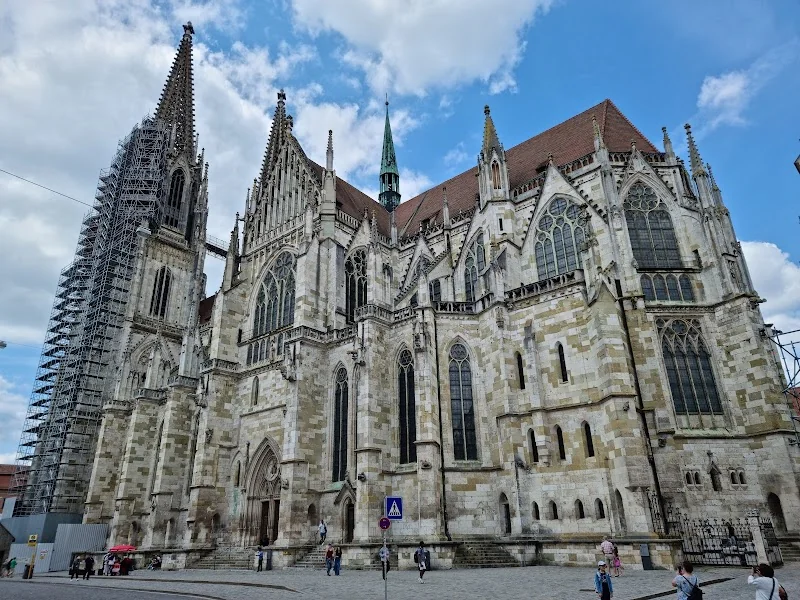
Domplatz 1, Regensburg
Domplatz 1, 93047 Regensburg, Germany
St. Peter Cathedral Regensburg | Tours & Opening Hours
The St. Peter Cathedral in Regensburg is much more than a landmark of the old town. It is the main and bishop's church of the Diocese of Regensburg, a place of prayer, a vibrant music center, and one of the most impressive examples of Gothic architecture in Germany. Entering the St. Peter Cathedral, one experiences not only a large church space but a historical total work of art made up of architecture, glass, sculpture, sound, and liturgy. The cathedral has shaped the cityscape since the 13th century, its towers are visible from afar, and its interiors combine medieval substance with later additions, restorations, and spiritual use. For many visitors, the cathedral is both a quiet retreat and a must-stop on any trip to Regensburg. This is why so many people search for opening hours, tours, stained glass windows, cathedral sparrows, directions, parking, and accessible access. This page consolidates the most important information in a clear, detailed overview and shows why the cathedral is not only architecturally but also culturally and spiritually one of the major highlights of the UNESCO World Heritage city.
Opening Hours, Tours, and Visiting Rules at St. Peter Cathedral
Those wishing to visit the St. Peter Cathedral in Regensburg should first know the seasonal opening hours. The cathedral is open for different lengths of time in winter and summer: from November to March, it is accessible on weekdays from 6:30 AM to 5:00 PM, from April, May, and October on weekdays from 6:30 AM to 6:00 PM, and from June to September on weekdays from 6:30 AM to 7:00 PM. On Sundays and public holidays, visiting starts at 1:00 PM and ends with the closing of the cathedral. This regulation is important because the cathedral always remains primarily a house of God and is not simply a museum. During services and special events, visits are not possible, and short-term partial closures in the interior can occur. This makes the visit to the cathedral somewhat more planning-intensive, but at the same time authentic: one enters a space that continues to function in the rhythm of church life. Those who prefer guided tours will find a professionally organized offer at the information and visitor center DOMPLATZ 5. Public cathedral tours without the cloister take place on weekdays at 12:30 PM, on weekends and public holidays at 2:30 PM. In the summer, additional tours with the cloister are offered from May to October, lasting about 75 minutes. For many guests, these tours are the best way to truly understand the cathedral, as they explain not only architecture and art but also construction history, liturgy, and symbolism. Participation is subject to a fee, but reasonably priced, and private tours can also be organized upon request. Those who wish to experience the cathedral as a quiet place can also benefit from the midday meditation, which takes place on weekdays at 12:00 PM and offers a particularly calm access to the cathedral.
The visiting rules are clear and practical at the same time. The cathedral is open for prayer and visits, but religious celebrations always take precedence. This means: those who want to see as much as possible should not arrive just before a mass but choose a time when there is enough space for an undisturbed tour. Especially on Sundays and public holidays, the period after 1:00 PM is recommended. For families, groups, and first-time visitors, the combination of free visiting and professional guiding is ideal, as it allows one to experience both the quiet atmosphere and the historical contexts. DOMPLATZ 5 is the central point of contact for questions about cathedral tours, bookings, and thematic tours. The information center is specifically designed to convey the cathedral not only as a building but as a living cultural site. This is particularly helpful for all those searching for terms like St. Peter Cathedral tours, Regensburg Cathedral opening hours, or Regensburg Cathedral visit. Those who inform themselves in advance can easily combine the visit with a walk through the old town and have the opportunity to experience the cathedral in different moods: calm in the morning, spiritual at noon, touristy lively in the afternoon, and as a quiet backdrop to the historic city in the evening.
Construction History and Gothic Architecture of the Regensburg Cathedral
The construction history of the Regensburg Cathedral is one of the most fascinating chapters of European Gothic. After a fire in 1273, the complete reconstruction of the present St. Peter Cathedral began in 1275/76, which was built as the third cathedral on this site. The work developed from east to west, starting with the choir. Thus, the construction follows a medieval logic, where the liturgical center was created first, and the entire space was oriented towards the altar area. The present cathedral is a testament to the high Gothic ambition, which sought to draw the building upwards and into the light. Like many great cathedrals, Regensburg was never fully completed in its original form. Around 1520, the work came to a standstill, and for centuries the towers stood as blunt ends in the cityscape. Only in the 19th century did the desire for a completion in the spirit of the Gothic Renaissance of the time grow. Between 1859 and 1869, the tower tops were erected under Bishop Ignatius von Senestrey and with the support of the Bavarian kings Ludwig I and Maximilian II. Thus, the towers received their current soaring profile, which still shapes the silhouette of the city today. The construction history is therefore not just a sequence of dates but a reflection of piety, political power, urban self-confidence, and art historical rediscovery. The cathedral is today one of the most significant achievements of Gothic architecture in Bavaria and at the same time a building that has continued to evolve over centuries.
When viewed from the inside, one quickly recognizes that not only a large space was created here but a consciously composed spiritual architecture. The nave, the choir, the light from the windows, and the vertical tension of the pillars create an impression of sublimity that often overwhelms visitors upon entry. In the 19th century, historical layers were also re-evaluated: in 1810, the cathedral fell to the Kingdom of Bavaria as a result of secularization and became a state building before later returning to the center as a church space. King Ludwig I had non-Gothic additions removed in 1835 to emphasize the medieval character. Such interventions show how strongly the perception of the cathedral has also been shaped by later generations. Particularly impressive is that the cathedral does not stand in isolation but is part of a large historical ensemble that defines the Regensburg old town. Visible from afar, detailed up close, and with an almost contemplative depth inside, St. Peter is one of those buildings that one does not just look at but learns to orient oneself within. Those searching for keywords like history, Gothic, UNESCO World Heritage, or Regensburg Cathedral architecture will find here an example of how a sacred building retains its shape over centuries while being continually reinterpreted.
Cathedral Sparrows, Cathedral Organ, and Musical Experiences in the Cathedral
Hardly any other feature shapes the St. Peter Cathedral in Regensburg as strongly as its music. The Regensburg Cathedral Sparrows are inseparably linked to the cathedral and are considered the oldest boys' choir in the world. Their origins date back to 975, when Bishop Wolfgang founded a cathedral school that placed a special emphasis on musical education alongside general education. From this tradition, a choral institution developed over centuries, which is now known far beyond Regensburg. The Cathedral Sparrows regularly shape services in the cathedral and are thus not only a concert choir but part of the liturgical identity of the place. Those searching for Regensburg Cathedral Sparrows are therefore not only looking for a famous name but a living musical organism that has filled the cathedral with sound for centuries. Especially during Sunday services and on church high festivals, the connection between space and voice is immediately tangible. This also applies to special musical evening prayers and spiritual concerts that transform the cathedral into a concentrated sound space. The choral tradition has evolved under various cathedral music directors and is currently led by Christian Heiß, who has been the cathedral music director since 2019.
The organ is also part of the musical identity of the cathedral. The Regensburg Cathedral is an important venue for organ concerts and organ music, and the cathedral organ is a significant attraction for many visitors. Those searching for Regensburg Cathedral organ or organ concerts will regularly find programs, tickets, and tours in the vicinity of the cathedral. Music here is not an addition but a central experience of the place. Especially in conjunction with the Gothic spatial effect, the organ unfolds a strong presence: the sound rises, fills the vaults, and connects architecture with liturgy. This musical profile is complemented by the cathedral's strong historical consciousness. The Cathedral Sparrows are not only a choir but a cultural trademark of the city of Regensburg. This explains why they appear in many search queries and why visitors frequently ask about concerts, performances, photos, and the history of the choir. For the visit to the cathedral, this means: even if one does not specifically plan a concert, one should check whether a musical service or spiritual program is currently taking place. Then one experiences the cathedral in a form that perhaps expresses its character most completely - as a place where stone, light, and music belong together.
Stained Glass Windows, West Facade, and Cathedral Treasure as Artistic Highlights
Among the most famous treasures of the Regensburg Cathedral are its stained glass windows. A total of 39 windows from the period of 1310 to 1450 shape the interior of the cathedral and comprise more than 1100 glass panes. They belong to the largest preserved collection of medieval stained glass in the German-speaking world. This is not only art-historically remarkable but also changes the spatial feeling: the light does not enter neutrally but is transformed into a sacred atmosphere through color, image, and craftsmanship. Visitors quickly notice that the light here is not simply functional but narrative. In addition, there is the silver altar in the choir, the stone sculptures in the interior and exterior, and the free-standing statue of the church patron Peter in the southern aisle. Among the artistic highlights is also the Annunciation group with Mary and the laughing angel. These details make the cathedral not only grand but also readable. One experiences how medieval and later artistic layers overlap and converse with each other. The cloister with its Gothic ribbed vaulting is also one of the most impressive parts of the complex, as are the cathedral towers, which shape the cityscape from afar.
The west facade is another highlight that attracts many visitors and photographers. From 1325, it grew over 200 years from the lower right to the upper left and is richly adorned with figures. 50 medieval stone figures and four relief representations shape the facade, complemented by around 170 figures and figurines at the main portal. This makes the west facade a densely staged image program that forms a unity with the architecture. The history of preservation is also exciting, as weathering and environmental influences have repeatedly led to restorations and replacements of individual figures. The cathedral treasure, which is currently closed and is expected to reopen in 2027, complements this artistic profile with precious liturgical objects and artisanal masterpieces. It is located in the historical rooms of the former episcopal residence with Renaissance frescoes and shows how closely faith, goldsmithing, and representative culture were connected in Regensburg. For search queries like cathedral treasure Regensburg, stained glass windows St. Peter Cathedral, west facade Regensburg, or St. Peter Cathedral photos, these details are crucial because they show what one can really see on site and why the cathedral has such a strong visual impact. Those who take their time will discover not only beautiful individual objects but a composed visual world where theology, history, and art come together in close quarters.
Directions, Parking, and Accessible Access Around the Cathedral Square
The St. Peter Cathedral is located in the heart of the historic center of Regensburg at Cathedral Square and is therefore particularly easily accessible on foot if one is already in the old town. For visitors arriving by car, it is important to know that the city center and the old town are traffic-calmed and that the official Regensburg information provides a number of central parking options. These include parking garages such as Arnulfsplatz, Dachauplatz, Petersweg, and Posthof, as well as open parking and P+R locations like Unterer Wöhrd and Dultplatz. Those wishing to visit the cathedral should therefore not hope for a direct parking space immediately at the entrance but consider the logic of the city center: first park, then walk into the old town and into Cathedral Square. However, this is part of the experience, as the walk through the historic city enhances the approach to the cathedral. Those arriving by bus or train also benefit from the fact that Regensburg, as a UNESCO World Heritage city, is well developed for tourism, and the cathedral is prominently marked on many city maps and visitor overviews. For groups arriving by tour buses, there are also designated stopping points and parking options in the city center area.
Especially important is the accessible access. Since 2010, St. Peter Cathedral has had a wheelchair-accessible entrance. The path leads through the cathedral garden past the cathedral construction office; the pavement has been replaced with large stone slabs, and the entrance is located at the northeast corner of the cathedral by the Eselsturm. An automatic sensor door further facilitates access. This makes the cathedral significantly more accessible for visitors with mobility impairments without compromising the historical character of the building. Those who rely on accessible routes, wheelchair access, or the shortest paths should plan this access specifically. Overall, it shows: the cathedral is indeed a medieval building in the heart of a historic old town, but it is very well accessible for today's visitors when one combines directions, parking, and paths correctly. In conjunction with tours from DOMPLATZ 5, a visit thus becomes one that is clear in organization and rich in culture. This is exactly why many people search for Regensburg Cathedral directions, Regensburg Cathedral parking, or St. Peter Cathedral accessible. The answer is a historic place that does not exclude its visitors but facilitates access with clear paths, public infrastructure, and a well-organized visitor center.
Why a Visit to the Regensburg Cathedral is Especially Worthwhile
The St. Peter Cathedral in Regensburg unites many elements that make an extraordinary place: centuries-old history, outstanding Gothic architecture, precious artworks, a vibrant liturgical use, and a musical tradition of international rank. Additionally, it is embedded in the UNESCO-protected old town, whose silhouette would hardly be imaginable without the towers of the cathedral. The cathedral is not a place to simply check off quickly. It unfolds its effect especially when one enters it with some time, attention, and calm. Those who only plan a few minutes will be impressed by the dimensions. However, those who know the construction history, pay attention to the stained glass windows, consciously observe the silver altar, or participate in a tour experience a multifaceted cultural and spiritual center. This makes the cathedral interesting for repeated visits as well. Each season, each light mood, and each form of use changes the impression. In summer, the cathedral is brighter and more open, in winter more concentrated and quieter, particularly powerful during music, and historically multifaceted during a tour. The interplay of these layers makes the cathedral one of the places in Regensburg that both tourists and locals can rediscover time and again.
So, those searching for St. Peter Cathedral Regensburg, Dom St. Peter Regensburg, Regensburg Cathedral opening hours, tours, or Cathedral Sparrows are fundamentally looking for a total experience. This is exactly the experience the cathedral offers: a building that has developed over centuries, an art space with outstanding windows and figures, a spiritual place with daily life, and a tourist magnet with clear visiting structures. Particularly practical is that a visit to the cathedral can be easily combined with the old town. This creates a day program that connects history, architecture, and atmosphere. The Regensburg Cathedral is not a loud place but a sustainable one. Those who visit often take away more than just a photo: light, sound, spatial feeling, and the memory of a place where history does not seem past but remains present.
Sources:
- DOMPLATZ 5 - St. Peter Cathedral
- DOMPLATZ 5 - Construction History of the Regensburg Cathedral
- DOMPLATZ 5 - Regensburg Cathedral Sparrows
- DOMPLATZ 5 - West Facade of the Regensburg Cathedral
- DOMPLATZ 5 - Cathedral Treasure
- Diocese of Regensburg - Opening Hours of the Regensburg Cathedral
- Regensburg Tourism GmbH - St. Peter's Cathedral
Show moreShow less
St. Peter Cathedral Regensburg | Tours & Opening Hours
The St. Peter Cathedral in Regensburg is much more than a landmark of the old town. It is the main and bishop's church of the Diocese of Regensburg, a place of prayer, a vibrant music center, and one of the most impressive examples of Gothic architecture in Germany. Entering the St. Peter Cathedral, one experiences not only a large church space but a historical total work of art made up of architecture, glass, sculpture, sound, and liturgy. The cathedral has shaped the cityscape since the 13th century, its towers are visible from afar, and its interiors combine medieval substance with later additions, restorations, and spiritual use. For many visitors, the cathedral is both a quiet retreat and a must-stop on any trip to Regensburg. This is why so many people search for opening hours, tours, stained glass windows, cathedral sparrows, directions, parking, and accessible access. This page consolidates the most important information in a clear, detailed overview and shows why the cathedral is not only architecturally but also culturally and spiritually one of the major highlights of the UNESCO World Heritage city.
Opening Hours, Tours, and Visiting Rules at St. Peter Cathedral
Those wishing to visit the St. Peter Cathedral in Regensburg should first know the seasonal opening hours. The cathedral is open for different lengths of time in winter and summer: from November to March, it is accessible on weekdays from 6:30 AM to 5:00 PM, from April, May, and October on weekdays from 6:30 AM to 6:00 PM, and from June to September on weekdays from 6:30 AM to 7:00 PM. On Sundays and public holidays, visiting starts at 1:00 PM and ends with the closing of the cathedral. This regulation is important because the cathedral always remains primarily a house of God and is not simply a museum. During services and special events, visits are not possible, and short-term partial closures in the interior can occur. This makes the visit to the cathedral somewhat more planning-intensive, but at the same time authentic: one enters a space that continues to function in the rhythm of church life. Those who prefer guided tours will find a professionally organized offer at the information and visitor center DOMPLATZ 5. Public cathedral tours without the cloister take place on weekdays at 12:30 PM, on weekends and public holidays at 2:30 PM. In the summer, additional tours with the cloister are offered from May to October, lasting about 75 minutes. For many guests, these tours are the best way to truly understand the cathedral, as they explain not only architecture and art but also construction history, liturgy, and symbolism. Participation is subject to a fee, but reasonably priced, and private tours can also be organized upon request. Those who wish to experience the cathedral as a quiet place can also benefit from the midday meditation, which takes place on weekdays at 12:00 PM and offers a particularly calm access to the cathedral.
The visiting rules are clear and practical at the same time. The cathedral is open for prayer and visits, but religious celebrations always take precedence. This means: those who want to see as much as possible should not arrive just before a mass but choose a time when there is enough space for an undisturbed tour. Especially on Sundays and public holidays, the period after 1:00 PM is recommended. For families, groups, and first-time visitors, the combination of free visiting and professional guiding is ideal, as it allows one to experience both the quiet atmosphere and the historical contexts. DOMPLATZ 5 is the central point of contact for questions about cathedral tours, bookings, and thematic tours. The information center is specifically designed to convey the cathedral not only as a building but as a living cultural site. This is particularly helpful for all those searching for terms like St. Peter Cathedral tours, Regensburg Cathedral opening hours, or Regensburg Cathedral visit. Those who inform themselves in advance can easily combine the visit with a walk through the old town and have the opportunity to experience the cathedral in different moods: calm in the morning, spiritual at noon, touristy lively in the afternoon, and as a quiet backdrop to the historic city in the evening.
Construction History and Gothic Architecture of the Regensburg Cathedral
The construction history of the Regensburg Cathedral is one of the most fascinating chapters of European Gothic. After a fire in 1273, the complete reconstruction of the present St. Peter Cathedral began in 1275/76, which was built as the third cathedral on this site. The work developed from east to west, starting with the choir. Thus, the construction follows a medieval logic, where the liturgical center was created first, and the entire space was oriented towards the altar area. The present cathedral is a testament to the high Gothic ambition, which sought to draw the building upwards and into the light. Like many great cathedrals, Regensburg was never fully completed in its original form. Around 1520, the work came to a standstill, and for centuries the towers stood as blunt ends in the cityscape. Only in the 19th century did the desire for a completion in the spirit of the Gothic Renaissance of the time grow. Between 1859 and 1869, the tower tops were erected under Bishop Ignatius von Senestrey and with the support of the Bavarian kings Ludwig I and Maximilian II. Thus, the towers received their current soaring profile, which still shapes the silhouette of the city today. The construction history is therefore not just a sequence of dates but a reflection of piety, political power, urban self-confidence, and art historical rediscovery. The cathedral is today one of the most significant achievements of Gothic architecture in Bavaria and at the same time a building that has continued to evolve over centuries.
When viewed from the inside, one quickly recognizes that not only a large space was created here but a consciously composed spiritual architecture. The nave, the choir, the light from the windows, and the vertical tension of the pillars create an impression of sublimity that often overwhelms visitors upon entry. In the 19th century, historical layers were also re-evaluated: in 1810, the cathedral fell to the Kingdom of Bavaria as a result of secularization and became a state building before later returning to the center as a church space. King Ludwig I had non-Gothic additions removed in 1835 to emphasize the medieval character. Such interventions show how strongly the perception of the cathedral has also been shaped by later generations. Particularly impressive is that the cathedral does not stand in isolation but is part of a large historical ensemble that defines the Regensburg old town. Visible from afar, detailed up close, and with an almost contemplative depth inside, St. Peter is one of those buildings that one does not just look at but learns to orient oneself within. Those searching for keywords like history, Gothic, UNESCO World Heritage, or Regensburg Cathedral architecture will find here an example of how a sacred building retains its shape over centuries while being continually reinterpreted.
Cathedral Sparrows, Cathedral Organ, and Musical Experiences in the Cathedral
Hardly any other feature shapes the St. Peter Cathedral in Regensburg as strongly as its music. The Regensburg Cathedral Sparrows are inseparably linked to the cathedral and are considered the oldest boys' choir in the world. Their origins date back to 975, when Bishop Wolfgang founded a cathedral school that placed a special emphasis on musical education alongside general education. From this tradition, a choral institution developed over centuries, which is now known far beyond Regensburg. The Cathedral Sparrows regularly shape services in the cathedral and are thus not only a concert choir but part of the liturgical identity of the place. Those searching for Regensburg Cathedral Sparrows are therefore not only looking for a famous name but a living musical organism that has filled the cathedral with sound for centuries. Especially during Sunday services and on church high festivals, the connection between space and voice is immediately tangible. This also applies to special musical evening prayers and spiritual concerts that transform the cathedral into a concentrated sound space. The choral tradition has evolved under various cathedral music directors and is currently led by Christian Heiß, who has been the cathedral music director since 2019.
The organ is also part of the musical identity of the cathedral. The Regensburg Cathedral is an important venue for organ concerts and organ music, and the cathedral organ is a significant attraction for many visitors. Those searching for Regensburg Cathedral organ or organ concerts will regularly find programs, tickets, and tours in the vicinity of the cathedral. Music here is not an addition but a central experience of the place. Especially in conjunction with the Gothic spatial effect, the organ unfolds a strong presence: the sound rises, fills the vaults, and connects architecture with liturgy. This musical profile is complemented by the cathedral's strong historical consciousness. The Cathedral Sparrows are not only a choir but a cultural trademark of the city of Regensburg. This explains why they appear in many search queries and why visitors frequently ask about concerts, performances, photos, and the history of the choir. For the visit to the cathedral, this means: even if one does not specifically plan a concert, one should check whether a musical service or spiritual program is currently taking place. Then one experiences the cathedral in a form that perhaps expresses its character most completely - as a place where stone, light, and music belong together.
Stained Glass Windows, West Facade, and Cathedral Treasure as Artistic Highlights
Among the most famous treasures of the Regensburg Cathedral are its stained glass windows. A total of 39 windows from the period of 1310 to 1450 shape the interior of the cathedral and comprise more than 1100 glass panes. They belong to the largest preserved collection of medieval stained glass in the German-speaking world. This is not only art-historically remarkable but also changes the spatial feeling: the light does not enter neutrally but is transformed into a sacred atmosphere through color, image, and craftsmanship. Visitors quickly notice that the light here is not simply functional but narrative. In addition, there is the silver altar in the choir, the stone sculptures in the interior and exterior, and the free-standing statue of the church patron Peter in the southern aisle. Among the artistic highlights is also the Annunciation group with Mary and the laughing angel. These details make the cathedral not only grand but also readable. One experiences how medieval and later artistic layers overlap and converse with each other. The cloister with its Gothic ribbed vaulting is also one of the most impressive parts of the complex, as are the cathedral towers, which shape the cityscape from afar.
The west facade is another highlight that attracts many visitors and photographers. From 1325, it grew over 200 years from the lower right to the upper left and is richly adorned with figures. 50 medieval stone figures and four relief representations shape the facade, complemented by around 170 figures and figurines at the main portal. This makes the west facade a densely staged image program that forms a unity with the architecture. The history of preservation is also exciting, as weathering and environmental influences have repeatedly led to restorations and replacements of individual figures. The cathedral treasure, which is currently closed and is expected to reopen in 2027, complements this artistic profile with precious liturgical objects and artisanal masterpieces. It is located in the historical rooms of the former episcopal residence with Renaissance frescoes and shows how closely faith, goldsmithing, and representative culture were connected in Regensburg. For search queries like cathedral treasure Regensburg, stained glass windows St. Peter Cathedral, west facade Regensburg, or St. Peter Cathedral photos, these details are crucial because they show what one can really see on site and why the cathedral has such a strong visual impact. Those who take their time will discover not only beautiful individual objects but a composed visual world where theology, history, and art come together in close quarters.
Directions, Parking, and Accessible Access Around the Cathedral Square
The St. Peter Cathedral is located in the heart of the historic center of Regensburg at Cathedral Square and is therefore particularly easily accessible on foot if one is already in the old town. For visitors arriving by car, it is important to know that the city center and the old town are traffic-calmed and that the official Regensburg information provides a number of central parking options. These include parking garages such as Arnulfsplatz, Dachauplatz, Petersweg, and Posthof, as well as open parking and P+R locations like Unterer Wöhrd and Dultplatz. Those wishing to visit the cathedral should therefore not hope for a direct parking space immediately at the entrance but consider the logic of the city center: first park, then walk into the old town and into Cathedral Square. However, this is part of the experience, as the walk through the historic city enhances the approach to the cathedral. Those arriving by bus or train also benefit from the fact that Regensburg, as a UNESCO World Heritage city, is well developed for tourism, and the cathedral is prominently marked on many city maps and visitor overviews. For groups arriving by tour buses, there are also designated stopping points and parking options in the city center area.
Especially important is the accessible access. Since 2010, St. Peter Cathedral has had a wheelchair-accessible entrance. The path leads through the cathedral garden past the cathedral construction office; the pavement has been replaced with large stone slabs, and the entrance is located at the northeast corner of the cathedral by the Eselsturm. An automatic sensor door further facilitates access. This makes the cathedral significantly more accessible for visitors with mobility impairments without compromising the historical character of the building. Those who rely on accessible routes, wheelchair access, or the shortest paths should plan this access specifically. Overall, it shows: the cathedral is indeed a medieval building in the heart of a historic old town, but it is very well accessible for today's visitors when one combines directions, parking, and paths correctly. In conjunction with tours from DOMPLATZ 5, a visit thus becomes one that is clear in organization and rich in culture. This is exactly why many people search for Regensburg Cathedral directions, Regensburg Cathedral parking, or St. Peter Cathedral accessible. The answer is a historic place that does not exclude its visitors but facilitates access with clear paths, public infrastructure, and a well-organized visitor center.
Why a Visit to the Regensburg Cathedral is Especially Worthwhile
The St. Peter Cathedral in Regensburg unites many elements that make an extraordinary place: centuries-old history, outstanding Gothic architecture, precious artworks, a vibrant liturgical use, and a musical tradition of international rank. Additionally, it is embedded in the UNESCO-protected old town, whose silhouette would hardly be imaginable without the towers of the cathedral. The cathedral is not a place to simply check off quickly. It unfolds its effect especially when one enters it with some time, attention, and calm. Those who only plan a few minutes will be impressed by the dimensions. However, those who know the construction history, pay attention to the stained glass windows, consciously observe the silver altar, or participate in a tour experience a multifaceted cultural and spiritual center. This makes the cathedral interesting for repeated visits as well. Each season, each light mood, and each form of use changes the impression. In summer, the cathedral is brighter and more open, in winter more concentrated and quieter, particularly powerful during music, and historically multifaceted during a tour. The interplay of these layers makes the cathedral one of the places in Regensburg that both tourists and locals can rediscover time and again.
So, those searching for St. Peter Cathedral Regensburg, Dom St. Peter Regensburg, Regensburg Cathedral opening hours, tours, or Cathedral Sparrows are fundamentally looking for a total experience. This is exactly the experience the cathedral offers: a building that has developed over centuries, an art space with outstanding windows and figures, a spiritual place with daily life, and a tourist magnet with clear visiting structures. Particularly practical is that a visit to the cathedral can be easily combined with the old town. This creates a day program that connects history, architecture, and atmosphere. The Regensburg Cathedral is not a loud place but a sustainable one. Those who visit often take away more than just a photo: light, sound, spatial feeling, and the memory of a place where history does not seem past but remains present.
Sources:
- DOMPLATZ 5 - St. Peter Cathedral
- DOMPLATZ 5 - Construction History of the Regensburg Cathedral
- DOMPLATZ 5 - Regensburg Cathedral Sparrows
- DOMPLATZ 5 - West Facade of the Regensburg Cathedral
- DOMPLATZ 5 - Cathedral Treasure
- Diocese of Regensburg - Opening Hours of the Regensburg Cathedral
- Regensburg Tourism GmbH - St. Peter's Cathedral
St. Peter Cathedral Regensburg | Tours & Opening Hours
The St. Peter Cathedral in Regensburg is much more than a landmark of the old town. It is the main and bishop's church of the Diocese of Regensburg, a place of prayer, a vibrant music center, and one of the most impressive examples of Gothic architecture in Germany. Entering the St. Peter Cathedral, one experiences not only a large church space but a historical total work of art made up of architecture, glass, sculpture, sound, and liturgy. The cathedral has shaped the cityscape since the 13th century, its towers are visible from afar, and its interiors combine medieval substance with later additions, restorations, and spiritual use. For many visitors, the cathedral is both a quiet retreat and a must-stop on any trip to Regensburg. This is why so many people search for opening hours, tours, stained glass windows, cathedral sparrows, directions, parking, and accessible access. This page consolidates the most important information in a clear, detailed overview and shows why the cathedral is not only architecturally but also culturally and spiritually one of the major highlights of the UNESCO World Heritage city.
Opening Hours, Tours, and Visiting Rules at St. Peter Cathedral
Those wishing to visit the St. Peter Cathedral in Regensburg should first know the seasonal opening hours. The cathedral is open for different lengths of time in winter and summer: from November to March, it is accessible on weekdays from 6:30 AM to 5:00 PM, from April, May, and October on weekdays from 6:30 AM to 6:00 PM, and from June to September on weekdays from 6:30 AM to 7:00 PM. On Sundays and public holidays, visiting starts at 1:00 PM and ends with the closing of the cathedral. This regulation is important because the cathedral always remains primarily a house of God and is not simply a museum. During services and special events, visits are not possible, and short-term partial closures in the interior can occur. This makes the visit to the cathedral somewhat more planning-intensive, but at the same time authentic: one enters a space that continues to function in the rhythm of church life. Those who prefer guided tours will find a professionally organized offer at the information and visitor center DOMPLATZ 5. Public cathedral tours without the cloister take place on weekdays at 12:30 PM, on weekends and public holidays at 2:30 PM. In the summer, additional tours with the cloister are offered from May to October, lasting about 75 minutes. For many guests, these tours are the best way to truly understand the cathedral, as they explain not only architecture and art but also construction history, liturgy, and symbolism. Participation is subject to a fee, but reasonably priced, and private tours can also be organized upon request. Those who wish to experience the cathedral as a quiet place can also benefit from the midday meditation, which takes place on weekdays at 12:00 PM and offers a particularly calm access to the cathedral.
The visiting rules are clear and practical at the same time. The cathedral is open for prayer and visits, but religious celebrations always take precedence. This means: those who want to see as much as possible should not arrive just before a mass but choose a time when there is enough space for an undisturbed tour. Especially on Sundays and public holidays, the period after 1:00 PM is recommended. For families, groups, and first-time visitors, the combination of free visiting and professional guiding is ideal, as it allows one to experience both the quiet atmosphere and the historical contexts. DOMPLATZ 5 is the central point of contact for questions about cathedral tours, bookings, and thematic tours. The information center is specifically designed to convey the cathedral not only as a building but as a living cultural site. This is particularly helpful for all those searching for terms like St. Peter Cathedral tours, Regensburg Cathedral opening hours, or Regensburg Cathedral visit. Those who inform themselves in advance can easily combine the visit with a walk through the old town and have the opportunity to experience the cathedral in different moods: calm in the morning, spiritual at noon, touristy lively in the afternoon, and as a quiet backdrop to the historic city in the evening.
Construction History and Gothic Architecture of the Regensburg Cathedral
The construction history of the Regensburg Cathedral is one of the most fascinating chapters of European Gothic. After a fire in 1273, the complete reconstruction of the present St. Peter Cathedral began in 1275/76, which was built as the third cathedral on this site. The work developed from east to west, starting with the choir. Thus, the construction follows a medieval logic, where the liturgical center was created first, and the entire space was oriented towards the altar area. The present cathedral is a testament to the high Gothic ambition, which sought to draw the building upwards and into the light. Like many great cathedrals, Regensburg was never fully completed in its original form. Around 1520, the work came to a standstill, and for centuries the towers stood as blunt ends in the cityscape. Only in the 19th century did the desire for a completion in the spirit of the Gothic Renaissance of the time grow. Between 1859 and 1869, the tower tops were erected under Bishop Ignatius von Senestrey and with the support of the Bavarian kings Ludwig I and Maximilian II. Thus, the towers received their current soaring profile, which still shapes the silhouette of the city today. The construction history is therefore not just a sequence of dates but a reflection of piety, political power, urban self-confidence, and art historical rediscovery. The cathedral is today one of the most significant achievements of Gothic architecture in Bavaria and at the same time a building that has continued to evolve over centuries.
When viewed from the inside, one quickly recognizes that not only a large space was created here but a consciously composed spiritual architecture. The nave, the choir, the light from the windows, and the vertical tension of the pillars create an impression of sublimity that often overwhelms visitors upon entry. In the 19th century, historical layers were also re-evaluated: in 1810, the cathedral fell to the Kingdom of Bavaria as a result of secularization and became a state building before later returning to the center as a church space. King Ludwig I had non-Gothic additions removed in 1835 to emphasize the medieval character. Such interventions show how strongly the perception of the cathedral has also been shaped by later generations. Particularly impressive is that the cathedral does not stand in isolation but is part of a large historical ensemble that defines the Regensburg old town. Visible from afar, detailed up close, and with an almost contemplative depth inside, St. Peter is one of those buildings that one does not just look at but learns to orient oneself within. Those searching for keywords like history, Gothic, UNESCO World Heritage, or Regensburg Cathedral architecture will find here an example of how a sacred building retains its shape over centuries while being continually reinterpreted.
Cathedral Sparrows, Cathedral Organ, and Musical Experiences in the Cathedral
Hardly any other feature shapes the St. Peter Cathedral in Regensburg as strongly as its music. The Regensburg Cathedral Sparrows are inseparably linked to the cathedral and are considered the oldest boys' choir in the world. Their origins date back to 975, when Bishop Wolfgang founded a cathedral school that placed a special emphasis on musical education alongside general education. From this tradition, a choral institution developed over centuries, which is now known far beyond Regensburg. The Cathedral Sparrows regularly shape services in the cathedral and are thus not only a concert choir but part of the liturgical identity of the place. Those searching for Regensburg Cathedral Sparrows are therefore not only looking for a famous name but a living musical organism that has filled the cathedral with sound for centuries. Especially during Sunday services and on church high festivals, the connection between space and voice is immediately tangible. This also applies to special musical evening prayers and spiritual concerts that transform the cathedral into a concentrated sound space. The choral tradition has evolved under various cathedral music directors and is currently led by Christian Heiß, who has been the cathedral music director since 2019.
The organ is also part of the musical identity of the cathedral. The Regensburg Cathedral is an important venue for organ concerts and organ music, and the cathedral organ is a significant attraction for many visitors. Those searching for Regensburg Cathedral organ or organ concerts will regularly find programs, tickets, and tours in the vicinity of the cathedral. Music here is not an addition but a central experience of the place. Especially in conjunction with the Gothic spatial effect, the organ unfolds a strong presence: the sound rises, fills the vaults, and connects architecture with liturgy. This musical profile is complemented by the cathedral's strong historical consciousness. The Cathedral Sparrows are not only a choir but a cultural trademark of the city of Regensburg. This explains why they appear in many search queries and why visitors frequently ask about concerts, performances, photos, and the history of the choir. For the visit to the cathedral, this means: even if one does not specifically plan a concert, one should check whether a musical service or spiritual program is currently taking place. Then one experiences the cathedral in a form that perhaps expresses its character most completely - as a place where stone, light, and music belong together.
Stained Glass Windows, West Facade, and Cathedral Treasure as Artistic Highlights
Among the most famous treasures of the Regensburg Cathedral are its stained glass windows. A total of 39 windows from the period of 1310 to 1450 shape the interior of the cathedral and comprise more than 1100 glass panes. They belong to the largest preserved collection of medieval stained glass in the German-speaking world. This is not only art-historically remarkable but also changes the spatial feeling: the light does not enter neutrally but is transformed into a sacred atmosphere through color, image, and craftsmanship. Visitors quickly notice that the light here is not simply functional but narrative. In addition, there is the silver altar in the choir, the stone sculptures in the interior and exterior, and the free-standing statue of the church patron Peter in the southern aisle. Among the artistic highlights is also the Annunciation group with Mary and the laughing angel. These details make the cathedral not only grand but also readable. One experiences how medieval and later artistic layers overlap and converse with each other. The cloister with its Gothic ribbed vaulting is also one of the most impressive parts of the complex, as are the cathedral towers, which shape the cityscape from afar.
The west facade is another highlight that attracts many visitors and photographers. From 1325, it grew over 200 years from the lower right to the upper left and is richly adorned with figures. 50 medieval stone figures and four relief representations shape the facade, complemented by around 170 figures and figurines at the main portal. This makes the west facade a densely staged image program that forms a unity with the architecture. The history of preservation is also exciting, as weathering and environmental influences have repeatedly led to restorations and replacements of individual figures. The cathedral treasure, which is currently closed and is expected to reopen in 2027, complements this artistic profile with precious liturgical objects and artisanal masterpieces. It is located in the historical rooms of the former episcopal residence with Renaissance frescoes and shows how closely faith, goldsmithing, and representative culture were connected in Regensburg. For search queries like cathedral treasure Regensburg, stained glass windows St. Peter Cathedral, west facade Regensburg, or St. Peter Cathedral photos, these details are crucial because they show what one can really see on site and why the cathedral has such a strong visual impact. Those who take their time will discover not only beautiful individual objects but a composed visual world where theology, history, and art come together in close quarters.
Directions, Parking, and Accessible Access Around the Cathedral Square
The St. Peter Cathedral is located in the heart of the historic center of Regensburg at Cathedral Square and is therefore particularly easily accessible on foot if one is already in the old town. For visitors arriving by car, it is important to know that the city center and the old town are traffic-calmed and that the official Regensburg information provides a number of central parking options. These include parking garages such as Arnulfsplatz, Dachauplatz, Petersweg, and Posthof, as well as open parking and P+R locations like Unterer Wöhrd and Dultplatz. Those wishing to visit the cathedral should therefore not hope for a direct parking space immediately at the entrance but consider the logic of the city center: first park, then walk into the old town and into Cathedral Square. However, this is part of the experience, as the walk through the historic city enhances the approach to the cathedral. Those arriving by bus or train also benefit from the fact that Regensburg, as a UNESCO World Heritage city, is well developed for tourism, and the cathedral is prominently marked on many city maps and visitor overviews. For groups arriving by tour buses, there are also designated stopping points and parking options in the city center area.
Especially important is the accessible access. Since 2010, St. Peter Cathedral has had a wheelchair-accessible entrance. The path leads through the cathedral garden past the cathedral construction office; the pavement has been replaced with large stone slabs, and the entrance is located at the northeast corner of the cathedral by the Eselsturm. An automatic sensor door further facilitates access. This makes the cathedral significantly more accessible for visitors with mobility impairments without compromising the historical character of the building. Those who rely on accessible routes, wheelchair access, or the shortest paths should plan this access specifically. Overall, it shows: the cathedral is indeed a medieval building in the heart of a historic old town, but it is very well accessible for today's visitors when one combines directions, parking, and paths correctly. In conjunction with tours from DOMPLATZ 5, a visit thus becomes one that is clear in organization and rich in culture. This is exactly why many people search for Regensburg Cathedral directions, Regensburg Cathedral parking, or St. Peter Cathedral accessible. The answer is a historic place that does not exclude its visitors but facilitates access with clear paths, public infrastructure, and a well-organized visitor center.
Why a Visit to the Regensburg Cathedral is Especially Worthwhile
The St. Peter Cathedral in Regensburg unites many elements that make an extraordinary place: centuries-old history, outstanding Gothic architecture, precious artworks, a vibrant liturgical use, and a musical tradition of international rank. Additionally, it is embedded in the UNESCO-protected old town, whose silhouette would hardly be imaginable without the towers of the cathedral. The cathedral is not a place to simply check off quickly. It unfolds its effect especially when one enters it with some time, attention, and calm. Those who only plan a few minutes will be impressed by the dimensions. However, those who know the construction history, pay attention to the stained glass windows, consciously observe the silver altar, or participate in a tour experience a multifaceted cultural and spiritual center. This makes the cathedral interesting for repeated visits as well. Each season, each light mood, and each form of use changes the impression. In summer, the cathedral is brighter and more open, in winter more concentrated and quieter, particularly powerful during music, and historically multifaceted during a tour. The interplay of these layers makes the cathedral one of the places in Regensburg that both tourists and locals can rediscover time and again.
So, those searching for St. Peter Cathedral Regensburg, Dom St. Peter Regensburg, Regensburg Cathedral opening hours, tours, or Cathedral Sparrows are fundamentally looking for a total experience. This is exactly the experience the cathedral offers: a building that has developed over centuries, an art space with outstanding windows and figures, a spiritual place with daily life, and a tourist magnet with clear visiting structures. Particularly practical is that a visit to the cathedral can be easily combined with the old town. This creates a day program that connects history, architecture, and atmosphere. The Regensburg Cathedral is not a loud place but a sustainable one. Those who visit often take away more than just a photo: light, sound, spatial feeling, and the memory of a place where history does not seem past but remains present.
Sources:
- DOMPLATZ 5 - St. Peter Cathedral
- DOMPLATZ 5 - Construction History of the Regensburg Cathedral
- DOMPLATZ 5 - Regensburg Cathedral Sparrows
- DOMPLATZ 5 - West Facade of the Regensburg Cathedral
- DOMPLATZ 5 - Cathedral Treasure
- Diocese of Regensburg - Opening Hours of the Regensburg Cathedral
- Regensburg Tourism GmbH - St. Peter's Cathedral

Frequently Asked Questions
Reviews
Denys
9. November 2025
The cathedral is truly impressive! A magnificent structure that’s hundreds of years old. I can’t even say whether I liked it more from the outside or the inside. Every day in summer, the organ plays at noon, it’s absolutely amazing! An architectural masterpiece that definitely deserves attention. The only downside is that the exterior has been under renovation for many years.
Adriel Ruiz
23. December 2025
We arrived too late to go inside, but even from the outside, St. Peter Cathedral is absolutely stunning. The gothic architecture is impressive and full of detail—it really stands out in the heart of Regensburg. There was some construction during our visit, but it didn’t take away from the experience. We’d love to come back earlier next time to explore the inside!
Seimen Burum
23. October 2025
Massive pure German gothic church that was built from the end of the 13th to the beginning of the 16th century using the architecture of French cathedrals as an example. The inside is dark and has beautiful details like the silver altar. The stained glass windows from the 13th and 14th century are impressive and the most extensive, still preserved, collection of medieval stained glass in the German-speaking world. An interesting detail was a large waterwell with a hoist and bucket inside the church which was used as a secure source of water for the clergy, cathedral staff and cleaning.
Curtis Trindal
21. January 2026
When I went it was a cloudy and gloomy day. I think that added more to the churches outward mystique. My experience shows that Germany has marvelous designs of their building. I had almost mistaken this for the Cologne Cathedral. Inside is a marvel too.
Sharon Williams
17. December 2025
Just a stunning cathedral. Stained glass is gorgeous & although I am not that religious, I did light a candle for my parents inside.❤️❤️ P.s., no cost to enter & walk through.