
Am Ölberg 1, Regensburg
Am Ölberg 1, 93047 Regensburg, Germany
Trinity Church Regensburg | Tower & Bach Organ
The Trinity Church in Regensburg, in German Dreieinigkeitskirche, is located at Ölberg in the middle of the historic old town and today belongs to the Evangelical-Lutheran Congregation Regensburg Neupfarr- and Dreieinigkeitskirche. Those who visit this place experience not only a house of worship but also a compact piece of Regensburg's city history with architecture, music, memorial culture, and views. The church is an early Baroque building from the time of the Thirty Years' War, its tower opens the view over the roofs of the old town, and directly behind it lies the Gesandtenfriedhof as an extraordinary monument of European history. For visitors, the location is therefore equally interesting for city walks, quiet contemplation, guided tours, cultural events, and concert evenings. The mix of historical substance and vibrant use makes the Dreieinigkeitskirche a destination that one can discover not just once but repeatedly anew.
Opening Hours, Tower Climb, and Admission Prices
Those who want to experience the Dreieinigkeitskirche as a sight should plan their visit well according to the opening hours. According to the congregation, the tower is open during the summer from the last weekend in March to the last weekend in October. During this period, one can climb up from Wednesday to Sunday from 12:00 to 18:00. In winter, the tower remains closed. Additionally, it is important to note that there may be temporary closures during church events. This is helpful for planning if one wants to combine the visit with a city tour or a concert.
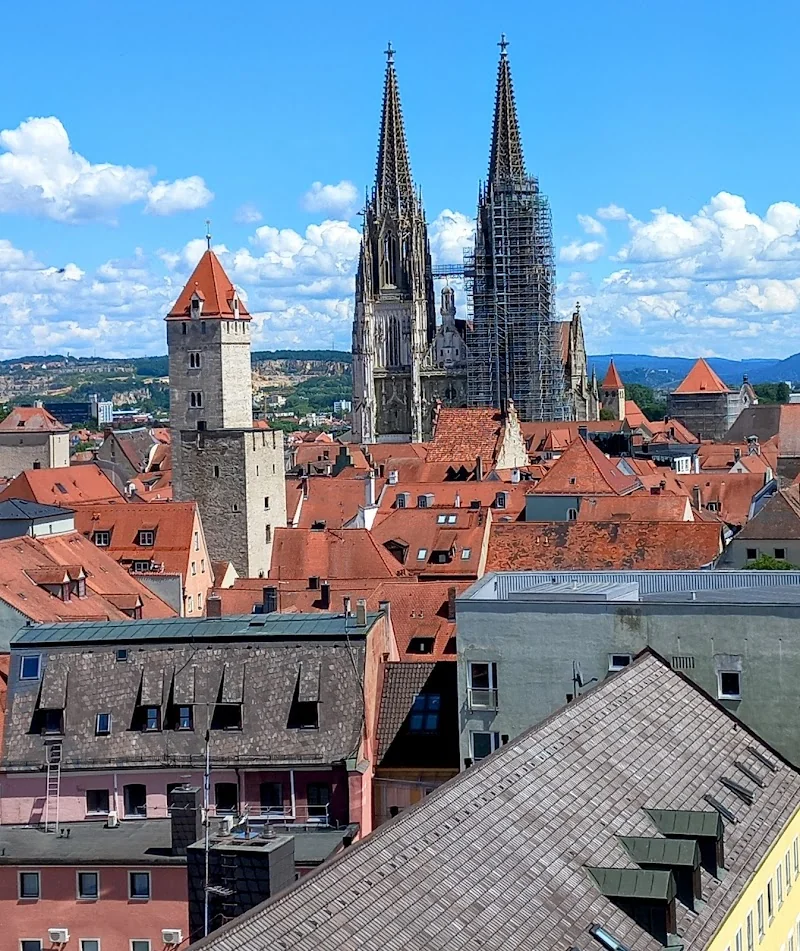
The tower climb is more than just a short attraction. The north tower comprises eight floors and houses a small museum on the history and significance of the church, along with exhibits on the west gallery. Once at the top, a wide view opens over the Regensburg old town, the cathedral, and deep into the hinterland. This panoramic view is one of the reasons why the Dreieinigkeitskirche is so popular among city visitors. The admission prices are deliberately kept low: regular admission costs 3 euros, reduced 2 euros, and families 5 euros. The entire admission fee goes towards building maintenance, making the visit also sensible from a heritage conservation perspective. Those who want to see more than just the tower can book group tours upon request; according to the congregation, these should be arranged at least a week in advance at the parish office. Thus, a spontaneous stop quickly turns into a well-informed visit with historical value.
History of the Dreieinigkeitskirche in Regensburg
The history of the Dreieinigkeitskirche begins in a time of great upheaval. With the introduction of the Reformation in 1542, Regensburg became Protestant, but the confessional situation remained tense in the 17th century. Initially, the congregation had several churches, but later there was an acute shortage of places of worship, not least due to the loss of the Dominican church in 1628 and the influx of numerous religious refugees from the Upper Palatinate and Austria. In this situation, the Protestant congregation decided in February 1627 to build a new church. Construction began in July of the same year and was completed in December 1631. The Regensburg fortress builder Johann Carl was commissioned with the planning. The church is considered the first originally Protestant church building in southern Germany and still stands for the Reformation's understanding of worship.
Architecturally, the Dreieinigkeitskirche is remarkable because it was designed as a bright, column-free hall building. This was unusual for the time and made the building widely known in the following decades. The surrounding wooden galleries are not supported by vertical columns but anchored in the outer walls, allowing for an unobstructed view of the altar and pulpit from all seats. This sightline corresponded to Lutheran ideas of preaching and congregation. The construction of the barrel vault was also innovative, as the entire weight of the roof rests on the outer walls, while the vault is anchored back in the roof structure. Historically, the church offered more than 1,000 seats. Its external appearance was so fortress-like that it almost appeared like a castle from the outside. The south tower and the adjacent sacristy could only be provisionally completed after construction because Bavarian troops plundered the city treasury in April 1632 while fleeing from the Swedes. Nevertheless, the building has largely remained unchanged and is still an impressive testament to early Protestantism in southern Germany.
Bach Organ, Music, and Concerts
Another central reason for the popularity of the Dreieinigkeitskirche is its organ tradition. As early as 1758, the church received a large organ from the Regensburg organ builder Franz Jakob Späth. Today, only the historical case and a few pipes of this instrument remain, but the musical history of the place is by no means concluded. After an interior renovation, a new Bach organ by Hendrik Ahrend was installed in spring 2020 and was ceremoniously inaugurated on September 27, 2020. The instrument is specifically designed to represent the music of Johann Sebastian Bach and the central German organ tradition. It has 30 registers and around 2,500 pipes; the total cost was about 1.3 million euros. These figures make it clear that the Dreieinigkeitskirche is not only a monument but also an active sound space.
The musical use fits excellently with the spatial effect of the church. The bright, clear interior and the good visibility from all seats create ideal conditions for services and concerts. The congregation explicitly points out that the church space invites to services and musical events. Regensburg has a strong church music tradition overall, and the Dreieinigkeitskirche seamlessly integrates with its Bach organ into this profile. Particularly for visitors looking for a concert venue, organ music, or spiritual music, this location is highly interesting. Additionally, regular cultural formats can take place on the grounds, such as tours, organ events, or light art as part of city programs. The church was, for example, part of the RE.LIGHT festival, which shows that historical architecture and contemporary art can find a good match in this space. So, for those looking for a place where history becomes audible and tangible, the Dreieinigkeitskirche offers a particularly strong example.
Gesandtenfriedhof: Monument of European Importance
Behind the Dreieinigkeitskirche lies the Gesandtenfriedhof, one of the most impressive historical ensembles in the city. This cemetery is not just a side show but an independent monument of European importance. It was first occupied in 1633, and as early as 1634, the city council rejected the erection of epitaphs in and on the church. After a multi-year burial ban, members of imperial delegations and Protestant exiles from Austria were regularly buried from 1653 onwards. The cemetery thus became the final resting place for diplomats, envoys, and members of the political and religious world that shaped Regensburg for centuries. The close connection to the Permanent Diet makes the place particularly exciting for history-interested travelers.
Today, 24-meter-high wall monuments and 32 grave slabs are still preserved in the Gesandtenfriedhof. They tell of power, wealth, political responsibility, and private fates between 1633 and 1805. The monumental design of the epitaphs with standing figures, busts, wigs, skulls, and angels makes the cemetery an extraordinary place of remembrance. The cemetery was paved in 1735, the last burial took place in 1805, and the fountain system was dismantled in 1835. Since 2023, a comprehensive renovation has been underway to secure the value of the monument in the long term. Admission is free, and the cemetery is accessible during the tower opening hours from March to October. Therefore, anyone visiting the church should definitely also go behind the church nave. The Gesandtenfriedhof expands the church visit with a political and European perspective that is rarely found in such density. It is thus not just a quiet place but a historical archive in the open air.
Access, Parking, and Accessibility in the Old Town
The Dreieinigkeitskirche is located at Am Ölberg 1, 93047 Regensburg, right in the old town. This location is both an advantage because it can be easily integrated into a walk through the UNESCO World Heritage site. On the other hand, it also means that access and parking should be carefully planned. The official pages of the church do not mention a dedicated visitor parking garage. The city of Regensburg points out bundled parking options and the system of downtown parking garages for the old town. Therefore, for visitors, a parking garage in the old town or a parking space on the outskirts of the city center is usually the most practical solution, from where the rest of the way is covered on foot. This combination of parking on the edge and walking through the historic city center fits well with the character of the place.
Accessibility is also relevant for planning. The municipal Regensburg guide mentions a step access at the west portal and a mobile ramp if needed. This shows that access is generally possible but not completely level. Those traveling with a wheelchair, walking aid, or stroller should therefore check in advance which paths are best suited. In the same municipal overview of venues, the Dreieinigkeitskirche is listed as a church with 620 seats and an organ, making the place relevant for concerts and events. Due to its location in the old town, it is also worth planning enough time for the walk. The church is best experienced when it is not approached as an isolated point but viewed as part of a tour of the old town with the cathedral, the streets at Ölberg, the Gesandtenfriedhof, and other sights. Thus, the journey itself becomes a piece of city experience, and the historical surroundings unfold their effect even before entering the church.
Events, Tours, and Visiting Tips for the Dreieinigkeitskirche
The Dreieinigkeitskirche is not just a monument but an active cultural and event location. Visitors will find services, concerts, tours, and thematic visits here. The official tourism website of the city of Regensburg explicitly recommends the tower climb and refers to the Gesandtenfriedhof as a special highlight behind the church. At the same time, the Bach organ shows that the place is used musically. Those who want to attend a concert or a tour should always check the current schedule, as the space is actively used and may be restricted on certain days. The particularly appealing aspect is the combination of historical architecture and modern cultural programs. The Dreieinigkeitskirche thus does not function like a closed museum but as a place where history, faith, and the present intertwine.
For practical visits, a clear plan is worthwhile. Those who want to climb the tower should come best in the second half of the day between 12:00 and 18:00 when the opening hours are. Those who want to view the Gesandtenfriedhof in peace can combine both in a tour and then continue walking through the old town. Those who love music should specifically search the church for concerts or organ events, as the Bach organ is a central feature of the house. And those interested in architecture should spend enough time in the interior to perceive the column-free construction, the galleries, and the clear sightline from every seat. This mix of good accessibility, quiet atmosphere, historical depth, and cultural use makes the Dreieinigkeitskirche a place suitable for both first visits and repeat visits. It is a Regensburg classic, but by no means just a must-see. Those who experience it consciously quickly understand why this place remains so present to this day.
Sources:
- Ev.-Luth. Neupfarr- and Dreieinigkeitskirche Regensburg - History of the Dreieinigkeitskirche
- Ev.-Luth. Neupfarr- and Dreieinigkeitskirche Regensburg - Tower of the Dreieinigkeitskirche
- Ev.-Luth. Neupfarr- and Dreieinigkeitskirche Regensburg - Bach Organ
- Ev.-Luth. Neupfarr- and Dreieinigkeitskirche Regensburg - Gesandtenfriedhof
- Regensburg Tourism GmbH - Dreieinigkeitskirche
- City of Regensburg - Event Venues Regensburg
- City of Regensburg - Barrier-Free in Regensburg
- City of Regensburg - Traffic Calming Old Town
Show moreShow less
Trinity Church Regensburg | Tower & Bach Organ
The Trinity Church in Regensburg, in German Dreieinigkeitskirche, is located at Ölberg in the middle of the historic old town and today belongs to the Evangelical-Lutheran Congregation Regensburg Neupfarr- and Dreieinigkeitskirche. Those who visit this place experience not only a house of worship but also a compact piece of Regensburg's city history with architecture, music, memorial culture, and views. The church is an early Baroque building from the time of the Thirty Years' War, its tower opens the view over the roofs of the old town, and directly behind it lies the Gesandtenfriedhof as an extraordinary monument of European history. For visitors, the location is therefore equally interesting for city walks, quiet contemplation, guided tours, cultural events, and concert evenings. The mix of historical substance and vibrant use makes the Dreieinigkeitskirche a destination that one can discover not just once but repeatedly anew.
Opening Hours, Tower Climb, and Admission Prices
Those who want to experience the Dreieinigkeitskirche as a sight should plan their visit well according to the opening hours. According to the congregation, the tower is open during the summer from the last weekend in March to the last weekend in October. During this period, one can climb up from Wednesday to Sunday from 12:00 to 18:00. In winter, the tower remains closed. Additionally, it is important to note that there may be temporary closures during church events. This is helpful for planning if one wants to combine the visit with a city tour or a concert.
The tower climb is more than just a short attraction. The north tower comprises eight floors and houses a small museum on the history and significance of the church, along with exhibits on the west gallery. Once at the top, a wide view opens over the Regensburg old town, the cathedral, and deep into the hinterland. This panoramic view is one of the reasons why the Dreieinigkeitskirche is so popular among city visitors. The admission prices are deliberately kept low: regular admission costs 3 euros, reduced 2 euros, and families 5 euros. The entire admission fee goes towards building maintenance, making the visit also sensible from a heritage conservation perspective. Those who want to see more than just the tower can book group tours upon request; according to the congregation, these should be arranged at least a week in advance at the parish office. Thus, a spontaneous stop quickly turns into a well-informed visit with historical value.
History of the Dreieinigkeitskirche in Regensburg
The history of the Dreieinigkeitskirche begins in a time of great upheaval. With the introduction of the Reformation in 1542, Regensburg became Protestant, but the confessional situation remained tense in the 17th century. Initially, the congregation had several churches, but later there was an acute shortage of places of worship, not least due to the loss of the Dominican church in 1628 and the influx of numerous religious refugees from the Upper Palatinate and Austria. In this situation, the Protestant congregation decided in February 1627 to build a new church. Construction began in July of the same year and was completed in December 1631. The Regensburg fortress builder Johann Carl was commissioned with the planning. The church is considered the first originally Protestant church building in southern Germany and still stands for the Reformation's understanding of worship.
Architecturally, the Dreieinigkeitskirche is remarkable because it was designed as a bright, column-free hall building. This was unusual for the time and made the building widely known in the following decades. The surrounding wooden galleries are not supported by vertical columns but anchored in the outer walls, allowing for an unobstructed view of the altar and pulpit from all seats. This sightline corresponded to Lutheran ideas of preaching and congregation. The construction of the barrel vault was also innovative, as the entire weight of the roof rests on the outer walls, while the vault is anchored back in the roof structure. Historically, the church offered more than 1,000 seats. Its external appearance was so fortress-like that it almost appeared like a castle from the outside. The south tower and the adjacent sacristy could only be provisionally completed after construction because Bavarian troops plundered the city treasury in April 1632 while fleeing from the Swedes. Nevertheless, the building has largely remained unchanged and is still an impressive testament to early Protestantism in southern Germany.
Bach Organ, Music, and Concerts
Another central reason for the popularity of the Dreieinigkeitskirche is its organ tradition. As early as 1758, the church received a large organ from the Regensburg organ builder Franz Jakob Späth. Today, only the historical case and a few pipes of this instrument remain, but the musical history of the place is by no means concluded. After an interior renovation, a new Bach organ by Hendrik Ahrend was installed in spring 2020 and was ceremoniously inaugurated on September 27, 2020. The instrument is specifically designed to represent the music of Johann Sebastian Bach and the central German organ tradition. It has 30 registers and around 2,500 pipes; the total cost was about 1.3 million euros. These figures make it clear that the Dreieinigkeitskirche is not only a monument but also an active sound space.
The musical use fits excellently with the spatial effect of the church. The bright, clear interior and the good visibility from all seats create ideal conditions for services and concerts. The congregation explicitly points out that the church space invites to services and musical events. Regensburg has a strong church music tradition overall, and the Dreieinigkeitskirche seamlessly integrates with its Bach organ into this profile. Particularly for visitors looking for a concert venue, organ music, or spiritual music, this location is highly interesting. Additionally, regular cultural formats can take place on the grounds, such as tours, organ events, or light art as part of city programs. The church was, for example, part of the RE.LIGHT festival, which shows that historical architecture and contemporary art can find a good match in this space. So, for those looking for a place where history becomes audible and tangible, the Dreieinigkeitskirche offers a particularly strong example.
Gesandtenfriedhof: Monument of European Importance
Behind the Dreieinigkeitskirche lies the Gesandtenfriedhof, one of the most impressive historical ensembles in the city. This cemetery is not just a side show but an independent monument of European importance. It was first occupied in 1633, and as early as 1634, the city council rejected the erection of epitaphs in and on the church. After a multi-year burial ban, members of imperial delegations and Protestant exiles from Austria were regularly buried from 1653 onwards. The cemetery thus became the final resting place for diplomats, envoys, and members of the political and religious world that shaped Regensburg for centuries. The close connection to the Permanent Diet makes the place particularly exciting for history-interested travelers.
Today, 24-meter-high wall monuments and 32 grave slabs are still preserved in the Gesandtenfriedhof. They tell of power, wealth, political responsibility, and private fates between 1633 and 1805. The monumental design of the epitaphs with standing figures, busts, wigs, skulls, and angels makes the cemetery an extraordinary place of remembrance. The cemetery was paved in 1735, the last burial took place in 1805, and the fountain system was dismantled in 1835. Since 2023, a comprehensive renovation has been underway to secure the value of the monument in the long term. Admission is free, and the cemetery is accessible during the tower opening hours from March to October. Therefore, anyone visiting the church should definitely also go behind the church nave. The Gesandtenfriedhof expands the church visit with a political and European perspective that is rarely found in such density. It is thus not just a quiet place but a historical archive in the open air.
Access, Parking, and Accessibility in the Old Town
The Dreieinigkeitskirche is located at Am Ölberg 1, 93047 Regensburg, right in the old town. This location is both an advantage because it can be easily integrated into a walk through the UNESCO World Heritage site. On the other hand, it also means that access and parking should be carefully planned. The official pages of the church do not mention a dedicated visitor parking garage. The city of Regensburg points out bundled parking options and the system of downtown parking garages for the old town. Therefore, for visitors, a parking garage in the old town or a parking space on the outskirts of the city center is usually the most practical solution, from where the rest of the way is covered on foot. This combination of parking on the edge and walking through the historic city center fits well with the character of the place.
Accessibility is also relevant for planning. The municipal Regensburg guide mentions a step access at the west portal and a mobile ramp if needed. This shows that access is generally possible but not completely level. Those traveling with a wheelchair, walking aid, or stroller should therefore check in advance which paths are best suited. In the same municipal overview of venues, the Dreieinigkeitskirche is listed as a church with 620 seats and an organ, making the place relevant for concerts and events. Due to its location in the old town, it is also worth planning enough time for the walk. The church is best experienced when it is not approached as an isolated point but viewed as part of a tour of the old town with the cathedral, the streets at Ölberg, the Gesandtenfriedhof, and other sights. Thus, the journey itself becomes a piece of city experience, and the historical surroundings unfold their effect even before entering the church.
Events, Tours, and Visiting Tips for the Dreieinigkeitskirche
The Dreieinigkeitskirche is not just a monument but an active cultural and event location. Visitors will find services, concerts, tours, and thematic visits here. The official tourism website of the city of Regensburg explicitly recommends the tower climb and refers to the Gesandtenfriedhof as a special highlight behind the church. At the same time, the Bach organ shows that the place is used musically. Those who want to attend a concert or a tour should always check the current schedule, as the space is actively used and may be restricted on certain days. The particularly appealing aspect is the combination of historical architecture and modern cultural programs. The Dreieinigkeitskirche thus does not function like a closed museum but as a place where history, faith, and the present intertwine.
For practical visits, a clear plan is worthwhile. Those who want to climb the tower should come best in the second half of the day between 12:00 and 18:00 when the opening hours are. Those who want to view the Gesandtenfriedhof in peace can combine both in a tour and then continue walking through the old town. Those who love music should specifically search the church for concerts or organ events, as the Bach organ is a central feature of the house. And those interested in architecture should spend enough time in the interior to perceive the column-free construction, the galleries, and the clear sightline from every seat. This mix of good accessibility, quiet atmosphere, historical depth, and cultural use makes the Dreieinigkeitskirche a place suitable for both first visits and repeat visits. It is a Regensburg classic, but by no means just a must-see. Those who experience it consciously quickly understand why this place remains so present to this day.
Sources:
- Ev.-Luth. Neupfarr- and Dreieinigkeitskirche Regensburg - History of the Dreieinigkeitskirche
- Ev.-Luth. Neupfarr- and Dreieinigkeitskirche Regensburg - Tower of the Dreieinigkeitskirche
- Ev.-Luth. Neupfarr- and Dreieinigkeitskirche Regensburg - Bach Organ
- Ev.-Luth. Neupfarr- and Dreieinigkeitskirche Regensburg - Gesandtenfriedhof
- Regensburg Tourism GmbH - Dreieinigkeitskirche
- City of Regensburg - Event Venues Regensburg
- City of Regensburg - Barrier-Free in Regensburg
- City of Regensburg - Traffic Calming Old Town
Trinity Church Regensburg | Tower & Bach Organ
The Trinity Church in Regensburg, in German Dreieinigkeitskirche, is located at Ölberg in the middle of the historic old town and today belongs to the Evangelical-Lutheran Congregation Regensburg Neupfarr- and Dreieinigkeitskirche. Those who visit this place experience not only a house of worship but also a compact piece of Regensburg's city history with architecture, music, memorial culture, and views. The church is an early Baroque building from the time of the Thirty Years' War, its tower opens the view over the roofs of the old town, and directly behind it lies the Gesandtenfriedhof as an extraordinary monument of European history. For visitors, the location is therefore equally interesting for city walks, quiet contemplation, guided tours, cultural events, and concert evenings. The mix of historical substance and vibrant use makes the Dreieinigkeitskirche a destination that one can discover not just once but repeatedly anew.
Opening Hours, Tower Climb, and Admission Prices
Those who want to experience the Dreieinigkeitskirche as a sight should plan their visit well according to the opening hours. According to the congregation, the tower is open during the summer from the last weekend in March to the last weekend in October. During this period, one can climb up from Wednesday to Sunday from 12:00 to 18:00. In winter, the tower remains closed. Additionally, it is important to note that there may be temporary closures during church events. This is helpful for planning if one wants to combine the visit with a city tour or a concert.
The tower climb is more than just a short attraction. The north tower comprises eight floors and houses a small museum on the history and significance of the church, along with exhibits on the west gallery. Once at the top, a wide view opens over the Regensburg old town, the cathedral, and deep into the hinterland. This panoramic view is one of the reasons why the Dreieinigkeitskirche is so popular among city visitors. The admission prices are deliberately kept low: regular admission costs 3 euros, reduced 2 euros, and families 5 euros. The entire admission fee goes towards building maintenance, making the visit also sensible from a heritage conservation perspective. Those who want to see more than just the tower can book group tours upon request; according to the congregation, these should be arranged at least a week in advance at the parish office. Thus, a spontaneous stop quickly turns into a well-informed visit with historical value.
History of the Dreieinigkeitskirche in Regensburg
The history of the Dreieinigkeitskirche begins in a time of great upheaval. With the introduction of the Reformation in 1542, Regensburg became Protestant, but the confessional situation remained tense in the 17th century. Initially, the congregation had several churches, but later there was an acute shortage of places of worship, not least due to the loss of the Dominican church in 1628 and the influx of numerous religious refugees from the Upper Palatinate and Austria. In this situation, the Protestant congregation decided in February 1627 to build a new church. Construction began in July of the same year and was completed in December 1631. The Regensburg fortress builder Johann Carl was commissioned with the planning. The church is considered the first originally Protestant church building in southern Germany and still stands for the Reformation's understanding of worship.
Architecturally, the Dreieinigkeitskirche is remarkable because it was designed as a bright, column-free hall building. This was unusual for the time and made the building widely known in the following decades. The surrounding wooden galleries are not supported by vertical columns but anchored in the outer walls, allowing for an unobstructed view of the altar and pulpit from all seats. This sightline corresponded to Lutheran ideas of preaching and congregation. The construction of the barrel vault was also innovative, as the entire weight of the roof rests on the outer walls, while the vault is anchored back in the roof structure. Historically, the church offered more than 1,000 seats. Its external appearance was so fortress-like that it almost appeared like a castle from the outside. The south tower and the adjacent sacristy could only be provisionally completed after construction because Bavarian troops plundered the city treasury in April 1632 while fleeing from the Swedes. Nevertheless, the building has largely remained unchanged and is still an impressive testament to early Protestantism in southern Germany.
Bach Organ, Music, and Concerts
Another central reason for the popularity of the Dreieinigkeitskirche is its organ tradition. As early as 1758, the church received a large organ from the Regensburg organ builder Franz Jakob Späth. Today, only the historical case and a few pipes of this instrument remain, but the musical history of the place is by no means concluded. After an interior renovation, a new Bach organ by Hendrik Ahrend was installed in spring 2020 and was ceremoniously inaugurated on September 27, 2020. The instrument is specifically designed to represent the music of Johann Sebastian Bach and the central German organ tradition. It has 30 registers and around 2,500 pipes; the total cost was about 1.3 million euros. These figures make it clear that the Dreieinigkeitskirche is not only a monument but also an active sound space.
The musical use fits excellently with the spatial effect of the church. The bright, clear interior and the good visibility from all seats create ideal conditions for services and concerts. The congregation explicitly points out that the church space invites to services and musical events. Regensburg has a strong church music tradition overall, and the Dreieinigkeitskirche seamlessly integrates with its Bach organ into this profile. Particularly for visitors looking for a concert venue, organ music, or spiritual music, this location is highly interesting. Additionally, regular cultural formats can take place on the grounds, such as tours, organ events, or light art as part of city programs. The church was, for example, part of the RE.LIGHT festival, which shows that historical architecture and contemporary art can find a good match in this space. So, for those looking for a place where history becomes audible and tangible, the Dreieinigkeitskirche offers a particularly strong example.
Gesandtenfriedhof: Monument of European Importance
Behind the Dreieinigkeitskirche lies the Gesandtenfriedhof, one of the most impressive historical ensembles in the city. This cemetery is not just a side show but an independent monument of European importance. It was first occupied in 1633, and as early as 1634, the city council rejected the erection of epitaphs in and on the church. After a multi-year burial ban, members of imperial delegations and Protestant exiles from Austria were regularly buried from 1653 onwards. The cemetery thus became the final resting place for diplomats, envoys, and members of the political and religious world that shaped Regensburg for centuries. The close connection to the Permanent Diet makes the place particularly exciting for history-interested travelers.
Today, 24-meter-high wall monuments and 32 grave slabs are still preserved in the Gesandtenfriedhof. They tell of power, wealth, political responsibility, and private fates between 1633 and 1805. The monumental design of the epitaphs with standing figures, busts, wigs, skulls, and angels makes the cemetery an extraordinary place of remembrance. The cemetery was paved in 1735, the last burial took place in 1805, and the fountain system was dismantled in 1835. Since 2023, a comprehensive renovation has been underway to secure the value of the monument in the long term. Admission is free, and the cemetery is accessible during the tower opening hours from March to October. Therefore, anyone visiting the church should definitely also go behind the church nave. The Gesandtenfriedhof expands the church visit with a political and European perspective that is rarely found in such density. It is thus not just a quiet place but a historical archive in the open air.
Access, Parking, and Accessibility in the Old Town
The Dreieinigkeitskirche is located at Am Ölberg 1, 93047 Regensburg, right in the old town. This location is both an advantage because it can be easily integrated into a walk through the UNESCO World Heritage site. On the other hand, it also means that access and parking should be carefully planned. The official pages of the church do not mention a dedicated visitor parking garage. The city of Regensburg points out bundled parking options and the system of downtown parking garages for the old town. Therefore, for visitors, a parking garage in the old town or a parking space on the outskirts of the city center is usually the most practical solution, from where the rest of the way is covered on foot. This combination of parking on the edge and walking through the historic city center fits well with the character of the place.
Accessibility is also relevant for planning. The municipal Regensburg guide mentions a step access at the west portal and a mobile ramp if needed. This shows that access is generally possible but not completely level. Those traveling with a wheelchair, walking aid, or stroller should therefore check in advance which paths are best suited. In the same municipal overview of venues, the Dreieinigkeitskirche is listed as a church with 620 seats and an organ, making the place relevant for concerts and events. Due to its location in the old town, it is also worth planning enough time for the walk. The church is best experienced when it is not approached as an isolated point but viewed as part of a tour of the old town with the cathedral, the streets at Ölberg, the Gesandtenfriedhof, and other sights. Thus, the journey itself becomes a piece of city experience, and the historical surroundings unfold their effect even before entering the church.
Events, Tours, and Visiting Tips for the Dreieinigkeitskirche
The Dreieinigkeitskirche is not just a monument but an active cultural and event location. Visitors will find services, concerts, tours, and thematic visits here. The official tourism website of the city of Regensburg explicitly recommends the tower climb and refers to the Gesandtenfriedhof as a special highlight behind the church. At the same time, the Bach organ shows that the place is used musically. Those who want to attend a concert or a tour should always check the current schedule, as the space is actively used and may be restricted on certain days. The particularly appealing aspect is the combination of historical architecture and modern cultural programs. The Dreieinigkeitskirche thus does not function like a closed museum but as a place where history, faith, and the present intertwine.
For practical visits, a clear plan is worthwhile. Those who want to climb the tower should come best in the second half of the day between 12:00 and 18:00 when the opening hours are. Those who want to view the Gesandtenfriedhof in peace can combine both in a tour and then continue walking through the old town. Those who love music should specifically search the church for concerts or organ events, as the Bach organ is a central feature of the house. And those interested in architecture should spend enough time in the interior to perceive the column-free construction, the galleries, and the clear sightline from every seat. This mix of good accessibility, quiet atmosphere, historical depth, and cultural use makes the Dreieinigkeitskirche a place suitable for both first visits and repeat visits. It is a Regensburg classic, but by no means just a must-see. Those who experience it consciously quickly understand why this place remains so present to this day.
Sources:
- Ev.-Luth. Neupfarr- and Dreieinigkeitskirche Regensburg - History of the Dreieinigkeitskirche
- Ev.-Luth. Neupfarr- and Dreieinigkeitskirche Regensburg - Tower of the Dreieinigkeitskirche
- Ev.-Luth. Neupfarr- and Dreieinigkeitskirche Regensburg - Bach Organ
- Ev.-Luth. Neupfarr- and Dreieinigkeitskirche Regensburg - Gesandtenfriedhof
- Regensburg Tourism GmbH - Dreieinigkeitskirche
- City of Regensburg - Event Venues Regensburg
- City of Regensburg - Barrier-Free in Regensburg
- City of Regensburg - Traffic Calming Old Town
Upcoming Events
No events found
Frequently Asked Questions
Reviews
but. sorryforseen
16. January 2024
The church is well maintained and provides a peaceful atmosphere for visitors. Inside, there are stained-glass windows that let in a soft, colourful light. The church is also known for its impressive organ, which adds a majestic touch to the overall experience, as well as the view from the top of the tower, which for only €2.5 you can capture a unique view of the city. There's a book with reviews inside the church as well, so please be kind to leave one over there as well!
Ria
23. April 2023
The church was built from 1627 to 1631 according to plans by Hanns Carl and was one of the first new Evangelical Lutheran churches to be built in Bavaria. The church is considered to be the largest new church building in the then free imperial city of Regensburg. Opens after 12pm.
Mariana Wijayanti
27. September 2017
Evangelical Lutheran Holy Trinity Church. The tower ascend costs €2 and it's well worth it. The view from the bell tower is great, you see all the patrician towers of Regensburg. Take note of the opening time though, only open 12 noon onwards.
Evgeniia
30. November 2024
Calm and ambient church, you can go upstairs and view the church from the second floor which is also nice.
Lina Che
6. September 2022
Entry to the tower costs 2.5€. Perfect view point. You can see all old part of the city.