
Regensburg
93047 Regensburg, Deutschland
Wiedfangbrunnen | History & Pictures
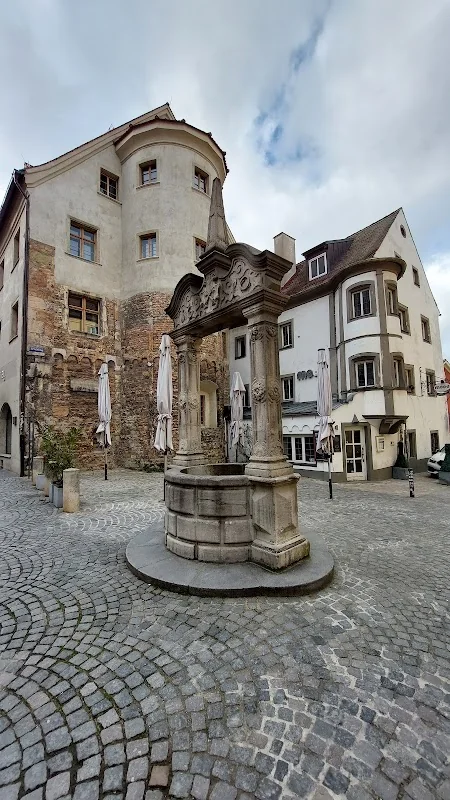
The Wiedfangbrunnen in Regensburg is one of those places that seem inconspicuous at first glance and precisely for that reason remain long in memory. It stands at Wiedfang, in an area of the old town closely connected to the historical traffic and trade landscape at the Stone Bridge. The public monument records list the fountain as a historical draw well from 1610; it is characterized in the description as a Renaissance structure with pilasters and an obelisk and is also classified as a Bavarian architectural monument. This very mix of simple function, old construction form, and urban memory is what makes it appealing. Those who want to read Regensburg not just as a backdrop but as an evolved city will find a very compact entry into the history of the place at the Wiedfangbrunnen. At the same time, the fountain is a popular photographic motif and a frequent meeting point for city tours, which further strengthens its role as a landmark in the old town. ([commons.wikimedia.org](https://commons.wikimedia.org/wiki/Category%3AWiedfangbrunnen_%28Regensburg%29))
History of the Wiedfangbrunnen: from 1610 to the Renewal in 1906
The most important reliable information about the history of the Wiedfangbrunnen is its year of origin, 1610. In the publicly accessible structured data regarding the monument category, it is listed as a water fountain or draw well with inception in 1610, as well as an architectural heritage monument in Bavaria. This is noteworthy because the fountain originates from a time when Regensburg was already a significant trading and imperial city, and the urban space around the Stone Bridge had a particularly high economic density. The fact that the structure has been preserved to this day speaks to the historical significance of the location as well as to the value that was later attributed to it. The same description also mentions that the fountain was renewed in 1906. This shows: The Wiedfangbrunnen is not a frozen relic but a monument that has been maintained, secured, and adapted to the respective preservation practices over time. This combination of the early 17th century and later renewal is typical for many historical city fountains. ([commons.wikimedia.org](https://commons.wikimedia.org/wiki/Category%3AWiedfangbrunnen_%28Regensburg%29))
For the classification of the structure, its typology is also important. The term draw well refers to an original use where water was not drawn from an open decorative figure but obtained through a draw or lift system. The Wiedfangbrunnen is therefore not just decoration in the modern sense but a historically grown part of the urban infrastructure. In the category of related media in Wikimedia Commons, the fountain is also described as a draw well in Regensburg, with gallows on pilasters and an obelisk in Renaissance form. This formulation suggests a representative yet functional architecture. It shows that even a fountain that fulfilled practical tasks was aesthetically designed in the urban space of the early modern period. The fact that the fountain was renewed in 1906 can be understood as a sign of early monument preservation: They did not want to lose the place but rather keep it visible in a changed time. Thus, the Wiedfangbrunnen today connects at least three temporal layers: its creation around 1610, the renewal of 1906, and the current perception as a historical memorial site. ([commons.wikimedia.org](https://commons.wikimedia.org/wiki/Category%3AWiedfangbrunnen_%28Regensburg%29))
Pictures of the Wiedfangbrunnen and its Architecture
Those looking for pictures of the Wiedfangbrunnen will find an unusually good digital documentation. In Wikimedia Commons, there is a dedicated category for the Wiedfangbrunnen with several files from different years. Among other things, recordings from around 1925, 2010, and 2018 are listed, showing the fountain through very different photographic languages. This is particularly valuable for online searches, as it allows both the historical stock and the current condition to be traced. The repeated photographic presence suggests that the Wiedfangbrunnen is not overlooked in the urban landscape, even though it is not a monumental large fountain. It is rather a quiet but highly recognizable object that thrives on its surroundings. Especially in views of the old town, it unfolds a special effect because it does not appear isolated but interacts with the houses, alleys, and paths of Wiedfang. Those who look at photos of the fountain quickly understand why it repeatedly appears as a motif for city walks, monument captures, and tourist impressions. ([commons.wikimedia.org](https://commons.wikimedia.org/wiki/Category%3AWiedfangbrunnen_%28Regensburg%29))
The architectural description also makes the appeal of the fountain tangible. In the Commons data, it is described as a Renaissance fountain or draw well with gallows on pilasters and an obelisk. Such terms sound technical at first glance but tell a lot about the form language of the time. Pilasters, i.e., flat wall projections, give a structure an ordered, vertical structure; the obelisk above enhances the upward effect and gives the fountain a certain solemnity despite its compact size. This contrast is typical for urban furniture of the 17th century: they were meant to be useful but also to radiate dignity. The fact that the Wiedfangbrunnen is listed in the monument register of Bavaria and in the monument metadata database further emphasizes its protective and memorial value. Therefore, those who look at pictures of it see not only a pretty fountain but a preserved piece of architectural culture. This makes it equally interesting for photographers, architecture enthusiasts, and urban history lovers. ([commons.wikimedia.org](https://commons.wikimedia.org/wiki/Category%3AWiedfangbrunnen_%28Regensburg%29))
At Wiedfang in Regensburg: Location, Access, and Historical Context
The Wiedfangbrunnen stands on the street Am Wiedfang in Regensburg, at a place whose name already points to the old topography. The city of Regensburg describes in its monument and open monument day information that a port district once spread between the chapel of St. Georg at Wiedfang and the Wurstkuchl, where valuable goods were transshipped. It is also explained there that a ship canal once lay under the southernmost bridge arch of the Stone Bridge. This is crucial for the classification of the fountain: it does not stand randomly somewhere in the old town but in an area that was directly connected to trade, shipping, and bridge function. Those who stand there today look into an urban space that was once characterized by streams of goods, boats, and storage areas. The Wiedfangbrunnen reminds of this phase without loudly displaying it. This is precisely where its strength lies: it is a small fixed point in a very large historical narrative. ([regensburg.de](https://www.regensburg.de/rathaus/aemteruebersicht/kulturreferat/amt-fuer-kulturelles-erbe/tag-des-offenen-denkmals-2025))
The environment also includes the view of the neighboring ship passage at Am Wiedfang 5a. The city of Regensburg explains there that the construction of the Stone Bridge changed the flow rate of the Danube and caused eddies for shipping. Over the centuries, various solutions were tried; finally, fixed installed winches helped, and in 1914 the current winch house with electric winch was built. This technical monument is an excellent example of how Regensburg had to continually adapt to the forces of the river. For visitors, this means: a short stop at the Wiedfangbrunnen can be very well combined with a look at the technical and port history of the surroundings. The place is therefore more than just a pretty fountain viewpoint. It is a starting point to understand the city as an organism of water, trade, bridge, and city wall. Those who linger here quickly recognize that Regensburg's old town consists not only of facades but of a long succession of functional urban building blocks. ([regensburg.de](https://www.regensburg.de/rathaus/aemteruebersicht/kulturreferat/amt-fuer-kulturelles-erbe/tag-des-offenen-denkmals-2025))
Wiedfangbrunnen as a Meeting Point for Tours and City Walks
A good sign of the current significance of a place is whether it serves as a meeting point. This is clearly the case with the Wiedfangbrunnen. The adult education center of the city of Regensburg regularly uses the fountain as a starting point for city tours, including walks with historical focuses such as the Regensburg patricians or the fountains and squares of the city. In the current program pages for 2026, the meeting point appears multiple times as the fountain at Wiedfang. This shows that the place is not only a monument but also a point of orientation for the cultural mediation of the city's history. Those who start a tour there are immediately in the narrative about old Regensburg: about trade, urban power, social classes, and the topographical significance of the bridgehead. A fountain chosen as a starting point for such themes is never just a side issue. It marks a very dense historical space. ([vhs-regensburg.de](https://www.vhs-regensburg.de/gesellschaft/programm/kategorie/Stadtfuehrungen/359))
The themes of the tours are also enlightening because they show which questions visitors associate with the place. The program descriptions speak of the heyday and decline of the Regensburg patricians, of fountains and squares, or generally of experiencing Regensburg. The Wiedfangbrunnen functions in this context as an anchor point for reading the city. Its location is ideal: those who meet there can head towards the Stone Bridge, port area, Wurstkuchl, Stadtamhof, or further into the old town. The fact that the fountain repeatedly appears in course programs also proves that it is firmly anchored in the tourist-cultural everyday life of Regensburg. It is therefore not just an object for specialists but a lively meeting point for locals and guests. Especially for visitors who want to consciously start a city tour at a historical site, this is an attractive solution. Thus, the Wiedfangbrunnen connects monument preservation and urban experience in a very natural way. ([vhs-regensburg.de](https://www.vhs-regensburg.de/gesellschaft/programm/kategorie/Stadtfuehrungen/359))
Monument Status, Dedication, and Significance for Regensburg
The Wiedfangbrunnen is registered as a Bavarian architectural monument, and that is precisely what makes it significant beyond mere local aesthetics. In the official metadata, it is listed as an architectural heritage monument in Bavaria; additionally, there is a dedicated monument-related identifier in the monument documentation. For visitors, this is more than just an administrative statement. It means that the fountain is considered a valuable testimony to construction and urban history. The fact that it is described as a draw well with Renaissance character also places it in a building culture where even practical structures were designed with urban planning aspirations. The monument worthiness lies not only in its rarity but in the interplay of form, age, location, and historical function. In a city like Regensburg, whose old town particularly thrives on tradition, the Wiedfangbrunnen fits into an ensemble of places that do not explain the past abstractly but make it spatially experienceable. ([commons.wikimedia.org](https://commons.wikimedia.org/wiki/Category%3AWiedfangbrunnen_%28Regensburg%29))
Regarding the question of a special dedication, one can say from the publicly accessible sources primarily one thing: the construction history, the monument status, and the context of the former port district are in the foreground. A separate modern dedication or an official dedication text is not mentioned in the researched sources. However, this is by no means a disadvantage but rather shows how historically direct the place feels. The fountain does not need a grand symbolic staging because its environment already tells enough. Its effect arises from its location at the old bridgehead, from the craft-influenced Renaissance form, and from its visible integration into the urban memory. In this sense, the Wiedfangbrunnen itself is a kind of dedication to the history of Regensburg: to shipping, trade, infrastructure, and the long continuity of public space. Therefore, those who look at it see not only a monument but an urban memory object that still functions today. ([regensburg.de](https://www.regensburg.de/rathaus/aemteruebersicht/kulturreferat/amt-fuer-kulturelles-erbe/tag-des-offenen-denkmals-2025))
What Visitors Can Associate with the Wiedfangbrunnen on Site
A visit to the Wiedfangbrunnen is particularly worthwhile when one does not isolate it but considers it in connection with the surroundings. A natural combination is with the Stone Bridge, with St. Georg at Wiedfang, and with the paths along the Danube bank. The historical references from the city of Regensburg to the old port district make it clear that this area was once a logistical hub. Today, it has become a quiet, easily walkable urban space that is suitable for both short stops and longer old town walks. The fountain helps to read the layers of the place: here once stood infrastructure for water and goods, here paths of merchants, boatmen, and city dwellers intersected, and here the history of Regensburg condenses into a very small excerpt. Those who visit the place with open eyes quickly understand why Regensburg is often described as a city of short distances and long stories. ([regensburg.de](https://www.regensburg.de/rathaus/aemteruebersicht/kulturreferat/amt-fuer-kulturelles-erbe/tag-des-offenen-denkmals-2025))
For image seekers and city explorers, the Wiedfangbrunnen is particularly grateful because it stands in an environment that practically offers historical perspectives. The photographic evidence in Wikimedia Commons, ranging from older images to newer pictures, shows that the fountain has been repeatedly perceived over decades. This is interesting for SEO, but primarily helpful for real visitors: those searching for Wiedfangbrunnen Regensburg, fountain at Wiedfang, or pictures of Wiedfangbrunnen Regensburg are usually looking not just for an object but for a place with atmosphere. This very atmosphere arises here from small scale, history, and location. The fountain is not a loud exclamation point but a quiet marker. That is why it fits so well with Regensburg: a city that preserves its past not only in large monuments but also in small, precise memorial places. ([commons.wikimedia.org](https://commons.wikimedia.org/wiki/Category%3AWiedfangbrunnen_%28Regensburg%29))
Sources:
- Wikimedia Commons - Category Wiedfangbrunnen (Regensburg) and related file information ([commons.wikimedia.org](https://commons.wikimedia.org/wiki/Category%3AWiedfangbrunnen_%28Regensburg%29))
- City of Regensburg - Office for Cultural Heritage, Open Monument Day 2025 ([regensburg.de](https://www.regensburg.de/rathaus/aemteruebersicht/kulturreferat/amt-fuer-kulturelles-erbe/tag-des-offenen-denkmals-2025))
- Adult Education Center of the City of Regensburg - City Tours and Experience Regensburg ([vhs-regensburg.de](https://www.vhs-regensburg.de/gesellschaft/programm/kategorie/Stadtfuehrungen/359))
- City of Regensburg - Cultural Prize Regina Hellwig-Schmid and Atelier Am Wiedfang ([regensburg.de](https://www.regensburg.de/rathaus/staedtische-auszeichnungen/kulturpreis/regina-hellwig-schmid?utm_source=openai))
Show moreShow less
Wiedfangbrunnen | History & Pictures
The Wiedfangbrunnen in Regensburg is one of those places that seem inconspicuous at first glance and precisely for that reason remain long in memory. It stands at Wiedfang, in an area of the old town closely connected to the historical traffic and trade landscape at the Stone Bridge. The public monument records list the fountain as a historical draw well from 1610; it is characterized in the description as a Renaissance structure with pilasters and an obelisk and is also classified as a Bavarian architectural monument. This very mix of simple function, old construction form, and urban memory is what makes it appealing. Those who want to read Regensburg not just as a backdrop but as an evolved city will find a very compact entry into the history of the place at the Wiedfangbrunnen. At the same time, the fountain is a popular photographic motif and a frequent meeting point for city tours, which further strengthens its role as a landmark in the old town. ([commons.wikimedia.org](https://commons.wikimedia.org/wiki/Category%3AWiedfangbrunnen_%28Regensburg%29))
History of the Wiedfangbrunnen: from 1610 to the Renewal in 1906
The most important reliable information about the history of the Wiedfangbrunnen is its year of origin, 1610. In the publicly accessible structured data regarding the monument category, it is listed as a water fountain or draw well with inception in 1610, as well as an architectural heritage monument in Bavaria. This is noteworthy because the fountain originates from a time when Regensburg was already a significant trading and imperial city, and the urban space around the Stone Bridge had a particularly high economic density. The fact that the structure has been preserved to this day speaks to the historical significance of the location as well as to the value that was later attributed to it. The same description also mentions that the fountain was renewed in 1906. This shows: The Wiedfangbrunnen is not a frozen relic but a monument that has been maintained, secured, and adapted to the respective preservation practices over time. This combination of the early 17th century and later renewal is typical for many historical city fountains. ([commons.wikimedia.org](https://commons.wikimedia.org/wiki/Category%3AWiedfangbrunnen_%28Regensburg%29))
For the classification of the structure, its typology is also important. The term draw well refers to an original use where water was not drawn from an open decorative figure but obtained through a draw or lift system. The Wiedfangbrunnen is therefore not just decoration in the modern sense but a historically grown part of the urban infrastructure. In the category of related media in Wikimedia Commons, the fountain is also described as a draw well in Regensburg, with gallows on pilasters and an obelisk in Renaissance form. This formulation suggests a representative yet functional architecture. It shows that even a fountain that fulfilled practical tasks was aesthetically designed in the urban space of the early modern period. The fact that the fountain was renewed in 1906 can be understood as a sign of early monument preservation: They did not want to lose the place but rather keep it visible in a changed time. Thus, the Wiedfangbrunnen today connects at least three temporal layers: its creation around 1610, the renewal of 1906, and the current perception as a historical memorial site. ([commons.wikimedia.org](https://commons.wikimedia.org/wiki/Category%3AWiedfangbrunnen_%28Regensburg%29))
Pictures of the Wiedfangbrunnen and its Architecture
Those looking for pictures of the Wiedfangbrunnen will find an unusually good digital documentation. In Wikimedia Commons, there is a dedicated category for the Wiedfangbrunnen with several files from different years. Among other things, recordings from around 1925, 2010, and 2018 are listed, showing the fountain through very different photographic languages. This is particularly valuable for online searches, as it allows both the historical stock and the current condition to be traced. The repeated photographic presence suggests that the Wiedfangbrunnen is not overlooked in the urban landscape, even though it is not a monumental large fountain. It is rather a quiet but highly recognizable object that thrives on its surroundings. Especially in views of the old town, it unfolds a special effect because it does not appear isolated but interacts with the houses, alleys, and paths of Wiedfang. Those who look at photos of the fountain quickly understand why it repeatedly appears as a motif for city walks, monument captures, and tourist impressions. ([commons.wikimedia.org](https://commons.wikimedia.org/wiki/Category%3AWiedfangbrunnen_%28Regensburg%29))
The architectural description also makes the appeal of the fountain tangible. In the Commons data, it is described as a Renaissance fountain or draw well with gallows on pilasters and an obelisk. Such terms sound technical at first glance but tell a lot about the form language of the time. Pilasters, i.e., flat wall projections, give a structure an ordered, vertical structure; the obelisk above enhances the upward effect and gives the fountain a certain solemnity despite its compact size. This contrast is typical for urban furniture of the 17th century: they were meant to be useful but also to radiate dignity. The fact that the Wiedfangbrunnen is listed in the monument register of Bavaria and in the monument metadata database further emphasizes its protective and memorial value. Therefore, those who look at pictures of it see not only a pretty fountain but a preserved piece of architectural culture. This makes it equally interesting for photographers, architecture enthusiasts, and urban history lovers. ([commons.wikimedia.org](https://commons.wikimedia.org/wiki/Category%3AWiedfangbrunnen_%28Regensburg%29))
At Wiedfang in Regensburg: Location, Access, and Historical Context
The Wiedfangbrunnen stands on the street Am Wiedfang in Regensburg, at a place whose name already points to the old topography. The city of Regensburg describes in its monument and open monument day information that a port district once spread between the chapel of St. Georg at Wiedfang and the Wurstkuchl, where valuable goods were transshipped. It is also explained there that a ship canal once lay under the southernmost bridge arch of the Stone Bridge. This is crucial for the classification of the fountain: it does not stand randomly somewhere in the old town but in an area that was directly connected to trade, shipping, and bridge function. Those who stand there today look into an urban space that was once characterized by streams of goods, boats, and storage areas. The Wiedfangbrunnen reminds of this phase without loudly displaying it. This is precisely where its strength lies: it is a small fixed point in a very large historical narrative. ([regensburg.de](https://www.regensburg.de/rathaus/aemteruebersicht/kulturreferat/amt-fuer-kulturelles-erbe/tag-des-offenen-denkmals-2025))
The environment also includes the view of the neighboring ship passage at Am Wiedfang 5a. The city of Regensburg explains there that the construction of the Stone Bridge changed the flow rate of the Danube and caused eddies for shipping. Over the centuries, various solutions were tried; finally, fixed installed winches helped, and in 1914 the current winch house with electric winch was built. This technical monument is an excellent example of how Regensburg had to continually adapt to the forces of the river. For visitors, this means: a short stop at the Wiedfangbrunnen can be very well combined with a look at the technical and port history of the surroundings. The place is therefore more than just a pretty fountain viewpoint. It is a starting point to understand the city as an organism of water, trade, bridge, and city wall. Those who linger here quickly recognize that Regensburg's old town consists not only of facades but of a long succession of functional urban building blocks. ([regensburg.de](https://www.regensburg.de/rathaus/aemteruebersicht/kulturreferat/amt-fuer-kulturelles-erbe/tag-des-offenen-denkmals-2025))
Wiedfangbrunnen as a Meeting Point for Tours and City Walks
A good sign of the current significance of a place is whether it serves as a meeting point. This is clearly the case with the Wiedfangbrunnen. The adult education center of the city of Regensburg regularly uses the fountain as a starting point for city tours, including walks with historical focuses such as the Regensburg patricians or the fountains and squares of the city. In the current program pages for 2026, the meeting point appears multiple times as the fountain at Wiedfang. This shows that the place is not only a monument but also a point of orientation for the cultural mediation of the city's history. Those who start a tour there are immediately in the narrative about old Regensburg: about trade, urban power, social classes, and the topographical significance of the bridgehead. A fountain chosen as a starting point for such themes is never just a side issue. It marks a very dense historical space. ([vhs-regensburg.de](https://www.vhs-regensburg.de/gesellschaft/programm/kategorie/Stadtfuehrungen/359))
The themes of the tours are also enlightening because they show which questions visitors associate with the place. The program descriptions speak of the heyday and decline of the Regensburg patricians, of fountains and squares, or generally of experiencing Regensburg. The Wiedfangbrunnen functions in this context as an anchor point for reading the city. Its location is ideal: those who meet there can head towards the Stone Bridge, port area, Wurstkuchl, Stadtamhof, or further into the old town. The fact that the fountain repeatedly appears in course programs also proves that it is firmly anchored in the tourist-cultural everyday life of Regensburg. It is therefore not just an object for specialists but a lively meeting point for locals and guests. Especially for visitors who want to consciously start a city tour at a historical site, this is an attractive solution. Thus, the Wiedfangbrunnen connects monument preservation and urban experience in a very natural way. ([vhs-regensburg.de](https://www.vhs-regensburg.de/gesellschaft/programm/kategorie/Stadtfuehrungen/359))
Monument Status, Dedication, and Significance for Regensburg
The Wiedfangbrunnen is registered as a Bavarian architectural monument, and that is precisely what makes it significant beyond mere local aesthetics. In the official metadata, it is listed as an architectural heritage monument in Bavaria; additionally, there is a dedicated monument-related identifier in the monument documentation. For visitors, this is more than just an administrative statement. It means that the fountain is considered a valuable testimony to construction and urban history. The fact that it is described as a draw well with Renaissance character also places it in a building culture where even practical structures were designed with urban planning aspirations. The monument worthiness lies not only in its rarity but in the interplay of form, age, location, and historical function. In a city like Regensburg, whose old town particularly thrives on tradition, the Wiedfangbrunnen fits into an ensemble of places that do not explain the past abstractly but make it spatially experienceable. ([commons.wikimedia.org](https://commons.wikimedia.org/wiki/Category%3AWiedfangbrunnen_%28Regensburg%29))
Regarding the question of a special dedication, one can say from the publicly accessible sources primarily one thing: the construction history, the monument status, and the context of the former port district are in the foreground. A separate modern dedication or an official dedication text is not mentioned in the researched sources. However, this is by no means a disadvantage but rather shows how historically direct the place feels. The fountain does not need a grand symbolic staging because its environment already tells enough. Its effect arises from its location at the old bridgehead, from the craft-influenced Renaissance form, and from its visible integration into the urban memory. In this sense, the Wiedfangbrunnen itself is a kind of dedication to the history of Regensburg: to shipping, trade, infrastructure, and the long continuity of public space. Therefore, those who look at it see not only a monument but an urban memory object that still functions today. ([regensburg.de](https://www.regensburg.de/rathaus/aemteruebersicht/kulturreferat/amt-fuer-kulturelles-erbe/tag-des-offenen-denkmals-2025))
What Visitors Can Associate with the Wiedfangbrunnen on Site
A visit to the Wiedfangbrunnen is particularly worthwhile when one does not isolate it but considers it in connection with the surroundings. A natural combination is with the Stone Bridge, with St. Georg at Wiedfang, and with the paths along the Danube bank. The historical references from the city of Regensburg to the old port district make it clear that this area was once a logistical hub. Today, it has become a quiet, easily walkable urban space that is suitable for both short stops and longer old town walks. The fountain helps to read the layers of the place: here once stood infrastructure for water and goods, here paths of merchants, boatmen, and city dwellers intersected, and here the history of Regensburg condenses into a very small excerpt. Those who visit the place with open eyes quickly understand why Regensburg is often described as a city of short distances and long stories. ([regensburg.de](https://www.regensburg.de/rathaus/aemteruebersicht/kulturreferat/amt-fuer-kulturelles-erbe/tag-des-offenen-denkmals-2025))
For image seekers and city explorers, the Wiedfangbrunnen is particularly grateful because it stands in an environment that practically offers historical perspectives. The photographic evidence in Wikimedia Commons, ranging from older images to newer pictures, shows that the fountain has been repeatedly perceived over decades. This is interesting for SEO, but primarily helpful for real visitors: those searching for Wiedfangbrunnen Regensburg, fountain at Wiedfang, or pictures of Wiedfangbrunnen Regensburg are usually looking not just for an object but for a place with atmosphere. This very atmosphere arises here from small scale, history, and location. The fountain is not a loud exclamation point but a quiet marker. That is why it fits so well with Regensburg: a city that preserves its past not only in large monuments but also in small, precise memorial places. ([commons.wikimedia.org](https://commons.wikimedia.org/wiki/Category%3AWiedfangbrunnen_%28Regensburg%29))
Sources:
- Wikimedia Commons - Category Wiedfangbrunnen (Regensburg) and related file information ([commons.wikimedia.org](https://commons.wikimedia.org/wiki/Category%3AWiedfangbrunnen_%28Regensburg%29))
- City of Regensburg - Office for Cultural Heritage, Open Monument Day 2025 ([regensburg.de](https://www.regensburg.de/rathaus/aemteruebersicht/kulturreferat/amt-fuer-kulturelles-erbe/tag-des-offenen-denkmals-2025))
- Adult Education Center of the City of Regensburg - City Tours and Experience Regensburg ([vhs-regensburg.de](https://www.vhs-regensburg.de/gesellschaft/programm/kategorie/Stadtfuehrungen/359))
- City of Regensburg - Cultural Prize Regina Hellwig-Schmid and Atelier Am Wiedfang ([regensburg.de](https://www.regensburg.de/rathaus/staedtische-auszeichnungen/kulturpreis/regina-hellwig-schmid?utm_source=openai))
Wiedfangbrunnen | History & Pictures
The Wiedfangbrunnen in Regensburg is one of those places that seem inconspicuous at first glance and precisely for that reason remain long in memory. It stands at Wiedfang, in an area of the old town closely connected to the historical traffic and trade landscape at the Stone Bridge. The public monument records list the fountain as a historical draw well from 1610; it is characterized in the description as a Renaissance structure with pilasters and an obelisk and is also classified as a Bavarian architectural monument. This very mix of simple function, old construction form, and urban memory is what makes it appealing. Those who want to read Regensburg not just as a backdrop but as an evolved city will find a very compact entry into the history of the place at the Wiedfangbrunnen. At the same time, the fountain is a popular photographic motif and a frequent meeting point for city tours, which further strengthens its role as a landmark in the old town. ([commons.wikimedia.org](https://commons.wikimedia.org/wiki/Category%3AWiedfangbrunnen_%28Regensburg%29))
History of the Wiedfangbrunnen: from 1610 to the Renewal in 1906
The most important reliable information about the history of the Wiedfangbrunnen is its year of origin, 1610. In the publicly accessible structured data regarding the monument category, it is listed as a water fountain or draw well with inception in 1610, as well as an architectural heritage monument in Bavaria. This is noteworthy because the fountain originates from a time when Regensburg was already a significant trading and imperial city, and the urban space around the Stone Bridge had a particularly high economic density. The fact that the structure has been preserved to this day speaks to the historical significance of the location as well as to the value that was later attributed to it. The same description also mentions that the fountain was renewed in 1906. This shows: The Wiedfangbrunnen is not a frozen relic but a monument that has been maintained, secured, and adapted to the respective preservation practices over time. This combination of the early 17th century and later renewal is typical for many historical city fountains. ([commons.wikimedia.org](https://commons.wikimedia.org/wiki/Category%3AWiedfangbrunnen_%28Regensburg%29))
For the classification of the structure, its typology is also important. The term draw well refers to an original use where water was not drawn from an open decorative figure but obtained through a draw or lift system. The Wiedfangbrunnen is therefore not just decoration in the modern sense but a historically grown part of the urban infrastructure. In the category of related media in Wikimedia Commons, the fountain is also described as a draw well in Regensburg, with gallows on pilasters and an obelisk in Renaissance form. This formulation suggests a representative yet functional architecture. It shows that even a fountain that fulfilled practical tasks was aesthetically designed in the urban space of the early modern period. The fact that the fountain was renewed in 1906 can be understood as a sign of early monument preservation: They did not want to lose the place but rather keep it visible in a changed time. Thus, the Wiedfangbrunnen today connects at least three temporal layers: its creation around 1610, the renewal of 1906, and the current perception as a historical memorial site. ([commons.wikimedia.org](https://commons.wikimedia.org/wiki/Category%3AWiedfangbrunnen_%28Regensburg%29))
Pictures of the Wiedfangbrunnen and its Architecture
Those looking for pictures of the Wiedfangbrunnen will find an unusually good digital documentation. In Wikimedia Commons, there is a dedicated category for the Wiedfangbrunnen with several files from different years. Among other things, recordings from around 1925, 2010, and 2018 are listed, showing the fountain through very different photographic languages. This is particularly valuable for online searches, as it allows both the historical stock and the current condition to be traced. The repeated photographic presence suggests that the Wiedfangbrunnen is not overlooked in the urban landscape, even though it is not a monumental large fountain. It is rather a quiet but highly recognizable object that thrives on its surroundings. Especially in views of the old town, it unfolds a special effect because it does not appear isolated but interacts with the houses, alleys, and paths of Wiedfang. Those who look at photos of the fountain quickly understand why it repeatedly appears as a motif for city walks, monument captures, and tourist impressions. ([commons.wikimedia.org](https://commons.wikimedia.org/wiki/Category%3AWiedfangbrunnen_%28Regensburg%29))
The architectural description also makes the appeal of the fountain tangible. In the Commons data, it is described as a Renaissance fountain or draw well with gallows on pilasters and an obelisk. Such terms sound technical at first glance but tell a lot about the form language of the time. Pilasters, i.e., flat wall projections, give a structure an ordered, vertical structure; the obelisk above enhances the upward effect and gives the fountain a certain solemnity despite its compact size. This contrast is typical for urban furniture of the 17th century: they were meant to be useful but also to radiate dignity. The fact that the Wiedfangbrunnen is listed in the monument register of Bavaria and in the monument metadata database further emphasizes its protective and memorial value. Therefore, those who look at pictures of it see not only a pretty fountain but a preserved piece of architectural culture. This makes it equally interesting for photographers, architecture enthusiasts, and urban history lovers. ([commons.wikimedia.org](https://commons.wikimedia.org/wiki/Category%3AWiedfangbrunnen_%28Regensburg%29))
At Wiedfang in Regensburg: Location, Access, and Historical Context
The Wiedfangbrunnen stands on the street Am Wiedfang in Regensburg, at a place whose name already points to the old topography. The city of Regensburg describes in its monument and open monument day information that a port district once spread between the chapel of St. Georg at Wiedfang and the Wurstkuchl, where valuable goods were transshipped. It is also explained there that a ship canal once lay under the southernmost bridge arch of the Stone Bridge. This is crucial for the classification of the fountain: it does not stand randomly somewhere in the old town but in an area that was directly connected to trade, shipping, and bridge function. Those who stand there today look into an urban space that was once characterized by streams of goods, boats, and storage areas. The Wiedfangbrunnen reminds of this phase without loudly displaying it. This is precisely where its strength lies: it is a small fixed point in a very large historical narrative. ([regensburg.de](https://www.regensburg.de/rathaus/aemteruebersicht/kulturreferat/amt-fuer-kulturelles-erbe/tag-des-offenen-denkmals-2025))
The environment also includes the view of the neighboring ship passage at Am Wiedfang 5a. The city of Regensburg explains there that the construction of the Stone Bridge changed the flow rate of the Danube and caused eddies for shipping. Over the centuries, various solutions were tried; finally, fixed installed winches helped, and in 1914 the current winch house with electric winch was built. This technical monument is an excellent example of how Regensburg had to continually adapt to the forces of the river. For visitors, this means: a short stop at the Wiedfangbrunnen can be very well combined with a look at the technical and port history of the surroundings. The place is therefore more than just a pretty fountain viewpoint. It is a starting point to understand the city as an organism of water, trade, bridge, and city wall. Those who linger here quickly recognize that Regensburg's old town consists not only of facades but of a long succession of functional urban building blocks. ([regensburg.de](https://www.regensburg.de/rathaus/aemteruebersicht/kulturreferat/amt-fuer-kulturelles-erbe/tag-des-offenen-denkmals-2025))
Wiedfangbrunnen as a Meeting Point for Tours and City Walks
A good sign of the current significance of a place is whether it serves as a meeting point. This is clearly the case with the Wiedfangbrunnen. The adult education center of the city of Regensburg regularly uses the fountain as a starting point for city tours, including walks with historical focuses such as the Regensburg patricians or the fountains and squares of the city. In the current program pages for 2026, the meeting point appears multiple times as the fountain at Wiedfang. This shows that the place is not only a monument but also a point of orientation for the cultural mediation of the city's history. Those who start a tour there are immediately in the narrative about old Regensburg: about trade, urban power, social classes, and the topographical significance of the bridgehead. A fountain chosen as a starting point for such themes is never just a side issue. It marks a very dense historical space. ([vhs-regensburg.de](https://www.vhs-regensburg.de/gesellschaft/programm/kategorie/Stadtfuehrungen/359))
The themes of the tours are also enlightening because they show which questions visitors associate with the place. The program descriptions speak of the heyday and decline of the Regensburg patricians, of fountains and squares, or generally of experiencing Regensburg. The Wiedfangbrunnen functions in this context as an anchor point for reading the city. Its location is ideal: those who meet there can head towards the Stone Bridge, port area, Wurstkuchl, Stadtamhof, or further into the old town. The fact that the fountain repeatedly appears in course programs also proves that it is firmly anchored in the tourist-cultural everyday life of Regensburg. It is therefore not just an object for specialists but a lively meeting point for locals and guests. Especially for visitors who want to consciously start a city tour at a historical site, this is an attractive solution. Thus, the Wiedfangbrunnen connects monument preservation and urban experience in a very natural way. ([vhs-regensburg.de](https://www.vhs-regensburg.de/gesellschaft/programm/kategorie/Stadtfuehrungen/359))
Monument Status, Dedication, and Significance for Regensburg
The Wiedfangbrunnen is registered as a Bavarian architectural monument, and that is precisely what makes it significant beyond mere local aesthetics. In the official metadata, it is listed as an architectural heritage monument in Bavaria; additionally, there is a dedicated monument-related identifier in the monument documentation. For visitors, this is more than just an administrative statement. It means that the fountain is considered a valuable testimony to construction and urban history. The fact that it is described as a draw well with Renaissance character also places it in a building culture where even practical structures were designed with urban planning aspirations. The monument worthiness lies not only in its rarity but in the interplay of form, age, location, and historical function. In a city like Regensburg, whose old town particularly thrives on tradition, the Wiedfangbrunnen fits into an ensemble of places that do not explain the past abstractly but make it spatially experienceable. ([commons.wikimedia.org](https://commons.wikimedia.org/wiki/Category%3AWiedfangbrunnen_%28Regensburg%29))
Regarding the question of a special dedication, one can say from the publicly accessible sources primarily one thing: the construction history, the monument status, and the context of the former port district are in the foreground. A separate modern dedication or an official dedication text is not mentioned in the researched sources. However, this is by no means a disadvantage but rather shows how historically direct the place feels. The fountain does not need a grand symbolic staging because its environment already tells enough. Its effect arises from its location at the old bridgehead, from the craft-influenced Renaissance form, and from its visible integration into the urban memory. In this sense, the Wiedfangbrunnen itself is a kind of dedication to the history of Regensburg: to shipping, trade, infrastructure, and the long continuity of public space. Therefore, those who look at it see not only a monument but an urban memory object that still functions today. ([regensburg.de](https://www.regensburg.de/rathaus/aemteruebersicht/kulturreferat/amt-fuer-kulturelles-erbe/tag-des-offenen-denkmals-2025))
What Visitors Can Associate with the Wiedfangbrunnen on Site
A visit to the Wiedfangbrunnen is particularly worthwhile when one does not isolate it but considers it in connection with the surroundings. A natural combination is with the Stone Bridge, with St. Georg at Wiedfang, and with the paths along the Danube bank. The historical references from the city of Regensburg to the old port district make it clear that this area was once a logistical hub. Today, it has become a quiet, easily walkable urban space that is suitable for both short stops and longer old town walks. The fountain helps to read the layers of the place: here once stood infrastructure for water and goods, here paths of merchants, boatmen, and city dwellers intersected, and here the history of Regensburg condenses into a very small excerpt. Those who visit the place with open eyes quickly understand why Regensburg is often described as a city of short distances and long stories. ([regensburg.de](https://www.regensburg.de/rathaus/aemteruebersicht/kulturreferat/amt-fuer-kulturelles-erbe/tag-des-offenen-denkmals-2025))
For image seekers and city explorers, the Wiedfangbrunnen is particularly grateful because it stands in an environment that practically offers historical perspectives. The photographic evidence in Wikimedia Commons, ranging from older images to newer pictures, shows that the fountain has been repeatedly perceived over decades. This is interesting for SEO, but primarily helpful for real visitors: those searching for Wiedfangbrunnen Regensburg, fountain at Wiedfang, or pictures of Wiedfangbrunnen Regensburg are usually looking not just for an object but for a place with atmosphere. This very atmosphere arises here from small scale, history, and location. The fountain is not a loud exclamation point but a quiet marker. That is why it fits so well with Regensburg: a city that preserves its past not only in large monuments but also in small, precise memorial places. ([commons.wikimedia.org](https://commons.wikimedia.org/wiki/Category%3AWiedfangbrunnen_%28Regensburg%29))
Sources:
- Wikimedia Commons - Category Wiedfangbrunnen (Regensburg) and related file information ([commons.wikimedia.org](https://commons.wikimedia.org/wiki/Category%3AWiedfangbrunnen_%28Regensburg%29))
- City of Regensburg - Office for Cultural Heritage, Open Monument Day 2025 ([regensburg.de](https://www.regensburg.de/rathaus/aemteruebersicht/kulturreferat/amt-fuer-kulturelles-erbe/tag-des-offenen-denkmals-2025))
- Adult Education Center of the City of Regensburg - City Tours and Experience Regensburg ([vhs-regensburg.de](https://www.vhs-regensburg.de/gesellschaft/programm/kategorie/Stadtfuehrungen/359))
- City of Regensburg - Cultural Prize Regina Hellwig-Schmid and Atelier Am Wiedfang ([regensburg.de](https://www.regensburg.de/rathaus/staedtische-auszeichnungen/kulturpreis/regina-hellwig-schmid?utm_source=openai))
Frequently Asked Questions
Reviews
No reviews found