
Wolf Erlbruch
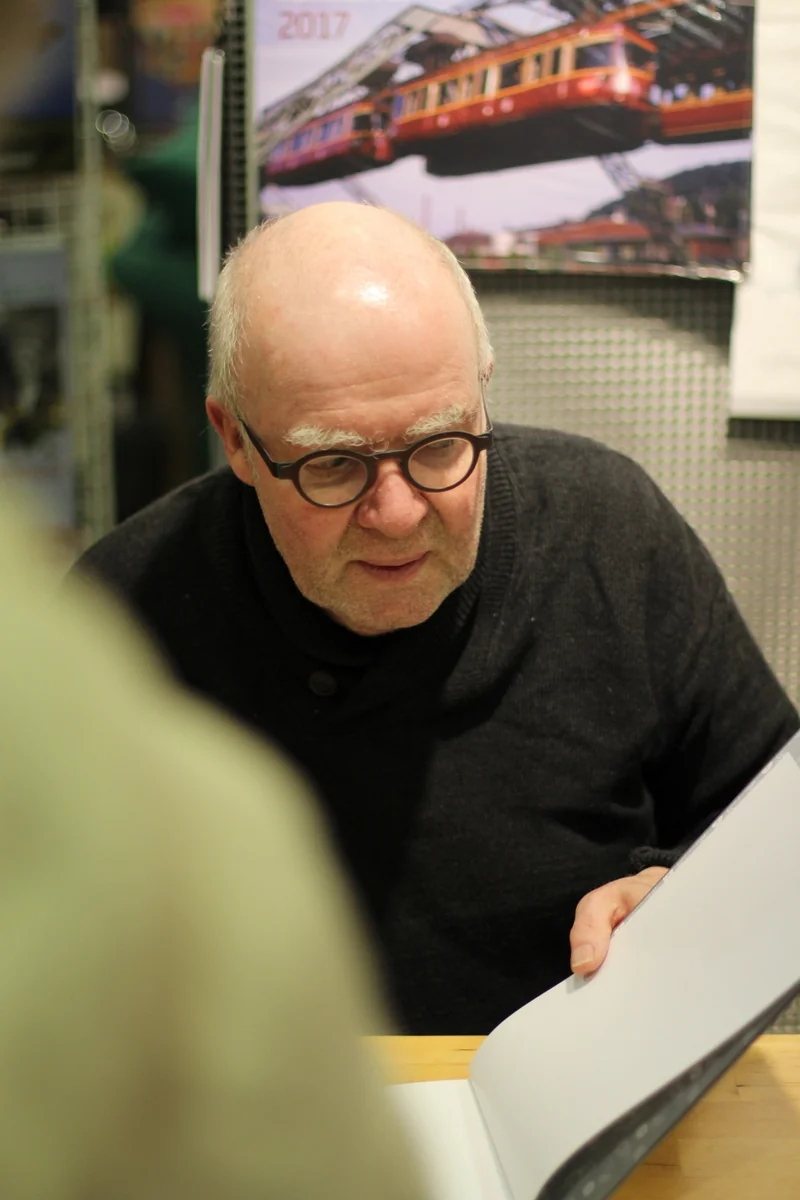
Image from Wikipedia
Image from Wikipedia
Wolf Erlbruch – The Great Picture Book Artist Between Poetry, Collage, and Philosophical Depth
A Life for Children’s Books, Reaching Far Beyond the Nursery
Wolf Erlbruch was one of the most independent German illustrators and authors of the late 20th and early 21st centuries. Born on June 30, 1948, in Wuppertal, and passing away there on December 11, 2022, he shaped the picture book with a distinctive style that intertwines humor, melancholy, and existential questions. His books speak to children, yet remain accessible to adults as they tackle profound themes with visual intelligence and narrative clarity. ([goethe.de](https://www.goethe.de/ins/lv/de/m/kul/ser/uak/per.cfm?personId=1432))
His path did not begin in publishing, but at the Folkwang University of Applied Sciences in Essen, where he studied drawing from 1967 to 1974. He then worked as an illustrator in the advertising industry and was internationally successful before he began illustrating children's and youth books in 1985, later also writing them himself. This development led to a body of work that consistently blurred the boundaries between art, illustration, and literature. ([de.wikipedia.org](https://de.wikipedia.org/wiki/Wolf_Erlbruch))
Biography: From Advertising to a Literary Universe
Erlbruch’s artistic career showcases a rare combination of craftsmanship and intellectual risk-taking. After studying in Essen, he initially worked as a freelance illustrator, published in magazines, and developed a visual language that early on emphasized reduction, character, and poignant imagery. It was only later that his focus shifted towards children's books, where he could fully unleash his typically engaging mix of visual wit, tenderness, and provocation. ([de.wikipedia.org](https://de.wikipedia.org/wiki/Wolf_Erlbruch))
A pivotal moment came in 1985 with his first own illustrated book The Eagle Who Did Not Want to Fly. The idea came from a publisher, and the birth of his son Leonard gave Erlbruch the final impetus to take on this project. This marked the beginning of a career that made him one of the most recognized and celebrated names in illustrated literature. ([goethe.de](https://www.goethe.de/ins/co/de/m/bib/aut/web.html))
The Breakthrough: A Mole Conquers the World
The international breakthrough came in 1989 with From the Little Mole Who Wanted to Know Who Had Trodden on His Head, a picture book described by the German Academy for Children's and Youth Literature as a taboo-breaking work that quickly became a bestseller. The book exemplifies how Erlbruch works with the seemingly simple: a pointed story, clear characters, strong visual ideas, and a humor that never comes at the expense of intelligence. Thus, a modern classic emerged, read, translated, and contemplated in many countries. ([akademie-kjl.de](https://www.akademie-kjl.de/online-lexikon/erlbruch-wolf/))
This very success explains why Erlbruch is regarded not only as an illustrator but as a significant creator of images. His books inquire about origin, meaning, fear, death, and identity without becoming didactic. Instead of delivering moral certainties, he provides open spaces where both children and adults can find themselves. ([de.wikipedia.org](https://de.wikipedia.org/wiki/Wolf_Erlbruch))
Style and Technique: Collage, Drawing, and the Play with Meanings
Wolf Erlbruch’s style is immediately recognizable: he combines drawing, painting, and collage into dense visual compositions. The German Academy for Children's and Youth Literature describes his method as an arrangement of paper fragments that are further processed with different materials. It is from this very tension that his illustrations acquire their uniqueness: familiar forms seem displaced, and characters appear quirky yet profoundly human. ([akademie-kjl.de](https://www.akademie-kjl.de/online-lexikon/erlbruch-wolf/))
His images are not mere accompanying illustrations but autonomous narrative surfaces. Erlbruch shifts perspectives, places the familiar in new contexts, and opens up philosophical contemplation of the world, language, and perception through subtle irony. This is particularly evident in works like New ABC Book, where he reinterprets a classic text and dissolves the boundary between text and image. ([akademie-kjl.de](https://www.akademie-kjl.de/online-lexikon/erlbruch-wolf/))
Important Works: Between Life Questions and Picture Book Classics
Erlbruch’s most famous books include not only The Eagle Who Did Not Want to Fly and From the Little Mole Who Wanted to Know Who Had Trodden on His Head but also titles like The Big Question, Duck, Death and Tulip, The Creation, Mrs. Meier, the Blackbird, Leonard, and The Bear Miracle. These titles illustrate the range of his work: from existential philosophy to tender observations of everyday life, and stories that make complex emotions understandable through animal characters. ([de.wikipedia.org](https://de.wikipedia.org/wiki/Wolf_Erlbruch))
Erlbruch is particularly strong where he does not shy away from heavy themes. Duck, Death and Tulip addresses the encounter with death with great calm, warmth, and clarity. It is this seriousness, combined with an accessible visual language, that has made him a formative figure in international picture book culture. ([de.wikipedia.org](https://de.wikipedia.org/wiki/Wolf_Erlbruch))
Awards and Authority: A Work of International Significance
The list of his awards reads like a compass of children’s and youth literature: the German Youth Literature Prize, the Troisdorf Picture Book Prize, the Hans Christian Andersen Award, and the Astrid Lindgren Memorial Award are among the most significant honors of his work. The Kunstmann Verlag also recognizes him as the first German recipient of the Astrid Lindgren Memorial Award for his entire body of work, emphasizing his status as an authority in picture books far beyond the German-speaking world. ([de.wikipedia.org](https://de.wikipedia.org/wiki/Wolf_Erlbruch))
As a university teacher, Erlbruch also had a profound impact. He taught at various universities and was a professor of illustration at the Bergische University Wuppertal until 2009, shaping not only books but also generations of illustrators. His influence thus extends into education, the publishing world, and international illustration. ([goethe.de](https://www.goethe.de/ins/lv/de/m/kul/ser/uak/per.cfm?personId=1432))
Cultural Influence: Why Wolf Erlbruch Remains Important Today
Erlbruch's significance lies in his ability to affirm the picture book as a serious art form. He popularized collage in children's literature and, according to the German Academy for Children's and Youth Literature, introduced a fundamentally different understanding of illustration into the picture book. His works continue to inspire authors, illustrators, and publishers alike, demonstrating that a children’s book can be poetic, radical, and entertaining at the same time. ([akademie-kjl.de](https://www.akademie-kjl.de/online-lexikon/erlbruch-wolf/))
Furthermore, there is the international resonance of his work. The Goethe-Institut describes him as one of the most well-known and celebrated figures in illustrated literature; other institutions point to the ongoing translation and reception of his books. Thus, Wolf Erlbruch remains not only a name in German book culture but a global reference point for sophisticated picture book art. ([goethe.de](https://www.goethe.de/ins/co/de/m/bib/aut/web.html))
Conclusion: A Picture Book Artist Who Has Redefined Thinking, Feeling, and Seeing
Wolf Erlbruch is intriguing because he has liberated the picture book from merely being child-centric. His works connect formal boldness with emotional openness, making even profound questions easily accessible without diminishing them. Those who read or view his books experience illustration as an art form with character, depth, and an unmistakable voice. His images remain alive because they do not explain but open up. Anyone wanting to understand how powerful modern picture book art can be should not only read Wolf Erlbruch but continually rediscover him, celebrating his books as a lasting part of literary history. ([de.wikipedia.org](https://de.wikipedia.org/wiki/Wolf_Erlbruch))
Official Channels of Wolf Erlbruch:
- Instagram: No official profile found
- Facebook: No official profile found
- YouTube: No official profile found
- Spotify: No official profile found
- TikTok: No official profile found